
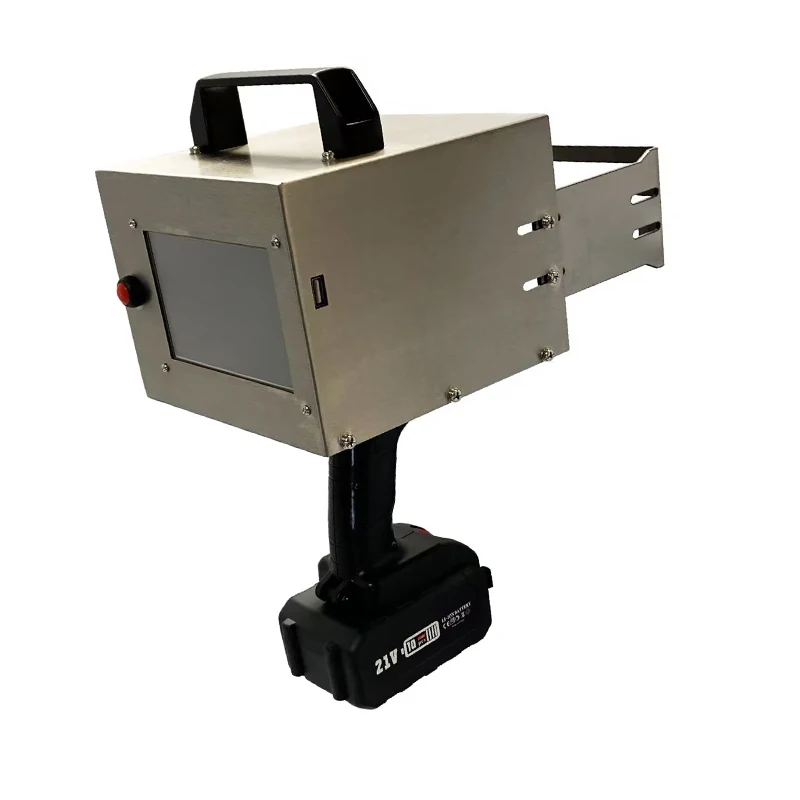
Source-controlled product identity
The Hoting queue identifies Product ID 1601353953250 as a handheld marking machine for coding VIN numbers on automobile frames, listed under the title "2 Battery Coding VIN Number Automobile Frame Handheld Pneumatic Marking Machine Peen Letter Plate Portable Metal Dot Pin Machine". The description opens with its own title for the same item: "TEBAK 2 battery XY/SD-4-12030 90*40MM Handheld Coding VIN Number Marking Machine For Automobile Frame Dot Peen Or Line Marking".
Unlike several neighbouring records in this queue, this one carries a real parameter table rather than an empty specification block. That changes the job of this guide. The buyer is not being asked to buy on a size list and a hope, but to buy on nine stated values, and the useful work is to read those nine values carefully, separate the ones that can be used as given from the ones that contradict each other or sit outside the range where the stated unit is meaningful, and identify the questions that remain unanswered. Three of the nine entries fail that reading, and this article shows why.
The nine recorded parameters, verbatim
| Parameter | Recorded value |
|---|---|
| Product Name | Handheld Electric Marking Machine |
| Model No. | XY/SD-4-9030XY/SD-4-12030 |
| Marking Depth | 0.01~1.5mm(Depending on the material) |
| Pin Hardness | HRC 92 |
| Power supply | Li-battary |
| User provided | NON |
| Machine Power: | S250 W |
| Working Environment: | -5~40 C |
| Machine Weight: | 5.8KG |
The description repeats the same table in flat text and adds two pieces of information that do not appear in the parameter block: a marking area of 90 by 40 mm in its title line, and the statement that the machine performs dot peen or line marking. The packing section contains headings only and no packing figures, and the company text ends mid-sentence.
Contradiction one: pneumatic or battery powered
The first and most consequential problem is in the product title, which describes the machine as pneumatic, while the parameter table names it "Handheld Electric Marking Machine" and states its power supply as a lithium battery. These are different machines. A pneumatic marker is driven by compressed air and needs a compressor, an air line, a regulator and a moisture trap at the point of use, and it cannot be carried to a vehicle in a yard that has no air supply. A battery marker carries its own power, needs no air line, and can be taken anywhere, at the cost of run time and battery weight.
This is not a wording preference. It decides whether the buyer needs a compressor and whether the tool can be used in the field, and it should be resolved in writing before an order, by reference to the machine that will actually be shipped rather than the listing title. Ask for the machine's name plate photograph and for the manufacturer's own model documentation, since a listing that mixes the two terms cannot be used to settle the question.
The parameter row "User provided: NON" should also be read in this context. It appears to be a leftover row recording that nothing is required from the user, which, if the machine is in fact pneumatic, would be exactly the row that should state the air pressure and flow required. Ask directly whether any compressed air supply is needed, and if so, at what pressure and consumption.
Contradiction two: the model codes and the marking window
The model number is recorded as "XY/SD-4-9030XY/SD-4-12030", which is not one code but two codes run together without a separator: XY/SD-4-9030 and XY/SD-4-12030. The suffix pattern strongly suggests that the digits encode the marking window, so that 9030 would be a 90 by 30 mm window and 12030 a 120 by 30 mm window, in which case the two models differ in width and are otherwise comparable.
That reading does not agree with the marking area given in the description title, which states 90 by 40 mm. If the suffix encodes the window, the 9030 model has a 90 by 30 mm window and not a 90 by 40 mm one, and the buyer does not know which model the 90 by 40 mm figure belongs to. Ask which window each of the two model codes has, and ask for the figure against each code separately rather than one figure for the product.
The window matters because it decides whether a vehicle identification number fits on one line. A VIN is 17 characters. Laying 17 characters across a 90 mm window gives about 5.3 mm of width per character, while the same 17 characters across a 120 mm window gives about 7 mm each. Those are arithmetic results from the stated window widths and the character count, not quoted specifications, and they show that the wider model is not a cosmetic difference. At the narrow end the usable character height and the space between characters become tight, and a marking that has to remain legible after paint and in service is not the place to save 30 mm. The buyer should therefore ask for the maximum character height, the maximum number of characters per line, and the number of lines the machine can lay down for each model, and should test a full 17-character VIN rather than a short sample before accepting a delivery.
Contradiction three: pin hardness on the wrong scale
The pin hardness is given as HRC 92. The Rockwell C scale, however, is a scale for hardened steels and is not used above roughly HRC 68, because the indenter and the geometry stop producing a reliable reading beyond that. Harder materials, and cemented carbide in particular, are reported on the Rockwell A scale or as a Vickers figure, and a tungsten carbide marking pin commonly reads around HRA 90 to 92.
The most likely explanation for the recorded value is therefore that the figure 92 belongs to the Rockwell A scale and has been relabelled HRC somewhere along the way. That is a reasonable question rather than a defect, but it must be asked, because the pin is the part that does the work and wears first. Ask which scale the 92 is on, and if the answer is HRA, record it that way. Ask also what the pin is made of, what its service life is in terms of characters marked, what a replacement pin costs and how many are included with the machine.
Pin consumption is easy to underestimate in a marking operation. A pin that marks at the top of the depth range on hard material wears far faster than one marking a shallow dot on aluminium, so the buyer should ask for a pin life figure at a stated depth on a stated material, and should order spare pins and any pin holder or collet as part of the first order rather than as a follow-up.
Marking depth: a range that is set by the material, not by the machine
The recorded depth range is 0.01 to 1.5 mm, explicitly qualified as depending on the material. Read that qualification carefully, because it means the range is an envelope covering everything from a light dot on soft aluminium to a deep mark on steel, and not a setting the machine will deliver on whatever the buyer happens to be marking.
The buyer's real question is the depth the machine can achieve on the specific material of their frames at an acceptable speed. Steel that has been hardened, or a frame that has been painted or coated, behaves differently from bare mild steel, and the same machine may not reach the same depth on each. Ask for the achievable depth and the corresponding marking speed on the buyer's own material specification, and ask for a sample marked on that material before ordering, since a marked sample settles more questions than any table.
Depth also has a regulatory dimension that the buyer must settle on their own side. Marking a vehicle identification number is not a free choice of appearance: the applicable requirements, including where the number must be placed, how deep it must be and which characters are permitted, are set by the authority that governs the destination market, and they differ between markets. This guide states none of those requirements because they are not in the record and are not a supplier question. The buyer should confirm the applicable requirements for their market with the proper authority or their own compliance adviser, and should state them to the supplier as a requirement to be met rather than asking the supplier what is required.
Power: the ambiguous wattage and the missing battery data
Machine power is recorded as "S250 W". The leading S is not explained. If the figure is 250 W, it still needs to be attributed: 250 W could be the input power drawn by the charger, or the power of the marking head, or a peak figure, and those three are not interchangeable. A buyer comparing machines on wattage alone would be comparing figures that may describe different things. Ask what the 250 W refers to and what the leading S stands for.
The power supply row states only "Li-battary" and nothing else, while the product title promises two batteries. From this the buyer learns almost nothing that matters. Ask for the battery chemistry, nominal voltage and capacity, the number of cells, whether the two batteries are identical, and whether the charger accepts the mains voltage and frequency of the buyer's market, since a charger built for one market will not work in another without a transformer.
Ask also for the run time per battery at a stated marking depth and character count, the charge time, and whether the machine can be operated while charging. A marking operation that is paced by battery swaps needs the second battery, and it needs to know how long each one lasts; a run time quoted as hours without a stated depth and character count cannot be used to plan a shift. Because the machine ships with lithium batteries, the buyer should also ask for the transport documentation and labelling for those batteries and for the air or sea consignment rules that apply to their route, which is a question for the supplier and the freight forwarder together.
Weight and environment: the two rows that shape how the tool is used
The machine weighs 5.8 kg. Held in one hand against a frame rail, that is a substantial load, and the consequence is practical rather than cosmetic: at that weight a single operator will not hold the tool steady for a long shift, and the quality of the mark depends on the tool being held steady against the surface. Ask what the tool weighs in the configuration it is used in, with the battery fitted and any cable or harness attached, and ask whether a balancer, a stand or a two-hand fixture is available or recommended, because a support changes the work rate and the operator requirement.
Because the marking is percussive, also ask for the hand-arm vibration value of the tool if the supplier has it, and for the recommended duty cycle or maximum continuous use. A buyer who intends full-shift marking should know the exposure before equipping a line, and a supplier who cannot state the value is telling the buyer to measure it on arrival.
The working environment is recorded as minus 5 to 40 degrees Celsius. The cold end of that range deserves attention for a battery tool, since lithium batteries lose available capacity as they get colder and the pair of figures should be read together rather than separately. Ask whether a full marking depth is still achievable at the cold end of the stated range while on battery power, and test a cold start at that temperature during acceptance if the tool will be used outdoors in winter.
What the record leaves out entirely
Three areas that decide whether a marking machine is usable in production are absent from the record altogether.
The first is what the machine can mark beyond a window size: the character height range, the maximum characters per line, the number of lines, the fonts available, whether the machine can produce sequential numbers, dates and shift codes, how many marking programmes it stores, and how a programme is entered and transferred. A tool that only repeats one fixed layout needs a different workflow than one that can be programmed per vehicle, and the difference shows up on the line rather than in the catalogue.
The second is guidance and fixturing. Marking a VIN requires the characters to be laid in a straight line and in the correct orientation relative to the frame, and a handheld tool achieves that either through a guide, a template, a roller edge or the operator's hand. Ask what is supplied to keep the line straight, and whether a frame-specific template or a magnetic guide is available.
The third is support: the warranty period and what it covers, whether the battery and charger are covered, the price and lead time of spare pins, holders and batteries, whether a service manual and a parts list are supplied, and who handles a claim across borders and who pays the freight in each direction.
What a buyer should request before ordering
- Confirmation, in writing, whether the machine is pneumatic, battery powered or both, with a photograph of the machine's name plate.
- The manufacturer's name, the model number in the manufacturer's own documentation, and a copy of that documentation.
- The marking window of each model, XY/SD-4-9030 and XY/SD-4-12030 stated separately, and which model the 90 by 40 mm figure refers to.
- Maximum character height, maximum characters per line and number of lines, for each model.
- A test mark of a complete 17-character VIN at the buyer's required depth, on the buyer's own frame material, photographed with a scale.
- Achievable marking depth and marking speed on the buyer's stated material, in dot peen mode and in line marking mode separately, with the stylus life at that depth.
- Whether the machine supports both dot peen and line marking, and whether the same stylus performs both.
- The scale on which the pin hardness of 92 is stated, the pin material, the number of pins supplied, the price of spares and their lead time.
- What the figure 250 W refers to, and what the leading S in "S250 W" denotes.
- Battery chemistry, voltage, capacity, whether both batteries are identical, run time per battery at a stated depth and character count, charge time, and whether the tool runs while charging.
- The charger's input voltage and frequency, and whether a version for the buyer's market is available.
- Transport documentation and labelling for the lithium batteries on the buyer's shipping route.
- Hand-arm vibration value and the recommended continuous duty cycle.
- Programme capacity: character height range, characters per line, lines, fonts, sequential numbering, date and shift codes, stored programmes and how they are entered.
- What is supplied to keep a marking line straight, and whether a frame template or magnetic guide exists.
- Warranty terms, spare parts list and prices, service manual availability, and how a cross-border claim is handled.
- Carton or case dimensions, gross weight and quantity per case for the machine, the batteries and the charger.
- Lead time for the machine, for spare pins and for spare batteries, stated separately, and the trade term and payment terms.
Acceptance and incoming inspection
The first check is the one the model codes make necessary. Confirm which model was delivered, XY/SD-4-9030 or XY/SD-4-12030, and measure the marking window on the delivered machine rather than accepting the code as proof. Measure the window in both directions with a rule and record the figures, because the codes and the stated 90 by 40 mm area do not agree and only a measurement settles which is right.
Mark a test plate and measure the depth rather than reading the setting. Use the material the machine will actually mark, mark a full 17-character VIN at the intended character height, and measure the depth of the deepest and shallowest character in the line, since a line that is uneven across its length is a sign of the tool moving rather than of the setting. Check the mark is square to the edge and that the line is straight over the full window.
Run each battery down in turn from full to empty while marking at the intended depth, and record the actual run time and the character count achieved, since the supplier's figure and the shop floor figure are rarely identical. Charge each battery and time the charge. Then test a cold start if the tool will be used outdoors in winter, allowing the machine to soak at the cold end of the stated environment range before marking, which is where a battery tool shows its limits.
Weigh the machine as it is used, with the battery fitted, and compare with the recorded 5.8 kg. Finally, check the contents against the packing list: the number of batteries, the charger, the pins, any pin holder or collet, the manual and the parts list. Missing consumables are the most common shortfall on a first order and the most expensive to correct afterwards, because the freight to send a pin later usually exceeds the pin.
Buyer decision framework
The source for this guide is a record with nine stated parameters, a name, two model codes, a marking area of 90 by 40 mm and the statement that the machine marks by dot peen or line. Its packing section has headings and no figures, and its company paragraph is truncated.
Three of the nine parameters cannot be used as they stand. The machine is described as pneumatic in the title and as a battery powered electric machine in the parameter table, which decides whether a compressor is needed and whether the tool can leave the workshop. Two model codes are run together and neither agrees with the stated marking area, which decides whether a full VIN fits in one line. The pin hardness is given on a scale that is not used at that value, which matters because the pin is the part that wears.
The remaining six rows are usable once their gaps are filled: the depth range is an envelope whose real value depends on the buyer's material, the wattage needs an attribution, the battery row needs chemistry, capacity and run time, and the weight and temperature range both shape how the tool is used rather than how it is chosen.
The purchase becomes a business decision once four answers are in hand: what the machine actually is, so that the power source and the air supply are settled; which window each model offers, so that a full VIN fits at a legible character height; what depth and speed it achieves on the buyer's own frame material, demonstrated on a sample; and what the pins and batteries cost to keep running. Until then the record gives a buyer a plausible starting specification for a handheld VIN marking tool, and not a machine that can be ordered against a production line.
Frequently asked questions
Is this marking machine pneumatic or battery powered?
The record contradicts itself. The product title says pneumatic, while the parameter table names it "Handheld Electric Marking Machine" and states a lithium battery supply, and the title also promises two batteries. Treat this as unresolved and require written confirmation plus a photograph of the name plate before ordering, since the answer decides whether a compressor and air line are needed.
How large is the marking window?
The description title states 90 by 40 mm, while the two model codes XY/SD-4-9030 and XY/SD-4-12030 appear to encode window sizes of 90 by 30 mm and 120 by 30 mm. The figures do not agree. Ask for the window against each code separately and measure the delivered machine.
Will a full VIN fit in one line?
A VIN is 17 characters. Across the recorded 90 mm width that leaves about 5.3 mm per character, and across 120 mm about 7 mm. Whether that is enough depends on the character height the buyer requires, so ask for the maximum character height and characters per line, and mark a complete 17-character VIN on a sample before accepting the machine.
What does the marking depth of 0.01 to 1.5 mm mean?
It is an envelope covering the machine's whole range across different materials, not a setting it will achieve on any given workpiece. The achievable depth on the buyer's own material, and the speed at that depth, must be obtained separately and demonstrated on a sample.
Is a pin hardness of HRC 92 plausible?
The Rockwell C scale is not used above roughly HRC 68, and harder materials such as cemented carbide are reported on the Rockwell A scale instead, where a figure in the low 90s is typical. The recorded figure is most likely HRA 92. Ask which scale applies, what the pin is made of, how long it lasts and what a spare costs.
What is the machine's power rating?
Recorded as "S250 W" with the leading S unexplained and no indication of whether the figure refers to the charger input or the marking head. Ask for the attribution and for the meaning of the prefix.
How long do the batteries last?
Not stated. The record gives only "Li-battary" and a two-battery count in the title. Ask for chemistry, voltage, capacity, run time per battery at a stated depth and character count, charge time, and whether the tool runs while charging, along with the transport documentation for shipping lithium batteries.
What else can the machine mark besides a VIN?
Not stated. The record gives no character height range, no characters per line, no line count, no fonts, no sequential numbering and no programme storage. Ask for those before assuming the tool can carry the buyer's full marking workload.
How much does it weigh, and is that a problem?
Recorded as 5.8 kg, which is a heavy tool to hold steady in one hand for a long shift, and steadiness determines mark quality. Ask for the weight as used, with battery and any cable, and ask about a balancer, stand or two-hand support, plus the hand-arm vibration value and the recommended duty cycle.
Source and contact
This guide is based on the Hoting queue record for Product ID 1601353953250. All nine recorded parameters are reproduced above verbatim, including the two model codes run together as XY/SD-4-9030XY/SD-4-12030, the marking depth of 0.01 to 1.5 mm with its material qualification, the pin hardness of HRC 92, the power supply stated as Li-battary, the row reading "User provided: NON", the machine power of S250 W, the working environment of minus 5 to 40 degrees Celsius and the machine weight of 5.8 kg. The marking area of 90 by 40 mm is reproduced from the description title, which also states that the machine performs dot peen or line marking, and the two-battery count comes from the product title. The description title, the packing headings and the company paragraph naming Hengshui Mengshang Trading Co., Ltd. and the TEBAK brand are reproduced as recorded, with the company text ending where the record ends. The character widths derived from the 90 mm and 120 mm windows are arithmetic on the stated figures and not quoted specifications, and the observations about the Rockwell C scale and the Rockwell A scale for cemented carbide are general materials knowledge rather than claims about this product. No depth requirement, character set, marking location or other regulatory requirement for vehicle identification numbers is stated in this article, because those are set by the authority governing the destination market and must be confirmed by the buyer. Nothing in this article is a specification of the machine beyond the nine recorded values and the two figures quoted from the titles.
Request written confirmation of whether the machine is pneumatic, battery powered or both, with a name plate photograph; the window size for each model code separately; the maximum character height, characters per line and line count; a test mark of a full 17-character VIN on the buyer's own frame material with a scale in the photograph; the achievable depth, marking speed and stylus life on that material in both dot peen and line marking modes; the pin material, the scale on which 92 is stated, the number of pins supplied and their spare price and lead time; the meaning of the figure 250 W and its prefix; battery chemistry, voltage, capacity, run time per battery, charge time, charger input voltage and battery transport documentation; the hand-arm vibration value and duty cycle; programme capacity including sequential numbering and stored programmes; the straight-line marking guide and any frame template; warranty terms, spare parts prices and service documentation; packing dimensions and gross weight; and the lead times for the machine, pins and batteries separately, quoted through the TEBAK sales inquiry channel before ordering.
Key specifications
- Product Name
- Handheld Electric Marking Machine
- Model No.
- XY/SD-4-9030XY/SD-4-12030
- Marking Depth
- 0.01~1.5mm(Depending on the material)
- Pin Hardness
- HRC 92
- Power supply
- Li-battary
- User provided
- NON
- Machine Power:
- S250 W
- Working Environment:
- -5~40 C
- Machine Weight:
- 5.8KG