
What this record contains
The Hoting queue identifies Product ID 1601317037261 as a stair climbing hand truck with a crawler track, listed under a title that leads with two batteries, 3000W of electric power, a 500 kilogram load and a crawler belt. The record supplies seven parameter rows, a short description text and eight detail images.
The parameter block is the useful part, because unlike most of the records around it in this queue this one is populated. It reads product size 54*62*122cm, folded size 122*54*36cm, charger voltage AC 100-240V 50/60HZ, battery 72A, product name Electric Trolly, power 3000w and lithium battery 48V. The description text repeats those same seven rows and adds nothing: its remaining headings are the standard product introduction, packing and shipping, company information and FAQ labels, with no content under them in the record.
Two lines in that block are the reason this guide exists. The battery line reads 72A, which is not a complete battery specification, and the charger line gives the input voltage of the charger while saying nothing about its output current. Between them they leave a buyer unable to work out either the energy in the pack or how long it takes to charge, and those are the two numbers that decide whether the machine suits a job.
The parameter block, verbatim
| Line as printed | Value |
|---|---|
| Product Size | 54*62*122cm |
| Folded Size | 122*54*36cm |
| Charger Voltage | AC 100-240V, 50/60HZ |
| Battery | 72A |
| Product name | Electric Trolly |
| power | 3000w |
| Lithium battery | 48V |
Three things follow from that table before any arithmetic. First, the block states the voltage of the battery twice, once as the lithium battery line at 48V, and it never states the capacity. Second, the load figure of 500 kilograms appears in the title and in the description heading only, and does not appear in the parameter block at all. Third, the product name line reads Electric Trolly, which is a category rather than a model, so this record carries no model number for a buyer to put on a purchase order other than the platform product ID.
Ask for the model number before ordering. On the marking machine and magnet kit records in this queue, the model in the title and the model on the machine have not always agreed, and here there is no model at all.
The battery line says 72A, and the unit is the problem
The line reads 72A. Battery capacity is normally written in amp hours, so 72Ah, and a discharge current limit is written in amps, so 72A. The two mean entirely different things and, unusually, the same two numbers produce the same figure either way, which is why the line cannot be resolved by arithmetic alone.
- Read as capacity, 72 amp hours at 48 volts is 3,456 watt hours, or 3.456 kilowatt hours. That is the energy in one pack.
- Read as discharge current, 72 amps at 48 volts is 3,456 watts of available electrical power.
Both readings give 3,456, because 72 multiplied by 48 is the same number in each case. The reading that matters to the buyer is decided by which one the supplier means, and the two have opposite implications.
If 72A is a current limit, it can be checked against the motor line. The motor is stated as 3,000 watts and the current limit would allow 3,456 watts, which is only 15.2 per cent of headroom above the motor rating. Fifteen per cent is thin for a machine that stalls on stairs under load, because a stalled motor draws far more than its rated current, and the margin between a 3,000 watt draw and a 3,456 watt supply is the margin between the motor tripping its protection and the battery limiting the drive.
If 72A is capacity, the pack holds 3.456 kilowatt hours, and the same 15.2 per cent figure becomes irrelevant. The two readings also differ in what the title means by two batteries. Two packs of 72 amp hours is 6.912 kilowatt hours, nearly seven kilowatt hours, which is a large traction battery. Two current limits do not add in the same way, since two batteries in parallel can supply more current, while two batteries used one after the other do not.
Ask the supplier to write the battery specification in full: cell chemistry, nominal voltage, capacity in amp hours, continuous and peak discharge current, the number of packs supplied, whether they run together or one after the other, and the pack weight. A traction battery of nearly seven kilowatt hours is a heavy item and it moves the shipping weight and the freight class.
The charger line describes the input, not the charge time
The charger line reads AC 100-240V, 50/60HZ. That is an input specification and it is a useful one, because it means the charger works from a wall supply anywhere in the world without a step-down transformer, which suits a machine used on sites in more than one country. It does not say how long the battery takes to charge, because charge time depends on the charger's direct current output, which the record does not state.
The arithmetic that shows why that gap matters is simple. Charge time is the pack capacity divided by the charge current, plus a little for the final constant-voltage stage:
- A 72 amp hour pack on a 5 amp charger takes about 14.4 hours.
- The same pack on a 10 amp charger takes about 7.2 hours.
- The same pack on a 15 amp charger takes about 4.8 hours.
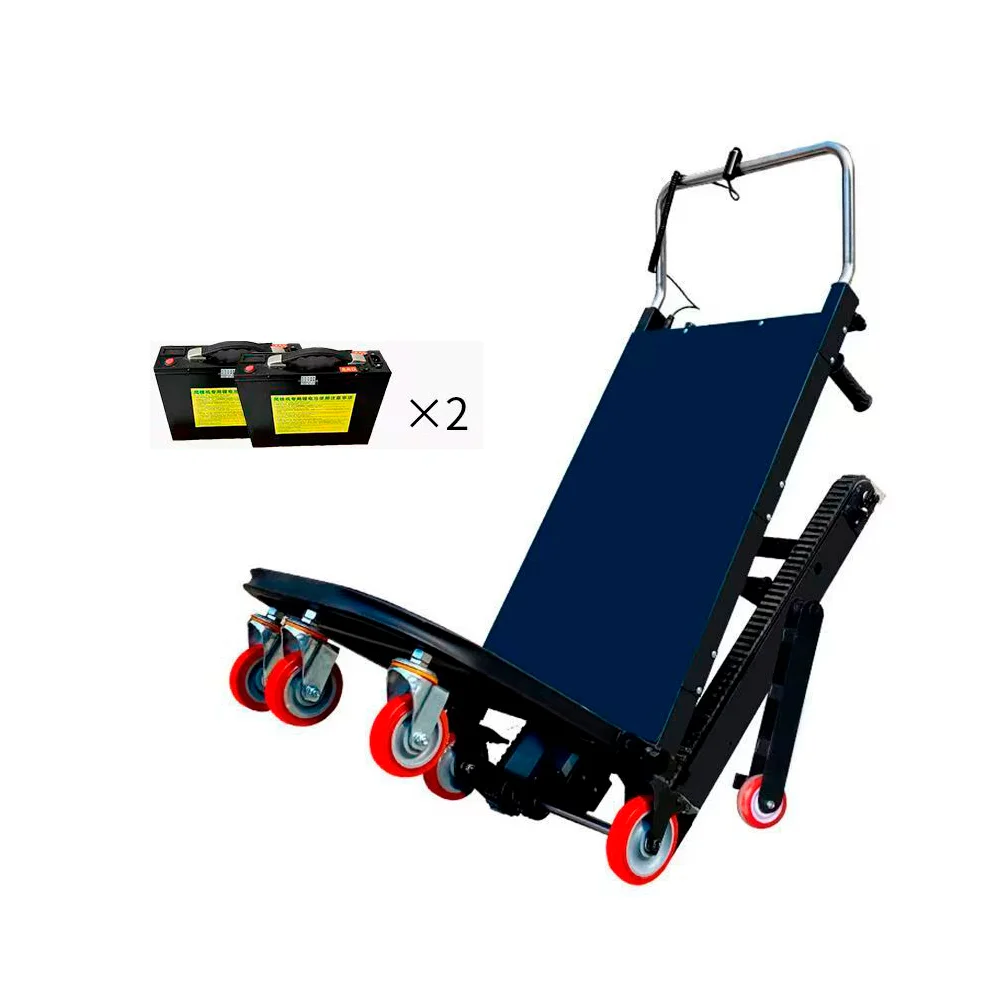
A machine that takes fourteen hours to charge is a machine that cannot do two shifts a day on one pack, while the same machine at five hours can. The record also gives no number of charge cycles, no charging temperature range, and no statement of whether the pack can be charged in place or must be removed. The images answer the last one: the feature page lists a removable lithium battery and a hidden battery box, so removal is intended, and the main image shows two battery packs with carry handles pictured beside the machine.
Ask for the charger output voltage and current, the charge time from empty, and the cycle life of the pack. Charge time is the single most useful number missing from this record for a buyer who plans to use the machine on a working day.
The 500 kilogram claim against the 3000 watt motor
The title claims a 500 kilogram load and the parameter block claims 3,000 watts. Those two figures can be compared with school physics, and the comparison is the most useful thing in this record, because it shows which of the two is the real constraint.
Climbing work against gravity is power equals mass times gravity times vertical speed. Taking gravity as 9.81 metres per second squared:
- At a vertical climb speed of 0.1 metres per second, lifting 500 kilograms needs 500 times 9.81 times 0.1, which is 490.5 watts of mechanical work. Allowing a generous 70 per cent efficiency for the track drive, the electrical draw is about 700 watts.
- Run the same formula backwards on the stated motor. At 3,000 watts and the same 70 per cent efficiency, the mechanical power available is 2,100 watts, which lifts 500 kilograms at 2,100 divided by 4,905, that is 0.43 metres per second of vertical speed.
- On a step rise of about 0.18 metres, a vertical speed of 0.43 metres per second is about 2.4 steps per second. That is faster than an operator can walk a loaded hand truck up a staircase.
The conclusion is that the motor is not what limits a 500 kilogram climb. At a realistic pace of about one step per second, the machine needs roughly 700 watts of electrical power to lift 500 kilograms, and the stated motor has more than four times that. What actually limits the load on a machine of this kind is traction between the track and the stair nose, the balance of the load on the platform, the strength of the frame and the axle of the track, and above all the operator's ability to keep the machine upright on a staircase. None of those is a wattage figure and none of them is in this record.
That conclusion explains something a buyer will notice when comparing this supplier's range. The same chassis appears in this record's own range at a lower power rating, and a lower rating does not mean a lower load. It means a lower climb speed. A 1,500 watt machine on the same frame lifts 500 kilograms at about 0.21 metres per second, roughly half the speed, and still lifts it. So a buyer comparing a 1,500 watt and a 3,000 watt version should treat the difference as speed and duty cycle rather than as capacity, and should ask both suppliers for the same three numbers: the rated load, the climb speed at that load, and the maximum stair angle.
The record states no climb speed, no maximum stair angle, no track width, no load rating per stair type, and no load test result. The load demonstration in the images is a rendered scene with cardboard cartons on the platform, not a photograph of a measured load test, so it is a marketing illustration rather than evidence.
How long will it run
With the pack read as 3.456 kilowatt hours, run time is simply the energy divided by the average draw, and the answer swings widely with the duty cycle:
| Average draw | Run time on one 3.456 kWh pack | What that draw corresponds to |
|---|---|---|
| 700 W | about 4.9 hours | Climbing 500 kg at a realistic pace of about 0.1 m/s vertical, at 70 per cent efficiency |
| 1,500 W | about 2.3 hours | Sustained work at half the rated motor power |
| 3,000 W | about 1.15 hours | Continuous operation at the full motor rating, which a stair climb cannot sustain |
Two packs double those figures if they are used one after the other. The practical reading is that a machine of this size will climb a realistic number of flights on one charge and that the number depends almost entirely on how much of the time the track is actually lifting, which the record does not quantify. Ask for a measured endurance figure on a stated load over a stated number of steps, and ask whether the battery can be swapped mid-shift.
Dimensions: the record gives one height, the drawing gives a range
The record states a product size of 54 by 62 by 122 centimetres and a folded size of 122 by 54 by 36 centimetres. The dimensioned drawing among the detail images tells a different and more useful story.
| Dimension | Record | Dimensioned drawing in the images |
|---|---|---|
| Overall height | 122 cm, stated as a single figure | 1200 to 1800 mm, adjustable |
| Platform or base plate | not stated separately | 520 mm |
| Base length on the ground | not stated separately | 650 mm |
The most important line in that comparison is the first. The drawing shows the machine's height adjustable across a 600 millimetre range, from 1200 to 1800 millimetres, and the record quotes only a single 122 centimetre figure. A single figure cannot tell a buyer whether the machine fits through a doorway, under a counter or into a van in either its extended or its retracted position, and the two ends of that range differ by more than half a metre.
The remaining two drawn dimensions are close to, but not identical with, the record's figures: the drawing's 520 millimetre platform against the record's 54 centimetre dimension, and the drawing's 650 millimetre base against the record's 62 centimetre dimension. The differences are 20 and 30 millimetres, which is within the range of different measuring points on a machine of this size, but it is another reason to ask for a labelled drawing with every dimension marked rather than two sets of numbers in different axis orders.
The folded size repays one calculation, because folding does less than the two numbers suggest. The unfolded volume is 54 times 62 times 122 centimetres, which is 408,456 cubic centimetres, or about 408 litres. The folded volume is 122 times 54 times 36 centimetres, 237,168 cubic centimetres, or about 237 litres. Folding therefore removes about 42 per cent of the volume, and the machine folds to 58 per cent of its unfolded size. Note also that the folded footprint keeps the 122 centimetre and 54 centimetre dimensions and only reduces the third from 62 to 36 centimetres, so the floor footprint does not shrink, only the depth. For a buyer planning storage, that is the difference between a machine that tucks against a wall and one that does not.
The same chassis appears at two power ratings in this range
A buyer comparing stair climbers from this supplier will meet the same machine more than once. Within this queue alone, four records share the identical product size of 54 by 62 by 122 centimetres, the identical folded size of 122 by 54 by 36 centimetres and the identical charger line of AC 100-240V 50/60HZ, while their power and battery lines differ:
| Record | Power line | Battery line | Load in the title |
|---|---|---|---|
| Product ID 1601277135120 | 1500w, with a 12A lithium battery line | 24AH/36AH | not stated |
| Product ID 1601310439566 | 1500w | 24AH/36AH, lithium 36/48V | 400/500kg |
| Product ID 1601277045365 | not stated | 24AH/36AH | 380/400kg |
| This record, 1601317037261 | 3000w | 72A, lithium 48V | 500kg |
This is not a criticism of any one listing; it is a description of how this product is sold, and it has a practical consequence. The same frame is offered at two power ratings and with battery lines written three different ways, 24AH/36AH, 36/48V and 72A, and the load claim moves between 380, 400 and 500 kilograms across the records. A buyer cannot assemble a coherent specification by reading one record, and cannot compare two records without asking the supplier to restate both on the same template.
The practical instruction is to ask for a single written specification that pins down, for the exact unit quoted: the frame, the power rating, the battery chemistry and capacity, the number of packs, the load rating, the climb speed at that load, the maximum stair angle, the charger output, and the dimensions with a labelled drawing. Then compare quotations on that document rather than on the listing text. The related guide on this site covering the 380 and 400 kilogram version of the same trolley works through the load and dimension terminology in more detail.
What the eight images establish
Seven of the eight detail images are feature and dimension pages rather than photographs, and it is worth separating what they prove from what they illustrate.
| Image | What it shows | What it establishes |
|---|---|---|
| Main product image | A black frame with a blue deck plate, a cleated crawler track on one side, six red castor wheels, an armrest type handle, and two separate battery packs with carry handles pictured with a multiplication sign between them and the machine | The machine is a tracked stair climber with castors for level ground, and the kit contains two battery packs as the title states |
| Dimensioned drawing | The machine from the side with a dimension line for an adjustable height of 1200 to 1800mm, a 520mm platform and a 650mm base length | The height is adjustable over 600mm, which the parameter block does not say |
| Feature icons | Nine captioned icons: high quietness, large load, long battery life, easy to use with one touch cruise, humanised design armrest, strengthened vehicle body, hidden battery box, removable lithium battery, and multiple specifications with a waterproof storage bag | There is a one touch cruise control and a removable battery; neither is quantified |
| Load illustration | A rendered scene of the trolley climbing stairs carrying six cardboard cartons | An illustration, not a load test photograph; no weight is shown and no measurement is stated |
| Track page | The track described as tank style rubber track, lengthened and thickened, with the note that the staircase spans three steps, and the words non-slip and durable | The track is stated to span three stair steps, which is the only geometry in the record about climbing |
| Pull rod page | The telescopic pull rod shown in three positions with up and down arrows | The handle height adjusts, consistent with the 1200 to 1800mm range on the drawing |
| Motor page | A cutaway rendering captioned pure copper motor with thick copper wire, silent bearings and a high temperature power off function | A thermal cut off exists, which matters on a machine that can be stalled under load |
| Track photograph | A real close up photograph of the cleated rubber track with a tensioning bolt and locknut on the track frame | The track has an accessible tensioner; tension maintenance is part of ownership |
Two of those rows deserve more than a table line. The track page states that the staircase spans three steps, which is the only dimensional information in the record about the climbing interface. If a stair going is between 250 and 300 millimetres, a track spanning three of them has a contact length of roughly 750 to 900 millimetres. That is a derived figure rather than a stated one, but it gives the buyer a way to check whether the machine will sit on a given staircase, and it is worth asking for the actual track contact length and width. The cleat pitch matters as well: the page says the track teeth are more suitable for stair steps, and a buyer with unusually shallow or unusually deep steps should ask whether the cleat pitch suits them.
The other row worth isolating is the motor page, because the thermal cut off it names is a symptom as much as a feature. A cut off exists to protect a motor that can be overloaded, and on a stair climber the way to overload it is to stall the track against a stair nose. Ask what the machine does when the thermal cut off operates: whether it stops and requires a wait, or limits power, and how long it takes to reset. On a working day that behaviour matters more than the difference between a 1,500 and a 3,000 watt rating.
The trademark wording in the description
The parameter block calls the machine an Electric Trolly, which is simply a misspelling of trolley. The description heading goes further and describes the machine as having a Caterpillar belt, while the title of the same record calls it a crawler belt.
These are the same component under two names, and one of the two names is a registered trademark belonging to a construction machinery manufacturer. A reseller writing their own listing, catalogue or advertisement should describe the part as a crawler track or a rubber track, and avoid the trademarked term, because using it to describe a generic component is a risk the buyer takes on rather than the supplier. This is a small point with a concrete instruction attached, and it is worth passing on to whoever writes the copy.
Total cost of ownership
The purchase is the smaller half of the cost of running a machine of this kind, and the record's omissions are clustered exactly where the running costs sit.
| Cost line | Source in this record |
|---|---|
| Machine price | Not stated. Nothing in the record gives a price or a minimum order quantity. |
| Number of battery packs | The title says two and the main image shows two; the parameter block does not state a count, so the price difference between one and two packs is unknown. |
| Replacement packs | Not stated. A traction pack of up to 3.456 kWh each is the largest single consumable on the machine, and two of them exceed the value of many components on the frame. |
| Charger | Input voltage is stated, output is not. Ask whether the charger is included and its output rating. |
| Track and tensioner maintenance | The track photograph shows a tensioner, and the page describes a thickened rubber track. Track and castor wheels are wear items; neither price nor life is stated. |
| Castor wheels | Six red castors are visible. No size, load rating or price is given. |
| Freight for a heavy machine plus two battery packs | Not stated. Lithium batteries are also regulated for transport, which adds documentation and can restrict air carriage. |
| Duty and import documentation | Not stated. |
| Operator training for stair work | Not stated. A loaded stair climb is an operator skill, and the record's only operating instruction is the one touch cruise label. |
The freight and battery points are connected and worth planning early. Two packs of up to 3.456 kilowatt hours each are lithium cells, and lithium cells travelling internationally carry transport restrictions that do not apply to the frame. Ask the supplier how the packs are declared, whether they ship in the same consignment as the machine, and what documentation is provided, before comparing landed prices.
Questions to put to the supplier before ordering
- What is the model number of this machine? The parameter block names only a category, Electric Trolly.
- Please write the battery specification in full: chemistry, nominal voltage, capacity in amp hours, continuous and peak discharge current, and whether the line reading 72A is a capacity or a current limit.
- How many battery packs are supplied, and do they run together or one after the other? The title says two and the parameter block does not say.
- What is the charger output voltage and current, and what is the charge time from empty to full?
- What is the cycle life of the pack, and what is the price of a replacement pack and charger?
- What is the rated load, and what is the climb speed at that load? The record gives a 500kg claim in the title and no climb speed anywhere.
- What is the maximum stair angle the machine will climb, and the maximum step height?
- What is the load rating per stair type, and has the load rating been measured on a test rig or on a staircase?
- What is the track contact length and width, the cleat pitch, and the track tension setting and check interval?
- What is the load rating and the size of each castor wheel, and are the wheels replaceable?
- What happens when the thermal cut off operates: does the machine stop or limit power, how long does it take to reset, and what triggers it?
- Please supply a labelled drawing with every dimension marked, since the record gives two sets of numbers in different axis orders and the drawing shows an adjustable height of 1200 to 1800mm that the parameter block does not mention.
- What is the actual height at the lowest and highest pull rod positions?
- What is the weight of the machine, the weight of each battery pack, and the packed weight and carton count?
- What is the frame material and the surface treatment, and what is the corrosion protection?
- How are the lithium packs declared for transport, and what documentation comes with them?
- What is the warranty term and what does it cover, particularly the track, the motor and the battery?
- What spare parts are recommended for the first year, and what are their prices?
- What is the price, trade term, lead time, deposit and balance, and the landed cost at our address?
- Please confirm the full registered name of the contracting entity and the bank account beneficiary name, and confirm the two match.
Questions two, six and twelve are the ones that unlock the rest. Until the battery line is resolved, the run time cannot be calculated. Until the climb speed and the maximum stair angle are given, the 500 kilogram claim cannot be checked against a real staircase. And until a labelled drawing arrives, the machine cannot be checked against a doorway, a van or a store room.
Incoming inspection when the machine arrives
- Check the carton count and weigh each carton against the supplier's packed figures before opening.
- Check the battery packs separately and first, since they are the highest value item and the most regulated. Photograph each pack label, record the capacity and voltage printed on it, and compare with the written specification.
- Count the battery packs and confirm the number matches the order, then charge one pack fully and note the time taken, to test the charge figure you were given.
- Assemble and check the frame for welds, paint defects and deformation, and check the six castors turn freely and are the size stated.
- Inspect the track for cleat damage, check the tension against the supplier's setting, and confirm the tensioner adjusts and locks.
- Check the pull rod adjusts through its full range, and measure the actual minimum and maximum height against the drawing's 1200 to 1800 millimetres.
- Measure the platform and the base length against the drawing's 520 and 650 millimetres and against the record's 54 and 62 centimetre figures, and record which figure the machine actually matches.
- Power up on level ground and test the one touch cruise function and the brake or hold function.
- Climb a short flight with no load and note the noise level and whether the track tracks straight.
- Climb the first loaded test well below the rated load, then step the load up over several runs rather than going straight to the maximum. Record the load, the number of steps and the time for each run.
- Test the thermal cut off deliberately on a light load by stalling the track briefly, and time the reset, so that the behaviour is known before it happens on a job.
- Record all timings and loads on one sheet with the date, and keep it with the machine's documents, so that any later claim about load or endurance is answered from measurements.
Answers to the questions this record raises most often
Is 72A a battery capacity or a current rating?
The record does not say, and either reading is arithmetically possible: 72 amp hours at 48 volts is 3,456 watt hours of energy, while 72 amps at 48 volts is 3,456 watts of power. Ask the supplier to restate the battery line in full. If it is a current limit, note that it leaves only about 15 per cent of headroom above the stated 3,000 watt motor.
How long does it take to charge?
That depends on the charger's output current, which the record does not give. Its input line of AC 100-240V 50/60HZ only confirms that it works from any wall supply. On a 72 amp hour pack, a 5 amp charger takes about 14.4 hours, a 10 amp charger about 7.2 hours and a 15 amp charger about 4.8 hours.
Will it really lift 500 kilograms?
The physics says the motor is not the limit. Lifting 500 kilograms at a realistic 0.1 metres per second needs about 490 watts of mechanical power, roughly 700 watts electrically, and the stated 3,000 watt motor has more than four times that. At full power the motor would lift 500 kilograms at about 0.43 metres per second, faster than an operator can walk a loaded truck up a staircase. The real limits are traction, frame strength, balance and operator skill, and the record states nothing about any of them, so treat the 500 kilogram figure as one to be verified on a test climb.
Why does the same machine appear at 1500W and 3000W?
Because the power rating sets the climb speed rather than the load. On the same 54 by 62 by 122 centimetre frame, 1,500 watts lifts 500 kilograms at roughly half the speed of 3,000 watts. Compare the two versions on climb speed at a stated load and on duty cycle, not on wattage alone.
What is the real height of the machine?
The parameter block says 122 centimetres and the dimensioned drawing says 1200 to 1800 millimetres adjustable. The drawing is the more useful figure: it means the height varies over a span of 600 millimetres, which decides whether the machine fits through a doorway or under a shelf. Ask for the height at both ends of the adjustment.
Does the machine fold down small?
Folding removes about 42 per cent of the volume, from about 408 litres to about 237 litres, but it does not shrink the floor footprint: the folded size keeps the 122 and 54 centimetre dimensions and only reduces the third from 62 to 36 centimetres.
Are there differences between the listings for this machine?
Yes. Four records in this range share the same product size, folded size and charger line, while their power lines read 1500w or 3000w, their battery lines read 24AH/36AH, 36/48V or 72A, and their title load claims read 380, 400 or 500 kilograms. Ask for one written specification for the exact unit quoted and compare quotations on that.
Source, scope and what this guide does not claim
This guide is based on the Hoting queue record for Product ID 1601317037261, a stair climbing hand truck whose title names two batteries, 3000W of electric power, a 500kg load and a crawler belt, and whose description heading describes the same item as having a Caterpillar belt.
The parameter block in that record contains seven rows, quoted in full above: product size 54*62*122cm, folded size 122*54*36cm, charger voltage AC 100-240V, 50/60HZ, battery 72A, product name Electric Trolly, power 3000w and lithium battery 48V. The description text repeats those rows and adds no further specification. The eight detail images supply the main product view with the cleated track, six red castors and two battery packs; the dimensioned drawing with the adjustable height of 1200 to 1800mm, the 520mm platform and the 650mm base; the nine feature captions including one touch cruise, hidden battery box, removable lithium battery and a waterproof storage bag; the rendered load illustration with cardboard cartons; the track page stating that the staircase spans three steps; the pull rod page with three positions; the motor page with thick copper wire, silent bearings and a high temperature power off function; and the close up photograph of the cleated track with its tensioning bolt and locknut. The comparison of records sharing the same product and folded sizes is drawn from other records in the same queue, quoted in the table above with their product IDs.
Six passages are the author's arithmetic or reasoning and are identified here so that they are not mistaken for supplier data. The energy figure of 3,456 watt hours and the power figure of 3,456 watts are the product of the stated 48 volts and 72, in the two possible readings of the battery line; the 15.2 per cent headroom is that figure compared with the stated 3,000 watt motor. The charge times of about 14.4, 7.2 and 4.8 hours are 72 amp hours divided by an assumed 5, 10 or 15 amp charge current, and the charge current is not stated in the record. The climb power figures are calculated from power equals mass times gravity times vertical speed using the stated 500 kilogram load and 3,000 watt motor with an assumed 70 per cent drive efficiency, giving about 490 watts of mechanical power at 0.1 metres per second, about 700 watts of electrical draw, and about 0.43 metres per second at full motor power; the corresponding step rates assume a 0.18 metre step rise. The run times in the table are the 3.456 kilowatt hour figure divided by the stated average draws. The volume figures of about 408 litres and about 237 litres and the 42 and 58 per cent figures are calculated from the stated product and folded dimensions, and the observation that folding leaves the floor footprint unchanged is a reading of the two stated sizes against each other. The track contact length of roughly 750 to 900 millimetres is derived from the track page's statement that the staircase spans three steps together with an assumed stair going of 250 to 300 millimetres.
Unless a figure appears in the lists above, it is not in this article because it is not in the record. This record states no model number, no price, no minimum order quantity, no trade term, no lead time, no deposit or balance terms, no battery capacity in amp hours, no charge current or charge time, no number of charge cycles, no climb speed, no maximum stair angle, no maximum step height, no track length, width, cleat pitch or tension setting, no castor size or rating, no machine weight, no battery weight, no packed weight, no carton count, no frame material or surface treatment, no warranty, no spare parts list, no certification, no load test result and no transport documentation for the lithium packs.
Two numbers decide whether this machine suits a job, and neither is in the record: the climb speed at the rated load, and the time to charge the battery. The 500 kilogram claim itself is not the difficult part, because the stated motor has several times the power that load requires at a walking pace. Close the battery and charger lines in writing, get a climb speed and a maximum stair angle for the exact unit, and confirm the height range from a labelled drawing, through the TEBAK sales inquiry channel.
Key specifications
- Product Size
- 54*62*122cm
- Folded Size
- 122*54*36cm
- Charger Voltage
- AC 100-240V, 50/60HZ
- Battery
- 72A
- Lithium Battery
- 48V
- Power
- 3000w
- Product Name
- Electric Trolly
- Load Claim in Title
- 500kg (not repeated in the parameter block)
- Battery Count
- Two packs shown in the main image (title says 2 Battery; the parameter block does not state the count)