
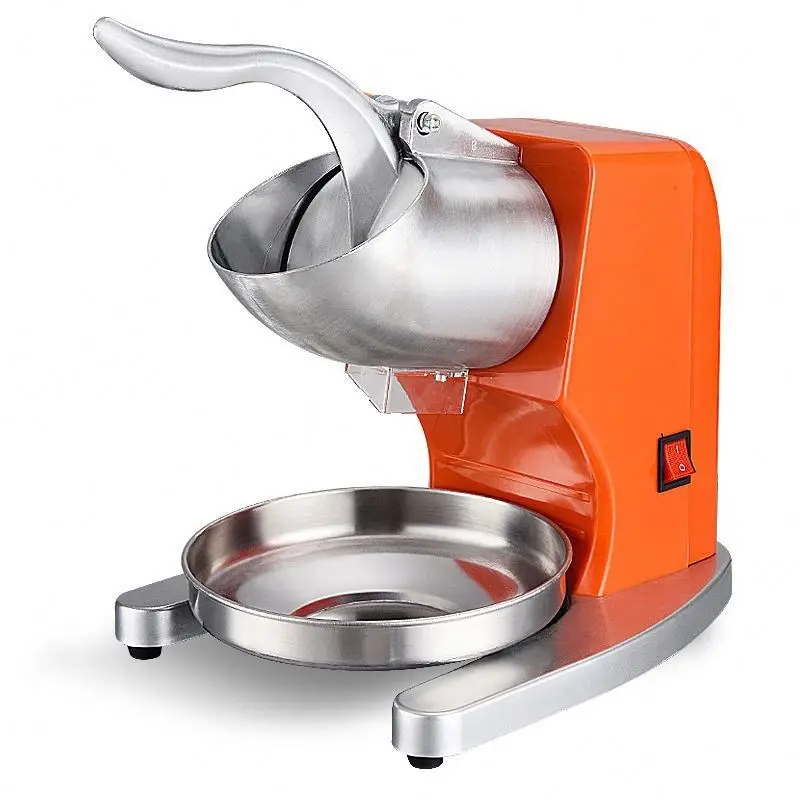
One machine, two parameter sets, and three numbers that do not agree
The Hoting queue carries Product ID 1601276018834 as a commercial electric shaved ice and snow ice shaver offered in 110 volt and 220 volt versions, and the listing publishes seven parameters. The record's third detail image publishes a complete specification table of its own, for a machine it names the Qi Sheng ice crusher in the raised body version, model 128A. Putting the two sets side by side is the fastest way to see what a buyer is actually being offered, because three of the four numbers they share are different.
| Quantity | Listing parameter | The record's own specification table |
|---|---|---|
| Motor power | 500 W | 380 W |
| Weight | Gross 5 kg, net 5.7 kg | Machine weight 6.5 kg |
| Voltage | 220 V | 220 V, 50 Hz |
| Throughput | 65 kg per hour | No throughput row at all |
| Number of knives | Single knife or twin knives | No blade row; the photographs show a toothed lattice plate |
| Model | Not stated | 128A |
| Speed | Not stated | 2000 revolutions per minute |
| Material | Not stated | Plastic, aluminium alloy and stainless steel |
| Machine dimensions | Not stated; only packing dimensions | 40 by 20 by 32 cm, axes unnamed |
The power difference is not trivial. A 500 watt motor and a 380 watt motor differ by nearly a quarter, and the figure matters twice over: once for the electrical circuit the machine will be connected to, and once for the cross-check below, where the power rating sets a hard ceiling on how much ice the machine could melt if any part of its output were thermal rather than mechanical.
The weight field contains an impossibility as printed. The parameter reads gross and net as five kilograms and five point seven kilograms, which has the gross weight below the net weight; a packed machine weighing less than the machine alone is not a rounding error but a transposition or a typing error. Neither figure agrees with the record's own table, which gives a machine weight of six point five kilograms, and none of the three agrees with the packing volume implied by the stated carton, as the freight section below shows. So the record offers three different weights and no way to choose among them, and gross weight is the one a buyer needs for freight.
The throughput figure, and the record's own timing claims that contradict it
The listing states a productivity of sixty-five kilograms per hour. The record's own specification table has no throughput row, so the figure is unsupported by the supplier's own document. It can still be tested, in two ways, against numbers the record itself prints.
The first test is thermal. Shaving ice mechanically does not melt it, but a figure that large invites the question of whether any part of the claimed output could be produced by melting, and the melting rate is fixed by the machine's power. Melting one kilogram of ice takes about 334 kilojoules, so a machine of 380 watts can melt at most about 1.14 grams per second, which is about 4.1 kilograms per hour, and the listing's 500 watt figure raises the ceiling only to about 5.4 kilograms per hour. Sixty-five kilograms per hour is about 18 grams per second, which would require roughly 6 kilowatts if the ice were being melted. The conclusion is that the claimed output can only be mechanical removal, which is physically reasonable for a toothed plate turning at 2,000 revolutions per minute against a pressed block, and that the machine's power is not the limiting factor for melting. It also means the throughput figure tells the buyer nothing about the motor and must be established by measurement on the buyer's own ice.
The second test is internal to the record's own artwork. The first image carries two timing claims: eight seconds for a smoothie, described as speed grinding, and three seconds grinding into sand. Those claims can be converted into a throughput and compared with the sixty-five kilogram figure. At three seconds for a serving, a 200 gram bowl of shaved ice implies about 67 grams per second, which is about 240 kilograms per hour, and at eight seconds a 400 gram smoothie implies about 50 grams per second, which is about 180 kilograms per hour. Both are roughly three to four times the stated productivity. Working the comparison the other way, sixty-five kilograms per hour delivers about 54 grams in three seconds and about 144 grams in eight seconds, which is a small dessert rather than a serving. So the record's own timing claims and its own throughput figure cannot both describe the same machine, and the buyer should ask which one the specification is based on.
There is a third problem with the throughput figure, and it is the one that decides how useful the number is at all. Ice shaving rate depends on three things the record never states: the form of the ice, since a block presents a continuous surface to the plate while cubes present a shifting one; the temperature of the ice, since ice at minus two degrees shaves far more readily than a hard block at minus eighteen; and the plate's setting and the pressure applied through the handle, which is under the operator's control. A throughput figure quoted without all three is not a specification, and the practical substitute is a timed test on the buyer's own ice, weighing the output over a fixed interval and recording the ice temperature at the start.
The voltage claim, and the frequency the table states
The listing's title offers the machine in 110 volt and 220 volt versions. The record's own specification table gives 220 volts at 50 hertz, and the listing's own voltage parameter gives 220 volts in the singular. So the 110 volt version is asserted in the title and unsupported everywhere else in the record.
For a buyer in a 60 hertz market the frequency matters as much as the voltage. A machine built for 50 hertz and supplied into a 60 hertz supply will, if the motor's speed follows the supply, run about twenty per cent faster than its rated 2,000 revolutions per minute, which changes the shaving rate, the load on the plate and the heat the motor has to shed. A transformer solves the voltage but not the frequency, so a 220 volt 50 hertz machine converted for a 110 volt 60 hertz market is not the same machine as one built for that market. The right request is the 110 volt variant's own specification table, with its own power, its own speed and its own frequency, rather than an assumption that the same machine is offered in two voltages.
The speed figure also deserves a question of its own. The table states 2,000 revolutions per minute without saying whether that is the plate's speed or the motor's before reduction. If it is the plate, the arithmetic explains why a machine of this size can remove ice quickly: a plate of about twenty centimetres diameter has a circumference of about 63 centimetres, so at 2,000 revolutions per minute its rim travels at about 21 metres per second. That is the speed of a high speed grater, and it is worth asking about the noise level and about the cover over the plate for the same reason. It is also worth asking whether the plate's speed is adjustable, because a single fixed speed leaves the operator with only the pressing handle to control the texture.
One or two knives, against a plate full of teeth
The listing states the number of knives as single knife or twin knives, which is the vocabulary of a blade shaver: a drum or a disc carrying one or two cutting blades, with the count deciding how often the blade passes the ice per revolution. The record's photographs show something else. The first image is a close view of a disc covered in a triangular lattice, like a grater plate, captioned as lattice leakproof, and the machine carries a curved pressing handle above it. A toothed lattice and one or two knives are different cutting geometries, and a buyer cannot tell from the record which one is supplied.
The difference is not academic, because the two designs fail in different ways and their consumables differ. A blade can be sharpened and replaced as a single part. A lattice plate wears across its whole face and is replaced as a plate. So the questions are which geometry the delivered machine has, what the cutting part is made of, whether it is replaceable by the user or requires a service visit, and what a spare costs. On a commercial machine used daily, the cutting part is the consumable that decides the cost of ownership, and this record does not price it or even name it.
The lattice also carries a claim worth unpacking. The caption reads lattice leakproof, and leakproof in the context of a shaving head most plausibly means that the plate's perforations do not pass water or meltwater through into the machine's body. That is a useful property, but it is not a specification until the supplier says how it is achieved and how it is tested, so the question to ask is whether the plate is a single machined part or an assembly, what seals it, and whether the machine's body is protected if the head is flooded.
The dimensions, which come in three sets and reconcile in none
The record gives dimensions three times, in three places, and they do not fit together.
| Source | Figures | What is unclear |
|---|---|---|
| The listing | Packing dimensions 55 by 43.5 by 71 cm | Packing only, so the machine's own size is unstated |
| The record's specification table | Machine dimensions 40 by 20 by 32 cm | The three axes are not named, so which figure is the height is unknowable |
| The record's dimensioned drawing | 20.5 cm across the basin, 4.5 cm for the orange plinth, 25 cm and 30 cm across the base | No overall height is dimensioned; one vertical dimension line carries garbled label text |
Two consequences follow, and both matter at the point of sale. The first is that the machine's height is unavailable. This model is described in its own table as the raised body version, and a raised body exists so that a serving bowl can stand underneath the shaving head; the clearance under the head is therefore a working dimension, not a cosmetic one, because a bowl taller than the clearance simply will not fit. The drawing shows a 4.5 centimetre plinth and a 20.5 centimetre basin but no overall height, and the table's three unnamed figures could put the height at 20, at 32 or at 40 centimetres, which is the difference between a machine that takes a dessert bowl and one that does not.
The second consequence is in the carton. The stated packing volume is 55 by 43.5 by 71 centimetres, which is 0.1699 of a cubic metre, or about 170 litres. The machine's own bounding volume from the table, 40 by 20 by 32 centimetres, is about 25.6 litres. The carton is therefore about six and a half times the machine's own bounding volume, which is far more than normal dunnage and suggests either that the machine ships with the head raised and the handle fitted, in which case its true height is much greater than any figure in the table, or that the carton dimensions and the machine dimensions were not taken from the same machine. A buyer should ask for a dimensioned drawing with the three axes named, the clearance under the head, and confirmation that the 71 centimetre figure is the carton's height with the machine packed as delivered.
What 170 litres does to the freight
The carton volume decides what an importer actually pays, because freight is charged on the greater of actual and volumetric weight, and on a light machine in a large carton the volumetric figure wins by a wide margin.
| Measure | Value | Note |
|---|---|---|
| Carton volume | 0.1699 cubic metres, about 170 litres | Calculated from the stated 55 by 43.5 by 71 cm |
| Volumetric weight at a divisor of 6,000 | 28.3 kg | Common for air freight |
| Volumetric weight at a divisor of 5,000 | 34.0 kg | Common for express couriers |
| Actual weight | 5, 5.7 or 6.5 kg depending on which figure is read | The three figures in the record do not agree |
| Cartons per cubic metre | About 5.9 | One divided by the carton volume |
The consequence is that an air or courier shipment of this machine is charged at roughly five times its own mass, so the carton's efficiency is worth more to the buyer than its price. If the machine is to move by sea, the volume sets the container count instead: at the estimated practical stow of about 28 cubic metres in a twenty foot container, this carton fills a container at roughly 165 units, and a forty foot high cube at roughly 388 units, both of which a forwarder should confirm against the actual carton and the actual stow.
There is one more consequence, and it is the reason the weight question has to be settled before the order rather than after. If the machine really weighs 6.5 kilograms and ships in a 170 litre carton, the packed density is about 38 kilograms per cubic metre, which is at the very light end for packed machinery and normally implies a generous amount of foam. If instead the gross weight is truly five kilograms, the packing is lighter still. Either way, the buyer is buying volume, and the supplier can reduce the buyer's freight by reducing the carton and the dunnage, which is a request worth making in writing before the price is fixed.
Materials, food contact, and the applications the collage claims
The record's specification table gives the material as plastic, aluminium alloy and stainless steel, without saying which part is which. On a machine that shaves ice and holds it in a basin, the material map matters: the parts that touch the ice are the shaving plate, the head, the basin and any chute, and those are the parts that have to be stainless or food grade. The body is usually plastic, and the aluminium alloy is usually structural rather than in contact with food. So the request is a part by part material list, naming which components are in contact with the product, followed by the food contact declaration for those parts in the destination market's terms.
The collage attached to the record's fourth image also carries a claim the machine cannot support. One of its photographs is captioned fruit and vegetable juice, and an ice shaver does not produce fruit or vegetable juice; that requires a juicer or a blender. The other photographs in the same collage show shaved ice desserts and a milkshake, which are within the machine's reach. The distinction is worth keeping in mind for two reasons: an over-claiming application photograph tells a buyer that the gallery is generic rather than product specific, and the acidic juices named in that caption are exactly the fluids that should not be held in an aluminium vessel, which is why the material map above is worth requesting rather than assuming.
The name, the year, and what the record does not state at all
Three naming details are worth recording because they affect what a buyer can search for and what a supplier must confirm. The listing calls the machine a shaved ice cream and snow ice shaver, while the record's own table calls it the Qi Sheng ice crusher in the raised body version and gives the model as 128A. A crusher, a shaver and a snow ice machine are related but distinct products, and the model number appears nowhere in the listing. The title also carries the words 2024 new, which was a claim about the year of launch; used in a listing that is still live later, it dates the page and invites the question of what replaced it. Neither the year nor a model number is a specification, but both are what a buyer will quote back to a supplier, so the model number in the specification table should be the identifier used in the order.
Finally, the record states no throughput that matches its own table, no blade or plate material, no cutting part part number or spare price, no warranty, no certificate of any kind, no packing list, and no operating instructions. The description text is the same company profile paragraph that appears in other records for unrelated products, with the parameter heading misspelled and repeated, the profile heading repeated, and the profile ending mid sentence. None of that is a defect in the machine, and all of it means the specification has to be written by the buyer rather than read from the listing.
The specification to send before ordering
| Item | Answer required as |
|---|---|
| Model and version | Model number as printed on the nameplate, and confirmation of the raised body version |
| Power and voltage | Watts, volts and hertz, for the 220 volt version and separately for the 110 volt version |
| Speed | Plate speed in revolutions per minute, motor speed if different, and whether it is fixed |
| Cutting geometry | Lattice plate or blade drum, number of cutting edges, and the material of the cutting part |
| Cutting part supply | Part number, spare price, replacement interval, and whether the user can replace it |
| Throughput | Kilograms per hour, with the ice form, the ice temperature and the plate setting stated |
| Machine dimensions | A drawing with the three axes named, plus the height, and the clearance under the head |
| Net and gross weight | Machine weight and packed weight as separate figures, in kilograms |
| Carton | Length, width and height in centimetres, packed as delivered, with the packing list |
| Materials by part | A list naming each food contact part and its material, and each structural part and its material |
| Food contact compliance | The declaration for the destination market, naming the parts it covers |
| Electrical compliance | The certification for the destination market, and the plug and cable fitted |
| Basin and head | Basin diameter and depth, and whether a second basin or a chute is available |
| Safety and noise | Whether the plate is enclosed, whether there is an interlock, and the measured noise level |
| Cleaning | Which parts are removable without tools, and whether they are dishwasher safe |
| Documentation | Operating instructions and a parts diagram with part numbers, in English |
| Commercial terms | Price, minimum order quantity, colour options and their minimums, trade term, lead time, warranty |
Incoming inspection when the machine arrives
- Photograph the nameplate before unpacking, and record the model, voltage, frequency, power and any serial number, then compare them with the order and with the record's own table.
- Weigh the machine alone and the complete packed carton separately, and record both, since the record offers three weights and none of them can be checked without a scale.
- Measure the machine's height, width and depth, and measure the clearance under the shaving head with the head in its working position, then test the largest bowl the buyer intends to use.
- Measure the carton and recompute the volumetric weight for the buyer's own freight mode, using the forwarder's divisor rather than the one assumed here.
- Freeze a known mass of ice in the form the buyer will actually use, record its temperature with a probe thermometer, and shave it for a measured interval, then compute kilograms per hour from the output.
- Repeat that timed test with the same ice at a lower temperature and with the plate setting changed, so the buyer has a rate for the soft end and the hard end of the range rather than a single number.
- Weigh the shaved output from a fixed ice input and compare the two masses, since any loss is meltwater and it tells the buyer how much of the ice is being wasted as it passes through the head.
- Inspect the cutting part with a magnifier, identify whether it is a lattice plate or a blade arrangement, and record the number of cutting edges and any part number stamped on it.
- Run the machine empty at its working speed and measure the noise level at one metre, using a sound level meter or a phone application, and record the reading.
- Check the enclosure of the head and the basin for sharp edges, for traps where shaved ice will collect, and for any gap through which meltwater can reach the motor compartment.
- Clean the machine according to the supplier's instructions, time the strip down, and note which parts require tools, since that time is the daily cleaning cost.
- Run the machine continuously for the length of a busy service and feel the motor housing and the cable entry at intervals for excessive heat.
- Confirm the earthing of the machine and the polarity of the plug for the destination market, and have an electrician check the machine before it is connected to a commercial circuit.
- Record the delivered weights, dimensions, noise level and throughput on a single sheet kept with the photographs, so the second order can be checked against the first.
The second, third, fifth and eighth checks are the four that replace this record's missing or contradictory data, because packed weight, the clearance under the head, an actual throughput on the buyer's ice and the identity of the cutting part are the four facts the listing states wrongly or not at all.
Answers to the questions this record raises most often
Is the motor 500 watts or 380 watts?
The listing's parameter says 500 watts. The record's own specification table says 380 watts. The two differ by nearly a quarter and the record offers no basis for choosing. Require the figure as printed on the machine's nameplate and on the certificate, and treat the nameplate as authoritative.
What does the machine weigh?
The listing gives gross 5 kilograms and net 5.7 kilograms, which is impossible as printed because gross weight cannot be less than net weight. The record's own table gives a machine weight of 6.5 kilograms, which matches neither. Require machine weight and packed weight as two separate figures, and confirm both on arrival with a scale.
Is a 110 volt version available?
The title offers 110 volts and 220 volts. The record's specification table gives 220 volts at 50 hertz and the listing's voltage parameter gives 220 volts, so the 110 volt version is asserted only in the title. Ask for the 110 volt variant's own table with its own power, speed and frequency, and note that a transformer converts voltage but not frequency.
How fast is the throughput?
The listing states 65 kilograms per hour and the record's own table states none. The record's own artwork claims three seconds to grind ice into sand, which implies roughly 240 kilograms per hour for a 200 gram serving, and eight seconds for a smoothie, which implies about 180 kilograms per hour for a 400 gram serving; both are about three to four times the stated productivity, so the two claims cannot both be right. The only figure worth relying on is one measured on the buyer's own ice at a recorded temperature.
Could the machine melt the ice rather than shave it?
No, and the arithmetic rules it out. Melting a kilogram of ice takes about 334 kilojoules, so a 380 watt machine can melt at most about 4.1 kilograms per hour and a 500 watt machine about 5.4 kilograms per hour. A claimed 65 kilograms per hour would need roughly 6 kilowatts if it were melting, which is more than ten times the stated power, so the output has to be mechanical removal by the plate.
Does it have one knife or two?
The listing says single knife or twin knives. The photographs show a disc covered in a triangular lattice, more like a grater plate than a one or two knife drum. Ask which geometry is delivered, what the cutting part is made of, whether the user can replace it, and what a spare costs.
How big is the machine, and will my bowl fit?
The record's table gives 40 by 20 by 32 centimetres without naming the axes, and the record's drawing shows a 25 by 30 centimetre base and a 20.5 centimetre basin but no overall height. Because the machine is the raised body version, the clearance under the head is the dimension that decides whether a serving bowl fits. Ask for a drawing with the axes named, the overall height and the clearance.
Why is the carton so large?
The stated carton is 55 by 43.5 by 71 centimetres, about 170 litres, against a machine bounding volume of about 26 litres from the table, so the carton is roughly six and a half times the machine's own volume. That either implies a machine that ships taller than the table suggests or a carton and machine whose dimensions were not taken together. Either way the buyer pays for the volume, since volumetric weight of about 28 to 34 kilograms dwarfs an actual weight of about 6 kilograms.
Is the machine suitable for fruit juice?
The record's collage carries a photograph captioned fruit and vegetable juice, which an ice shaver does not produce; that requires a juicer or a blender. The machine shaves ice, and the acidic juices named in that caption are the fluids least suited to an aluminium vessel, so a part by part material list should be obtained for the food contact parts.
What is not in the record at all?
A throughput figure consistent with the supplier's own table, the blade or plate material and spare price, a warranty, a certificate for any market, a packing list, operating instructions, the model number in the listing, and a machine height. Each of those becomes a line in the buyer's own specification rather than a figure read from the listing.
Source, scope and what this guide does not claim
This guide is based on the Hoting queue record for Product ID 1601276018834, titled as a commercial electric shaved ice and snow ice shaver offered in 110 volt and 220 volt versions, and on the eight detail images that accompany it. All eight images were examined.
The seven listing parameters are quoted as they appear: optional colours, orange; nominal voltage, 220 V; motor power, 500 W; productivity, 65 kg per hour; number of knives, single knife or twin knives; packing dimensions, 55 by 43.5 by 71 cm; gross and net weight, 5 and 5.7 kg. The record's own specification table supplies the second set: name, Qi Sheng ice crusher in the raised body version; model, 128A; colour, orange; material, plastic, aluminium alloy and stainless steel; voltage, 220 V; frequency, 50 Hz; machine weight, 6.5 kg; power, 380 W; speed, 2,000 per minute; plate size, a row printed with no value; and machine dimensions, 40 by 20 by 32 cm with the axes unnamed. The record's dimensioned drawing supplies the 20.5 cm basin, the 4.5 cm plinth and the 25 cm and 30 cm base figures, and one vertical dimension line carries garbled label text rather than a value. The timing claims, eight seconds for a smoothie and three seconds grinding into sand, and the captions delicate taste and lattice leakproof, are printed on the record's first image and are quoted from there. The application photographs, including the one captioned fruit and vegetable juice, are on the record's fourth image.
Several figures in this guide are the author's arithmetic rather than published data, and are identified here so that they are not mistaken for specifications. The latent heat of fusion used for the melting ceiling is about 334 kilojoules per kilogram. The implied throughputs of about 240 and about 180 kilograms per hour are derived from the record's own timing claims applied to an assumed 200 gram serving and an assumed 400 gram smoothie. The plate rim speed of about 21 metres per second is calculated from the stated 2,000 revolutions per minute and an assumed plate diameter of about 20 centimetres, chosen because the drawing gives a 20.5 centimetre basin; the actual plate diameter is not stated anywhere in the record. The carton volume of about 0.170 cubic metres and the machine bounding volume of about 26 litres are calculated from the stated dimensions. The volumetric weights of 28.3 and 34.0 kilograms use divisors of 6,000 and 5,000, which are common but depend on the carrier. The packed density of about 38 kilograms per cubic metre follows from the 6.5 kilogram figure and the carton volume. The container counts of roughly 165 and 388 units are estimates based on assumed practical stow volumes of about 28 and about 66 cubic metres and must be confirmed with a forwarder. The twenty per cent speed change from 50 to 60 hertz is a general property of motors whose speed follows the supply, and the machine's own behaviour on a 60 hertz supply should be confirmed by the supplier rather than assumed.
A buyer can close this specification with four questions and three measurements. The questions are the power, voltage and frequency as printed on the nameplate of the version actually supplied; the cutting geometry, material and spare price; the machine's overall height and the clearance under the head; and the machine weight and packed weight as two separate figures. The measurements are the throughput on the buyer's own ice at a recorded temperature, the noise level at one metre, and the delivered packed weight. Everything else in this guide follows from those seven answers, and none of them is in the record as it stands.
Key specifications
- Optional colors
- orange
- Nominal voltage
- 220V
- Motor power
- 500W
- Productivity
- 65kg/h
- The number of knives
- Single-knife/bi-knives
- Packing dimensions
- 55*43.5*71cm
- Gross/Net weight
- 5/5.7kg
- Name on the record's own specification table
- Qi Sheng ice crusher (raised body)
- Model on the record's own specification table
- 128A
- Material on the record's own specification table
- Plastic + aluminum alloy + stainless steel
- Voltage and frequency on the record's own specification table
- 220V, 50HZ
- Machine weight on the record's own specification table
- 6.5KG
- Power on the record's own specification table
- 380W
- Speed on the record's own specification table
- 2000 /min
- Machine dimensions on the record's own specification table
- 40x20x32 cm, with the axes not named
- Plate size on the record's own specification table
- row present with no value printed
- Dimensions drawn on the record's own specification image
- 20.5CM across the basin, 4.5CM for the orange plinth, 25CM and 30CM across the base
- Shaving surface shown
- a disc with a triangular lattice pattern, captioned as lattice leakproof, with a curved pressing handle
- Timing claims printed on the record's images
- 8 seconds smoothie speed grinding; 3 seconds grinding into sand, delicate and smooth taste
- Throughput on the record's own specification table
- not stated
- Blade or plate material
- not stated
- Warranty, certificate or packing list
- not stated