
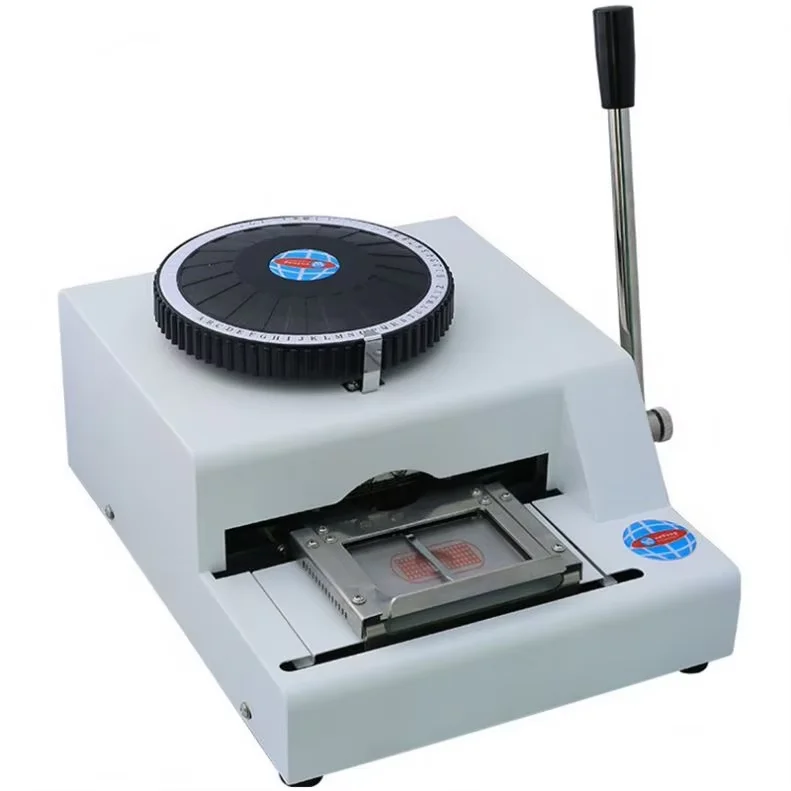
Source-controlled product identity
The Hoting queue record identifies a TEBAK manual plastic card making machine, PVC card embosser and code embossing machine. The structured record specifies an embossing card format of 85.6x54mm, also written as 3.375" x 2.125" and identified as a CR-80 card. It records 80 total characters, uppercase and lowercase English letter fields, uppercase and lowercase Arabic number fields, spacing gaps of 1/7 and 1/10, manual operation, machine size 340x300x180mm, net weight 9.8 kg, gross weight 10.6 kg, carton packing and carton size L400 x W350 x H260mm.
The source record does not provide embossing depth, character height, impression force, card thickness, positioning system, indexing method, repeatability, cycle time or material compatibility beyond the CR-80 listing. Those items are supplier confirmation points. The English-letter fields are reproduced as recorded: “Big: A~Z. Small: A~Z.” Confirm the actual character set and type size on the quotation and sample before ordering.
Product ID 1601607761557 should appear on the quotation, machine label, inspection sheet, packing list and spare-parts record. This guide is for access-card suppliers, membership-card printers, identification-card service providers, clubs, schools, hotels, offices, small personalization shops, security integrators and distributors evaluating a manually operated card embosser.
Confirmed fields and open RFQ questions
| Information | Recorded value or status | Buyer action |
|---|---|---|
| Product ID | 1601607761557 | Require the same ID on the quotation, inspection record, machine label and shipping documents. |
| Embossing card | 85.6x54mm (3.375" x 2.125"), CR-80 card | Confirm whether the dimension is the supported card size, the finished card size or the fixture reference. |
| Total characters | 80 | Request an itemized character inventory and confirm whether all 80 positions are supplied as standard. |
| English letters | Big: A~Z. Small: A~Z | Confirm the actual uppercase/lowercase dies, type size, font shape and replacement availability. |
| Arabic numbers | Big: 0~9. Small: 0~9 | Confirm the actual number dies, type size, font shape and whether duplicates are included. |
| Spacing gap | 1/7, 1/10 | Ask the supplier to define the unit, mechanism, selectable positions and repeatability of the spacing. |
| Operation mode | Manual | Confirm the handle sequence, loading procedure, force adjustment and operator safety controls. |
| Machine size | 340x300x180mm | Confirm whether these are overall unpacked dimensions and request operating clearance. |
| Net weight | 9.8 kg | Verify whether the value includes installed dies, tray, handle and standard accessories. |
| Gross weight | 10.6 kg | Confirm the packed shipping weight against the final carton and packing list. |
| Packing | Carton | Request carton material, internal protection, moisture protection and carton marks. |
| Carton size | L400 x W350 x H260mm | Use for logistics planning; do not treat it as the working footprint. |
Define the card personalization workflow
A manual card embosser is not selected only by the words “PVC card making machine.” The buyer must define the card material, finished dimensions, thickness, print or laminate condition, embossing location, character size, required spacing, sequence of characters and acceptance standard.
Prepare a sample pack containing blank CR-80 cards, the intended card material, any printed or laminated surfaces, and representative artwork. Mark the required character positions on a drawing. Include the most demanding layout, the closest-to-edge character, the longest text sequence and any repeated numbers that require duplicate dies.
For access cards, confirm whether the embossed area must avoid magnetic stripes, contact chips, contactless antenna zones, signature panels, holograms, printed photographs or lamination edges. For membership or loyalty cards, define the visual and tactile requirements separately. The source record does not confirm compatibility with any of these features.
For a service bureau, prioritize quick character selection, clear indexing and repeatable alignment. For an occasional user, prioritize simple loading, safe manual operation and a complete die set. For a distributor, quote the base machine and any extra character sets as separate line items so the 80-character field is not confused with the buyer's required inventory.
CR-80 card size and fixture verification
The recorded card field is 85.6x54mm with a CR-80 reference. Request a dimensioned drawing of the card bed, stops, guides, clamps and registration marks. Confirm the supported card thickness and the tolerance accepted by the fixture.
Measure the buyer's actual cards at several locations. Check length, width, squareness, thickness, corner radius, flatness and any laminate curl. A card that matches the nominal length and width may still sit differently if its thickness or corner radius differs.
Test the closest permitted character to each card edge and corner. Record the distance from the edge, the position repeatability, the risk of card movement and the amount of manual alignment required. Do not assume a CR-80 label proves that every CR-80 card construction will load identically.
Request the supplier's fixture cleaning and adjustment instructions. Dust, laminate fragments and adhesive residue can affect seating and alignment. Confirm whether wear parts or replacement guides are available.
Character inventory: 80 total characters
The source record states 80 total characters. It separately lists English letters and Arabic numbers in big and small forms. The record does not itemize the quantity of each die, the physical font size, font design, duplicate count or whether punctuation and symbols are included.
Request a complete die inventory with a photograph or drawing. The quotation should state each supplied uppercase letter, lowercase letter, number, symbol, duplicate and storage position. If the buyer needs a name, membership number, room number or card-code workflow, calculate the most frequently repeated characters and request sufficient duplicates.
Confirm how dies are loaded, removed, stored and identified. Ask whether the character set uses fixed blocks, individual dies, a removable tray or another arrangement. Confirm the tools required and whether the tool set is included.
Do not expand “A~Z” into unlisted punctuation or special characters. If the buyer needs hyphen, slash, period, ampersand, accented letters or a local-language character, ask for an explicit availability statement and quotation.
Uppercase and lowercase English letter fields
The queue field records “Big: A~Z. Small: A~Z” for English letters. Preserve that source wording for traceability but resolve the ambiguity: the buyer needs to know whether “Big” means uppercase die height, a large type size, a large case, or another catalog convention.
Request the actual uppercase and lowercase type dimensions in millimeters, character face shape, stroke geometry, relief direction and baseline relationship. Make a sample card using letters that include narrow, wide, curved and diagonal forms. Inspect legibility and consistency across the full alphabet.
If cards are read by people or photographed, define a minimum visual legibility requirement. If the embossing is used with a downstream scanning or verification process, test the actual recognition workflow. The source record does not establish OCR compatibility or a particular font standard.
Confirm replacement availability for worn or damaged letter dies. Ask whether uppercase and lowercase dies share a common holder and how their alignment is maintained.
Arabic number fields and code embossing
The source field records “Big: 0~9. Small: 0~9” for Arabic numbers. Confirm whether this means two number sizes and whether each size includes one die for every number or a different arrangement.
Prepare test sequences with repeated digits, zeros, adjacent digits and the longest code used by the buyer. Record the number of manual die changes, alignment time, spacing, impression quality and the risk of transposing characters.
For security or identification workflows, define who verifies the embossed code, how corrections are handled and how rejected cards are controlled. A manual embosser does not by itself establish data security, auditability or access control.
Ask whether the number dies can be ordered separately and whether duplicate 0, 1 or other high-frequency digits are available. Do not assume the 80-character total includes duplicates needed for a production run.
Spacing gap: 1/7 and 1/10
The recorded spacing gap values are 1/7 and 1/10, but the source does not define the unit or the mechanism. Request a clear explanation of what each ratio means, how it is selected and how its result is measured.
Ask for a spacing drawing showing the distance between adjacent character centers, the relationship to character width, and the baseline. Confirm whether 1/7 and 1/10 refer to character spacing, card indexing or a gear/rack setting.
Run two sample cards with the same character sequence at each setting. Measure center-to-center distance, line alignment, edge margin and repeatability. If the buyer needs several lines or a code in a fixed window, test line-to-line registration as well.
Do not convert the ratios into millimeters without supplier documentation. The final inspection sheet should record the selected spacing setting and the measured result in the buyer's approved units.
Manual operation and operator control
The operation mode is recorded as manual. Request a complete operating sequence: card loading, die selection, position setting, handle movement, impression release, card removal and die storage.
Ask for handle force, handle travel, adjustment method, mechanical stops and any pressure or depth control. These values are not in the source record and should not be inferred from the 9.8 kg net weight.
Observe an operator process the shortest and longest intended character sequences. Record cycle time, hand movement, die changes, alignment steps, fatigue and the risk of repeated impressions. If the buyer expects multiple operators, compare results between operators using the same sample cards.
Inspect the machine for pinch points around the handle, die block, card bed and guides. Request guards or safe-hand-position instructions where applicable. A manual mechanism still requires a documented risk assessment.
Embossing quality and acceptance testing
The source record does not provide embossing depth, relief height, impression force, card deformation limit or durability result. These values must be defined by sample testing. Agree the acceptance standard before the supplier prepares the factory sample.
Inspect the front and back of the card for clear relief, uniform character shape, complete impressions, cracks, whitening, delamination, card bending, surface scuffing and unintended marks. Photograph representative pass and fail examples.
Measure character height, width, spacing, baseline, edge margin and impression depth using the buyer's approved method. Repeat the test across all specified character types and both recorded spacing settings.
Test cards after any relevant handling, storage or lamination process. If the card is embossed after printing or before lamination, define the order and verify that the card construction remains acceptable. Do not claim durability, security or compliance without a test record.
Machine size, packing and logistics
The recorded machine size is 340x300x180mm. The recorded carton size is L400 x W350 x H260mm, with net weight 9.8 kg and gross weight 10.6 kg. Confirm that machine size means unpacked overall dimensions and identify the handle swing, card-loading side and maintenance access.
For freight planning, use the carton size and gross weight only after the supplier confirms the final packed configuration. Request carton construction, internal cushioning, moisture protection, shock protection, carton marks and the list of included dies and tools.
At receipt, photograph the carton before opening. Check the gross weight, carton damage, moisture, impact marks, model label and Product ID. After opening, verify the machine dimensions, card bed, handle, guides, die inventory, tools, manual and spare parts against the packing list.
Retain the carton until the incoming acceptance test is complete. If the machine will be moved between service counters or sites, ask whether a reusable case or additional protective packing is available.
Factory acceptance test proposal
- Verify Product ID 1601607761557, machine identity and manual operation mode.
- Verify the card fixture and demonstrate the recorded 85.6x54mm CR-80 card format.
- Measure supported card thickness, flatness, corner radius and loading tolerance.
- Inventory all 80 recorded characters and reconcile the supplier's itemized die list.
- Verify uppercase/lowercase English letter sets, type sizes, font shape and alignment.
- Verify uppercase/lowercase Arabic number sets, duplicate availability and storage labels.
- Explain and demonstrate spacing settings 1/7 and 1/10, including measured output.
- Run the buyer's longest text, repeated-character code and closest-to-edge layout.
- Measure character position, spacing, baseline, edge margin and impression quality.
- Record handle force, travel, adjustment, cycle time and operator steps.
- Check card movement, fixture stability, die alignment, pinch points and safe operation.
- Verify machine size 340x300x180mm, net/gross weight 9.8/10.6kg and carton dimensions.
- Verify manual, tools, die storage, replacement parts, warranty and package protection.
RFQ checklist
- Product ID 1601607761557 and exact machine revision.
- CR-80 card definition: supported thickness, flatness, corner radius and material.
- Card-bed drawing, stops, guides, clamps, registration reference and edge clearance.
- Complete 80-character inventory with uppercase/lowercase letters, numbers and symbols.
- Type dimensions, font drawings, relief geometry, die material and replacement codes.
- Meaning and measurement unit of spacing gap 1/7 and 1/10.
- Manual handle force, travel, adjustment method, stops, safety controls and cycle time.
- Embossing depth, impression force, card deformation limit and durability test method.
- Compatibility with printed cards, laminated cards, magnetic stripes, chips and antennas.
- Machine size 340x300x180mm, working clearance and maintenance access.
- Net/gross weight 9.8/10.6kg, carton L400 x W350 x H260mm and package protection.
- Inspection samples, pass/fail photos, acceptance tolerances and correction procedure.
- Manual language, tools, die storage, spare parts, warranty and after-sales support.
- Lead time, destination documents, packing marks and shipment insurance requirements.
Safety and compliance questions
A manual card embosser contains moving mechanical parts, a handle, die faces and pinch points. Request the operating manual, hazard labels, safe hand positions, maintenance procedure and cleaning instructions for the exact configuration.
Keep fingers away from the die area while the handle is moving. Secure the card and use the intended guides rather than holding the card close to the impression point. Stop the operation before changing dies or clearing a misaligned card.
Handle card dies carefully. Keep loose dies in a labeled container and prevent unauthorized changes to the character set where card personalization requires controlled work.
Do not claim CE, ISO, security certification, payment-card compliance or another certification unless the supplier provides current documents identifying the exact machine and intended application. A CR-80 size reference is not a security or regulatory approval.
Buyer decision framework
This candidate is a TEBAK manual PVC/CR-80 card embosser with a recorded 85.6x54mm card format, 80 total characters, uppercase/lowercase English letters and Arabic numbers, spacing settings 1/7 and 1/10, manual operation, 340x300x180mm machine size, 9.8/10.6kg net/gross weight and L400 x W350 x H260mm carton size.
Approve the unit only after the supplier confirms card thickness, die inventory, type dimensions, spacing definition, impression quality, positioning repeatability, operator force, compatibility with the buyer's card construction and the exact packed configuration. The most important open questions are the character set details, embossing depth, fixture accuracy and production workflow.
Frequently asked questions
What card size does this embosser support?
The source records 85.6x54mm, also identified as a CR-80 card. Confirm thickness, corner radius, flatness and fixture tolerance with the supplier.
Are 80 characters included?
The structured record states 80 total characters. Request an itemized inventory showing letters, numbers, duplicates, symbols and storage arrangement before purchase.
What do spacing gaps 1/7 and 1/10 mean?
The source records those values but does not define the unit or mechanism. Ask the supplier for a drawing, measurement method and sample output for both settings.
Can it emboss cards with chips or magnetic stripes?
Compatibility is not confirmed. Test the buyer's exact card construction and define safe embossing zones for stripes, chips, antennas, laminates and printed areas.
Is 340x300x180mm the required workbench space?
It is the recorded machine size. Request handle swing, card-loading access, die-changing space and maintenance clearance separately.
Source and contact
This guide is based on the Hoting queue record for Product ID 1601607761557. The recorded fields are CR-80 card size 85.6x54mm, 80 total characters, English letters, Arabic numbers, spacing 1/7 and 1/10, manual operation, 340x300x180mm machine size, 9.8/10.6kg net/gross weight, carton packing and L400 x W350 x H260mm carton size. Before purchase, request the current quotation, die inventory, fixture drawing, sample embossing, quality limits, operating manual, package details, spare-parts list, warranty and destination-market documents through the TEBAK sales inquiry channel.
Key specifications
- Embossing Card
- 85.6x54mm ( 3.375" x 2.125 "), CR-80 card
- Total characters
- 80
- English Letters
- Big: A~Z. Small: A~Z
- Arabic numbers
- Big: 0~9. Small: 0~9
- Spacing gap
- 1/7, 1/10
- Operation mode
- Manual
- Machine size
- 340x300x180mm
- Net weight
- 9.8 kg
- Gross weight
- 10.6 kg
- Packing
- Carton
- Carton size
- L400 x W350 x H260mm