
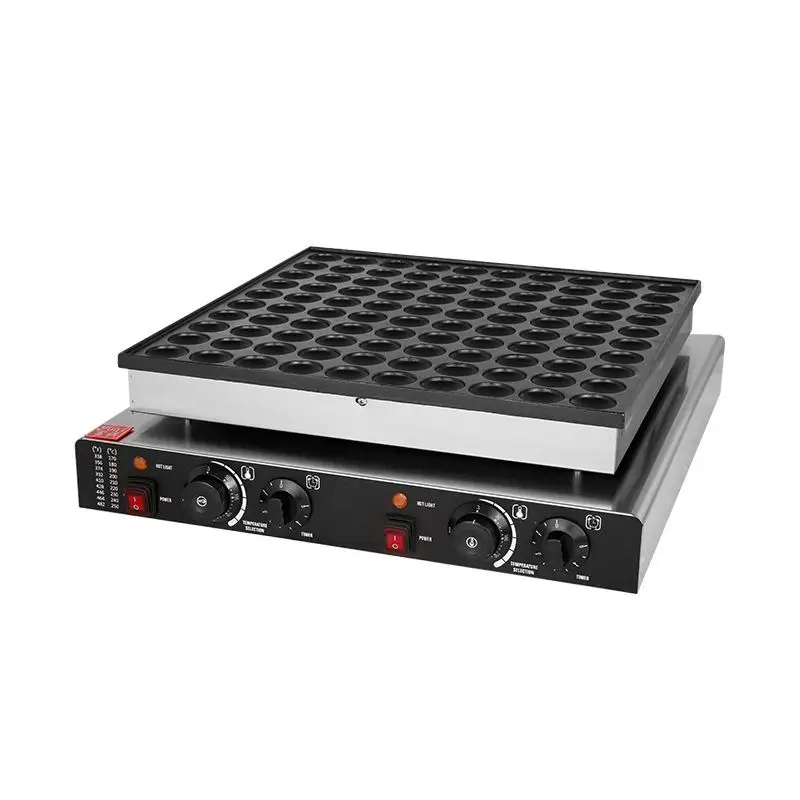
Source-controlled product identity
The Hoting queue identifies Product ID 1601276128224 as a 25-cavity electric mini pancake maker, model NP-542, listed under the title "25pcs Electric Dutch Poffertjes Waffle Machine Small Round-Shape Mini Dutch Pancake Machine".
Unlike most entries in this queue, this record carries a real specification block. The recorded description sets out the name, the model, the overall dimensions, the cavity size, the voltage and frequency, the power and the material, and the parameter block supplies the packing method and the delivery time. That gives a buyer enough to begin an evaluation, which is why the discrepancies and omissions below are worth resolving rather than reasons to set the product aside.
The recorded specification, in full
| Field | Value as recorded |
|---|---|
| Name | 25pcs electric mini pancake maker |
| Model | NP-542 |
| Dimension | 340x310x200mm |
| Waffle size | 45x45x10mm |
| Volts | 220v,50hz/110v,50hz |
| Power | 1.5kw |
| Material | stainless steel 201 |
| Packaging Details | Foam + paper carton (send by plane). Foam + paper carton + plywood crates ( send by ship) |
| Delivery Time | 15 working days after payment |
The cavity count of 25 is consistent with the recorded dimensions: a five by five grid of 45 mm cavities occupies about 225 mm by 225 mm, which fits inside a body of 340 mm by 310 mm with room for the frame and the handle. That internal consistency is a point in favour of the record, and it means the cavity count and the cavity size can be treated as stated pending confirmation rather than as unrelated claims.
Cavity shape: the title says round, the specification says 45x45x10mm
The title describes the machine as small round-shape, and the specification gives the cavity size as 45x45x10mm. A pair of equal figures in the form 45x45 reads as a square footprint, while round cavities are normally described by a diameter, or by a diameter and a depth.
This is not a cosmetic question. Poffertjes are traditionally round, and a round cavity produces a round cake with a domed profile, while a square cavity produces a square one. The two products serve different menus and different buyers, and a buyer who orders expecting round cavities and receives square ones has a product that is difficult to sell on as intended.
The record cannot settle which it is, and the buyer should not treat either the title or the specification as authoritative on its own. Ask the supplier for three things: whether the cavities are round or square, the diameter or the side length as the case may be, and the cavity depth. Ask for a photograph taken straight down at the open plate so that the cavity shape and the count can be seen rather than described, and ask for a photograph of a finished product in the cavity, which resolves both the shape and the cavity depth at once.
The depth figure of 10 mm deserves attention on its own. A 10 mm cavity filled level produces a thin cake. Ask whether the supplier intends 10 mm as the cavity depth and what batter volume the cavity holds, since a machine can only be evaluated for yield when the filled volume is known.
Material: stainless steel 201 and food contact
The recorded material is stainless steel 201. That is a specific grade rather than a general description, and on a machine whose surfaces are in contact with food it is the first item to resolve.
Stainless steel 201 is a lower-cost austenitic grade that uses manganese in place of part of the nickel found in the 300-series grades. Its corrosion resistance is lower than that of grade 304, particularly against chlorides and against acidic mixtures, and food batter is frequently either acidic or salted. Lower corrosion resistance shows up as discolouration, as pitting and, over time, as roughening of the surface that makes cleaning less effective.
Grade 201 is widely used in low-cost appliances and can be entirely serviceable where it is used for outer panels and where the surface is properly finished and dried after washing. The question a buyer should settle is therefore which parts are made of 201 and whether any part of the food-contact surface uses it. A body or a housing in 201 with a separate food-contact plate in a better grade is a different proposition from a machine whose cooking surfaces are also 201.
Ask the supplier which grade is used for each part, whether an alternative such as grade 304 or 316 is available and at what price difference, whether the plates are removable for cleaning, and what finish is applied to the food-contact surfaces. Ask also for the food-contact documentation the supplier holds, and confirm with the buyer's own market adviser which food-contact requirements apply to an appliance of this kind before ordering in volume.
Where the machine has a non-stick coating on the plates, the coating is a separate subject: ask what the coating is, how thick it is, whether it is applied to both the upper and the lower plate, how it is to be cleaned, and what the expected life of the coating is. A coating that is scoured off in the first month changes the machine's food-contact properties and its yield at the same time.
Voltage and frequency: the 110 V entry is stated at 50 Hz
The recorded voltage entry is 220v,50hz/110v,50hz. The two voltages correspond to different markets, which is normal for an appliance offered in several markets, but both are stated at 50 Hz, and a 110 V supply in the markets that use it is normally supplied at 60 Hz.
The record therefore contains either a typing convention that uses 50 Hz for both variants or an error in the 110 V entry. The buyer should have this stated explicitly rather than inferred, because the frequency affects the motor if the machine has one, affects any timing control that derives its clock from the mains, and affects the approvals the appliance can carry in the destination market.
Ask the supplier whether the 110 V version is rated for 50 Hz, for 60 Hz, or for both, and ask for the rated frequency to be printed on the nameplate of the version supplied. Ask also which of the two versions is the standard offering and which is made to order, since a made-to-order voltage often carries a longer lead time than the 15 working days recorded for the product as a whole.
Power: what 1.5 kW means at 110 V and at 220 V
The recorded power is 1.5 kW. Dividing that figure by the two recorded voltages gives the current the machine will draw on each supply: about 6.8 A at 220 V, and about 13.6 A at 110 V.
At 220 V that load sits comfortably within a normal domestic or light commercial circuit. At 110 V it does not. A standard 110 V branch circuit in the markets that use that voltage is commonly protected at 15 A or 20 A, and a machine drawing about 13.6 A steady-state is close enough to a 15 A limit that the buyer should establish the circuit requirement before installing it. On a shared circuit, a machine of this class can trip the protection when another appliance is running at the same time.
Ask the supplier for the rated current at each voltage as stated on the nameplate, the plug type fitted, the cord length and the cord cross-section, and whether the machine may be connected to a circuit shared with other equipment. Ask also whether the 1.5 kW figure applies to both voltage versions or only to one, since a manufacturer sometimes changes the heating element between versions, and whether the appliance has a thermostat that reduces the average draw once the plates are hot.
The power figure also determines warm-up. A machine of this power takes a certain time to bring 25 cavities of a stainless steel plate to cooking temperature, and the record does not state that time or the recovery time between batches. Both are asked for below, because they set the realistic output per hour that a buyer should use when comparing this machine with alternatives.
Dimensions, packing and what the record does not say about weight
The recorded dimension is 340x310x200mm. The record does not state which of those figures is width, which is depth and which is height, and it does not state whether the height includes the handle or the lid in the open position. The figure set is small enough that a buyer should treat it as the closed appliance without the handle, and ask the supplier to confirm the axis order and to state the height with the lid open, which determines the counter clearance needed above the machine.
The packing entry describes two methods: foam plus a paper carton for air freight, and foam plus a paper carton plus plywood crates for sea freight. That is a useful level of detail, and it shows that the supplier distinguishes the two shipping modes. What it does not give is the carton dimensions, the carton gross weight, the number of units per carton, the crate dimensions, or the crate gross weight.
The record states no net weight for the machine. Ask for it, together with the carton and crate figures, and note that the packing method changes the landed cost rather than only the transit risk: a plywood crate is a different freight classification and a different handling cost from a carton, and it usually means the machine is shipped as a single unit rather than as multiple units per pallet. Ask the supplier which packing method applies to the quantity the buyer intends to order, since the two methods may have different minimum quantities.
The recorded delivery time is 15 working days after payment. Ask whether that clock starts from payment alone or from confirmed order details such as the voltage version and any label or artwork, whether it applies to sample orders of one unit as well as to bulk, and what the lead time is for a spare part such as a thermostat, a heating element or a set of plates.
What a buyer should request before ordering
- Cavity count, cavity shape, cavity diameter or side length, and cavity depth, with a photograph taken straight down at the open plate.
- Batter volume per cavity when filled level, and the expected number of pieces per batch.
- Which stainless steel grade is used for the housing and which for the food-contact plates.
- Whether food-contact surfaces carry a non-stick coating, what the coating is, and how it is to be cleaned.
- Whether the plates are removable, whether replacement plates are available, and their price.
- Whether the 110 V version is rated for 50 Hz or 60 Hz, and the frequency printed on the nameplate.
- Rated current at each voltage, plug type, cord length and cord cross-section.
- Thermostat type and temperature range, whether the setpoint is adjustable, and whether there is a timer or an audible ready signal.
- Whether both the upper and the lower plate are heated, and the heating element power in each.
- Warm-up time to working temperature and recovery time between consecutive batches.
- Whether the machine has an indicator for power, for warm-up completion and for over-temperature.
- Net weight, and the weight with the lid open for counter clearance.
- Carton dimensions, gross weight and units per carton for air freight; crate dimensions, gross weight and unit per crate for sea freight.
- Surface finish and whether the appliance is intended for continuous commercial use or for intermittent domestic use, with a stated duty cycle.
- Certification or declaration held for the appliance for the buyer's market, including electrical safety and food-contact documentation.
- Cleaning instructions and whether any part is dishwasher safe.
- Spare parts list with prices and lead times, including the thermostat, the heating element, the plates and the power cord.
- Warranty period and coverage, and how a warranty claim is handled across borders.
- MOQ, unit price at the target quantity, sample terms and price, and packing method by quantity.
- Delivery time measured from payment or from order confirmation, and lead time for spare parts.
Acceptance and incoming inspection
Because the record supplies a real specification, the delivered machine can be checked against a written baseline rather than assessed on impression, and that is the main advantage of buying a specified product.
On arrival, check the model number against the order, confirm the nameplate voltage and frequency against the version ordered, and inspect the body and the plates for damage in transit. Measure the overall dimensions and confirm the axis order the supplier stated, and open the lid to check the counter clearance the machine needs in the buyer's own kitchen layout.
Then test the machine in cooking conditions rather than only switching it on. Measure the time from cold to working temperature, and compare it with the figure the supplier quoted. Fill the cavities and cook a batch, timing it, and then cook a second and a third batch back to back to measure how the recovery time between batches affects output. That sequence gives the real pieces-per-hour figure, which is what a buyer needs in order to compare this machine with alternatives and to plan a menu.
Check the cooked result for evenness across all 25 cavities, since uneven heating between the centre and the edges of a plate is the most common defect on machines of this size and it can only be found by cooking. Inspect the plate surface after cooking and cleaning for discolouration, for scratching and for any sign that the coating is thin in places.
Finally, verify the drawing current if the buyer has the means, or at least confirm that the machine runs without tripping the circuit it will be used on, and record the warm-up time, the batch time, the recovery time and the evenness result. Those four figures, measured on the buyer's own supply, are a far better basis for the next purchase than any statement in a listing.
A note on the supplier profile in the record
The company description in this record states that the supplier deals in product machines, CNC carbide inserts, turning tools and milling tools under its own brand. A snack appliance such as a 25-cavity pancake maker does not sit inside that range.
A wide product range is common among trading companies and is not by itself a reason to decline a supplier. It does mean that the buyer should treat the specification as coming from a trading business rather than directly from the factory that builds the appliance, and should therefore ask directly which factory makes the machine, whether the supplier holds the factory's technical documentation and spare parts, and how a warranty claim would be handled if the factory is a third party. Where the answer is that the supplier assembles and supports the appliance itself, the range question disappears; where the answer is that the supplier simply resells, the buyer should confirm the support path before ordering in volume.
Buyer decision framework
The source for this guide is a record that carries a genuine specification block: a model, overall dimensions, a cavity size, a voltage and frequency pair, a power figure and a material grade, together with a packing description and a delivery time. That is more than most records in this queue provide, and it means the product can be evaluated rather than merely described.
The first decision concerns the cavity. Round and square cavities produce different products, and the record states a pair of equal figures that reads as square while the title says round. A buyer whose menu depends on traditional round poffertjes should have the cavity shape confirmed in writing and by photograph before ordering, because the wrong cavity shape is not a defect that can be corrected after delivery.
The second decision concerns the voltage and the circuit. If the target market is a 110 V market, the recorded 50 Hz entry, the roughly 13.6 A current drawn at 110 V and the plug and circuit requirements all need answers before a machine is installed, and the buyer should confirm that the intended location has a circuit that can carry the appliance.
The third decision concerns the material and the food-contact documentation. Grade 201 is a workable material in the right places but is not equivalent to grade 304 on a cooking surface, and the buyer should establish which parts use which grade and what documentation the supplier holds before committing to a volume order.
Where the supplier answers the cavity shape, the frequency and current for the 110 V version, the material by part, the warm-up and recovery times and the food-contact documentation, the machine can be compared with alternatives on the same basis and a single unit for trial is a reasonable next step. Where the answers are limited to the recorded block, the buyer still knows the model, the size, the power and the material, which is enough to order a sample for trial but not enough to place a volume order against a menu.
Frequently asked questions
Are the cavities round or square?
The title says small round-shape and the specification gives 45x45x10mm, which reads as square. Ask the supplier for the cavity shape, the diameter or side length, and a photograph taken straight down at the open plate.
Is stainless steel 201 acceptable for a food appliance?
Grade 201 is a lower-cost grade with lower corrosion resistance than grade 304, particularly against chlorides and acidic mixtures. Ask which parts use 201, whether a 304 or 316 option exists, and what food-contact documentation the supplier holds, then confirm the requirements for the buyer's own market.
Will the 110 V version work in a 60 Hz market?
The record states 110v,50hz, which is not the frequency used in markets that supply 110 V. This is the specific question to put to the supplier: whether the 110 V version is rated for 50 Hz, 60 Hz or both, and what the nameplate states.
How much current does the machine draw?
At the recorded 1.5 kW, about 6.8 A at 220 V and about 13.6 A at 110 V. The 110 V figure is high enough that the circuit and the plug must be checked before installation, particularly on a shared circuit.
How many pieces per hour can it produce?
Not stated. The record gives the cavity count and the cavity size but no warm-up time, no batch time and no recovery time. Ask for those three figures, then time them on the delivered machine, since the real output depends on the buyer's batter and the buyer's supply voltage.
What is the weight of the machine?
Not recorded. Ask for the net weight, the carton dimensions and gross weight for air freight, and the crate dimensions and gross weight for sea freight.
Can the plates be replaced?
Not stated. Ask whether the plates are removable, whether replacements are available, and at what price and lead time, since the plates are the part that wears.
What is included with the machine?
Not stated beyond the machine and its packing. Ask whether a stand, a drip tray, a batter dispenser, a cleaning tool or spare parts are included, and whether any of them are options at extra cost.
Source and contact
This guide is based on the Hoting queue record for Product ID 1601276128224. The recorded specification is reproduced above in full and without alteration: the name 25pcs electric mini pancake maker, the model NP-542, the dimension 340x310x200mm, the cavity entry 45x45x10mm, the voltage entry 220v,50hz/110v,50hz, the power 1.5kw, the material stainless steel 201, the two packing methods and the 15 working day delivery time. The cavity shape and the 110 V frequency are presented as points to confirm rather than as settled facts, and no yield, certification or compliance claim is made for this product in this article, because the record contains none.
Request the cavity shape and cavity photograph, the cavity volume, the grade used for each part, the rated frequency and current of the 110 V version, the plug and cord details, the thermostat range, the warm-up and recovery times, the net weight and packing figures, the spare parts list and the documentation held for the buyer's market through the TEBAK sales inquiry channel before placing a volume order.
Key specifications
- Packaging Details
- Foam + paper carton (send by plane). Foam + paper carton + plywood crates ( send by ship)
- Delivery Time
- 15 working days after payment