
Two machines in the title, seven parameters, and all seven belong to one of them
Product ID 1601252307652 is a bundle. Its title names two machines joined by the word and: a five-in-one digital heat press transfer machine, and a thirty-four inch vinyl cutting plotter machine with Artcut software. Its parameter block carries seven rows. Every one of the seven describes the press: its temperature range, its timer, an adjustable height, a wattage, a power input, a cord length and an overall dimension. Not one row describes the cutter.
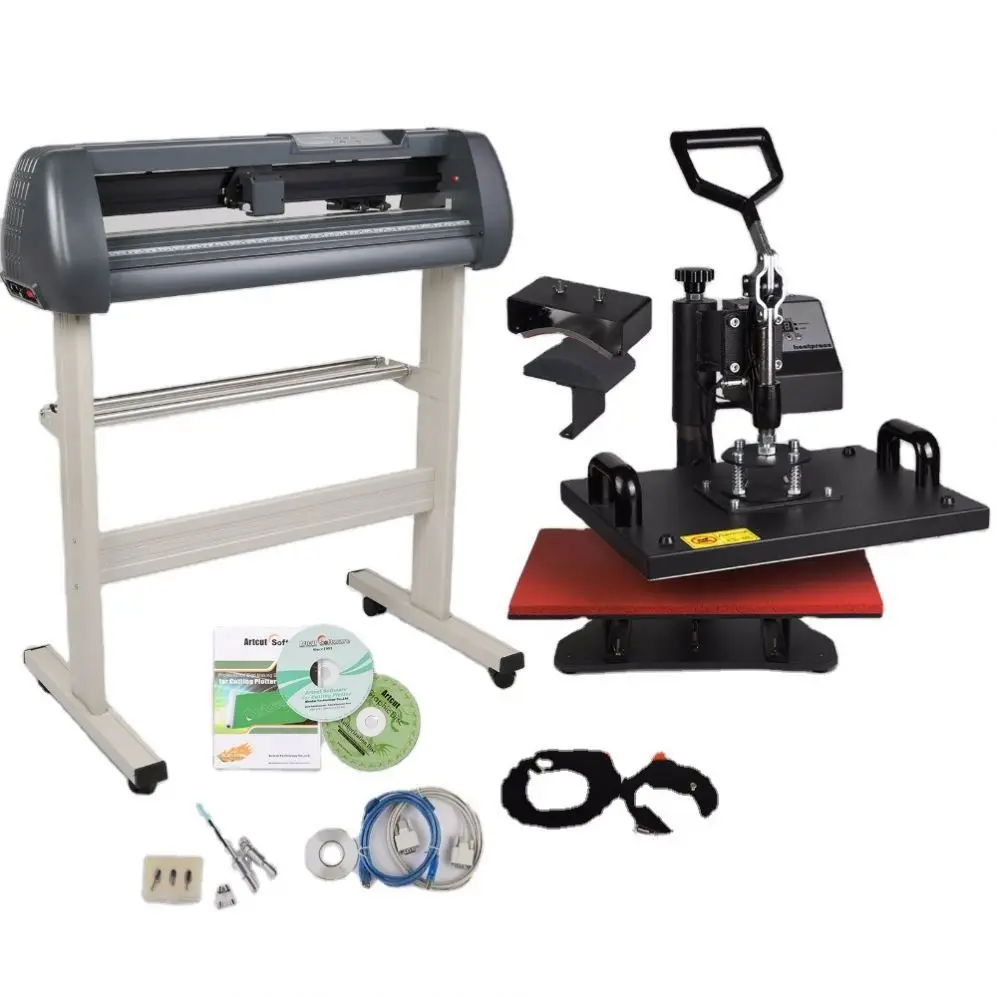
That is the central defect of this record, and it is worth stating exactly what it costs a buyer. The cutter in this bundle is a floor-standing machine on a wheeled stand, which is what the first picture shows. For that machine the record gives no cutting width, no cutting force, no cutting speed, no resolution, no number of pinch rollers, no list of media it will cut, no blade types, no interface and no weight. A buyer pricing this bundle is therefore pricing one specified machine and one unspecified one, and cannot tell from the listing whether the cutter is a light sign-making unit that will handle self-adhesive vinyl and nothing else, or a heavier machine that will handle sandblast stencil and thick film. Those two possibilities differ in price, in power, in the stand they are mounted on and in what they will cut, and the record chooses between them nowhere.
Even the nominal size needs a question attached. The title calls the cutter thirty-four inch, which is eight hundred and sixty-three point six millimetres, and the record never says whether that figure is the width of media the machine will feed or the width it will actually cut. On wide machines those two numbers are not the same, and the difference is the difference between a job fitting and a job being trimmed in two passes. Ask which dimension the thirty-four refers to, and ask for the maximum cutting width and the maximum media width separately.
The only record in the catalogue that names any of this, which cuts both ways
Scanning all five hundred and twelve records for the vocabulary of this product produces a striking result. Exactly one record contains the phrase heat press, and it is this one. Exactly one contains the word vinyl. Exactly one contains the word plotter, exactly one contains the phrase cutting plotter, and exactly one contains the word Artcut. Every one of those single hits is this record.
The consequence is that this bundle has no sibling in the catalogue. That is a change from the pattern of the last several items, where the same machine appeared two or more times and the listings could be read against each other: a duplicate listing is a nuisance, but it is also a second source of figures, and where two listings of one machine disagree the disagreement itself is information. Here there is nothing to cross-read. Whatever is missing from this record cannot be recovered from anywhere else in the supplier's catalogue, and a buyer who needs the cutter's specifications has to ask for them rather than search for them.
The single exception is the second half of the gallery. Two of this record's eight pictures are not of the product at all. The seventh is the supplier's factory gate with the company's name on the wall, and the eighth is a payment and courier panel. Those two files are used by seventy-eight and a hundred and thirty-two records respectively, which makes them supplier-wide furniture rather than part of this product's specification. The gate photograph is the same file, at a hundred and forty-eight thousand six hundred and thirty-seven bytes, that has appeared in this series of guides before, and the payment panel is the same file, at a hundred and ninety-two thousand six hundred and forty-six bytes, that appeared in the previous item and in earlier ones; both counts and both sizes are unchanged, which is the shape of a stable feed. The six remaining pictures are used by this record and by no other, which is worth noting because it is the opposite of the previous item, whose eight pictures were all shared.
The temperature range is stated twice and the two statements disagree
The first parameter gives the temperature range as thirty-two to four hundred and thirty degrees Fahrenheit, with the Celsius equivalent in brackets as zero to two hundred and fifty. The low end is exact: thirty-two degrees Fahrenheit is zero Celsius, to the decimal. The high end is not. Converting the record's own Fahrenheit figure gives four hundred and thirty minus thirty-two, times five ninths, which is two hundred and twenty-one point one degrees Celsius, not two hundred and fifty. Converting the record's own Celsius figure gives two hundred and fifty times nine fifths, plus thirty-two, which is four hundred and eighty-two degrees Fahrenheit, not four hundred and thirty. The two halves of one parameter differ by twenty-eight point nine degrees Celsius, or fifty-two degrees Fahrenheit, and they cannot both be right.
This matters more than a typographical slip usually would, for three reasons. The first is that it is the only temperature figure in the record, so a buyer has nothing to check it against. The second is that heat transfer work is done in a window, and the difference between two hundred and twenty-one and two hundred and fifty degrees Celsius is the difference between two different materials' working ranges: a press whose true ceiling is two hundred and twenty-one degrees may not reach the settings a buyer's own material data sheet calls for. The third is that heat presses are among the machines where a stated ceiling is treated as a working figure, so a buyer who plans to run near the top of the range is planning to run at a temperature the record has not decided upon.
It is also worth noting why this particular check is unusual here. Of five hundred and twelve records, this is the only one that states a temperature in both scales. Everywhere else in this catalogue a buyer cannot perform this check at all, because only one scale is given. So the contradiction is not a sign that this record is unusually bad; it is a sign that the catalogue's other records have simply made the same kind of error somewhere it cannot be seen. The question to put is simple: which of the two figures is the machine's actual maximum, what is the real range in each scale, and what is the accuracy and the recovery behaviour at the top of the range.
Temperature and time are given, pressure is not, and pressure is the third variable
A heat transfer is made by applying three things at once: a temperature, for a time, at a pressure. The record gives the first two and is silent on the third. Its timer runs from zero to nine hundred and ninety-nine seconds, which is ample for any transfer work, and its temperature range is stated in two scales that disagree. There is no pressure figure at all: no kilograms, no pounds, no bars, no statement of whether the pressure is set by a knob and read on a dial or simply applied by pulling a handle to a stop.
The photographs make the omission conspicuous rather than subtle, because the press in the third and fourth pictures clearly carries a pressure adjustment knob on the column above the platen, and the second picture shows the platen assembly with its four springs and its centre screw, which is the mechanism that sets how hard the platen presses. So the machine has a pressure adjustment, the record does not describe it, and a buyer cannot tell what range it covers or how repeatably a setting can be returned to.
Why that matters is that pressure is the variable most often got wrong on a manual press and the one that decides whether a transfer adheres evenly across a large area. A press that is set by feel produces a transfer that looks right at the middle of the platen and fails at the corners, and the failure appears after washing rather than before. The questions to send are: what pressure range does the adjustment cover and in what units; is the setting indicated, on a dial or a scale, or is it set by feel; is the platen's pressure uniform across its area; what does the supplier recommend for a standard garment transfer; and does the machine have a pressure gauge that can be read by an operator rather than by a technician.
What the five parts of the five-in-one are, and why the record cannot say
The title calls the press five in one, and the description begins to explain what that means. It runs through the materials the press can work with, lists garments and substrates, mentions sublimating and dissolved printing ink, and then reaches the sentence that was going to name the parts. The description stops there. It ends at eight hundred characters, in the middle of the phrase this all-in-one press includes flat pl, and the list of the five is never completed.
That is not an inference; it is where the field ends. The record's description is exactly eight hundred characters long and the truncation falls immediately after the first two attachments, which means the buyer is told that a flat platen is included and is told nothing else. The pictures fill in part of the gap: the first picture shows the press with a flat platen and, beside it, a black pressing attachment shaped for caps, and the fifth and sixth pictures show a separate cylindrical attachment with a heated pad inside, which is a mug press, mounted in its own frame with a lever and a rack. So three of the five are visible and two are not identified anywhere.
The mug attachment raises a question of its own, because a mug press only presses the mugs it fits. Its bore and the range of mug diameters and heights it will accept are stated nowhere, and a buyer whose product range is in a different size will find that one fifth of what they paid for does not do their job. The cap attachment raises the same question in a different form: cap presses are shaped, and the shapes differ between cap styles. So the questions are: what are the five attachments, with a written list; what diameter and height range does the mug attachment accept; what cap styles does the cap attachment fit; is the plate attachment included; and what does each additional attachment cost on its own.
Power, plugs, and a circuit a buyer should check before ordering
The wattage is given as fourteen hundred, and the power input as a hundred and ten volts or two hundred and twenty, with no frequency, no plug type and no rated current. The missing current is easy to work out and worth working out, because it is the figure that decides whether the machine can be run where the buyer intends to run it. Fourteen hundred watts divided by a hundred and ten volts is twelve point seven three amps; divided by two hundred and twenty volts it is six point three six amps.
Both of those are fine on a dedicated circuit and both are worth pausing over on a shared one. A heat press is not a device that draws its power for a moment; it draws it for the length of every press cycle and then again for the next one, with the element reheating between them, which makes it a continuous load rather than a momentary one. Continuous loads have to be planned against a circuit's continuous rating rather than its peak rating, and at twelve point seven amps the press is close to the usual continuous allowance of a fifteen ampere hundred-and-twenty volt circuit. A buyer planning to run the press, an iron, a cutter and lighting from one bench supply should establish the circuit's capacity before ordering rather than after the first nuisance trip. The same consideration applies to the cutter, whose consumption the record does not give at all.
The record does give the cord length as four and a half feet, which is one point three seven two metres, and that is a usefully specific figure. It means the machine has to stand within about a metre and a half of an outlet, extension leads permitting, which is the kind of constraint that decides a workshop layout. The question to add to the list is the plug type supplied with each voltage, because a hundred and ten volt machine and a two hundred and twenty volt machine do not share one, and a buyer who orders the wrong one gets a machine that has to be rewired or adapted before it can be tested, which puts the inspection outside the window in which a fault is easy to claim.
Geometry, and the number seventeen appearing twice
The record's one dimension is given with the qualifier with platen press, and it reads fifteen and a quarter inches long by fifteen inches wide by seventeen inches high, which is three hundred and eighty-seven point three by three hundred and eighty-one by four hundred and thirty-one point eight millimetres. Separately, the adjustable height is given as thirteen and a half inches to seventeen inches, which is three hundred and forty-two point nine to four hundred and thirty-one point eight millimetres, an adjustment travel of eighty-nine millimetres.
The same number, seventeen inches, appears at the top of the height adjustment and as the machine's overall height, and the record does not say whether they are the same dimension or two different ones. If they are the same, the machine's total height and the top of its adjustment coincide, which would mean the seventeen inch overall figure is measured with the press raised rather than closed, and the machine's actual footprint on a bench is smaller than a buyer would assume. If they are different, the coincidence is harmless. It is a small point, but it is the kind of small point that decides whether the press fits under a shelf, and it costs one question to resolve.
The other thing the dimension does not settle is the platen's own size. The label reads dimension, and the qualifier with platen press says which configuration is being measured, not what the platen measures. A press's productive area is the platen, and the difference between a fifteen inch platen and a smaller one is whether a large transfer can be done in a single press. Ask for the platen's length and width in millimetres, and for the same figures for each of the other attachments.
The bundle is photographed and enumerated nowhere
The first picture is a packing shot, and it is informative in a way the text is not. It shows the cutter on its stand, the press, a cap attachment, the mug press, a boxed software package with a disc, a second disc, a bundle of cables including what appear to be both a flat data cable and a round serial connector, a small box holding blades, a pen-shaped tool, and a roll of what looks like transfer tape or a film sample.
Two things follow. The first is that the machine's interface is visible before it is specified: the presence of a round serial connector alongside a flat data cable suggests the cutter can be driven over either, and a serial port is a real constraint on a modern laptop, which mostly no longer has one. Whether the machine is supplied with both, which the driver supports, and whether an adapter is needed are questions the record does not answer. The second is that none of this appears in writing anywhere in the record. There is no packing list, so a buyer cannot check on arrival that what arrived is what was photographed, and cannot price the bundle against a competitor's bundle by comparing contents.
The software deserves its own line, because it is named in the title as though it were a feature. The title says the bundle comes with Artcut software. The record gives no version, no statement of which operating systems it runs on, no licence terms and no statement of whether a driver for the cutter is included. Cutting software is the part of a cutter purchase that most often turns into a support problem, because it has to talk to the machine's own interface, and the version has to match the operating system in use. Ask for the version, the supported operating systems, whether the licence is perpetual or tied to one machine, whether the driver is supplied on the disc or must be obtained, and whether the supplier can confirm that the software communicates with the cutter under the buyer's own operating system before the order is placed.
What the record does not state at all
- Every specification of the cutter: cutting width, media width, cutting force, cutting speed, resolution, pinch rollers, media types, blade types, interface, weight and dimensions.
- Whether the thirty-four inch figure is a media width or a cutting width.
- Any power figure for the cutter, and therefore any figure for the bundle's total load.
- The frequency, the plug type and the rated current for either voltage.
- The pressure range of the press, the units it is set in and whether it is indicated or set by feel.
- Which of the two stated temperature scales is the machine's actual range, and the accuracy and recovery at the top of it.
- The platen's own dimensions, and the dimensions and working areas of the other attachments.
- The list of the five attachments, and the diameter and height range of the mug attachment.
- Whether the timer's steps are one second and whether it has an audible signal or any automatic release.
- Warm-up time, recovery time and the temperature stability across the platen.
- The cutter's software: version, supported operating systems, licence terms and whether a driver is included.
- Whether both interfaces shown in the picture are supplied, and what is needed for a computer without a serial port.
- The bundle's packing list, number of cartons, case dimensions, gross weight and volumetric weight for the floor-standing machine.
- Blade and consumable part numbers, prices and availability.
- Country of origin, warranty period and scope, spare parts, and who services the machines.
- Any certification or test report for either machine in the destination market.
- Minimum order quantity, price breaks, delivery term, port pair, production lead time and transit time.
Incoming inspection when the bundle arrives
- Unpack and inventory against the first picture before discarding any packing, since the record supplies no packing list and the picture is the only statement of contents that exists.
- Read the nameplate on both machines and record the rated voltage, frequency, wattage and current, comparing each with the quotation and with the record's fourteen hundred watts and two voltages.
- Check the plug fitted to each machine against the sockets in the workshop before the first power-up, and confirm the cutter's plug as well as the press's, since the record gives no plug type for either.
- Measure the supply circuit's capacity and confirm it can carry the press as a continuous load at the voltage supplied, working from the measured current rather than the nameplate alone.
- Measure the cord length against the stated four and a half feet, and place the machines within reach of an outlet without an extension lead in the first instance.
- Confirm which of the two stated temperature scales the controller displays, and set a known point on both scales to establish the discrepancy rather than assuming the higher figure.
- Check the controller against an independent thermometer at two or three settings across the range, and record the deviation at the top of the range, since the two stated scales disagree there.
- Time the warm-up from cold to the working temperature, and time the recovery after a full press cycle, because neither figure is stated.
- Find the pressure adjustment, establish its range and units, and check that a setting can be returned to after being changed, since the record describes no pressure control at all.
- Press a test transfer across the full platen, not only at the centre, and check the result at the corners for even adhesion.
- Fit each attachment in turn, including the mug press and the cap press, and establish what each will accept in size before committing production work to it.
- Measure the platen and each attachment's working area, since the record gives only an overall dimension with a qualifier.
- Assemble the cutter's stand, check that it is square and that the casters all bear, and measure the machine's height with the stand fitted, since the record gives no cutter dimensions at all.
- Load a roll of the buyer's own media and measure the maximum width that will feed and the maximum width that will cut, comparing both with the thirty-four inch figure in the title.
- Test the cutter's cut depth on the buyer's own media at a range of force settings, and record the setting that cuts the film without cutting the backing.
- Cut a test design with fine detail and a test design with large lettering, and check both for tracking, for drift over the length of the roll and for the accuracy of a repeated cut.
- Install the software and confirm that it recognises the machine over the interface supplied, testing the driver before the trial period expires rather than after.
- Confirm whether the second interface shown in the picture is usable and what is needed to connect it.
- Check the blade holder, the blades supplied and the cut strip for damage, and confirm part numbers against the supplier's list.
- Record the whole inspection with photographs and measurements, because the record's own documentation is thin and the buyer's file will be the only complete specification that exists.
What the catalogue says, counted
The counts below come from scanning all five hundred and twelve records, and they are this guide's own measurements of the feed rather than supplier statements, with the search strings named so that the same counts can be reproduced.
| Observation | Records | Share |
|---|---|---|
| Records containing the phrase heat press, this record the only one | 1 | 0.2% |
| Records containing the word vinyl, this record the only one | 1 | 0.2% |
| Records containing the word plotter, this record the only one | 1 | 0.2% |
| Records containing the phrase cutting plotter, this record the only one | 1 | 0.2% |
| Records containing the word Artcut, this record the only one | 1 | 0.2% |
| Records containing the word cutter, which in this catalogue otherwise means pipe and tube cutters | 34 | 6.6% |
| Records stating a temperature in both Fahrenheit and Celsius, this being the only one and therefore the only one where the two can be compared | 1 | 0.2% |
| Records whose parameter values contain an unescaped HTML entity such as the degree and inch marks in this record's own values | 59 | 11.5% |
| Records all of whose gallery images are used by no other record, which this record is not: six of its eight are unique and two are shared | 101 | 19.7% |
| Records sharing the factory gate photograph that is this record's seventh image | 78 | 15.2% |
| Records sharing the payment and courier panel that is this record's eighth image | 132 | 25.8% |
| Records whose description the supplier's company-name sentence appears in | 384 | 75.0% |
| Records referring to the ISO 9001 standard in that paragraph | 136 | 26.6% |
| Records containing the string OED&ODM, the misspelling used here and elsewhere | 329 | 64.3% |
| Records containing the string this filed, the misspelling used here and elsewhere | 319 | 62.3% |
| Records containing the phrase 70% for expert, as used here | 265 | 51.8% |
Four rows carry the argument of this guide. The first is the run of five rows each reading one record. A bundle whose every distinctive word appears exactly once in a catalogue of five hundred and twelve is a product with no siblings, which means the usual cross-reading between two listings of one machine is not available and every missing figure has to be asked for. The second is the temperature row: one record in the catalogue states a temperature in both scales, and that one record turns out to state the two scales inconsistently, which says something about the rest of the catalogue rather than only about this record, since everywhere else the error would be invisible. The third is the row counting the fifty-nine records with unescaped HTML entities inside parameter values, which is a small but reliable sign of how these listings are assembled: text is pasted from a document and the escapes survive into the field. The fourth is the pair of shared-panel rows, whose counts of seventy-eight and a hundred and thirty-two and whose file sizes of a hundred and forty-eight thousand six hundred and thirty-seven and a hundred and ninety-two thousand six hundred and forty-six bytes are identical to previous rounds' measurements of the same two files.
The house-style counts are unchanged once more: the company-name sentence in three quarters of the catalogue, the ISO 9001 reference in just over a quarter, the misspelled abbreviation in about two thirds, the phrase this filed in about five eighths and the claim that seventy per cent of products are for experts in about half.
The specification to send before ordering
| Item | What to require in writing |
|---|---|
| Bundle contents | A written packing list naming every item in the picture, the software, the cables, the blades, the holder and each attachment, with the quantity of each. |
| Press temperature | The actual maximum temperature and the actual range, in both scales, resolving the difference between the stated four hundred and thirty Fahrenheit and the stated two hundred and fifty Celsius, together with the accuracy and the stability across the platen. |
| Press pressure | The pressure range, the units, whether it is indicated on a scale or set by feel, the recommended setting for a standard garment transfer, and how uniform the pressure is across the platen. |
| Press timing | The timer's step in seconds, its accuracy, whether it sounds a signal and whether it releases automatically. |
| Attachments | The list of the five, the platen's dimensions in millimetres, the mug attachment's accepted diameter and height, the cap attachment's accepted styles, and the price of each attachment separately. |
| Cutter capacity | The maximum media width and the maximum cutting width stated separately, and confirmation of what the thirty-four inch figure refers to. |
| Cutter performance | Maximum cutting force in grams, maximum speed, mechanical resolution, number of pinch rollers, and the media thickness and types the machine is rated for. |
| Cutter geometry | The machine's own dimensions and weight with and without the stand, and the stand's dimensions. |
| Interface and software | Which interfaces are supplied, the software's version, the operating systems it supports, the licence terms, whether a driver is included, and written confirmation that it communicates with the cutter under the buyer's own operating system. |
| Electrical | Frequency, rated current, plug type for each voltage, and the cutter's own consumption so that the bundle's total load is known. |
| Blades and consumables | Blade and holder part numbers, quantities supplied, prices for replacements and availability. |
| Packing and freight | The number of cartons, each carton's dimensions and gross weight, the total gross weight, and the volumetric weight used for the quotation. |
| Inspection | A test of both machines before shipment, with a transfer pressed and a design cut, and the results recorded. |
| Documents | Manuals in a language the operators read, a parts list with prices, and any certification or test report held for the destination market. |
| Commercial | Unit price for the bundle and for each machine separately, price breaks, minimum order, delivery term and port pair, production lead time, transit time, warranty period and scope, and who services the machines. |
Frequently asked questions
Which machine do the parameters describe?
All seven describe the heat press: its temperature range, timer, adjustable height, wattage, power input, cord length and overall dimension. None describes the cutting plotter, although the title names the plotter as half the bundle. The cutter appears only in the pictures, as a floor-standing machine on a wheeled stand. Ask for its cutting width, media width, cutting force, speed, resolution, interface and weight before comparing this bundle with another.
Is the temperature range fifty degrees Celsius or something else?
The first parameter states thirty-two to four hundred and thirty Fahrenheit with the Celsius equivalent as zero to two hundred and fifty. The bottom ends agree exactly, since thirty-two Fahrenheit is zero Celsius. The top ends do not. The stated four hundred and thirty Fahrenheit converts to two hundred and twenty-one point one Celsius, and the stated two hundred and fifty Celsius converts to four hundred and eighty-two Fahrenheit, so the two halves of one parameter differ by twenty-eight point nine degrees Celsius, or fifty-two degrees Fahrenheit. This is the only record in the catalogue that states both scales, so it is also the only place where the two statements can be compared. Ask which figure is the machine's actual maximum.
Why does the pressure figure matter if the machine is manual?
Because a heat transfer is made by applying temperature, time and pressure together, and the record gives two of the three. The press in the pictures visibly has a pressure adjustment knob on the column and a sprung platen assembly, so the machine has the control; the listing simply does not describe it. Without a stated range and units, a buyer cannot tell what the press can be set to, cannot return to a setting after changing it, and cannot compare this machine with another. Uniform pressure across the platen is what decides whether a large transfer adheres at the corners or fails there after the first wash.
What are the five parts of the five-in-one?
The record does not say. Its description is exactly eight hundred characters and it stops in the middle of the sentence that lists them, immediately after the words flat pl, so the flat platen is named and the rest are not. The pictures show two more: a cap attachment and a separate cylindrical mug press in its own frame. The fourth and fifth are not identified anywhere in the record. Ask for the written list, and for the mug attachment's accepted diameter and height range, because an attachment that does not fit the buyer's product is a fifth of the purchase doing nothing.
Does the cutter cut thirty-four inches?
The title calls it a thirty-four inch vinyl cutting plotter, which is eight hundred and sixty-three point six millimetres, and the record never says whether that is the media width it will feed or the width it will actually cut. On wide machines those two figures differ, and the difference decides whether a job is done in one pass. Ask for the maximum media width and the maximum cutting width separately, and for the maximum cutting force, speed and resolution, none of which the record gives.
What about the software?
The title names Artcut as included, and the first picture shows a box and discs. The record gives no version, no list of operating systems it runs on, no licence terms and no statement of whether a driver for the cutter is supplied. Cutting software is where cutter purchases most often turn into support problems, because it has to communicate with the machine over its own interface, and the version must match the operating system in use. Ask for the version, the supported operating systems, the licence basis and the driver, and ask the supplier to confirm in writing that the software drives the cutter under the buyer's own operating system.
What should be checked about the power supply?
The record gives fourteen hundred watts and a choice of a hundred and ten or two hundred and twenty volts, with no frequency, no plug type and no current. Fourteen hundred watts is twelve point seven three amps at a hundred and ten volts and six point three six amps at two hundred and twenty. A heat press draws its power for the length of every cycle rather than momentarily, so it is a continuous load and should be planned against a circuit's continuous rating; at twelve point seven three amps the press is close to the usual continuous allowance of a fifteen ampere hundred-and-twenty volt circuit. The cutter's consumption is not given at all. Establish the circuit's capacity, the plug type for the chosen voltage and the bundle's total load before ordering.
Is the bundle inspected before shipment?
The record makes no offer of inspection and gives no test results, and its description is confined to the machine's capabilities. Given that half the bundle is unspecified in writing, the most useful arrangement is a pre-shipment test of both machines with the results recorded: a transfer pressed across the full platen and checked at the corners, a design cut in the buyer's own media at a stated force setting, and the software confirmed to drive the cutter. Ask for that in writing with the test method and the acceptance criteria named, and ask for photographs of the machines and their nameplates before the cartons are closed.
Is this machine related to anything else in the same catalogue?
No, and that is itself a finding. Exactly one record of five hundred and twelve contains the phrase heat press, exactly one contains the word vinyl, one contains plotter, one contains cutting plotter and one contains Artcut, and every one of those single hits is this record. There is no sibling listing to read against this one, so figures missing here cannot be recovered by finding the same machine listed twice. The only shared material is the supplier's own furniture, since two of the eight pictures are the factory gate and a payment and courier panel, used by seventy-eight and a hundred and thirty-two records respectively.
Source, scope and what this guide does not claim
Everything about the product comes from the record for Product ID 1601252307652 as it stands: a seven-row parameter block, an eight-hundred-character description, and eight gallery images. The parameter values quoted are verbatim, including the HTML entities for the degree and inch marks, which this guide reproduces as words rather than characters so the text stays plain. The figures are the record's own: a temperature range of thirty-two to four hundred and thirty Fahrenheit with zero to two hundred and fifty Celsius in brackets, a timer of zero to nine hundred and ninety-nine seconds, an adjustable height of thirteen and a half to seventeen inches, fourteen hundred watts, a hundred and ten or two hundred and twenty volts, a four and a half foot cord, and a dimension described as with platen press of fifteen and a quarter by fifteen by seventeen inches. The description's truncation point is quoted as it stands, at eight hundred characters, immediately after the words flat pl. The contents of the packing picture and of the two shared panels are described as they appear.
The arithmetic is this guide's own and every assumption behind it is stated. The Fahrenheit and Celsius conversions use the standard formulas, four hundred and thirty minus thirty-two times five ninths giving two hundred and twenty-one point one Celsius and two hundred and fifty times nine fifths plus thirty-two giving four hundred and eighty-two Fahrenheit, and the difference of twenty-eight point nine Celsius and fifty-two Fahrenheit is the subtraction of those two results. The currents divide fourteen hundred watts by each stated voltage. The metric figures multiply the record's own inches by twenty-five point four, and the adjustment travel is the subtraction of the stated limits. The thirty-four inch figure is the record's own title multiplied by twenty-five point four. No platen size, no pressure value, no cutting force, no cutting speed and no cutter dimension is estimated anywhere, because the record supplies none and an estimate of a machine's capacity is not a specification.
The catalogue counts are this guide's own scans of all five hundred and twelve records with the search strings named so that they can be reproduced. The five single-hit counts for heat press, vinyl, plotter, cutting plotter and Artcut were each produced by a case-insensitive search of the whole record, and each returned this record and this record only. The count of records stating a temperature in both scales was produced by matching a Fahrenheit range and a Celsius range inside the same parameter value, and it returned this record alone. The shared-panel counts of seventy-eight and a hundred and thirty-two, and the file sizes of a hundred and forty-eight thousand six hundred and thirty-seven and a hundred and ninety-two thousand six hundred and forty-six bytes, were all verified by downloading every one of this record's eight images and digesting them, and all four figures are identical to previous rounds' measurements of the same two files. The four house-style counts are likewise unchanged.
Nothing here asserts that the supplier has misrepresented anything. A bundle whose parameters describe one of its two machines, a temperature range stated in two scales that disagree at the top, a description truncated by a field limit just before it would have listed the five attachments, a pressure control that is visible in the photographs and absent from the fields, and a bundle contents photograph standing in for a packing list are all ordinary consequences of listings assembled by hand, and the counts above show how common each pattern is across this catalogue. Nothing here is engineering approval, a process specification or purchase advice for a particular application. The correct settings for any heat transfer or any cutting job are those published by the manufacturer of the transfer material, the garment and the film being used, established by the buyer's own testing on the buyer's own substrates; and the electrical requirements of any installation are established by the circuit's own capacity and by local code rather than by anything in a listing or in this guide.
Key specifications
- Temperature range
- 32-430ºF(0-250ºC), the record's own value including its HTML entities. The two scales agree at the bottom and disagree at the top: the stated 430 F converts to 221.1 C, and the stated 250 C converts to 482 F, a difference of 28.9 C or 52 F
- Timer control
- 0-999 seconds, given with no statement of the step, the resolution or the accuracy
- Adjustable height
- 13 1/2 to 17 inches, which is 342.9 to 431.8 mm, an adjustment travel of 3.5 inches or 88.9 mm; the record does not say which dimension is being adjusted
- Wattage
- 1400W, given for the press, with no figure for the plotter and therefore none for the bundle
- Power input
- 110V or 220V, with no frequency, no plug type and no rated current, so the amps have to be worked out: 1400W is 12.7A at 110V and 6.4A at 220V
- Cord length
- 4.5 feet, which is 1.372 m, a figure this record usefully gives and most records in this catalogue do not
- Dimension (w/ platen press)
- 15 1/4 inches long by 15 inches wide by 17 inches high, which is 387.3 by 381.0 by 431.8 mm; the label says dimension, not platen size, so the record does not state the platen's own dimensions
- Pressure
- not a parameter, and not stated anywhere in the record, although the press in the photographs visibly has a pressure adjustment knob and pressure is one of the three variables a heat transfer depends on
- The plotter, in any respect
- not a parameter. The record gives no cutting width, no cutting force, no cutting speed, no resolution, no number of pinch rollers, no media types, no blade types, no interface and no weight for the second machine in its own title
- The five attachments
- not a parameter. The record calls the press five in one and never lists the five anywhere, because the description is truncated mid-word before the list begins
- Bundle contents and packing
- not stated: no packing list, no number of cartons, no case dimensions, no gross weight and no volumetric weight for a bundle containing a machine on a floor stand
- Software
- Artcut is named in the title and shown as a box and a disc in the first picture, with no version, no operating-system compatibility statement, no licence terms and no statement of whether a driver is included
- Warranty, origin and certification
- not stated: no warranty period or scope, no country of origin, no spare parts availability and no certification for any destination market
- Commercial terms
- not stated: no price, no minimum order quantity, no delivery term, no production lead time and no transit time