
What this record contains
The Hoting queue identifies Product ID 1601250829015 as a fridge magnet machine kit listed under a title that leads with three sizes, 50 by 50 millimetres, 63.5 by 63.5 millimetres and 53 by 80 millimetres, then names a 90 by 65 millimetre kit with 1000 magnetic components and a paper cutter. The record sits in the Hoting category and carries eight detail images plus a main image.
Unlike the two marking machine records that precede it in this queue, this record does state a specification, but not in its parameter block. The structured parameter block is empty. The specification appears as a bulleted list inside the description text, and the description text also carries a size list and two marketing paragraphs. That list is reproduced in full below, because in this record it is the only structured data a buyer gets.
The description heading repeats the kit claim as 2024 new hot sales 90 by 65 millimetre fridge magnet machine kit with 1000 magnetic components and paper cutter. The company paragraph is the same generic text used on the sibling records in this queue, naming Hengshui Mengshang Trading Co., Ltd. and describing a supplier of product machine, CNC carbide inserts, turning tools and milling tools, and it is cut off mid-sentence.
The record's own specification, verbatim
The description text prints a specification list under the word Specification. It is short, and every line matters because nothing else in the record is structured.
| Line as printed | Value |
|---|---|
| Operation way | Manual |
| Material | Cast iron and injection |
| Speed | 200-300 pcs per hour |
| Gross weight | 60kg |
| Color | gold and black |
| Package | Individual white box |
| Packing | 40*16*29cm |
The same description opens with the size list that defines the blank range: 53*80mm, 63.5*63.5mm, 65*90mm, 115*40mm, 120*50mm, 127*41.5mm, 170*50mm, etc. Seven sizes are named and the list is closed with the words and so on, which is itself a piece of information: the range is open and the buyer cannot tell from the record which sizes the kit actually contains.
Two lines in that specification are strong evidence about what the product is. The colour line reading gold and black matches the photographs exactly, where the pressing station sits on a gold coloured base plate over a black base. The material line reading cast iron and injection tells the buyer that the machine frame is cast iron and that part of the product is injection moulded, which is the blank rather than the press.
The title sells two things the specification never mentions
The kit is sold on two components, and neither appears in the specification list. The title and the description heading both promise 1000 magnetic components and a paper cutter. The specification list contains no quantity of magnets, no description of the second unit, no statement of what the cutter cuts, and no bill of materials of any kind.
That gap is not cosmetic, because the two promises are what distinguishes this listing from the magnet machine listings around it, and they are also the two items most likely to move the price and the shipping cost. A buyer cannot tell from the record whether the 1000 components are finished magnets or moulded blanks, whether the magnet itself is already fitted, whether the 1000 pieces are all one size or split across the seven listed sizes, and whether the paper cutter arrives assembled with the press or as a separate item.
The photographs answer part of that question and not the rest. One image shows the whole kit laid out, and it contains both machines, a stack of large glossy black magnetic sheet, a stack of printed sheets wrapped in film, two bales of wrapped blanks, and a bag of small white pieces. So the kit is a starter package: two machines, sheet material, printed sheet stock and loose blanks. What the photographs cannot show is how many of each, and the record never says.
Ask for the bill of materials as a line list before comparing prices with any other kit: press, second unit, magnetic sheet, printed sheet or coating material, blanks by size and quantity, magnet pieces, adhesive or double sided tape, and any tool or spares. Until that list exists, two suppliers quoting different prices for what the title calls the same thing are not comparable.
Does the consignment fit in the stated packing?
The packing line reads 40 by 16 by 29 centimetres. That is 18,560 cubic centimetres, or 18.56 litres, which is roughly the volume of a small suitcase. The question a buyer should ask is whether the whole kit can be inside it, and the arithmetic says it cannot.
- A blank of the mid size in the list, 63.5 by 63.5 millimetres, at a thickness of 4 millimetres, occupies about 16.1 cubic centimetres. One thousand of them occupy about 16,129 cubic centimetres, or 16.13 litres, which is 87 per cent of the stated carton before a machine is placed inside.
- At a thinner 3 millimetres the same thousand pieces occupy about 12,100 cubic centimetres, two thirds of the carton. That is the most favourable assumption available, and it still leaves no room for a press.
- If the kit were supplied in the largest size in the list, 170 by 50 millimetres, at 4 millimetres thick, one thousand pieces would occupy about 34,000 cubic centimetres, which is almost twice the stated carton on its own.
The record's own photographs settle the question rather than the arithmetic alone. Three of the eight images show packing, and they show different cartons: one corrugated carton with a white foam insert and a cut cavity holding the press, one carton containing foam blocks and the long chrome lever of the second unit packed diagonally, and one carton containing a long white foam block on its own. The second unit's lever alone needs a carton longer than 40 centimetres, which is the longest dimension of the stated packing.
There is also a smaller discrepancy in the same two lines. The package line reads individual white box, and the cartons in the photographs are ordinary brown corrugated board with white foam inside, not white boxes. That difference matters to a seller planning retail presentation, because an individual white box is a display-ready pack for a shop shelf while a brown carton with foam is transport packing that a retailer has to open and repack.
The conclusion is that the 40 by 16 by 29 centimetre figure describes one carton of the consignment and not the consignment. Ask for the number of cartons, the dimensions and the weight of each, and for the packed total, and price the freight on that basis.
What 60 kilograms gross weight means for freight and handling
The gross weight is given as 60 kilograms and it is the second figure that shapes the landed cost. Two consequences follow directly.
First, 60 kilograms is beyond what one person should lift without equipment in most workplaces, and it is beyond the weight at which many express parcel services become the straightforward option. A consignment of that weight is normally quoted as freight, and the trade term therefore matters: a kit bought on a term that leaves the buyer to collect from a port or an airport adds a separate inland movement and a separate unloading problem to the project.
Second, the weight figure has to be read with the packing figure, and the two do not describe the same object. If 60 kilograms were packed inside a single 18.56 litre carton, the average density would be about 3,232 kilograms per cubic metre. Cast iron is roughly 7,200 kilograms per cubic metre, so 60 kilograms of iron would occupy only about 8.3 litres, or 45 per cent of that carton, leaving the rest of the volume empty for a machine with internal voids and for packing. That is not impossible, but it means the carton would be almost entirely machine, with no room left for the thousand components the title promises. The two figures are consistent only if they describe different cartons, which is what the photographs show.
Ask for the weight of the press alone, the weight of the second unit alone, the packed weight of each carton, and the total, and ask whether the 60 kilograms is the gross weight of one carton or of the kit.
What 200 to 300 pieces per hour means for a manual machine
The speed line reads 200 to 300 pieces per hour, and it is the only performance figure in the record. Read as a manual cycle it is a claim about the operator rather than about the machine, and the arithmetic shows what it demands.
- At 200 pieces per hour the operator completes one piece every 18 seconds.
- At 250 pieces per hour it is one piece every 14.4 seconds.
- At 300 pieces per hour it is one piece every 12 seconds.
- A thousand pieces therefore takes between 3 hours 20 minutes and 5 hours of continuous pressing, at 250 per hour about four hours.
Those are sustainable only if the cycle is a single press stroke with the item already positioned, which is why the record's own figure is a range rather than a number: the top of the range assumes an operator who is already fast at the job. More importantly, the record gives a rate for one station while the kit in the photographs contains two. If the second unit, which the title calls a paper cutter, has to be used on every piece, then the finished-piece rate is set by the slower of the two stations, and the record gives a figure for neither the cutter nor the combined line. Ask for the cycle time of each station separately and for the finished-piece rate for a job that uses both.
There is a second reading of the speed line that a buyer should test. A rate of 200 to 300 pieces per hour is sometimes quoted for the press stroke alone, on blanks that arrive palletised and identical, and sometimes for a finished decorated magnet. The two differ by the handling between the machines. Ask which one the figure describes, and ask for the figure per finished unit including the trim step.
Reading the kit from its own photographs
Seven of the eight detail images are product photographs. They show five things.
| Image | What it shows | What it establishes |
|---|---|---|
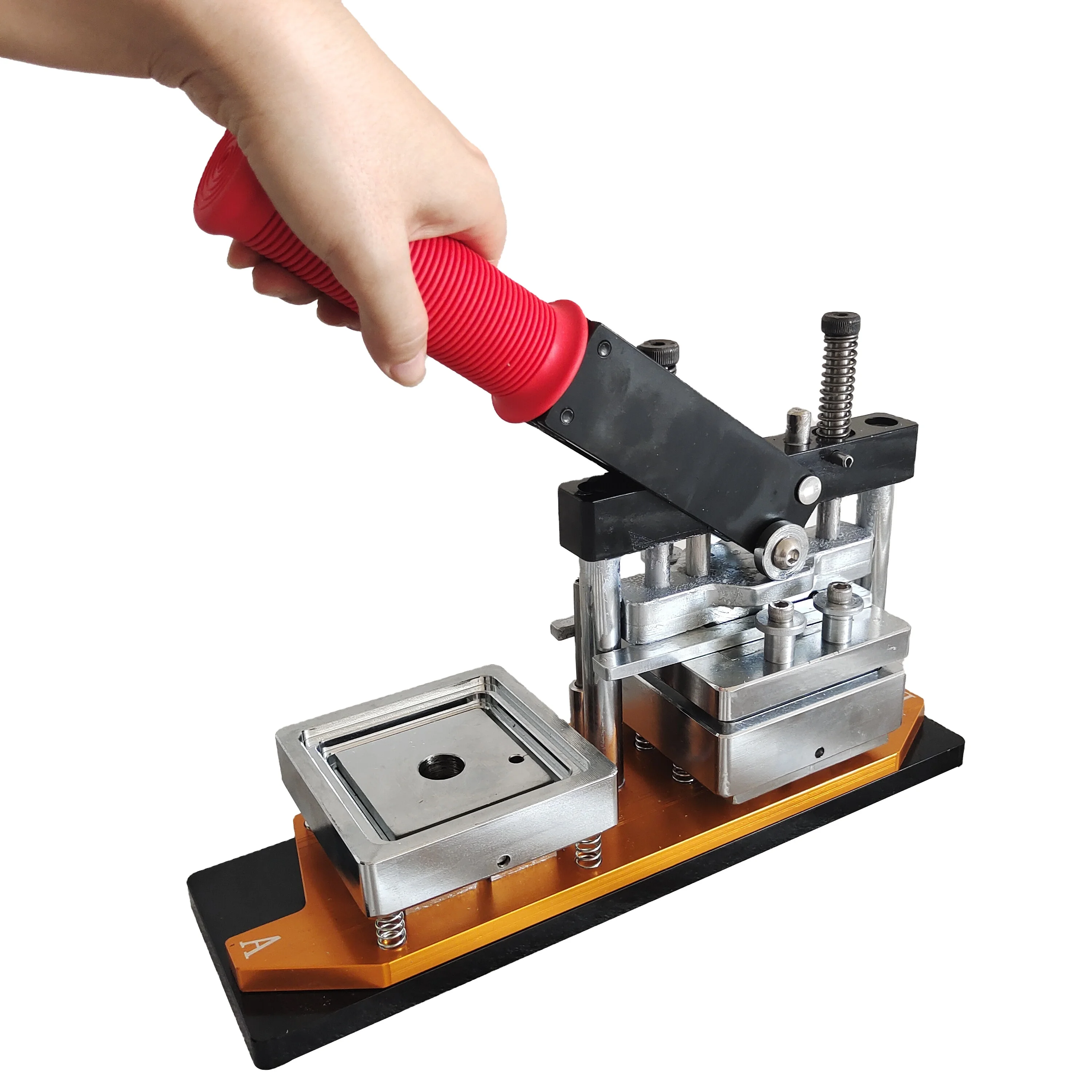
| Pressing station, close up | A lever press with a ribbed red grip, a black lever arm, two chromed guide pillars with springs, a rectangular die set, a gold coloured base plate carrying a stamped A, mounted on a black base | The machine is a single-station manual lever press, and the gold and black colour line in the specification is accurate |
| Both units side by side | The press on the left, and on the right a cast bodied machine with a speckled grey finish, an angled V blade assembly, a long chrome lever and a red ball knob | The second unit is a corner cutting or notching press, not a plain guillotine, and it is a separate cast bodied machine rather than an attachment |
| Whole kit laid out | Both machines, a stack of large glossy black magnetic sheet, a stack of printed sheets wrapped in film, two bales of wrapped blanks, and a bag of small white pieces | The kit is a starter package and the photographs do not state quantities, so the bill of materials has to come from the supplier |
| Blank finishes | Four blanks on a blue background: a brown board faced square, a brushed metal faced square, a black faced square with a pale edge, and a larger white faced octagon | Blanks are offered in more than one surface and shape, while the record's size list carries no finish column at all |
| Packing | Three cartons: one with a foam cavity holding the press, one with foam blocks and the long lever rod, one with a long white foam block | At least three cartons, foam protected, and therefore one packing dimension cannot describe the consignment |
Two conclusions follow. The kit's own photographs contradict none of the specification lines except the packing and package lines, which is worth noting because on the marking machine records in this queue the discrepancy was between the title and the specification. Here the title and the specification agree on the machine and disagree with the photographs on how it ships. And the blank photographs show the one dimension the record omits entirely: surface finish, which for a decorative fridge magnet is the feature the end buyer sees.
The size list, and the size in the title that is not in it
The record lists seven sizes and closes the list with the words and so on. The title leads with four designations, and one of them does not appear in the list.
- The title's 63.5 by 63.5 millimetres is the list's second size, an exact match.
- The title's 53 by 80 millimetres is the list's first size, an exact match.
- The title's 90 by 65 millimetres corresponds to the list's 65 by 90 millimetres, the same rectangle written the other way round, which is a naming convention rather than a difference.
- The title's 50 by 50 millimetres has no matching entry in the list, which runs 53 by 80, 63.5 by 63.5, 65 by 90, 115 by 40, 120 by 50, 127 by 41.5 and 170 by 50.
That single missing row is worth a question, because this family prices and ships by size and a buyer who orders a 50 millimetre square on the strength of the title may receive the nearest listed size instead. Ask whether 50 by 50 millimetres is available, and if it is, ask for it to be added to the written offer.
The list also mixes two measurement systems, which is a practical trap when comparing kits from different suppliers. Two entries are exact conversions from inches: 63.5 millimetres is two and a half inches, and 127 millimetres is five inches. The remaining entries are round metric numbers, including the 50 millimetre sides in 120 by 50 and 170 by 50. A nominal two inch blank from another supplier would be 50.8 millimetres, which is not the same as this list's 50 millimetres. When two suppliers quote by inch and by millimetre, the buyer should ask both for the drawing or a measured sample rather than converting on paper.
What the specification leaves out
Because the specification list is seven lines long, the omissions are easier to list than the contents. The record states no quantity per size, no split of the 1000 components across the listed sizes, no surface finish, no blank thickness, no blank material grade, no magnet grade or holding force, no sheet size, no printed sheet specification, no description of the second unit's blade or its cutting capacity, no spare blade, no spare die, no press force, no stroke, no die size, no machine dimensions, no weight of either unit separately, no warranty, no spare parts list, no certification, no carton count and no price.
Two of those omissions are more consequential than the rest. The first is the magnet grade, because holding force is what makes a fridge magnet work and it is normally specified as a grade code or as a pull force. The second is the spare blade and die set for the two machines, because a manual press and a corner cutter both use tooling that wears, and on a kit that is sold by its tooling the supply of that tooling is part of the price.
Two more identity signals, and one is on the images themselves
The factory photograph in the detail images is the same image used on the marking machine records in this queue: a building entrance with a large stone sign carrying the name in Chinese characters, which is the name of a trading company rather than of a manufacturing company. The description text names the same entity. So far the record is internally consistent about who is selling.
The images carry a second signal that the text does not. Several of the product photographs are watermarked with an Alibaba storefront address that is not the storefront this record belongs to: hebeiliubing.en.alibaba.com. The watermark appears on the two-machine image, on the blank finishes image and on the packing cartons.
A watermark is not proof of anything on its own, and there are innocent explanations: images are often supplied by a factory to several trading companies, and a trading company may have more than one storefront. But the practical instruction is the same as on the sibling records. Before a deposit, ask who the contracting seller is, ask whether the images and the product are licensed or supplied by the watermark owner, and ask for photographs of the actual kit that will be shipped, taken in the seller's own premises, rather than accepting the watermarked set as evidence of the goods.
One further caution applies to the marketing copy rather than to the goods. The description carries the line about the products being sold in a Paris landmark and in an Italy store, printed as one phrase. As printed it mixes two countries, and it names no store, no date and no reference. Nothing in the record supports the claim, and a buyer should not carry it into their own marketing material, where an unverifiable sourcing claim is the buyer's risk rather than the supplier's.
Total cost of ownership for a kit of this kind
The specification has seven lines and one of them, the packing line, describes a carton smaller than the consignment. The cost frame below is therefore built from what the record does not state, and the second column says where each line comes from.
| Cost line | Where it comes from |
|---|---|
| Kit price, by configuration | Not stated. Ask for the price with and without the second unit, and by blank size and quantity. |
| Freight for a consignment of about 60 kilograms in multiple cartons | Derived from the gross weight line and the multi-carton evidence in the photographs. The packing line alone understates the consignment. |
| Inland movement and unloading at destination | Depends on the trade term, which the record does not state. A 60 kilogram consignment needs equipment or two people. |
| Duty and taxes | Not stated. The kit is machinery plus printed goods plus plastic blanks, which may not fall in one tariff line. |
| Consumables: printed sheet, coating, magnetic sheet, adhesive | Printed sheet and magnetic sheet appear in the kit photograph but no quantity or specification is given. |
| Spare tooling: die set for the press, blade for the corner cutter | Not stated, and both wear. On a kit sold by its tooling this is a running cost, not a one-off. |
| Additional blank sizes | The size list is closed with the words and so on, so the price of a size outside the seven is unknown. |
| Retail packaging | The record says individual white box while the photographs show a brown carton with foam. A seller intending retail presentation should confirm which is supplied. |
| Labour for the batch | Derived from the 200 to 300 pieces per hour line: a thousand pieces is between three hours twenty minutes and five hours at the stated rate, before the second station. |
Reading that list top to bottom gives the shape of the purchase. This is not a machine bought once and used for years; it is a starter kit whose economics depend on the cost of the blanks and the printed sheet that feed it, and the record specifies none of those. A buyer who prices the kit alone and then discovers the blank and tooling cost has priced the smaller half of the project.
Questions to put to the supplier before ordering
- Please send the full bill of materials for the kit as a line list with quantities: press, second unit, magnetic sheet, printed sheet, blanks, magnet pieces, adhesive, tooling and any spares.
- What exactly are the 1000 magnetic components: finished magnets, moulded blanks with the magnet already fitted, or blanks alone?
- How are the 1000 pieces split across the seven listed sizes, and can the split be chosen?
- The title names 50 by 50 millimetres, which does not appear in the size list. Is that size available, and at what price?
- What is the surface finish of each blank size, and can the finish be specified per size?
- What is the blank thickness in each listed size, and what is the blank material?
- What magnet grade is used, and what holding force does a finished magnet develop on a steel surface?
- What is the second unit exactly: a corner cutter, a notching press, a guillotine, or a combination? What is its maximum cut and its maximum material thickness?
- Is the second unit required for every finished magnet, or only for certain sizes and finishes?
- What is the cycle time of the press alone, and what is the finished-piece rate for a job that uses both machines? The record states 200 to 300 pieces per hour for one figure only.
- What is the pressing force and the stroke of the press, and what is the die size for each blank size?
- What are the dimensions and the weight of the press alone and of the second unit alone?
- How many cartons does a complete kit ship in, what are the dimensions and weights of each, and what is the packed total?
- Is the packing a white box as the specification says or a brown carton with foam as the photographs show, and is a retail ready pack available?
- What is the price of the press die set and of the corner cutter blade, and what is their lead time?
- What is the price of each additional blank size, and what is the minimum order quantity per size?
- What printed sheet and coating material does the process require, and can you supply them?
- What is the warranty term, what does it cover, and what spare parts are recommended for the first year?
- What are the price, trade term, lead time, deposit and balance terms and packing for the configuration quoted, and what does the consignment come to landed at our address?
- Please confirm the full registered name of the contracting entity and the bank account beneficiary name, and confirm that the two match.
- The product images carry a watermark for a different storefront. Please confirm that the images and the goods are yours to supply, and send photographs of the actual kit at your premises.
Question one is the one that unlocks the rest. Until a bill of materials exists, none of the quantities in this record can be checked, and the kit cannot be compared with any other kit on price.
Incoming inspection when the kit arrives
The inspection below is ordered so that a failure at any step stops the next one, and it starts with the items the record is least able to prove.
- Count the cartons and photograph each label before opening anything, then compare the count with the number the supplier confirmed. The record's single packing dimension will not match what arrives.
- Weigh each carton and the consignment, and compare with the gross weight of 60 kilograms. If the total is materially different, record it before opening.
- Check the press for the features the photographs show: the ribbed red grip, the black lever arm, the two chromed guide pillars with springs, the gold coloured base plate with the stamped letter and the black base. The colour line in the specification is the easiest claim in the record to verify.
- Check the second unit for a cast body, the angled blade assembly and the lever with a red ball knob, and move the lever through its full stroke by hand to feel for a bind.
- Confirm the die set is present and that it matches the blank size ordered, and check the die face for damage in transit.
- Count the magnetic components and sort them by size and finish against the bill of materials, since the record does not state the split.
- Measure a sample of blanks in each size with a rule or callipers, and measure the thickness. The size list mixes inches and millimetres, so measure rather than convert.
- Confirm the magnetic sheet and printed sheet quantities, and check the sheet for creasing or edge damage.
- Test the holding force of a finished magnet on a steel surface by hand before trusting the magnet grade, since no grade is stated.
- Press a sample of ten pieces and time the cycle, then compare with the stated 200 to 300 pieces per hour. Time the second unit separately if it is needed for those pieces.
- Run a hundred pieces and inspect for die marking, misalignment and edge quality on the cut corner.
- File the timing sheet and the counted quantities with the inspection record, so that a later enquiry about rate or about blank supply is answered from evidence rather than from memory.
Answers to the questions this record raises most often
What is actually in the kit?
The record states a manual press, cast iron and injection construction, a gold and black finish and a 60 kilogram gross weight, and the title adds 1000 magnetic components and a paper cutter. The photographs show both machines, magnetic sheet, printed sheets, loose blanks in several finishes and a bag of small parts. The record gives no quantities for any of it, so the bill of materials has to be requested.
Is the second machine a paper cutter?
The title calls it a paper cutter and the photographs show a cast bodied machine with an angled blade and a long lever, which is a corner cutting or notching press rather than a flat bed guillotine. That distinction matters because a corner cutter trims a corner to a shape while a guillotine cuts a stack to size. Ask which one it is and what it is needed for on your blank and finish.
How many pieces per hour will I really get?
The record states 200 to 300 pieces per hour, which is one piece every 12 to 18 seconds and a thousand pieces in three hours twenty minutes to five hours of continuous pressing. That figure is for one station, and the kit contains two. Treat the record's figure as the press stroke rate, ask for the cycle time of the second unit, and use the slower station to plan the batch.
Will the whole kit arrive in one carton of 40 by 16 by 29 centimetres?
No, on the record's own evidence. A thousand mid size blanks occupy about 16 litres of the carton's 18.6 litres before a machine goes in, and the photographs show at least three separate cartons, one of which holds a lever longer than the carton's longest dimension. Ask for the carton count and per-carton weights.
What does the 60 kilogram figure weigh?
The record does not say whether it is one carton, the press, or the whole kit. Taken against the single stated packing it would imply an average density of about 3,232 kilograms per cubic metre, which is possible for a cast iron machine with voids but leaves no space for the thousand components. Ask for the weight of each item and each carton.
Why is the size list closed with the words and so on?
Because the range is open and the record does not enumerate it. Only seven sizes are named, and the title's 50 by 50 millimetres is not among them. Ask for the full size list with prices and minimum quantities, and ask whether 50 by 50 millimetres is available.
Where is the company that sells this kit?
The description text names Hengshui Mengshang Trading Co., Ltd., and the factory photograph in the same record carries the matching name on its entrance sign. Several product images, however, are watermarked with a different Alibaba storefront address. Confirm the contracting entity, the bank beneficiary name, and the seller's rights to the images before paying a deposit.
Source, scope and what this guide does not claim
This guide is based on the Hoting queue record for Product ID 1601250829015, whose title names 50 by 50 millimetres, 63.5 by 63.5 millimetres and 53 by 80 millimetres sizes in a 90 by 65 millimetre fridge magnet machine kit with 1000 magnetic components and a paper cutter, and whose description heading repeats the kit description as a 2024 new hot sales item.
The record's structured parameter block contains no rows. The specification quoted in this guide is the bulleted list inside the record's description text, which supplies the operation way reading manual, the material reading cast iron and injection, the speed reading 200 to 300 pieces per hour, the gross weight of 60 kilograms, the colour reading gold and black, the package reading individual white box, and the packing reading 40 by 16 by 29 centimetres. The same description supplies the size list reading 53 by 80 millimetres, 63.5 by 63.5 millimetres, 65 by 90 millimetres, 115 by 40 millimetres, 120 by 50 millimetres, 127 by 41.5 millimetres and 170 by 50 millimetres followed by the words and so on, the kit claim of 1000 magnetic components and a paper cutter, the sentence about printing pictures onto the surface of a fridge magnet and pressing it with the machine, the marketing line about a Paris landmark and an Italy store, and the company paragraph naming Hengshui Mengshang Trading Co., Ltd. The photographs supply the lever press with its ribbed red grip, black lever arm, two chromed guide pillars with springs, rectangular die, gold coloured base plate with a stamped letter and black base; the second unit with a speckled cast body, angled blade assembly, long chrome lever and red ball knob; the kit layout with magnetic sheet, printed sheets, wrapped blanks and a bag of small pieces; the four blank finishes in brown board, brushed metal, black with a pale edge and white octagon; the three cartons with foam inserts; the shipping service page; and the factory photograph with the entrance sign. The watermark appearing on several images is read from those images.
Six passages are the author's arithmetic or reasoning applied to the record and are identified here so they are not mistaken for supplier data. The carton volume of 18,560 cubic centimetres or 18.56 litres is calculated from the stated packing dimensions. The blank volume estimates, at about 16.1 litres for a thousand pieces of 63.5 by 63.5 by 4 millimetres and about 12.1 litres at 3 millimetres, and the comparison with the carton, are calculations from the stated size and an assumed thickness which the record does not give. The density figure of about 3,232 kilograms per cubic metre is 60 kilograms divided by the stated carton volume. The cycle times of 18, 14.4 and 12 seconds and the batch times of three hours twenty minutes to five hours are calculated from the stated speed range of 200 to 300 pieces per hour. The observation that 63.5 millimetres and 127 millimetres are exact conversions of two and a half inches and five inches while the other listed sizes are round metric numbers is a comparison of the list with itself. The observation that all eight detail images are shared with other magnet machine records in the same queue, and that two of them also appear on marking machine records, is a comparison of image addresses across the queue.
Unless a figure appears in the lists above, it is not in this article because it is not in the record. This record states no price, no trade term, no lead time, no deposit or balance terms, no quantity per size, no split of the 1000 components, no surface finish, no blank thickness, no blank material grade, no magnet grade or holding force, no sheet size or specification, no press force, no stroke, no die size, no machine dimensions, no weight of either unit separately, no second unit cutting capacity, no spare blade or die price, no carton count, no warranty, no spare parts list, no certification, no minimum order quantity and no service route outside China. A buyer should treat the seven line specification and the size list as the whole of the record's data, and close everything else by asking.
For a kit of this kind the two numbers that decide whether it earns its place are the cost of the blanks that feed it and the finished-piece rate of the slower of its two stations. This record publishes neither, and it states a carton that its own photographs show cannot hold the kit. Build the bill of materials first, price the blanks and the tooling with the machine, and settle the carton count and the landed weight before comparing the kit price, through the TEBAK sales inquiry channel.
Key specifications
- Operation Way
- Manual
- Material
- Cast iron and injection
- Speed
- 200-300 pcs per hour
- Gross Weight
- 60kg
- Colour
- Gold and black
- Package
- Individual white box
- Packing
- 40*16*29cm
- Blank Sizes Listed
- 53*80mm, 63.5*63.5mm, 65*90mm, 115*40mm, 120*50mm, 127*41.5mm, 170*50mm, etc.
- Kit Contents in Title
- 1000 magnetic components and paper cutter (not itemised in the specification list)