
What this record contains, and what it leaves out
The Hoting queue identifies Product ID 1601250521898 as fridge magnet material in sizes of 2inch by 2inch, 80 by 53 millimetres, 63.5 by 63.5 millimetres and 50 by 50 millimetres, offered in quantities of 500 pieces and 1000 pieces.
That title is the entire specification. The parameter block of this record contains no rows at all, and the description text contains nothing but the standard section headings of product description, packing and delivery, and company profile, plus a company paragraph that names the trading entity and lists unrelated product categories. There is no material, no thickness, no weight, no price, no minimum order quantity and no carton size anywhere in the record. Six detail images are attached, and none of them is a specification table.
A buyer reading this record alone therefore knows four sizes and two quantities and nothing else, and cannot tell from the title which quantity belongs to which size, or whether all four sizes are available in both quantities. That ambiguity is the reason this guide exists, and the rest of it answers the question with figures published elsewhere in the same supplier's range for what appears to be the same material.
The title lists two quantities and four sizes, and never joins them
Read as written, the title runs 500pcs, 1000pcs, then 2inch by 2inch, 80 by 53 millimetres, 63.5 by 63.5 millimetres and 50 by 50 millimetres. It is a list without a mapping. Three different readings are all consistent with the text:
- Two order quantities, any size. The two quantities are order options and each of the four sizes can be bought in either quantity. This is the usual arrangement for a material listing and the most likely reading.
- Two pack configurations. The 500 piece pack and the 1000 piece pack differ in contents, for example 500 pieces of one size against a mixed 1000 piece assortment.
- Four size options inside one pack. One order contains a mixture across the four sizes, and the two quantities are the only choices.
These readings matter commercially for a simple reason. If the sizes are alternatives, a buyer orders 1000 pieces of one size and needs one die or mould set. If the sizes are mixed in one pack, the buyer receives an assortment and needs a die for each size, and the price per piece becomes a weighted average rather than a single line. Ask the supplier to confirm in writing which reading applies, and to state the composition of a pack item by item.
Two inches is not fifty millimetres
The title lists 2inch by 2inch and 50 by 50 millimetres as if they were the same thing, and they are not. One inch is 25.4 millimetres, so two inches is 50.8 millimetres. The difference against 50 millimetres is 0.8 millimetres, which is 0.4 millimetres on each edge.
Four tenths of a millimetre sounds like nothing and is decisive in this product. A magnet blank sits inside a die or a mould cut to a size, and the blank is pressed or stuck against a printed sheet cut to the same size. If the die is cut for 50.8 millimetres and the blanks arrive at 50 millimetres, every blank sits loose in the die and the printed sheet cannot be registered. If the die is cut for 50 millimetres and the blanks arrive at 50.8 millimetres, the blanks do not enter the die at all.
The same family shows the risk is real rather than theoretical, because one of the sibling records in this range lists a mould table that includes a 50 by 50 millimetre row, while the per size weight and price table on another sibling record has no 50 by 50 millimetre row at all: it moves from 53 by 80 millimetres straight to 63.5 by 63.5 millimetres. So the 50 millimetre size exists as a mould in this range but carries no published weight and no published price, and the two inch size in this title has no published figure either.
Before ordering, ask for the size in millimetres to one decimal place, ask whether two inch and 50 millimetres are one size or two, and ask for the tolerance on the cut. A tolerance of plus or minus 0.2 millimetres is normal for a die cut paper and tin blank and is worth knowing before the printed sheets are ordered.
The same material carries a full specification on sibling records
This range sells the same three sizes, 80 by 53 millimetres, 63.5 by 63.5 millimetres and 50 by 50 millimetres, under more than one record. Two of those records carry the specification this one is missing, and a buyer should quote from them rather than from this page.
| Figure | Value | Record it comes from |
|---|---|---|
| Material, one construction | Coating paper + tin + cardboard + soft rubber magnet | Product ID 1601245381588 |
| Thickness | 2.5 to 3.8 millimetres | Product ID 1601245381588 |
| Process | Compressed / Stick | Product ID 1601245381588 |
| Net weight per piece and price per 1000 pieces | 53*80mm 23.1 grams at US$100; 63.5*63.5mm 22.0 grams at US$120; 65*90mm 32.4 grams at US$120; 115*40mm 27.0 grams at US$120; 120*50mm 35.5 grams at US$120; 127*41.5mm 30.0 grams at US$120; 170*50mm 50 grams at US$130 | Product ID 1601245381588 |
| Material, a different construction | Metal + ABS, with a separate line reading button material steel | Product ID 1601250493925 |
| Minimum order quantity | 100 pieces | Product ID 1601250493925 |
| Carton and weight | 47*35*28cm, 27 kilograms per 1000 pieces | Product ID 1601250493925 |
| Warranty | 6 months on core components | Product ID 1601250493925 |
The most important line in that table is the fifth. Two records covering the same three sizes describe the construction in two incompatible ways: one is a laminated sandwich of coating paper, tin, cardboard and soft rubber magnet, and the other is metal with ABS plastic. Those are not two descriptions of one product. A laminated sheet metal and rubber magnet blank and a metal and ABS badge are made on different equipment, have different weights, take different printing, and cost different amounts. Ask which one is being quoted before comparing any price, because the two are not interchangeable at the press.
The per piece weight is worth checking, and the published figures can be checked against each other
The sibling record publishes a net weight for each of seven sizes, and those seven figures can be tested against each other. Divide the weight of each size by its face area and the family becomes very consistent:
| Size | Face area | Published net weight per piece | Weight per square centimetre |
|---|---|---|---|
| 53*80mm | 42.40 cm² | 23.1 g | 0.545 g/cm² |
| 63.5*63.5mm | 40.32 cm² | 22.0 g | 0.546 g/cm² |
| 65*90mm | 58.50 cm² | 32.4 g | 0.554 g/cm² |
| 127*41.5mm | 52.71 cm² | 30.0 g | 0.569 g/cm² |
| 115*40mm | 46.00 cm² | 27.0 g | 0.587 g/cm² |
| 170*50mm | 85.00 cm² | 50.0 g | 0.588 g/cm² |
| 120*50mm | 60.00 cm² | 35.5 g | 0.592 g/cm² |
The seven figures land in a band from 0.545 to 0.592 grams per square centimetre, a spread of about nine per cent, and the two square sizes sit at the bottom of the band while the elongated sizes sit at the top. That pattern is worth understanding rather than ignoring. A uniform sheet cut to different shapes would give the same figure for every size, so the spread says that either the thicker end of the stated 2.5 to 3.8 millimetre range is used on the larger sizes, or the larger sizes carry more magnet and less board. Ask whether all sizes share one build or the large sizes are built heavier.
The same figures also let a buyer cross check the stated thickness. Taking a common density of about 1.9 grams per cubic centimetre, which is the average of the family, the two square sizes work out to a thickness of about 2.87 millimetres and the 170 by 50 millimetre size to about 3.10 millimetres:
- 23.1 grams divided by 42.40 square centimetres divided by 1.9 grams per cubic centimetre is 0.287 centimetres, or 2.87 millimetres.
- 22.0 grams divided by 40.32 square centimetres divided by 1.9 gives the same 2.87 millimetres.
- 50.0 grams divided by 85.00 square centimetres divided by 1.9 gives 3.10 millimetres.
Both results sit inside the published 2.5 to 3.8 millimetre band, so the published weights and the published thickness range do not contradict each other. That is a useful result because it means the two sets of published figures can be used together as a check on a delivered batch. Weigh ten pieces at random, measure the face, divide one by the other, and compare with the band above. A batch that comes in at 0.70 grams per square centimetre is heavier than anything the record describes, and a batch at 0.40 is lighter.
What 500 pieces and 1000 pieces actually weigh and occupy
With the published net weight of 23.1 grams per piece for the 53 by 80 millimetre size, the two quantities in the title convert into solid figures:
| Quantity | Net weight on the 23.1 g per piece basis | Net weight on the 27 kg per 1000 pieces basis | Solid volume at 3mm thickness |
|---|---|---|---|
| 500 pieces | 11.55 kg | 13.5 kg | about 6.4 litres |
| 1000 pieces | 23.1 kg | 27 kg | about 12.7 litres |
Note the two weight columns. The sibling record that publishes 23.1 grams per piece for the 53 by 80 millimetre blank and the sibling record that publishes 27 kilograms per 1000 pieces are describing the same size, and the two figures differ by 3.9 kilograms per 1000 pieces, which is 16.9 per cent. A corrugated carton of the stated 47 by 35 by 28 centimetres weighs well under one kilogram on its own, so packaging does not explain a gap of 3.9 kilograms. Either the two figures use different bases, one net and one gross with a heavier pack, or the two records describe slightly different builds. Ask which basis the quotation uses, because a 17 per cent weight difference is a 17 per cent freight difference on a product sold by weight.
The volume figure repays one more calculation. The sibling carton is 47 by 35 by 28 centimetres, which is 46,060 cubic centimetres, or about 46 litres. One thousand pieces at 3 millimetres thick occupy about 12.7 litres of solid material, which is about 28 per cent of the carton. So a 1000 piece carton is generously sized and holds the goods with a large void.
That void has a commercial consequence that decides whether to order 500 or 1000 pieces. Less than container load sea freight is charged on the greater of weight and volume, and for this product the volume wins: one carton at 0.046 cubic metres against 0.027 tonnes of goods means the chargeable figure is set by volume, not by weight. The practical result is that 500 pieces and 1000 pieces in the same carton attract almost the same sea freight, because the carton occupies the same space either way, while the goods value doubles. Unless a 500 piece order is being sent as a small parcel by air, doubling the quantity is close to free on the sea freight line. Ask the supplier for the packed dimensions of the 500 piece pack before assuming it uses the same carton, because a smaller carton for the smaller order removes that advantage.
What the six images do and do not show
| Image | What it shows | What it establishes |
|---|---|---|
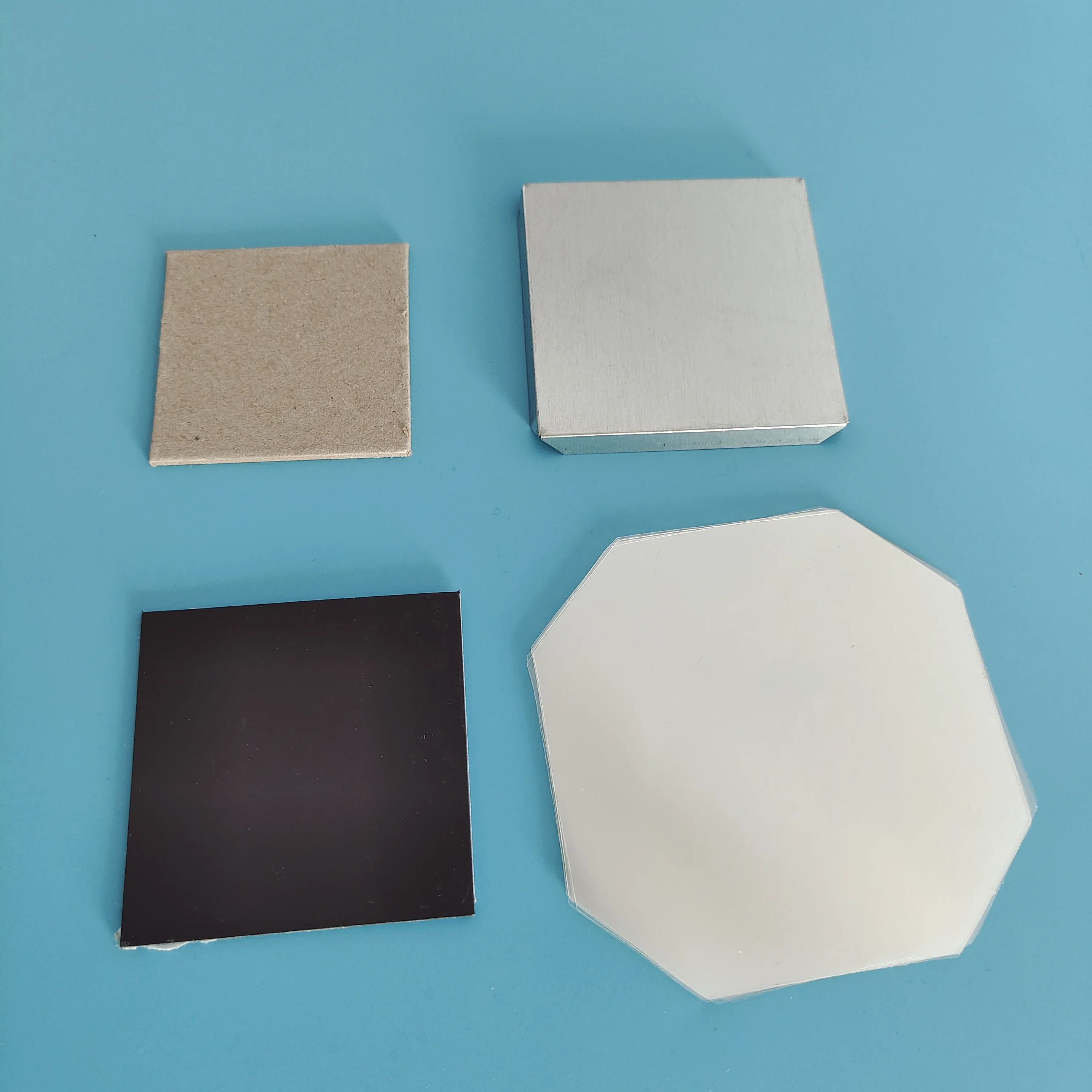
| Component view | Four blanks photographed on a blue background: a brown board faced square, a brushed metal square, a black square and a white octagonal piece | At least four face finishes are made in this range, and one of them, the octagon, is not one of the rectangular sizes listed in any title; ask which finish matches the quotation |
| Kit layout | The lever press and the corner cutter with a stack of glossy black magnetic sheets, a stack of printed sheets, two film wrapped bales and a bag of small white parts | The photograph belongs to the machine kit rather than to a material only order, so it does not show how the material is packed when bought on its own |
| Payment strip | Payment marks for Alibaba.com Trade Assurance Supplier, PayPal, Western Union, Escrow, L/C and T/T; shipping marks for EMS, TNT, DHL, FedEx and UPS | Payment and shipping channels the supplier advertises, though the record itself states no terms |
| Factory photograph | A building entrance with a stone sign carrying the name of a trading company in Chinese characters | The same photograph appears across this supplier's range, so it identifies the company rather than this product |
| Question and answer page | Six answered questions: quotation within 24 hours, samples available, design support, payment of 30 per cent deposit and 70 per cent before shipping by T/T, PayPal or Western Union, lead time of about 15 working days, and delivery terms EXW, FOB or CIF | The only commercial terms anywhere in this record, and they are on an image rather than in the parameter block |
| Contact card | A brand card carrying the supplier's mark, the words PTFE and technopolymers manufacturing under the mark, a sales manager name, a website, an address in Hengshui City, a mobile number and an email address | The brand describes itself on its own card as a PTFE and engineering polymer maker, which is a different product category from printed magnet blanks; ask how the brand's stated manufacturing specialism maps onto this product |
Two of those rows carry a practical instruction. The component view shows a white octagonal piece that appears in no size list in this range, so a buyer looking at that photograph should ask what it is and whether it is a standard size, because it cannot be ordered from any figure published in these records. And the question and answer image supplies the only terms in the record: a 24 hour quotation, samples on request, a 30 per cent deposit with the 70 per cent balance before shipping, about 15 working days of production, and a choice of EXW, FOB or CIF. The 70 per cent balance before shipment means the full amount leaves the buyer before the goods leave the country, and the choice of trade term then decides who books and insures the freight; for a light bulky product that is charged on volume, FOB against CIF is worth pricing both ways.
Design support is offered in the same image, and for this product that is the most valuable service on the list. A magnetic blank exists to carry a printed image, so the printed sheet is cut to the same size as the blank, and a supplier who will produce a cutting layout for the buyer's artwork removes the single largest source of waste in this trade.
Questions to put to the supplier before ordering
- Does the 500 piece and 1000 piece figure describe two order quantities available in any size, or two different pack contents? Please state the composition of each pack item by item.
- Is the two inch by two inch size the same size as the 50 by 50 millimetre size, or are they two different items? Please give every size in millimetres to one decimal place.
- What is the cut tolerance on each size, and what is the diagonal tolerance?
- Which construction is being quoted: the laminated coating paper, tin, cardboard and soft rubber magnet build, or the metal and ABS build? These are different products and I need to know which one the price covers.
- What is the thickness for each size, and is the thickness the same across all sizes or heavier on the larger ones?
- What is the net weight per piece and per 1000 pieces for each size, and is the 27 kilogram figure net or gross?
- What is the magnetic pull per square centimetre, and what is the rated holding force on a painted steel surface?
- What is the surface finish: matt, gloss or brushed, and is the finish on a printed paper face or on bare metal?
- Can the blank be supplied without printing, and if printing is offered, what is the print method and the artwork format required?
- Is a die or mould included, and if the printed sheet is cut to size, will the supplier supply the cutting layout for our artwork?
- Do all four sizes in the title use the same die set, or does each size need its own die?
- What is the minimum order quantity per size, and does it apply per size or per order? One sibling record states 100 pieces.
- What is the price per 1000 pieces for each size, and what is the price for 500 pieces? The published range runs from US$100 to US$130 per 1000 pieces depending on size.
- What is the packed weight and the packed dimensions of a 500 piece order and of a 1000 piece order, and are both shipped in the same carton or in different cartons?
- What are the payment terms, the trade term and the lead time for our quantity, and what is the balance payment trigger?
- What samples can be provided before the order, and at what cost, and can the sample be sent on our material specification?
- What is the warranty on the blanks, and what is the remedy for a batch that is out of size tolerance or under weight?
- What is the full registered name of the contracting entity and the bank account beneficiary name, and do they match?
- Are the blanks resistant to moisture and to sunlight for outdoor use, and is there a test report?
- What is the shelf life in storage, and are the blanks supplied with a protective film?
Questions two, four and six are the ones to settle first. Until the two inch and fifty millimetre sizes are resolved, no die can be ordered. Until the construction is fixed, no price comparison is possible. And until the weight basis is agreed, neither the freight cost nor the delivered cost per piece can be calculated.
Incoming inspection for a delivered batch
- Photograph the carton and record the packed weight and the packed dimensions before opening, and compare with the figures on the quotation.
- Weigh ten pieces at random and measure the face of each. Divide weight by area and compare with the band of 0.545 to 0.592 grams per square centimetre that the published figures describe for this family.
- Measure the thickness of ten pieces at the centre and near a corner of each, and compare with the stated 2.5 to 3.8 millimetre range and with the thickness the quotation names.
- Measure the length, width and both diagonals of ten pieces, and compare with the ordered size to the stated tolerance. A diagonal that differs from the sides indicates a blank that is out of square.
- Check the edge cut for burrs, delamination and visible paper lift, which are the usual defects on a laminated blank.
- Cut or section one piece and check the layer order: coating paper, tin, cardboard, rubber magnet. Confirm each layer is present and of the expected thickness rather than substituting board for magnet.
- Check the magnetic face against a painted steel panel and compare the pull with the figure the supplier stated.
- Check the printed face for registration, colour and scuff resistance, and test the adhesion of the coating paper to the metal with a small scratch test.
- Count the pieces and confirm the quantity matches the order rather than the carton label.
- Record every measurement on one sheet with the date, the batch and the supplier's lot number, so that a later claim on size or weight is answered from measurements rather than from memory.
- Keep at least five pieces from every batch in a marked bag as a reference sample, since the sizes in this trade are close enough that a later dispute is settled by comparing physical pieces.
Answers to the questions this record raises most often
How many sizes does this listing cover?
The title names four strings: two inch by two inch, 80 by 53 millimetres, 63.5 by 63.5 millimetres and 50 by 50 millimetres. Two inch by two inch is 50.8 millimetres, so it may or may not be the same item as the 50 by 50 millimetre size. Treat it as four listings until the supplier confirms otherwise.
Is a specification available?
Not in this record. Its parameter block is empty and its description text carries no specification. The specification exists on sibling records for the same sizes, including a material line, a thickness range of 2.5 to 3.8 millimetres, a process line, per piece net weights for seven sizes and prices of US$100 to US$130 per 1000 pieces.
Which construction is the material?
Two records for the same three sizes give two answers. One describes coating paper, tin, cardboard and soft rubber magnet; another describes metal and ABS. Ask which is being quoted, because the two are made differently and priced differently.
How heavy is a 1000 piece order?
On the published net weight of 23.1 grams per piece for the 53 by 80 millimetre size, 1000 pieces weigh 23.1 kilograms net. A sibling record gives 27 kilograms per 1000 pieces, which is 16.9 per cent higher, so ask whether that figure is gross and what the packaging contributes.
Should I order 500 or 1000 pieces?
Unless the order moves as a small air parcel, 1000 pieces is usually the better buy, because the carton is charged on volume in less than container load sea freight. One thousand pieces occupy about 12.7 litres of solid material in a carton of about 46 litres, and the freight on that carton is set by its size rather than by its weight, so doubling the goods adds very little freight.
Can a buyer check the weight on delivery?
Yes, and it is the fastest quality check available. Weigh ten pieces, measure the face area, and divide. The published figures for this family sit between 0.545 and 0.592 grams per square centimetre, so a batch well outside that band is out of specification.
What sizes have published prices?
Seven sizes carry published prices on a sibling record: 53 by 80 millimetres at US$100 per 1000 pieces, 63.5 by 63.5, 65 by 90, 115 by 40, 120 by 50 and 127 by 41.5 millimetres at US$120, and 170 by 50 millimetres at US$130. Neither the 50 by 50 millimetre size nor the two inch size carries a published weight or price, so ask for both.
What are the payment and delivery terms?
The record states none directly. Its question and answer image offers a quotation within 24 hours, samples on request, design support, payment of 30 per cent deposit with 70 per cent before shipping by T/T, PayPal or Western Union, a lead time of about 15 working days depending on quantity, and delivery on EXW, FOB or CIF terms.
Source, scope and what this guide does not claim
This guide is based on the Hoting queue record for Product ID 1601250521898, titled with quantities of 500pcs and 1000pcs and sizes of 2inch by 2inch, 80 by 53 millimetres, 63.5 by 63.5 millimetres and 50 by 50 millimetres. That record's parameter block contains no rows and its description text contains section headings and company paragraphs only, with no specification of any kind. Its six detail images are the four blank component view, the kit layout, the payment and shipping strip, the factory photograph, the question and answer page, and the brand contact card; all six were examined.
The material, thickness, process, per piece weight and price figures used in this guide are not from this record. They are taken from sibling records in the same queue for the same sizes, and each table row above names the record it comes from: Product ID 1601245381588 for the laminated material line, the 2.5 to 3.8 millimetre thickness, the compressed or stick process and the seven per piece net weights with their prices, and Product ID 1601250493925 for the metal and ABS line, the 100 piece minimum order quantity, the 47 by 35 by 28 centimetre carton, the 27 kilograms per 1000 pieces figure and the six month warranty.
Five passages are the author's arithmetic and are identified here so that they are not mistaken for published data. The face areas in the weight per square centimetre table are the products of the stated dimensions, and the gram per square centimetre figures are the published net weights divided by those areas. The thickness figures of about 2.87 millimetres for the square sizes and about 3.10 millimetres for the 170 by 50 millimetre size are those weights divided by area and then by an assumed average density of 1.9 grams per cubic centimetre, chosen as the average of the family; the density itself is not published by the supplier. The quantity weights of 11.55 and 23.1 kilograms are 500 and 1000 multiplied by the published 23.1 gram piece weight, and the 13.5 and 27 kilogram figures come from the sibling record's own per thousand figure. The volumes of about 6.4 and 12.7 litres assume a 3 millimetre thickness, and the 28 per cent fill figure compares 12.7 litres with the 46 litre carton derived from the stated 47 by 35 by 28 centimetres. The statement that sea freight is charged on volume for this product follows from the same numbers: 0.046 cubic metres against 0.027 tonnes.
Unless a figure appears in the lists above, it is not in this article because it is not in the records. This record states no material, no thickness, no finish, no magnet grade, no magnetic pull, no magnet thickness, no printing method, no printing colours, no weight, no price, no minimum order quantity, no carton size, no packed weight, no lead time, no trade term, no payment terms, no warranty, no certification, no shelf life, no moisture or sun resistance, and no packaging material. Its sibling records add a material line, a thickness range, per piece weights for seven sizes, prices for seven sizes, a minimum order quantity, a carton size, a warranty and a delivery and payment summary, but none of them states the magnetic pull, the printing method, the print colours, the moisture or sun resistance, the shelf life, or the tolerance on the cut.
Two questions decide whether this material can be ordered at all, and neither is answered in this record: whether the two inch size and the fifty millimetre size are the same item, and which of the two constructions is being quoted. Settle those two, then confirm the weight basis, and the quantity decision follows from the carton arithmetic, through the TEBAK sales inquiry channel.
Key specifications
- Quantity Options in Title
- 500pcs / 1000pcs
- Sizes in Title
- 2inch*2inch, 80*53mm, 63.5*63.5mm, 50*50mm
- Parameter Block in This Record
- not supplied (0 rows)
- Description Text
- section headings and company text only, no specification
- Material (per sibling record 1601245381588)
- Coating paper + tin + cardboard + soft rubber magnet
- Thickness (per sibling record 1601245381588)
- 2.5-3.8mm
- Process (per sibling record 1601245381588)
- Compressed / Stick
- Net Weight per 1000pcs (per sibling record)
- 53*80mm 23.1kg; 63.5*63.5mm 22.0kg; 65*90mm 32.4kg; 115*40mm 27.0kg; 120*50mm 35.5kg; 127*41.5mm 30.0kg; 170*50mm 50.0kg
- Price per 1000pcs (per sibling record)
- US$100 for 53*80mm; US$120 for 63.5*63.5mm, 65*90mm, 115*40mm, 120*50mm and 127*41.5mm; US$130 for 170*50mm
- MOQ and Carton (per sibling record 1601250493925)
- MOQ 100pcs; carton 47*35*28cm; 27kg per 1000pcs
- Construction per Sibling Record
- Metal + ABS on one record, laminated paper, tin, cardboard and rubber magnet on another; the two are not the same build