
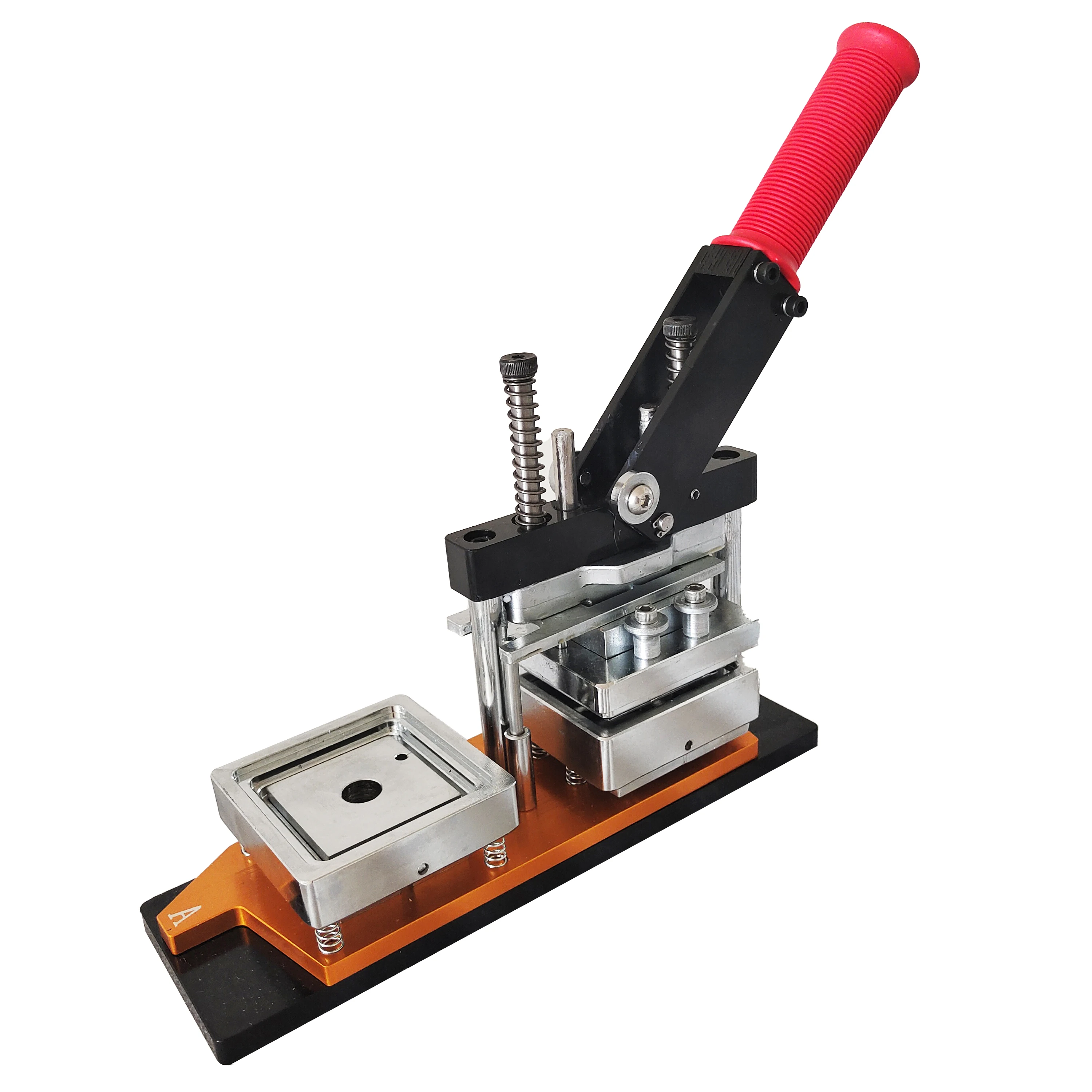
Source-controlled product identity
The Hoting queue identifies Product ID 1601245381588 as a tourist souvenir tin fridge magnet machine kit listed under the title "63.5*63.5 MM Tourist Souvenir Tin Square Fridge Magnet Machine Kit Machine + Paper Cutter + 1000 Pcs Fridge Magnet Materials".
This record is unusual in this queue in two ways, and both matter for how it should be read. It carries a component price list with a figure for every size it offers, which is real commercial information rather than a claim. It is also a kit rather than a single appliance: the title names a machine, a paper cutter and 1000 pieces of magnet material, while every specification in the record describes the magnet components and none of them describes the machine or the cutter.
That split is the central fact of this guide. A buyer can price the consumable side of this business precisely from the record. The equipment side, and the printing that turns a blank into a souvenir, have to be obtained from the supplier.
The recorded parameter block, in full
The parameter block is a two-column table in which the left column carries sizes and the right column carries two facts at once, a net weight and a price. The first row is a header rather than a size. It is reproduced here exactly as recorded.
| Magnet Component Size | Net Weight | Prices |
|---|---|
| 53*80mm | 23.1g/pc | US$100/1000pcs |
| 63.5*63.5mm | 22.0g/pc | US$120/1000pcs |
| 65*90mm | 32.4g/pc | US$120/1000pcs |
| 115*40mm | 27.0g/pc | US$120/1000pcs |
| 120*50mm | 35.5g/pc | US$120/1000pcs |
| 127*41.5mm | 30.0g/pc | US$120/1000pcs |
| 170*50mm | 50g/pc | US$130/1000pcs |
The remaining recorded entries are the material stack, the list of standard sizes, the thickness range and the process:
| Field | Value as recorded |
|---|---|
| Material | Coating paper+tin+cardboard+soft rubber magnet |
| Standard Hot Sizes | 53*80MM,65*90MM,63.5*63.5MM,120*50MM,127*41.5MM,115*40MM,170*50MM,ect. |
| Thickness | 2.5-3.8MM |
| Process | Compressed / Stick |
The description adds two further entries that are not in the parameter block: the packing is stated as in wooden case, and the shipment is stated as in 5 days after finishing the payment.
Reading the table: the first row is a header, not a size
A buyer who scans this block quickly can pair the label on the left with the value on the right without noticing that the first row is a column heading. Read that way, the block appears to say that the component size is "Magnet Component Size" and that its net weight and price are "Net Weight | Prices", which is meaningless, and the practical risk is that the seven real rows below it are read as belonging to a differently labelled table.
The correct reading is that the block is a table with a heading row and seven data rows, that the left column is the component size and that the right column contains a weight and a price separated by a vertical bar. Every figure quoted in this article is taken from that reading and reproduced without alteration.
The last entry in the standard sizes list ends with the abbreviation "ect.", which indicates that the list is not exhaustive. Ask whether sizes outside the seven priced rows are available, whether a new die or a new printing plate is needed for a non-standard size, and what the minimum quantity is for a new size.
What the kit contains, and what the record does not say about the machine
The title names three components: a machine, a paper cutter, and 1000 pieces of magnet material. The 63.5 mm by 63.5 mm figure in the title matches the second priced row, so the 1000 pieces included in the kit are most likely that size, but the record does not state which size is supplied with the kit and it should be confirmed in writing.
Nothing in the record describes the machine. There is no press type, no force rating, no die or platen size, no cycle time, no power requirement, no air requirement, no machine weight and no machine dimensions. For a product sold as a machine kit, that is the largest single gap in the record, and it is larger than it first appears because the choice between a manual press and a powered press changes the labour, the volume and the site requirements of the whole operation.
Ask the supplier to describe the machine on these points: whether it is a manual lever press, a pneumatic press or a powered press, the pressing force, the size of the die or the working area, the cycle time per piece, whether the die is heated and to what temperature, the power supply or air pressure required, the machine's own dimensions and weight, whether it is supplied with a die and of what size, whether dies for the other sizes in the table are available and at what price, and what the machine's rated throughput is in pieces per hour.
The description of the process gives one clue and no answer. The recorded process entry is "Compressed / Stick", which may mean that the component can be assembled by compression or by adhesive, or that two different product types are offered. Ask which method the kit uses, what tooling each method needs, and which method produces the more durable souvenir, since a compressed rim and a glued rim fail differently in use and a fridge magnet that separates in a customer's hand is a returned souvenir.
The paper cutter is named in the title and not described at all. Ask for its cutting width, its type, whether it is a guillotine or a roller cutter, whether it will cut the largest size in the table, and whether it is supplied with a spare blade.
Blank pricing as recorded, and how it breaks down
The record prices the blanks per thousand pieces. Four of the seven sizes are priced at US$120 per 1000 pieces, the smallest at US$100 per 1000 and the largest at US$130 per 1000.
| Size | Net weight per piece | Price per 1000 pcs as recorded | Price per piece |
|---|---|---|---|
| 53*80mm | 23.1g | US$100 | US$0.100 |
| 63.5*63.5mm | 22.0g | US$120 | US$0.120 |
| 65*90mm | 32.4g | US$120 | US$0.120 |
| 115*40mm | 27.0g | US$120 | US$0.120 |
| 120*50mm | 35.5g | US$120 | US$0.120 |
| 127*41.5mm | 30.0g | US$120 | US$0.120 |
| 170*50mm | 50g | US$130 | US$0.130 |
The price per piece column is worked out here from the recorded figures by dividing the price per thousand by one thousand, and it is the figure a buyer needs when costing a souvenir: from US$0.100 to US$0.130 per blank before printing.
Two features of the price list are worth noting because they do not follow the pattern a buyer might expect. The smaller 53 mm by 80 mm size is the cheapest at US$100 per 1000 rather than the middle of the range, so the 63.5 mm square costs more per piece than a rectangle whose area is slightly larger. And the largest size at 170 mm by 50 mm attracts only a US$10 premium over the six middle sizes despite being substantially larger.
Ask the supplier to confirm the price breaks behind the table, in particular whether there is a discount above 1000 pieces and where it steps, whether the price is FOB or ex works, what currency the price is quoted in and whether it is fixed for the term of the order, and what the price is for each size at the quantity the buyer actually intends to order. A price list is a starting point for a quotation rather than a quotation.
Because the blanks are the recurring cost of this business and the kit is bought once, the buyer should also establish the reorder terms now: the minimum reorder quantity, the lead time for a reorder, and whether the price is held for a stated period. A souvenir line that sells is reordered repeatedly, and the terms of the second order matter more than the terms of the first.
Weight and size consistency: a check that supports the figures
The recorded weights and sizes can be tested against each other, which is a useful check on whether the table is a measured set or a list of round numbers.
Dividing each recorded weight by the area of the same size gives a weight per unit area of about 5.45 g per 1000 mm² for the 53 mm by 80 mm size, about 5.46 for the 63.5 mm square, about 5.54 for the 65 mm by 90 mm size, about 5.87 for the 115 mm by 40 mm size, about 5.92 for the 120 mm by 50 mm size, about 5.69 for the 127 mm by 41.5 mm size and about 5.88 for the 170 mm by 50 mm size.
Those figures sit within roughly eight per cent of each other, which is what would be expected from a real material whose thickness varies within a stated range rather than from invented numbers. The recorded thickness range of 2.5 mm to 3.8 mm is consistent with that spread, since a thicker stack of the same materials weighs more per unit area than a thinner one.
The practical consequence is that a buyer cannot read a thickness figure off the table. The 2.5 mm to 3.8 mm range covers the whole product family rather than each size, and nothing in the record says which sizes are thin and which are thick. Ask the supplier for the nominal thickness of each size, and for the thickness of each layer in the stack, because the total thickness determines how the piece sits in the press and how it feels in the hand, and the layer thicknesses determine how the piece behaves when a customer drops it.
The material stack, layer by layer
The recorded material is a four-part stack: coating paper, tin, cardboard and soft rubber magnet. Read from the face to the back, that describes a printed paper layer over a tinplate face, on a cardboard core, backed by a flexible magnetic sheet. Each layer has a specification that the record does not give.
For the coating paper, ask for the paper weight, whether the surface is glossy, matt or textured, whether it is suitable for the printing method the supplier uses, and whether a protective varnish or laminate is applied. This is the layer a customer sees and touches, so its finish decides whether the souvenir looks like a gift or a giveaway.
For the tin, ask for the tinplate thickness and the coating if any. The tinplate is the part that gives the piece its rigidity and its flat face, and a thin tinplate dents in handling while a thick one makes the piece heavy and more expensive to ship.
For the cardboard, ask for the thickness and the board grade. The card core sets the total thickness of the assembly, which is why the thickness range in the record and the weights in the table move together.
For the magnet, ask for the magnetic sheet grade and its pull force, its thickness, whether the magnet covers the whole back or only part of it, and how the magnet is attached. Pull force is the figure that decides whether a souvenir magnet holds a note to a fridge door or slides down it, and it is not in the record. Ask also whether the magnet face is smooth or embossed, whether it can scratch a painted appliance door, and whether the sheet is supplied with an adhesive backing or is bonded by the press.
A buyer should also ask which of these layers the supplier manufactures and which it buys in, because that determines where the cost sits and which part of the specification the supplier can actually change. A supplier who presses the assemblies but buys printed paper and magnetic sheet from others will quote a range of finishes that depends on its sub-suppliers, and lead times will move with those sub-suppliers rather than with the supplier's own capacity.
The printing question, which the record does not address at all
A tourist souvenir magnet is a printed object. The record describes a machine, a cutter and 1000 blank components, and the process entry mentions compression and sticking, but there is no printing specification anywhere in it: no printing method, no number of colours, no artwork requirement, no proofing step and no minimum quantity for a printed order.
This is the decisive commercial gap for a souvenir line, and it should be settled before any equipment is bought, because the answer may change which machine is needed. Ask the supplier whether the kit's machine prints as well as presses, whether printing is a separate operation done on a different machine, and whether the supplier offers a printed component service in which the buyer supplies artwork and receives finished printed magnets rather than blanks.
Where printing is done by the buyer, ask what printing method suits the coated paper surface, what artwork format the supplier requires and at what resolution, whether a digital proof and a physical pre-production sample are available, what the minimum printed quantity is per design, what the colour tolerance is between the proof and the production run, and what happens to a design between runs, since a souvenir line usually carries several designs at once and re-orders them unevenly.
Where the supplier prints, ask for the price of a printed component at the buyer's quantity for each size, the setup or plate cost per design, the number of colours included, the lead time for a printed run, and whether the supplier can hold stock of a design and ship against call-off orders. Comparing the two routes on price per thousand pieces is the only way to decide whether to buy a machine at all.
Ask for photographs of printed finished product in each of the sizes the buyer intends to sell, taken in daylight rather than in a studio, because the appearance of a coated paper surface under ordinary light is what the customer will see. Ask also for a sample of a printed magnet, which for a product of this kind is worth more than any specification sheet.
Packing, shipment and the wooden case
The recorded packing is in a wooden case, and the recorded shipment is in 5 days after finishing the payment. The wooden case is consistent with a kit that contains a machine, which is heavier and more easily damaged than a carton of blanks, and it also means the shipping cost should be quoted rather than assumed.
Ask for the case dimensions and its gross weight, the number of kits per case, whether the case is plywood or solid timber, and whether it carries the marking and any treatment required for the destination country. Timber packing is regulated in many markets, and a case that cannot clear entry is a shipment at a port rather than a product in a workshop. Ask also whether the blanks and the printed materials are packed separately from the machine, and whether the kit can be shipped in more than one case if a single case would be too heavy to handle.
The recorded shipment term of 5 days after finishing the payment is shorter than the delivery terms recorded for other products in this queue. Ask whether that figure applies to the kit as a whole or only to the components, whether it starts from payment or from confirmation of the order details, whether it depends on the size or the quantity of blanks included, and what the lead time is for a spare part or for a second die.
Rights, compliance and the souvenir market
Souvenir magnets are usually printed with images of a place: a landmark, a skyline, a flag, a building or a photograph. Two questions should be settled before a design is produced at volume, and both are the buyer's responsibility rather than the supplier's.
The first is whether the image itself may be used. Landmarks, buildings, artworks and photographs frequently carry rights held by a photographer, an architect, a trust or a public authority, and the rules differ between countries. The buyer should confirm the position for each design in the market where the souvenir will be sold, rather than relying on the supplier, who may have printed the same image for other customers.
The second is whether the item is subject to any product rule in the destination market, either as a printed article or as an item containing a magnet. For an item sold through tourist retail outlets this is usually straightforward, but the buyer's own market adviser should confirm it before a large printed order is placed.
The record makes no compliance claim for this product and none should be inferred from it. Ask the supplier what documentation it holds for the magnet component, for any adhesive used in assembly and for the wooden case.
What a buyer should request before ordering
- Which blank size is included in the kit, in writing, since the title names the 63.5 mm square and the table prices seven sizes.
- The machine type, pressing force, die size, cycle time, whether the die is heated and to what temperature.
- The power or air supply the machine requires, and its dimensions and weight.
- Whether a die is included, the price of dies for the other six sizes, and the lead time for a new die.
- Rated throughput of the machine in pieces per hour, and the labour needed to run it.
- Whether the kit's process is compression or adhesive, and which method the machine is set up for.
- The paper cutter type, cutting width, whether it handles the largest size in the table, and spare blade availability.
- Nominal thickness of each size, and the thickness of each layer in the material stack.
- Paper weight and finish, and whether a varnish or laminate is applied.
- Tinplate thickness, and the coating if any.
- Cardboard thickness and board grade.
- Magnet sheet grade, thickness, pull force, coverage of the back face, and whether the face can mark a painted door.
- Whether printing is available, by what method, in how many colours, and at what setup cost per design.
- Artwork format, resolution, proofing steps, colour tolerance and minimum printed quantity per design.
- Price per size at the buyer's actual quantity, the price break points, the currency, the trade term and how long the price is held.
- Reorder terms: minimum reorder quantity, lead time and price validity.
- Samples: a printed sample magnet, and the cost and lead time of a pre-production sample.
- Wooden case dimensions, gross weight, kits per case, timber type and any treatment or marking required.
- Whether shipment is ex works, FOB, CIF or delivered, and who arranges the export documentation.
- Warranty on the machine and the cutter, and the spare parts list with prices and lead times.
- Documentation held for the magnet, any adhesive and the timber packing.
Acceptance and incoming inspection
The kit should be checked in two parts, because the equipment and the consumable fail in different ways and are discovered at different times.
On arrival, check the case for damage and check the machine and the cutter against the order for type and die size. Confirm that the die matches the blank size the buyer intends to use, since a machine delivered with a die of the wrong size is unusable until a second die arrives, and that delay is measured in weeks rather than days.
Set the machine up and press a batch of blanks using the supplier's own instructions and the components supplied in the kit. Count the pieces produced in a timed interval to establish the real throughput, and compare it with the figure the supplier quoted. Check the finished pieces for rim quality, for the assembly holding together, and for the alignment of the printed face within the rim, since the allowance for print registration is a property of the die and cannot be corrected afterwards.
Then test the product as a customer would. Stick each size on a vertical steel surface and leave it, rather than testing it by hand, and check after a day whether it has slid. Print a set of designs and check the colour against the approved proof in daylight. Try deliberately to separate the layers by flexing the piece and by dropping it on a hard floor, and see which layer gives first, because that tells the buyer where to specify more on the next order.
Finally, weigh the blanks from the shipment and compare them with the recorded figures, and measure the thickness of each size. Since the recorded weights are internally consistent with the recorded dimensions, a shipment that departs noticeably from them indicates a different stack of materials rather than the one specified.
Buyer decision framework
The source for this guide is a record that prices seven blank sizes with a weight and a price each, states the material stack, the thickness range and the process, and names a machine, a cutter and 1000 pieces in the title without describing any of the three. That asymmetry should shape the purchase.
The first decision is whether the buyer needs the equipment at all. The blanks are priced from US$0.100 to US$0.130 per piece, and the kit includes one thousand of them, so the consumable cost of the first thousand is between about US$100 and US$130 depending on the size included. Whether a machine is worth buying depends entirely on the volume the buyer expects and on whether printing can be arranged. A buyer who sells a few hundred souvenirs a season should compare the cost of buying printed finished magnets against the cost of buying a press, a cutter, artwork and labour, and should ask the supplier for both prices before choosing.
The second decision concerns printing, because it is not in the record and it determines the product. A blank is not a souvenir. The buyer should establish whether the supplier prints, what a printed piece costs per thousand at the buyer's quantity, the setup cost per design, and the minimum printed quantity, and should compare that route with printing locally on blanks bought at the recorded prices.
The third decision concerns the machine itself and the die. Because the record describes no machine, the specification that matters most is the die size and the availability of dies for the other six sizes. A buyer who intends to sell several shapes should ask for the die price for each size before ordering the kit, so that the equipment cost for the full range is known rather than discovered one die at a time.
The fourth decision concerns the magnet layer, because it is the part of the product the customer will judge. Pull force, magnet coverage and the risk of marking a door are all absent from the record, and a souvenir that slides down a fridge door is not a marketing cost but a stock write-off in the shop that stocked it.
Where the supplier answers the machine questions, the die prices, the printing route and the magnet pull force, and supplies a printed sample, the kit can be costed as a business rather than as a purchase. Where the answers are limited to the recorded table, the buyer still holds a usable price list for the blanks and can start there, ordering printed finished pieces from the supplier while the equipment questions are settled in parallel.
Frequently asked questions
Which size of blank is included in the kit?
The record does not state it. The title names 63.5 by 63.5 mm, which matches one of the seven priced rows, so that size is the likely content of the 1000 pieces, but it should be confirmed in writing before ordering.
What are the blank prices?
As recorded: US$100 per 1000 pieces for the 53 by 80 mm size, US$120 per 1000 for the 63.5 by 63.5, 65 by 90, 115 by 40, 120 by 50 and 127 by 41.5 mm sizes, and US$130 per 1000 for the 170 by 50 mm size. That is between US$0.100 and US$0.130 per piece.
What machine is supplied?
Not stated. The record describes no press type, force, die size, cycle time, power supply, weight or dimensions. Ask whether it is a manual, pneumatic or powered press, and what its rated throughput is.
Can the supplier print my design?
Not stated. The record contains no printing method, colour count, artwork requirement or minimum printed quantity. Ask whether printing is offered, at what setup cost per design, and whether a printed sample can be supplied before a volume order.
How thick is the finished magnet?
The record gives a range of 2.5 to 3.8 mm for the product family and does not say which sizes are thin and which are thick. Ask for the nominal thickness of each size and for the thickness of each layer.
Will the magnet hold a note on a fridge door?
Not stated. The record names a soft rubber magnet but gives no grade, no thickness and no pull force, and does not say whether the magnet covers the whole back. Ask for the pull force and the magnet coverage.
What does the process entry "Compressed / Stick" mean?
The record does not explain it. It may describe two assembly methods, compression and adhesive, or two product types. Ask which method the kit uses and what tooling each method needs.
How is it packed and how long does shipment take?
Recorded as packed in a wooden case and shipped in 5 days after finishing the payment. Ask for the case dimensions and gross weight, the kits per case, whether the timber needs treatment for the destination country, and whether the 5 days starts from payment or from order confirmation.
Source and contact
This guide is based on the Hoting queue record for Product ID 1601245381588. The recorded component table is reproduced above in full and without alteration, including its header row and the seven size rows with their weights and prices, together with the recorded material stack of coating paper, tin, cardboard and soft rubber magnet, the standard sizes list, the 2.5 to 3.8 mm thickness range and the process entry of compressed or stick. The wooden case packing and the 5 day shipment term come from the recorded description. The machine, the paper cutter and the printing arrangements are presented as capabilities to confirm rather than as facts, because the record contains no specification for any of them, and the price per piece column is a calculation from the recorded price per thousand rather than a quoted price.
Request the kit contents and the blank size supplied, the machine type, force, die size, cycle time and throughput, the die prices for all seven sizes, the cutter specification, the layer thicknesses and magnet pull force, the printing route with setup cost and printed sample, the price at the buyer's own quantity with its break points and validity, the reorder terms, the case dimensions and gross weight, and the documentation held through the TEBAK sales inquiry channel before placing an order.
Key specifications
- Magnet Component Size
- Net Weight | Prices
- 53*80mm
- 23.1g/pc | US$100/1000pcs
- 63.5*63.5mm
- 22.0g/pc | US$120/1000pcs
- 65*90mm
- 32.4g/pc | US$120/1000pcs
- 115*40mm
- 27.0g/pc | US$120/1000pcs
- 120*50mm
- 35.5g/pc | US$120/1000pcs
- 127*41.5mm
- 30.0g/pc | US$120/1000pcs
- 170*50mm
- 50g/pc | US$130/1000pcs
- Material
- Coating paper+tin+cardboard+soft rubber magnet
- Standard Hot Sizes
- 53*80MM,65*90MM,63.5*63.5MM,120*50MM,127*41.5MM,115*40MM,170*50MM,ect.
- Thickness
- 2.5-3.8MM
- Process
- Compressed / Stick