
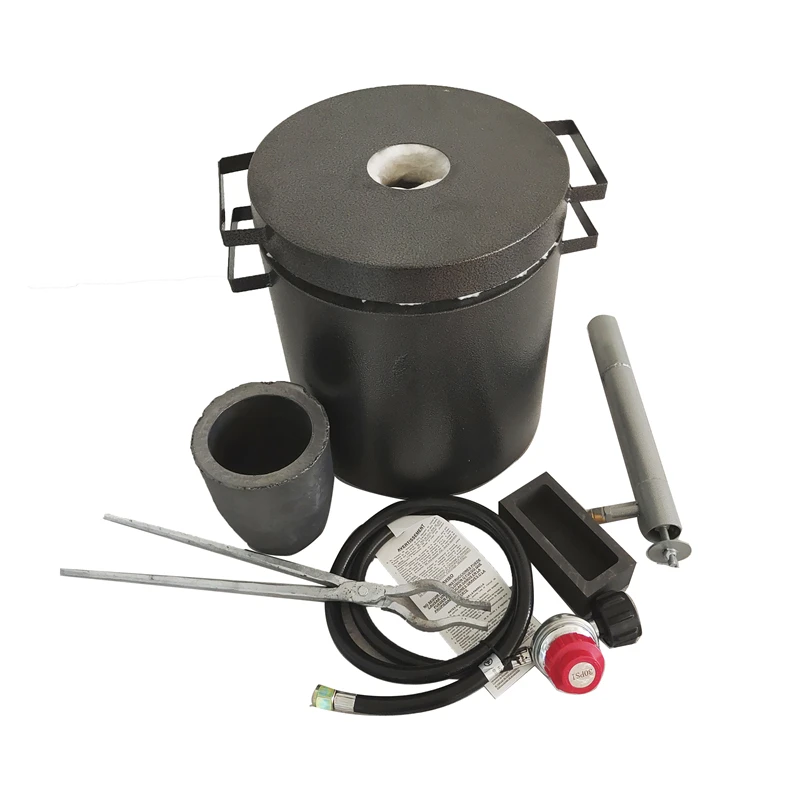
Source-controlled product identity
The Hoting queue record contains a listing for a metal-smelting furnace described in the title as a 6KG propane, graphite-crucible, electric and gas gold-melting furnace for tin, silver, copper and aluminium. The structured parameter list is empty. Consequently, no capacity, furnace type, heating power, fuel specification, crucible size, operating temperature, warm-up time, melting rate, dimensions, weight, electrical configuration, gas pressure, refractory material or compliance document can be treated as confirmed.
The title is useful for opening an RFQ, but it is not a verified datasheet. “6KG” may describe a nominal charge for one material rather than a universal capacity. “Propane,” “electric” and “gas” may refer to alternative versions, a mixed listing or a translated title. “Graphite crucible” may identify an included part, an optional accessory or only an intended application. The buyer must resolve these points before placing an order.
Product ID 1601318050613 should appear on the quotation, nameplate, furnace body, crucible documentation, inspection report and packing list. This guide is for metalworking distributors, casting workshops, jewelry and repair operations, educational labs and small-batch non-ferrous processing buyers evaluating a compact melting-furnace listing.
Recorded data versus open RFQ fields
| Information | Source status | Buyer action |
|---|---|---|
| Product ID | 1601318050613 | Require the same ID on quotation, nameplate, inspection report and shipment documents. |
| 6KG capacity | Title claim only | Define whether this is charge mass, molten output, crucible rating or material-specific capacity. |
| Propane | Title claim only | Confirm fuel version, pressure, consumption, regulator, hose, connector and local installation rules. |
| Electric | Title claim only | Confirm whether an electric version exists and request voltage, frequency, power and current. |
| Gas furnace | Title claim only | Clarify whether gas is the sole heat source or one alternative configuration. |
| Graphite crucible | Title claim only | Confirm included crucible material, dimensions, grade, mass limit and replacement price. |
| Gold, tin, silver, copper and aluminium | Application claims | Request material-specific test results, contamination limits, temperature and crucible compatibility. |
| Furnace capacity | Not supplied structurally | Request charge range, usable melt volume and maximum safe operating load. |
| Temperature | Not supplied | Request rated and measured temperature, sensor location, control range and stability. |
| Safety and compliance | Not supplied | Request fuel, electrical, thermal, EMC and destination-market documents for the exact model. |
Start with the metal and the batch requirement
A furnace should be selected from the alloy, batch mass, target temperature, contamination tolerance and pouring method. Gold, silver, copper, aluminium and tin do not impose the same thermal, crucible, atmosphere and handling requirements. A title that lists several metals does not prove that one setup can process all of them safely or cleanly.
Write the purchase requirement as a batch test: material identity, charge mass, ingot or scrap form, target molten mass, maximum allowable residue, target temperature, holding time, pouring vessel, expected cycle count and daily operating hours. Identify whether the buyer needs melting only or also holding, alloying, degassing, skimming and controlled pouring.
For a distributor, separate each fuel and control configuration into a distinct SKU. For a workshop, require a sample melt using the actual feedstock. For a laboratory or school, prioritize guarding, ventilation, training, emergency controls and documented operating limits over the headline capacity.
Resolve the 6KG claim
The title says 6KG, but the source gives no definition. Ask whether the number refers to graphite crucible charge, molten metal output, nominal capacity for aluminium, capacity for copper or a maximum load that is not intended for continuous operation.
Request a capacity table by material. It should state charge mass, usable crucible fill level, density assumption, melt time, target temperature, holding limit and pouring reserve. Do not compare two furnaces using “6KG” unless both suppliers define the value with the same material and test method.
During acceptance, weigh the charged feedstock and record the final recovered metal. Measure the remaining dross, residue and metal left in the crucible. The buyer should distinguish nominal charge capacity from saleable cast output.
Confirm the safe fill level. A crucible should not be filled to the rim because expansion, bubbling, slag and thermal movement can create a spill hazard. The supplier's manual should specify loading, lid clearance, preheating and pouring limits.
Propane, electric and gas configuration
The listing title combines propane, electric and gas language. Confirm whether the product is a propane furnace, an electrically heated furnace, a gas furnace with an electric control system, or a listing that covers several separate models.
For a propane or gas version, request fuel type, rated inlet pressure, consumption, heat input, burner model, jet size, regulator, hose, connector and flame-control method. For an electric version, request voltage, frequency, rated power, current, phase, cable, plug, breaker recommendation and heating-element type.
Never connect a fuel line or electrical supply based solely on the title. The nameplate, manual and quotation must describe the same configuration. Ask the supplier to photograph the nameplate, burner or element, controller, cable and included fittings for the exact sample.
Confirm whether propane cylinders, regulators and hoses are included. If the buyer must source them locally, request the interface specification and installation requirement. Gas installation should be reviewed by a qualified professional under the destination jurisdiction.
Graphite crucible verification
Graphite crucible is a title claim, not a structured parameter. Request crucible outside dimensions, usable internal dimensions, wall thickness, grade, density, mass, lid, pouring lip and safe charge range.
Ask whether the crucible is supplied with the furnace or sold separately. Confirm the replacement part number, lead time, price, storage procedure, preheating instruction and expected service conditions. A crucible suitable for one alloy may be unsuitable for another because of temperature, wetting, flux or contamination.
Inspect a sample crucible for cracks, chips, uneven walls, contamination and handling damage. Record its dry mass and dimensions before the test. After a controlled heat cycle, inspect for distortion, oxidation and surface degradation.
Request the supplier's guidance for flux, dross removal, tongs, lifting tools and pouring. Do not infer crucible compatibility from the word “graphite” alone.
Temperature and thermal performance
No temperature range, maximum temperature, sensor type or warm-up time is supplied. Request rated temperature, controlled setpoint range, measured hot-zone temperature, sensor location, temperature uniformity and stability.
A valid test should identify the material, charge mass, starting temperature, ambient conditions, fuel or electrical input and measurement instrument. Record the time to reach the agreed target and the temperature variation during holding.
Ask whether the displayed temperature is furnace atmosphere temperature, crucible surface temperature or an estimated controller value. If the sensor does not measure the melt, require an agreed method for confirming metal temperature before pouring.
Test recovery after loading a defined charge. A furnace may reach an empty-chamber temperature but fail to recover quickly with a full load. Record fuel pressure or electrical current during the same test.
Material-specific test planning
Aluminium, tin and some low-melting non-ferrous alloys may require a different process from copper or precious-metal work. Ask for separate recommendations for charge form, crucible, flux, target temperature, hold time, skimming and pouring.
For copper, confirm whether the furnace's thermal rating and crucible are suitable. Do not infer copper capability from a title that lists copper alongside lower-melting materials. Request a real copper test or an explicit written limitation.
For silver and gold, define contamination control, crucible history, batch segregation, flux and recovery of residues. Precious-metal buyers should require a chain-of-custody procedure for charge, dross and recovered metal.
For tin or aluminium, evaluate oxidation, dross and surface quality. Record the mass before and after melting and compare the recovered metal with the buyer's acceptance limits.
Furnace body, refractory and heat containment
No body material, insulation, refractory lining, lid construction or thermal-clearance data is provided. Request a cross-section or material description showing the hot zone, insulation, outer shell, lid, base, handles and serviceable parts.
Inspect the lid fit, hinge or lifting method, handle temperature, outer-surface temperature and visible gaps. Check whether the hot zone is protected from impact and whether the refractory can be replaced without replacing the entire furnace.
Ask for the refractory repair procedure and replacement material. Confirm dry-out or commissioning instructions for a new lining. Moisture in refractory can create a serious hazard during heating; the supplier should define a controlled first-use procedure.
Measure surface temperatures at agreed locations during a stable run. Do not describe the furnace as insulated, cool-touch or safe to operate near combustible materials without a measured clearance and documentation.
Controls, sensors and operator interface
The listing does not identify a controller, thermocouple, timer, power adjustment, gas valve, ignition system or alarm. Request a control diagram and list every operator control.
Confirm whether the operator can set temperature, heat input, hold time and shutdown. Ask whether the system has over-temperature protection, flame-failure protection, power-loss behavior, sensor-failure behavior and an emergency stop.
Run each protective function under a documented factory test. The test report should show the trigger condition, response, reset requirement and whether the heat source actually shuts off.
Check the readability of labels and the language of the manual. For export shipments, provide warnings in the destination language where required. The operator should not need to guess which valve, switch or control is safe to use.
Ventilation and workplace safety
Melting can produce heat, fumes, metal vapor, combustion products, flux fumes and splashes. The source record provides no ventilation or exhaust specification. Request the supplier's installation guidance and required extraction arrangement.
Define the workplace before purchase: non-combustible floor or bench, overhead clearance, ventilation, fire protection, gas storage, electrical isolation, PPE, spill control and restricted access.
Ask for procedures covering crucible lifting, charging, skimming, pouring, fuel isolation, electrical isolation, spill response, burns, fire and broken crucibles. These procedures are more important than the product title when the machine is used commercially.
Do not operate a gas furnace indoors without a site-specific assessment. Do not use water on a molten-metal spill. The buyer should follow local safety rules and obtain professional guidance for fuel, ventilation and fire protection.
Packaging and logistics
No dimensions, weight, packing method or carton information are supplied in the structured fields. Request gross weight, product dimensions, carton dimensions, pallet requirement, shock protection, moisture control and lifting points.
Inspect the shipment for damaged refractory, cracked crucible, bent lid, broken controls, loose fittings and missing manuals. Photograph the carton, product label, accessories and internal protection before commissioning.
If the unit contains a gas burner, regulator or electrical controller, identify whether those components are shipped installed or separately packed. Match each part number to the quotation and packing list.
Ask for spare crucibles, heating elements or burners, thermocouples, lids, tongs, seals, regulators and control parts as applicable. None of these items is confirmed by the source record and must be specified before purchase.
Factory acceptance test proposal
- Verify product ID 1601318050613, exact model, fuel configuration and nameplate.
- Resolve whether “6KG” is a charge, output or material-specific capacity claim.
- Record furnace dimensions, net weight, gross packing data and all included accessories.
- Inspect body, lid, refractory, insulation, handles, hot-zone opening and service points.
- Verify graphite crucible dimensions, grade, wall condition, safe fill level and replacement part.
- Check propane or gas pressure, consumption, connector, regulator, hose, burner and flame control.
- Check electric version voltage, frequency, power, current, cable, plug, controller and element if applicable.
- Test ignition, flame failure, over-temperature protection, sensor failure, shutdown and power-loss response.
- Measure warm-up time, target temperature, hot-zone uniformity, holding stability and recovery.
- Run an agreed material test with defined charge mass, melt target, dross, residue and recovered output.
- Inspect pouring, lid movement, crucible handling, tongs, splash control and operator clearances.
- Review manual, ventilation, fire safety, fuel/electrical documents, warranty, spare parts and packing.
RFQ checklist
- Product ID 1601318050613 and photograph of the exact production nameplate.
- 6KG definition: material, charge mass, usable fill level, molten output and test method.
- Propane/gas version: fuel, pressure, consumption, heat input, burner, jet, regulator, hose and connector.
- Electric version: voltage, frequency, phase, rated power, current, element, cable, plug and breaker.
- Graphite crucible: material grade, dimensions, wall thickness, safe load, lid, tongs and replacement.
- Material-specific capability for gold, tin, silver, copper and aluminium, including limitations.
- Rated temperature, maximum temperature, sensor, controller range, uniformity, stability and warm-up.
- Body, refractory, insulation, lid, service parts, commissioning and dry-out instructions.
- Flame failure, over-temperature, emergency shutdown, sensor failure and power-loss protections.
- Ventilation, exhaust, gas storage, electrical isolation, fire protection and PPE requirements.
- Dimensions, weight, carton, pallet, shock protection, marks and lifting/handling instructions.
- Manual, fuel/electrical safety documents, EMC, thermal and destination-market compliance.
- Sample test: charge, target, time, fuel/input, temperature measurement, dross and recovered output.
- MOQ, sample cost, lead time, spare crucibles, service, warranty and inspection terms.
Buyer decision framework
This listing is a metal-smelting furnace candidate whose structured source record contains no confirmed technical parameters. Approve it only after the supplier resolves the fuel configuration, 6KG definition, crucible specification, temperature capability, material-specific test, protective controls, installation requirements and destination-market documents.
For a distributor, create separate SKUs for propane, other gas and electric configurations rather than merging them under one title. For a workshop, prioritize a controlled sample melt and replacement-crucible availability. For precious-metal work, prioritize contamination control and documented recovery. A listing title can start procurement, but it cannot replace a furnace datasheet or safety assessment.
Frequently asked questions
Is the capacity definitely 6KG?
6KG appears in the title only. Confirm whether it is a nominal charge, molten output or material-specific rating, and obtain a test method.
Does the furnace use propane or electricity?
The title contains both propane and electric/gas wording. Confirm whether these are alternative models or one configuration, then require the exact nameplate and connection data.
Is a graphite crucible included?
Graphite crucible appears in the title, but inclusion and dimensions are not recorded. Request the accessory list, crucible grade and replacement quotation.
Can it melt copper, aluminium, silver, tin and gold?
The title lists those materials, but no material-specific test or temperature data is provided. Require separate capability statements and a buyer-approved sample test.
Can it be installed in a small workshop?
Installation suitability depends on fuel, ventilation, heat clearance, fire protection, electrical isolation and local requirements. Confirm the site conditions with qualified professionals before commissioning.
Source and contact
This guide is based on the Hoting queue record for product ID 1601318050613, whose structured parameter list is empty. Before purchase, request the current quotation, exact configuration, nameplate, furnace drawing, crucible data, fuel or electrical datasheet, measured temperature test, material sample results, safety manual, compliance documents, packing list, spare-parts offer, warranty and final machine photographs. For sourcing questions, contact the TEBAK sales team through the site's current inquiry channel.