
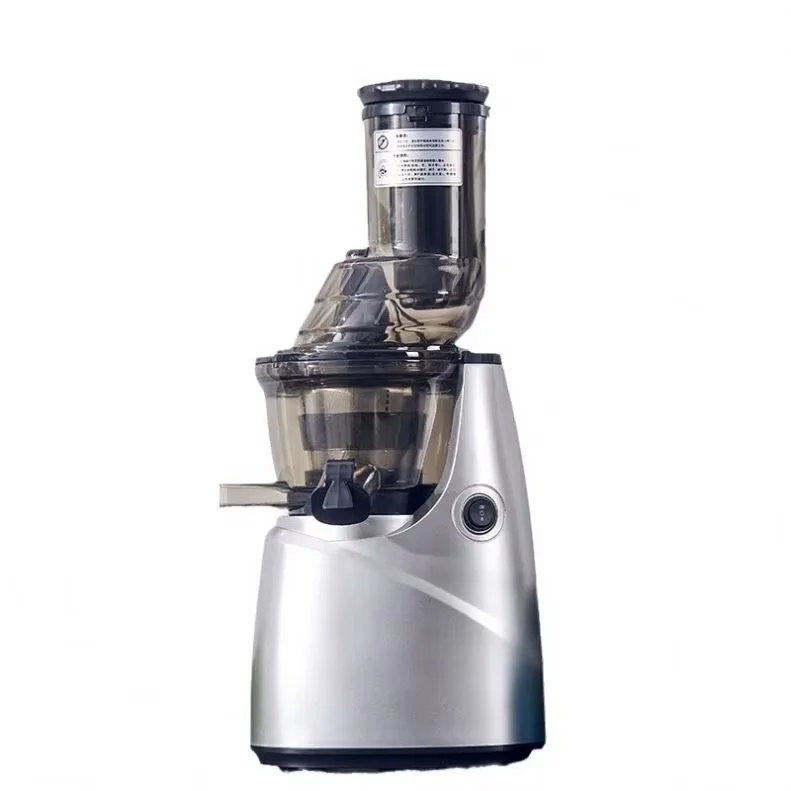
Source-controlled product identity
The Hoting queue identifies Product ID 1601607801304 as an automatic pulping juicer with a wide mouth and a slow-juicer/portable-juicer classification. The structured record lists a plastic housing, kitchen-appliance juicer extractor usage, dimensions of 22.9*20.1*49.7cm, a rated speed of 45 RPM, 240W power, 220V voltage, 1.0L capacity, Space Silver color and China as the place of origin.
This procurement guide keeps those values separate from product-name claims such as automatic pulping, wide-mouth loading, commercial use, home use and without-cutting operation. The source does not specify noise, juice yield, pulp dryness, feed opening diameter, auger material, filter mesh, duty cycle, reverse function, cleaning time or food-contact certification. Those details must be confirmed with the supplier and tested on the buyer’s ingredients before purchase.
The unit may suit juice bars, cafés, hotel breakfast stations, healthy-drink counters, home-appliance distributors, demonstration kitchens and small food-service operations. The correct buying decision depends on the buyer’s ingredient program, service hours, local electrical requirements, cleaning workflow and required output—not on the 1.0L label alone.
Confirmed specifications and supplier confirmation points
| Field | Recorded value | Procurement action |
|---|---|---|
| Product ID | 1601607801304 | Require the same ID on the quotation, label, inspection sheet and shipping documents. |
| Type | Slow Juicer, Portable Juicer | Confirm the operating principle, auger arrangement, included filters and portability features. |
| Housing material | Plastic | Confirm the material grade, heat resistance, impact resistance and cleanability. |
| Usage | Kitchen Appliance Juicer Extractor Machine | Confirm intended duty cycle and whether the supplier supports commercial service hours. |
| Dimensions | 22.9*20.1*49.7cm | Confirm the order of L/W/H, unpacked measurement method and required operating clearance. |
| Rated speed | 45 RPM | Confirm whether this is no-load speed, nominal operating speed or a fixed motor speed. |
| Power | 240W | Confirm rated input, peak/start current, frequency and motor protection. |
| Voltage | 220V | Confirm allowable voltage tolerance, frequency and plug for the destination market. |
| Origin | China | Request origin documents and the exact manufacturing entity if required by import rules. |
| Capacity | 1.0L | Ask whether this is juice output, hopper volume, pulp container or another nominal volume. |
| Color | Space Silver | Confirm finish, color tolerance and whether private-label colors are available. |
| Wide-mouth/automatic claims | Listing description only | Request feed-opening dimensions, loading limits, controls and a timed demonstration. |
Define the buyer’s juice program before quoting
Prepare a product list before asking for a quotation. Separate soft fruit, fibrous vegetables, leafy greens, citrus, hard vegetables, frozen ingredients and mixed recipes. A slow juicer’s result can change materially with ingredient size, ripeness, fiber, temperature and recipe order.
Record the expected service window, daily batches, serving size, target output, cleaning breaks and number of operators. The source gives 240W and 45 RPM but does not establish continuous operating time or commercial throughput. Ask the supplier to state a tested duty cycle rather than assuming that “commercial” in the listing means all-day operation.
Decide whether the buyer needs one 1.0L vessel for batch work or a larger workflow with rapid emptying and cleaning. Confirm whether the 1.0L figure refers to the juice container, pulp container, hopper or a maximum fill mark. Ask for a dimensioned drawing and photographs showing every container.
For home and small-counter use, footprint, noise, storage and cleaning may dominate. For a café or hotel, the key questions are repeatability, recovery after jams, operator training, spare parts and the time required between recipes.
Wide-mouth and without-cutting claims
The title describes a wide-mouth machine and suggests that fruit may be processed without cutting. These are listing claims, not structured performance specifications. Request the actual feed-opening width and height, the maximum recommended ingredient dimensions, the permitted loading rate and the list of ingredients that must still be cut.
Test whole and partially prepared ingredients that represent the buyer’s menu. Measure feeding effort, motor response, jamming, splashing, juice separation and residue. A wide mouth does not prove that every whole fruit is safe or appropriate for the machine.
Ask for the supplier’s loading procedure, pusher use, prohibited materials and jam-clearing method. Never force a hard or oversized ingredient through the feed opening. Confirm whether the motor must be stopped before reversing or removing the auger.
Document the difference between “without cutting” in marketing copy and the supplier’s written operating limit. Put the approved ingredient size in the purchase specification and acceptance test.
45 RPM: what to verify
The recorded rating is 45 RPM. Confirm how the supplier measured it and whether it describes the motor, shaft, auger or no-load speed. Ask whether the speed changes under load and whether the machine has a control, reverse function or fixed-speed switch.
During a sample test, measure the time required to process a fixed mass of each ingredient. Record feed rate, juice volume, pulp condition, temperature rise, vibration and any change in speed. Use the same ingredient preparation and recipe order for comparison.
Do not convert 45 RPM into a promised extraction rate. A slow rotational speed can be useful for a particular recipe, but it does not by itself establish yield, texture, oxidation, noise or continuous-duty performance.
Ask for motor protection against overload, jam recovery and thermal cut-off. Confirm whether a restart is automatic or requires operator intervention after protection activates.
240W power and 220V electrical planning
The source records 240W and 220V. Before ordering, confirm rated frequency, allowable voltage range, plug type, earthing arrangement, insulation class, fuse or breaker recommendation and the motor’s starting current. Do not assume that a 220V listing is suitable for every 220V supply without checking frequency and plug requirements.
Request a nameplate photograph for the exact production configuration. The quotation should identify input voltage, frequency, rated power, model, serial-number format and any electrical approvals required for the destination market.
For commercial counters, check the location of the socket, splash protection, cable length and cleaning isolation procedure. Keep the electrical connection away from wash water and establish a lockout or unplugging procedure before removing the auger, filter or cover.
The source does not provide noise, thermal or protection values. Request a supervised operating test at the buyer’s voltage and ingredient load, then record measured current, surface temperature, noise and protective behavior using an agreed method.
1.0L capacity and workflow design
The recorded capacity is 1.0L. Confirm the component to which this capacity applies and the usable fill level. Ask whether the mark indicates nominal container volume, maximum liquid volume, juice yield or batch guidance.
Run a timed batch test using the buyer’s recipe. Record starting ingredient mass, liquid input if any, juice recovered, pulp recovered, waste, elapsed time and the number of stops required. Repeat the test with a second batch after cleaning or emptying the containers.
If the buyer sells individual servings, calculate how many servings one tested batch produces. If the buyer operates a hotel or café line, test the queue between batches, vessel emptying, filter cleaning and restart time. Do not extrapolate daily capacity from a single 1.0L nominal value.
Confirm whether the product includes juice and pulp containers, covers, pushers, filters, cleaning brushes, seals and spare wear parts. List each included component on the quotation and packing list.
Plastic housing and food-contact review
The housing material is recorded as plastic, but no polymer grade, food-contact declaration, temperature rating, UV resistance or impact test is supplied. Ask the supplier to identify every food-contact component separately from the external housing.
Request material declarations for the auger, filter, chute, containers, seals, pusher and any coating. Confirm compatibility with acidic fruit, oils, pigments, hot-water cleaning and the buyer’s approved detergent. Do not treat “plastic housing” as evidence that all internal parts are food-contact compliant.
Inspect seams, corners, drain paths and hidden cavities where pulp can accumulate. Ask for disassembly instructions and a cleaning diagram. Verify that seals can be removed, inspected and replaced without damaging the machine.
If the destination market requires food-contact, electrical or environmental documents, request current documents for the exact model and configuration. Do not publish or promise CE, LFGB, FDA, RoHS or other compliance unless supporting documents are supplied and match the unit being purchased.
Cleaning, sanitation and serviceability
Juice equipment is purchased as a cleaning workflow as much as a motor. Ask the supplier to demonstrate shutdown, unplugging, disassembly, filter cleaning, auger removal, seal inspection, reassembly and leak testing.
Measure the time from the end of one recipe to a clean, ready-to-run machine. Record the tools required, water temperature, brush access, number of parts and drying method. Confirm whether any part is dishwasher-safe only when the supplier provides a written temperature and detergent limit.
Test a high-pulp recipe and inspect the filter, chute and pulp path. Check for retained fibers, staining, odor and difficult-to-reach corners. Repeat after the machine has cooled and after the parts have dried.
Request a spare-parts list for filters, seals, auger, containers, pusher, switches, motor protection parts and any proprietary tools. Agree replacement lead times and warranty handling before placing a production order.
Acceptance test for a B2B purchase
- Verify Product ID 1601607801304, model label, Space Silver finish and supplier paperwork.
- Confirm the exact 220V electrical configuration, frequency, plug and nameplate data.
- Measure the machine at 22.9*20.1*49.7cm and confirm measurement order and operating clearances.
- Verify 240W input under the buyer’s supply and record current and protection behavior.
- Verify the 45 RPM claim with the supplier’s stated measurement method.
- Confirm the actual feed-opening dimensions and demonstrate approved ingredient sizes.
- Run soft, fibrous and hard ingredients selected by the buyer; record jams and recovery.
- Confirm whether the 1.0L capacity refers to the juice container, pulp container or another part.
- Measure juice output, pulp output, waste and elapsed time using a defined recipe.
- Inspect food-contact parts, seals, filter, auger, containers and cleaning access.
- Run a cleaning and reassembly test and record ready-to-run time.
- Check vibration, noise, temperature, leakage, splash control and restart behavior.
- Verify included accessories, spare parts, manual, warranty and package protection.
RFQ checklist
- Product ID 1601607801304 and exact model/revision.
- Rated voltage range, frequency, plug, earthing and destination-market electrical documents.
- 240W input definition, starting current, overload protection and thermal recovery.
- 45 RPM measurement method, load behavior and reverse/jam function.
- Feed-opening dimensions, maximum ingredient size and written “without cutting” limits.
- Meaning of 1.0L capacity and dimensions of every container.
- Juice yield, pulp dryness, output rate, noise and continuous-duty test results.
- Food-contact material declarations for auger, filter, chute, containers and seals.
- Cleaning sequence, removable parts, dishwasher limits and sanitation instructions.
- Motor, auger, filter, seal, pusher and container spare-part codes.
- Machine size 22.9*20.1*49.7cm, packed dimensions and shipping weight.
- Housing color Space Silver, finish tolerance and OEM/private-label options.
- Warranty, service response, replacement lead time, packaging and inspection protocol.
Safety and compliance
Keep hands, utensils and loose clothing away from the feed opening and moving auger. Use only the specified pusher. Stop and unplug the machine before removing a cover, filter, auger or jammed ingredient.
Do not use the machine for ingredients that the supplier prohibits. Confirm whether pits, hard seeds, ice, hot liquids, fibrous skins, frozen material or non-food objects are excluded. The source record does not establish any of these limits.
Keep the plastic housing and electrical base dry. Do not immerse the motor housing. Establish a cleaning and inspection checklist for seals, cable, plug, switch, filter and container before each service period.
Request destination-market documentation for electrical safety and food-contact use. A product description, 220V field or China origin does not by itself prove regulatory compliance.
Buyer decision framework
This candidate is a TEBAK automatic pulping/slow juicer listing with a plastic housing, 45 RPM rating, 240W power, 220V voltage, 1.0L recorded capacity, 22.9*20.1*49.7cm dimensions and Space Silver color. It may fit a compact juice workflow when the buyer’s recipes and service hours match the tested duty cycle.
Approve the order only after the supplier defines the wide-mouth opening, ingredient limits, 1.0L capacity reference, food-contact materials, cleaning method, output test, noise, duty cycle, electrical configuration and spare-parts plan. The most important open questions are not visible in the title: they are yield, cleaning time, load behavior, protection and compliance.
Frequently asked questions
What is the recorded speed?
The queue record lists 45 RPM. Confirm whether this is no-load, nominal or loaded auger speed before using it in a production calculation.
Is the capacity 1.0L?
The source records 1.0L, but does not identify the component or usable fill level. Ask the supplier to identify the vessel and demonstrate the buyer’s recipe.
Can whole fruit be loaded without cutting?
The title makes that claim, but the source does not provide a feed-opening dimension or ingredient limit. Request a written loading limit and test representative ingredients.
What voltage does it use?
The recorded voltage is 220V and power is 240W. Confirm frequency, allowable range, plug and destination-market documents.
Is the plastic housing food-safe?
Housing material alone does not identify internal food-contact parts. Request material declarations for the auger, filter, chute, containers and seals.
Source and contact
This guide is based on the Hoting queue record for Product ID 1601607801304. Recorded fields are slow/portable juicer type, plastic housing, kitchen-appliance juicer usage, 22.9*20.1*49.7cm dimensions, 45 RPM, 240W, 220V, China origin, 1.0L capacity and Space Silver color. Before purchase, request the current quotation, technical drawing, ingredient limits, output test, cleaning instructions, material documents, spare-parts list, warranty and destination-market compliance documents through the TEBAK sales inquiry channel.
Key specifications
- Type
- Slow Juicer, Portable Juicer
- Housing Material
- Plastic
- Usage
- Kitchen Appliance Juicer Extractor Machine
- Dimensions
- 22.9*20.1*49.7cm
- Rating (Rpm)
- 45
- Power (W)
- 240
- Voltage (V)
- 220
- Place of Origin
- China
- Capacity
- 1.0L
- Color
- Space Silver