
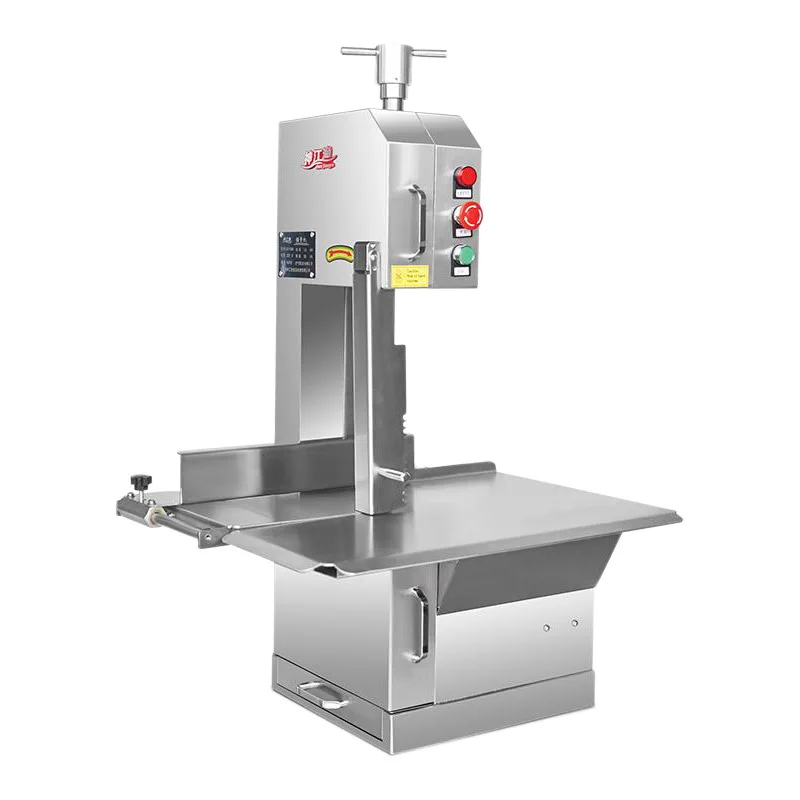
The parameter block is empty, and the description is a template
The product page publishes zero parameters. The description, all 800 characters of it, reads in full:
“Product Description / Butchery Pig Frozen Bone Saw Electric Meat Machine … If you make the order in our store, the each model real picture as follows: Packing&Shipping / Company Introduction / Company introduction. Hengshui Mengshang Trading Co., Ltd. is a main professional supplier in Product Machine, CNC Carbide inserts, Turning tools and Milling tools…”
That is a cutting-tool company's boilerplate. It says nothing about a bone saw: no blade, no table, no throat, no cutting height, no speed, no weight. A block of identical text appears on the hydrogen generator and the nail-gel filler listed in this same catalogue, which tells you how much attention went into it.
A sibling listing for what appears to be the same machine goes further. Item 181, in the same family with three of the same photographs, describes itself as “Shenzhen onetouch trading company … a wholesale company that manufactures good & high quality knitting wear and woven wear, starting from 2006 … current styles and fabrics.” A meat saw introduced by a garment wholesaler.
The specifications are inside the photographs
The eight images carry six specification panels. Reading them is the only way to learn anything about this machine, and they do not agree with each other or with the model table on the sibling listing.
| Panel | Stainless tag | Power | Pulley | Band speed | Cutting height | Overall dims |
|---|---|---|---|---|---|---|
| W120BC | not tagged | 0.85 kW | 128 mm | 15 m/s | not legible | 50 × 40 × 72 cm |
| W120A | full body stainless | 0.85 kW | 128 mm | 15 m/s | 20 cm | 50 × 40 × 72 cm |
| F120A | full body stainless | 0.85 kW | 128 mm | 15 m/s | 20 cm | 50 × 40 × 72 cm |
| F210A | full body stainless | 1.5 kW | 165 mm | 15 m/s | 22 cm | 62 × 50.5 × 102 cm |
| F250A | full body stainless | 1.5 kW | 1710 mm | 15 m/s | 26 cm | 62 × 50.5 × 102 cm |
| W250BE | not tagged | 1.5 kW | 165 mm | 15 m/s | 26 cm | 62 × 50.5 × 102 cm |
A fifth model appears in the sibling listing's parameter table but on no panel: SJY-F280A, 1.8 kW, 62 × 50.5 × 103 cm, 60 kg. Counting the two sources, this family carries seven designations — W120BC, W120A, F120A, F210A, F250A, F280A and W250BE — and no single page lists them all.
Every model runs at the same band speed
Fifteen metres per second, on all six panels. That is the single most consistent number in the listing, and it is worth understanding what it does and does not tell you.
Band speed is what turns motor power into cutting force. For a blade moving at velocity v driven by power P, the force available at the cutting edge is F = P / v. With v fixed at 15 m/s across the range, power converts to force one for one:
| Power | Force at the blade | In kgf | Models |
|---|---|---|---|
| 0.85 kW | 56.7 N | 5.8 kgf | W120BC, W120A, F120A |
| 1.5 kW | 100.0 N | 10.2 kgf | F210A, F250A, W250BE |
| 1.8 kW | 120.0 N | 12.2 kgf | F280A |
That is the whole difference between the classes, and it is a modest one: the 1.5 kW machine has 1.76 times the cutting force of the 0.85 kW machine, not twice, and the 1.8 kW has 2.1 times. Everything else on the panels — the stainless tag, the cutting height, the pulley — is a different question.
The practical consequence is that 57 N is a small number. An operator leaning on the sliding carriage can supply more than that by hand. On the 0.85 kW models the motor, not the operator, becomes the limit, and the symptom is a stalled blade in a frozen cut rather than a slow one.
What 15 m/s means in revolutions, and the pulley that cannot exist
Wheel speed follows from band speed and pulley diameter: revolutions per second equals 15 divided by the circumference.
| Pulley | Circumference | Wheel speed |
|---|---|---|
| 128 mm | 0.402 m | 37.3 rev/s = 2,238 rpm |
| 165 mm | 0.518 m | 28.9 rev/s = 1,736 rpm |
| 1,710 mm as printed | 5.372 m | 2.79 rev/s = 168 rpm |
The F250A panel lists a pulley diameter of 1,710 mm. The machine it is printed on is 1,020 mm tall. The pulley would be 690 mm wider than the machine is tall, and its circumference alone would be 5.37 metres. It cannot exist, and it is a typographical error for 165 mm, which is what the identical W250BE panel states.
Two things follow. First, the 0.85 kW class runs its wheel at 2,238 rpm and the 1.5 kW class at 1,736 rpm; lower speed with more power is the right direction for harder product, and it is the reason the bigger machine costs more than a bigger motor. Second, when one field on a printed panel is impossible, the rest of that panel deserves checking rather than trust.
Torque at the wheel, T = P / ω, gives 3.63 N·m on the 0.85 kW/128 mm combination against 8.25 N·m on the 1.5 kW/165 mm one — a factor of 2.3, which is the real measure of how much harder the larger saw can push.
Power supply: single phase only, and close to a small breaker
Every panel states 220 V. There is no three-phase option anywhere in the family, so the saw needs a single-phase circuit regardless of which model you choose.
| Power | Current at 220 V | Share of a 10 A circuit | Share of a 16 A circuit |
|---|---|---|---|
| 0.85 kW | 5.7 A | 57% | 36% |
| 1.5 kW | 10.0 A | 100% | 63% |
| 1.8 kW | 12.0 A | 120% | 75% |
Assuming a power factor of 0.80 and motor efficiency of 0.85, the 1.5 kW models sit exactly at the rating of a 10 A circuit and the 1.8 kW model exceeds it. In a kitchen wired with 10 A circuits, the larger saws need their own 16 A supply, and the 1.8 kW model should not share a circuit with anything that cycles.
Starting current is not published. A direct-on-line single-phase motor of this size draws several times its running current for a fraction of a second, which matters if the circuit already carries refrigeration.
Cutting height is the number that decides frozen from fresh
Three different cutting heights appear across six panels:
| Class | Cutting height | What it admits |
|---|---|---|
| 120 class | 200 mm | Portions, ribs, poultry, bone-in chops laid flat |
| 210 class | 220 mm | The same, with 20 mm more clearance for a standing block |
| 250 class | 260 mm | Frozen blocks and larger joints stood on edge |
The 40 mm between the 200 mm and the 260 mm class is the difference between a saw that cuts portions and one that breaks down frozen blocks. It is also the only published dimension that changes between the two 1.5 kW machines: F210A gives 220 mm and W250BE gives 260 mm for the same money in power, pulley and footprint.
Note what is not published: the throat, meaning the distance from the blade to the column, which sets the largest radius of workpiece that will pass. The overall dimensions do not give it. A 620 × 505 mm footprint tells you the machine's outline, not the opening you can push meat through.
The model digits do not match any published dimension
It is natural to read 120, 210 and 250 as millimetres of something. They do not line up with the cutting height:
| Class | Digits | Published cutting height | Difference |
|---|---|---|---|
| 120 | 120 mm | 200 mm | +80 mm |
| 210 | 210 mm | 220 mm | +10 mm |
| 250 | 250 mm | 260 mm | +10 mm |
If the digits were the cutting height, the 120 class would cut 120 mm, not 200 mm. If they were the throat, the 120 class would leave 120 mm from blade to column, which the panel does not state either. The pattern for 210 and 250 — digits plus ten — is suggestive, but the 120 breaks it by 80 mm, so the scheme is not consistent and the page never defines it.
Two pairs of panels are worse than uninformative, they are indistinguishable:
| Pair | Identical in | Differs in |
|---|---|---|
| W120A vs F120A | 0.85 kW, 128 mm, 15 m/s, 200 mm height, 50 × 40 × 72 cm, both tagged full body stainless steel | the prefix letter only |
| F250A vs W250BE | 1.5 kW, 15 m/s, 260 mm height, 62 × 50.5 × 102 cm | the pulley field (one is the 1,710 mm typo) and the stainless tag |
If W and F mean two different body materials, the panels should not both claim full stainless steel. If they mean something else, the listing does not say. In either case you cannot choose between them from this page, and the price difference between two designations that look identical is exactly the sort of thing a buyer should ask about.
The blade is the recurring cost, and it is not specified
Every number above is a purchase decision you make once. The blade is the decision you make every few weeks, and the listing publishes none of it: no blade length, no width, no thickness, no tooth pitch, no tooth material.
For a band saw this is the practical trap. Blade length is fixed by the wheel diameter and the frame geometry, and a length that only the seller stocks means every replacement comes from the same seller at whatever price they set. Three things to establish before ordering:
- Blade length in millimetres, so you can price it against commodity suppliers
- Blade width and thickness, which set the minimum radius the blade can turn on these wheels
- Tooth pitch options, because frozen bone and fresh meat want different pitches, and pitch is the one variable left to you when the band speed is fixed at 15 m/s
The listing advertises both frozen and fresh product in the same title, on the same machine, at the same speed. Since those two duties want different blades, the blade is where the difference has to be made, and no blade is specified.
For a food machine, the hygiene declarations are missing
A saw that contacts raw meat is not an ordinary machine purchase. The things a buyer needs and this page does not give:
| Declaration | Status on this listing | Why it matters |
|---|---|---|
| Body material and grade | “304” appears in a sibling title only; panels say “full body stainless steel” without a grade | 304 resists chloride washdown; painted steel does not |
| Food-contact compliance | absent | Local inspectors ask for it |
| Ingress protection | absent | A washdown saw needs a stated IP rating at the switch and motor |
| Lower blade guard | not visible in the photographs | Exposed blade below the table is the main injury path |
| Table lift-out for cleaning | not stated | Cleaning between products depends on it |
| Emergency stop | visible on the larger panels, red mushroom button | Present, which is the one safety item the panels do show |
The panels do show a sliding pusher and carriage at the left of the table, which keeps hands away from the blade, and an enclosed upper wheel housing. Those are real and worth noting. What is absent is documentation rather than hardware.
What 30 to 60 kilograms means for the floor and the freight
The sibling table gives net weights: 30 kg for the 120 class, 53 to 54 kg for the 210 and 250 classes, 60 kg for the 280. Those are net weights, not shipping weights, and no crate dimension appears anywhere.
| Model | Net weight | Overall footprint | Height |
|---|---|---|---|
| SJY-W120BC / W120A | 30 kg | 50 × 40 cm | 72 cm |
| SJY-F210A / F250A | 53–54 kg | 62 × 50.5 cm | 102 cm |
| SJY-F280A | 60 kg | 62 × 50.5 cm | 103 cm |
Two details worth flagging. The F210A to F250A step adds 10 mm of cutting height and 1 kg of weight, while the F280A adds another 10 mm of height and 6 kg — the last step is six times heavier for the same increment, which suggests a different frame or motor rather than a scaled opening. And the 1,020 mm tall models are floor-standing while the 720 mm ones need a table at working height, so the installation differs even though the titles do not.
For freight you need gross weight and crate dimensions, neither of which exists here. At 60 kg net a single crate is likely to move as general cargo rather than parcel, and the rate depends entirely on the carton, not the machine.
Choose by force and height, not by model number
Strip away the designations and there are three real choices:
| Duty | What you need | Model in this family |
|---|---|---|
| Portioning fresh poultry and fish, light use | 57 N is enough; 200 mm height is enough | The 0.85 kW class |
| Butchery counter, bone-in cuts, occasional frozen | 100 N and 260 mm; floor standing | The 1.5 kW class, 250 designation for the height |
| Frozen blocks, continuous production | 120 N, and a blade pitched for frozen product | The 1.8 kW F280A — which has no panel at all |
The last row is the problem. The model most suited to frozen production is the one with no published speed, no published cutting height and no published pulley. Its power and weight are known from a table; nothing about its cut is.
For everything else, the decision reduces to two numbers you now have: force at the blade, which is power divided by 15 m/s, and cutting height, which is 200, 220 or 260 mm. Buy on those and the model letters stop mattering.
What to put in the request for quotation
| # | Question | Why |
|---|---|---|
| 1 | Which model exactly, in one line, with the full designation including prefix | Seven designations circulate; the page names none |
| 2 | Blade length, width, thickness and available tooth pitches | The recurring cost, and the only variable for frozen versus fresh |
| 3 | Throat depth, blade to column | Sets the largest workpiece that will pass; not derivable |
| 4 | Cutting height as a measured millimetre value | 200 / 220 / 260 mm decide frozen versus portion work |
| 5 | Table dimensions and whether the table lifts out | Cleaning between products |
| 6 | Pulley diameter, confirmed, and wheel rpm | One panel prints 1,710 mm on a 1,020 mm machine |
| 7 | Band speed confirmed at the blade, not at the motor | All panels say 15 m/s; motor speed is unreduced on the small class |
| 8 | Body material and grade, 304 or otherwise, plus which parts are stainless | “Full body stainless” appears without a grade |
| 9 | IP rating of motor and switch gear | Washdown |
| 10 | Food-contact compliance documents | Required by most inspectors |
| 11 | Blade guard arrangement, including below the table, and whether the door is interlocked | The main injury path |
| 12 | Gross weight and crate dimensions | Only net weights are published |
| 13 | Starting current, and whether a 10 A circuit is acceptable for the 1.5 and 1.8 kW models | The 1.8 kW draws about 12 A running |
| 14 | Spare parts: blade, wheel bearings, scraper, drive belt | None listed |
Question 1 is the one that unblocks the rest. Until the seller names a single model, every other answer applies to a family of seven.
The honest summary
There is a real machine behind this page. The panels show an enclosed upper wheel housing, a sliding pusher carriage, an emergency stop on the larger models, and a body described as full stainless. The dimensional data in the sibling table is coherent, and the weights are consistent with the sizes.
What is missing is the product identity and the four numbers that decide whether it works for you: blade length, throat depth, cutting height for the model you actually get, and the tooth pitch you can buy. Against that, the published force figures — 57, 100 and 120 newtons — are genuinely useful, because they come from two numbers the panels do state plainly, power and band speed, and they are enough to tell you which class you need.
One printed pulley size on a 1,020 mm machine reads 1,710 mm. Treat that as a reminder to confirm every field rather than a reason to walk away.
Frequently asked questions
- What are the specifications of this bone saw?
- The parameter block is empty. Everything known comes from six specification panels inside the eight photographs. They show a 0.85 kW class at 128 mm pulley and 200 mm cutting height, and a 1.5 kW class at 165 mm pulley with either 220 mm or 260 mm cutting height. Every panel states 15 m/s band speed and 220 V single phase. A fifth model, SJY-F280A at 1.8 kW and 60 kg, appears only in a sibling listing's table with no panel of its own.
- How much cutting force does 0.85 kW give?
- With band speed fixed at 15 m/s on every model, force at the blade is power divided by speed. 0.85 kW gives 56.7 N, 1.5 kW gives 100 N and 1.8 kW gives 120 N. So the 1.5 kW machine has 1.76 times the cutting force of the 0.85 kW one rather than double, and an operator pushing on the carriage can exceed 57 N by hand, which is why the small class stalls in a frozen cut.
- The F250A panel says the pulley is 1,710 mm. Is that right?
- No. The machine on that panel is 1,020 mm tall, so a 1,710 mm pulley would be 690 mm wider than the machine is tall, with a 5.37 m circumference. It is a typographical error for 165 mm, which is what the otherwise identical W250BE panel states. At 15 m/s a 165 mm pulley turns at 1,736 rpm and a 128 mm pulley at 2,238 rpm.
- What is the difference between W120A and F120A?
- Nothing published. Both panels give 0.85 kW, a 128 mm pulley, 15 m/s, 200 mm cutting height and 50 x 40 x 72 cm, and both are tagged full body stainless steel. They differ only in the prefix letter, and the listing never defines what W and F mean, so the two cannot be told apart from the page. Ask the seller for the difference and the price gap.
- Why do the model numbers not match the dimensions?
- The digits 120, 210 and 250 do not equal the published cutting heights of 200, 220 and 260 mm. The 210 and 250 classes are ten millimetres below their height, but the 120 class is eighty millimetres below, so no single rule fits. The digits may be a throat dimension, but the page never defines it, and throat depth is not printed anywhere either.
- Can I buy blades elsewhere?
- Only if you know the blade length, width and thickness, and the listing publishes none of them. Blade length is fixed by the wheel diameter and frame, so an unusual length ties every replacement to the original seller. Ask for all four figures before ordering, together with the available tooth pitches, because with band speed fixed at 15 m/s the pitch is the only thing you can change between frozen and fresh work.
- Will it run on a normal kitchen circuit?
- All models are 220 V single phase. At a power factor of 0.80 and efficiency of 0.85, the 0.85 kW models draw 5.7 A, the 1.5 kW models 10.0 A and the 1.8 kW model 12.0 A. The 1.5 kW sits exactly at the rating of a 10 A circuit and the 1.8 kW exceeds it, so the larger saws want their own 16 A supply. Starting current is not published.