
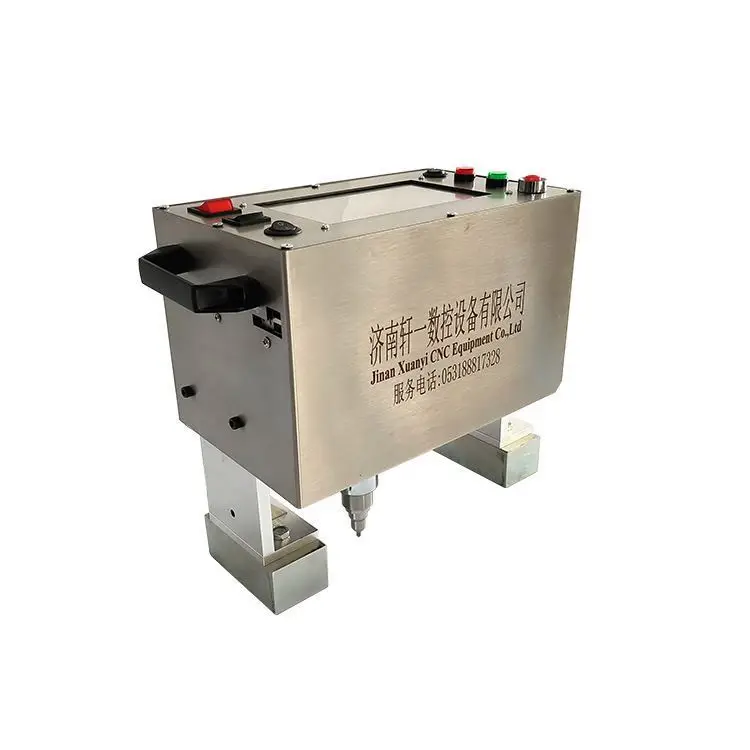
Source-controlled product identity
The Hoting queue identifies Product ID 1601251246030 as a handheld dot peen marking machine for vehicle identification numbers, steel nameplates and chassis numbers, listed under the title naming a car VIN number handheld dot pin engraving machine. The record carries sixteen populated parameters, which is the fullest marking-machine specification in this queue.
Two things have to be settled before any of those parameters can be used. The first is that the description's own heading names a different product: it calls the item a laser-cylinder gas bottles coding handheld portable pin dot marking machine and gives a model code XY-08, while the parameter block and the product title both describe model family PEQD-030 / PEQD-030E. The second is that one parameter cell states two rates that cannot both be right, and the gap between them is large enough to change how a production line is planned.
This guide reproduces the record, sets out what each parameter actually decides, works through the marking window against a standard seventeen character vehicle identification number so that a buyer can see which window suits which job, and lists the questions the block leaves open. The two figures that matter most in day to day use, marking time per unit and air consumption, are the two the record does not settle.
The sixteen recorded parameters, verbatim
| Parameter | Recorded value |
|---|---|
| Machine Name | Portable Dot Peen Marking Machine |
| Model | PEQD-030 | PEQD-030E |
| Machine Type | Portable Marking | LCD Control + Portable Marking |
| Standard Marking Area | 135mm×20mm |
| Optional Marking Area | 90mm×20mm, 125mm×20mm, 150mm×100mm, 200mm×100mm |
| Marking Depth | 0.01~2mm |
| Marking Speed | ≤50mm/second (for characters height of 3mm / 3-4 numbers/s) |
| Lifting Range | 0-300 mm |
| Marking Accuracy | 0.01 mm |
| Pin Hardness | HRA 92 |
| Power Supply | 220V±10%, 50HZ |
| Air Pressure | 0.2-0.6 Mpa |
| Machine Power | ≤400 W |
| Working Environment | -5~40 ℃ |
| Making Head Weight | 3 Kgs (Portable) |
| Whole Machine Weight | 5 Kgs | 30 kgs |
Which model, and what the letter buys
The model row gives two codes and the machine type row gives two descriptions in the same order: PEQD-030 is described as portable marking, and PEQD-030E is described as LCD control plus portable marking. So the difference between the two is a control and display arrangement rather than a marking mechanism.
That difference is not cosmetic in use. A dot peen machine without a display is normally programmed from a separate controller, a keypad or a connected computer, and the operator sends or selects a marking job from outside the head. A machine with its own LCD control can hold and select jobs at the point of marking, which matters at a chassis station where the operator is standing at the vehicle rather than at a bench.
What the record does not say is what the LCD model can actually store and do: how many marking files it holds, whether it can run a sequential counter or a date code without being reprogrammed for each unit, whether it accepts input from a keyboard or a barcode reader, what connection it offers for loading files, and whether the control is attached to the head or sits at the end of a cable. Ask which model is being quoted, what the price difference is, and whether the job program can be changed at the vehicle or requires a walk back to a computer. On a production line the answer to the last question decides the headcount as much as the marking speed does.
Model code mismatch between the description and the parameters
The description heading in this record names model XY-08 and describes the machine as a laser-cylinder gas bottles coding handheld portable pin dot marking machine. The parameter block names PEQD-030 and PEQD-030E, the product title describes a car VIN handheld dot pin engraving machine for steel nameplate and chassis numbering, and the supplied images show a dot peen marking head.
A model code that appears in the description but nowhere in the parameter block is a specific risk rather than a cosmetic one. Spare pins, spare pin holders, marking software and service documentation are all ordered against a model code, so a buyer who receives a machine whose nameplate reads one code while their purchase order reads another has no clean route to spares. Ask for a photograph of the machine's nameplate and of the plate on the control unit, and ask that the model code on the quotation match the code on the nameplate.
Consider also that the description may simply be a copy of another listing from the same supplier for a cylinder marking machine. That would explain both the unmatched code and the unmatched application, and it is worth a direct question: does the quoted machine mark flat steel nameplates and chassis rails as the title says, or cylinders as the description heading says, and if the same head can do both, what fixture is needed for the round surface.
The marking window decides the job, and the record offers five
The standard marking area is 135 by 20 millimetres and the optional areas are 90 by 20, 125 by 20, 150 by 100 and 200 by 100 millimetres. Those are not five variations of one thing. The first three share a 20 millimetre height and differ only in width, which makes them interchangeable for a single line of text. The last two are a different class of window entirely, 100 millimetres tall and therefore able to carry several lines of data or a two dimensional pattern.
The practical question is what a given window can mark. A vehicle identification number contains seventeen characters, and the width each character occupies in dot peen marking is roughly its height multiplied by between about 0.9 and 1.3 once the spacing between characters is counted. That ratio is an approximation for the process rather than a figure from this record, but it is enough to see the shape of the limits, and the buyer should replace it with the supplier's own measured pitch.
| Character height | Approximate width of 17 characters | Smallest window of the five that fits one line |
|---|---|---|
| 3 mm | about 46 to 66 mm | 90 × 20 mm |
| 5 mm | about 77 to 111 mm | 125 × 20 mm, or 135 × 20 mm |
| 7 mm | about 107 to 155 mm | 135 × 20 mm at the lower end only, otherwise 150 × 100 mm |
| 10 mm | about 153 to 221 mm | 200 × 100 mm |
Two consequences follow. First, the 20 millimetre tall windows carry essentially one line of characters: the tallest single line that fits a 20 millimetre window is well under 20 millimetres once clearance above and below is allowed, and a second line of any ordinary height will not fit at all. If the marking job is a vehicle identification number plus an axle code, an engine number, a date or a company identifier, the job needs the 150 by 100 or 200 by 100 millimetre window, and the narrow windows cannot be made to do it by slowing the machine down.
Second, the widest of the narrow windows is not automatically the best choice for a one line number. A wider window means a longer traverse for the same number of characters, and if the marking speed is limited, a longer traverse takes longer. For a seventeen character number at 5 millimetre height, a 125 millimetre window is enough and the extra width of a 135 millimetre window buys nothing except a longer machine. The right question to the supplier is not which window is largest but which window is the smallest that fits the buyer's longest line at the buyer's required character height, and what each area costs as an option.
One cell, two speeds, and they disagree by a factor of several
The marking speed row reads, as recorded, up to 50 millimetres per second and then states in the same line that this applies for characters 3 millimetres high at three to four numbers per second. Those two statements describe the same operation and they do not agree.
Take the second statement first, because it is the one a production planner would use. At three to four characters per second, a seventeen character vehicle identification number takes roughly four to six seconds to mark, which is a plausible figure for this class of machine and is the number to plan the station around. Now take the first statement. If the marking head travels at up to 50 millimetres per second, a seventeen character number at 3 millimetre height occupies roughly 46 to 66 millimetres of travel, so the whole number would be finished in about one second, and the characters would be laid down at roughly seventeen per second rather than three or four per second.
The gap between the two readings is therefore a factor of about four to five, and it changes the practical output of a marking station by the same factor. Both figures could be true in different senses, which is why the question is worth asking precisely: 50 millimetres per second may be the maximum axis speed during an individual stroke or on a continuous line marking job, while three to four characters per second may be the realistic average for dot peen characters where the head must index, strike and advance for each character. Those are different measurements of different things, and only the supplier can say which figure applies to the buyer's job.
Ask for the marking time of one seventeen character vehicle identification number at 3 millimetre and at 5 millimetre character height, measured on steel, at the marking depth the buyer needs, and ask for the corresponding figures for continuous line marking if the machine is offered for line engraving as the description suggests. Also ask what the machine's own cycle time is when a job includes positioning and a change of workpiece. A station's throughput is set by the longest of those steps, not by the fastest.
Depth, and the two engineering constraints behind it
The marking depth range is 0.01 to 2 millimetres, which is wide. Depth in dot peen marking is not set by a dial alone; it is the result of strike force, pin geometry and the number of passes the controller runs over the same path. The consequence for a buyer is that the deep end of the range is not free.
Two things follow. First, ask at which depth the quoted marking speed applies. A machine that marks at 50 millimetres per second at a shallow setting will not hold that figure at the maximum depth, because achieving depth means additional passes or a heavier strike, and both take time. Second, ask what the maximum depth is on the buyer's actual material rather than in general. A nominal maximum quoted for mild steel will read differently on a hardened chassis rail, on stainless, and on an aluminium nameplate, and those three are all named in this product's own title.
On the depth requirement itself, the governing figure is not the machine's capability but the rule the buyer's market applies to the marked item. Vehicle identification number marking, including the position, the depth and the character set, is set by the authority that governs registration in the destination market and it differs between markets. This article does not state any of those requirements. The buyer should determine the applicable rule through their own authority or a compliance adviser and then ask the supplier to confirm in writing that the machine achieves that depth on the specific material, and to demonstrate it on a sample.
Pin hardness, and one detail worth checking on the quotation
The pin hardness is given as HRA 92, which is a figure on the Rockwell A scale. That is the correct scale for a cemented carbide pin, and it is worth noting that the hardness of a marking pin is often quoted loosely: the Rockwell C scale is conventionally used only up to roughly HRC 68, and harder materials such as carbide are reported on the A scale or as Vickers hardness. A quotation that gives a marking pin as HRC 92 is almost certainly reporting an HRA figure under the wrong scale name, so a buyer comparing two suppliers should confirm which scale each is using before treating one pin as harder than another.
What the row does not give is the pin's diameter, its material specification beyond the hardness figure, its expected life, and its price. Pin life in this process is normally expressed as the length of marking or the number of characters a pin produces before the character quality falls away, and it is the consumable cost that dominates the running cost of a dot peen station. Ask for the pin diameter options, the life figure and how it was measured, the price of a pin, the price of the pin holder or collet, and the lead time for spares. Ask also whether the machine can be operated with a harder or larger pin for deeper marking, and what that does to the achievable speed.
Air pressure without air consumption is not enough to size a compressor
The air pressure row gives 0.2 to 0.6 megapascals, which is 2 to 6 bar, and this confirms that the machine is pneumatic in operation. The row does not give air consumption.
Pressure and flow are different requirements and a compressor has to satisfy both. A workshop can hold 6 bar easily and still fail to run a pneumatic marking head if the compressor's free air delivery and the receiver capacity are too small, because the head consumes air in bursts. The buyer cannot size a compressor, choose a receiver, or decide whether an existing air line has spare capacity from a pressure figure alone.
Ask for the machine's air consumption in litres per minute at the rated working pressure, whether that figure is for continuous marking or for intermittent striking, and the minimum receiver size the supplier recommends. Ask also what air quality is required, since a pneumatic marking head contains small passages and a striker, and water or oil carry-over from an untreated line will affect both the strike consistency and the life of the internal parts. If the workshop has no compressor at all, the cost of one, with a dryer and a filter, belongs in the comparison against a machine that requires no air.
Portable needs qualifying: mains power and compressed air at the workstation
The machine is described as portable and handheld, the marking head weighs 3 kilograms, and the power supply is 220 volts at 50 hertz plus or minus ten per cent with no battery option stated anywhere in the record. The air pressure row completes the picture.
So the head is hand held, but the machine is tethered twice: to a mains supply and to a compressed air line. That is a normal arrangement for this class of equipment and it is not a defect, but it does change what the buyer must prepare. The station needs a power point and an air outlet within reach of the cable and the hose, which is the buyer's choice and not the supplier's; the record gives neither the cable length nor the hose length nor whether the controller can be mounted at the vehicle. Ask for those lengths, and ask whether the air and power connections are made at the head or at the control unit, because that decides what has to be carried along the chassis as the operator moves down the vehicle.
Also note the working environment range of minus 5 to 40 degrees Celsius, which is a broad statement for an electronic control, and the voltage tolerance of plus or minus ten per cent around 220 volts. Ask whether the control is affected by the voltage dips that occur when welding equipment starts nearby, and whether the air supply must be regulated to a tighter band than 2 to 6 bar for consistent depth. On a chassis line both of those are everyday conditions rather than edge cases.
The weight row carries two figures, and they describe two different things
The whole machine weight row reads 5 kilograms and 30 kilograms, and the marking head is given separately as 3 kilograms. Read against the two models, the most likely meaning is that the portable configuration weighs about 5 kilograms in total, of which the head is 3, and that the LCD control version or a version supplied with a stand and controller cabinet weighs about 30 kilograms.
That reading has to be confirmed, because the difference between a 5 kilogram kit and a 30 kilogram machine is the difference between a box an operator carries to a vehicle and a machine that occupies a bench and a footprint. Ask what is included in each figure, whether the 30 kilogram configuration includes a stand, a control cabinet, or a marking table, and what the packed dimensions and weights are for each, since those are the figures freight is charged on. Ask also how the machine is supported in use: a 3 kilogram head held in one hand for a full shift, on a chassis rail that may be at knee height or overhead, is a different proposition from the same head carried on a stand or a balancer, and the supplier should say what support the design assumes.
What the block leaves out entirely
Several things a buyer needs in order to plan a marking station do not appear anywhere in this record.
There is nothing about the marking content capability: the range of character heights the machine can produce, the number of characters in one line, the number of lines, the fonts or character sets available, whether it can produce a sequential counter, a date code or a two dimensional code, and how much marking data the control can store. For the LCD model this is the parameter that justifies the letter E, and it is absent.
There is nothing about the interface: how marking files are transferred, whether there is a keyboard, a touch screen, a USB port or a network connection, and whether the control can be programmed without a computer.
There is nothing about the marking head's reach and geometry: the cable length, the hose length, the head's dimensions, and the minimum radius or the awkward positions the head can be presented in, which is what decides whether the tool can reach a chassis rail from underneath a vehicle.
There is nothing about the fixture. Marking a flat nameplate and marking a curved cylinder are different problems, and the description's own heading refers to cylinders; nothing in the block describes a V block, a support, a template guide or a bracket for either surface.
There is nothing about the marking quality specification: no reference to dot pitch, no statement of how consistent depth is across the window, and no statement about whether marking is done by a floating head or a fixed one.
There is nothing about warranty, service, price, packing or lead time, and there is nothing about the certifications or documentation that the destination market requires for the marked item or for the machine as electrical equipment.
What a buyer should request before ordering
- A photograph of the machine nameplate and of the control unit plate, and confirmation that the model code on the quotation matches the code on the machine, since the description names XY-08 while the parameters name PEQD-030 and PEQD-030E.
- Confirmation of which application the quoted machine is built for, flat steel nameplates and chassis rails or the cylinders named in the description heading, and what fixture is required for a curved surface.
- Which model is being quoted, PEQD-030 or PEQD-030E, what the price difference is, and specifically what the LCD control stores and does: marking files, sequential counters, date codes, character sets, and how files are loaded.
- Whether a job program can be changed at the vehicle or requires a computer, and how long that change takes.
- The measured marking time for one seventeen character vehicle identification number at 3 millimetre and at 5 millimetre character height, at the buyer's required depth, on the buyer's material, together with the machine's full cycle time including positioning.
- An explanation of how the up to 50 millimetres per second figure relates to the three to four characters per second figure in the same row, and which of the two applies to the buyer's job.
- The smallest marking window that fits the buyer's longest line at the required character height, the price of each optional window, and confirmation that the 20 millimetre high windows carry one line only.
- What the lifting range of 0 to 300 millimetres controls, whether it is a stand axis or part of the head assembly, and how it relates to the marking window.
- Maximum achievable depth on mild steel, on a hardened chassis rail, on stainless steel and on aluminium, with a sample marked at the buyer's required depth.
- Pin diameter options, pin life expressed in marking length or characters with the method of measurement, pin and collet prices, and spare part lead times.
- Air consumption in litres per minute at the rated pressure, minimum recommended receiver size, air quality requirements, and whether a regulator and filter are supplied.
- Cable and hose lengths, whether power and air connect at the head or at the control unit, head dimensions, and the minimum access envelope for marking a chassis rail from underneath a vehicle.
- What is included in the 5 kilogram and the 30 kilogram weight figures, whether a stand, cabinet or table is included, and the packed dimensions and weights of each configuration.
- Character height range, characters per line, number of lines, fonts and character sets, and support for sequential, date and two dimensional marking.
- Interface details: keyboard, screen, USB, network, and whether programming without a computer is possible.
- Warranty terms, what is covered, the spare parts list with prices, and the service route for a machine used outside China.
- The electrical documentation and marks the machine carries, and a declaration of conformity or test reports for the destination market, together with the buyer's own confirmation of the depth and character requirements that apply to the marked item in that market.
- Price, trade term, lead time, packing, and the price of the optional marking windows and the LCD model as separate line items.
Acceptance and incoming inspection
Because this record mixes two products' documentation, the first delivery is where the specification gets established. The checks below are the ones that settle the open questions.
Match the paperwork to the metal. Photograph the nameplate on the marking head and on the control unit and compare both codes with the purchase order. Confirm which model was supplied and whether the control has the display the order specified.
Measure the marking window. Mark a rectangle at the outer limits of the window and measure the marked area, rather than trusting the stated size. Confirm that the two 20 millimetre windows behave as one line devices and record the actual maximum character height that fits with clearance.
Time a real job. Mark a seventeen character number at 3 millimetre and at 5 millimetre character height at the depth the buyer needs on the buyer's material, and record the time. Repeat at the end of a shift to see whether the time changes as the machine warms. Compare both figures with the supplier's claims and record which of the two stated speed figures the machine actually behaves like.
Measure depth properly. Depth should be measured on a sample with a depth gauge or by a method agreed in advance, on the material the buyer will actually mark, and not only on the demonstration plate an engineer brings. Record depth at the start and the end of a window, since consistency across the window is what matters for readability.
Run the pin to the end of its life. Mark with one pin until character quality visibly falls away and record how much marking was produced. That measured figure, multiplied by the pin price, is the consumable cost per unit and the only reliable way to compare two suppliers' running costs.
Test the air and the power arrangement. Connect the machine to the buyer's own compressor and air line and confirm that it holds depth across a run, since a workshop air line that sags under other loads will show up as inconsistent marking rather than as an obvious fault. Confirm the voltage tolerance under a realistic load and note whether welding equipment nearby disturbs the control.
Test the access. Mark a chassis rail in the position the buyer actually needs, from the position an operator would have to adopt, and record whether the head, the cable and the hose allow it. This is the check that decides whether a bench demonstration machine is usable on a vehicle at all.
Buyer decision framework
This record is one of the fullest marking-machine specifications available, and it still leaves the two figures that decide the economics unstated. The decision turns on five points.
First, establish which product is being sold. The description names XY-08 and an application involving gas cylinders; the parameters and the images name PEQD-030 or PEQD-030E and a vehicle identification and nameplate application. Until the nameplate code and the application are confirmed, nothing else in the record can be relied on.
Second, choose the model on what the LCD control actually does, not on the letter. Ask what files it stores, whether it runs sequential and date marking, and whether the program can be changed at the vehicle. That answer decides the station's manning more than the marking speed does.
Third, choose the marking window from the longest line to be marked, at the character height the job requires, using the approximation in the table above as a starting point and the supplier's measured pitch as the real figure. The 20 millimetre windows are single line devices, and multi line jobs need the 100 millimetre windows.
Fourth, resolve the speed contradiction with a measured marking time for a real job at a real depth on a real material, and treat the two figures in the speed row as one measurement of axis travel and one measurement of character rate rather than as a single performance claim.
Fifth, size the supporting equipment. The machine is tethered to mains power and to compressed air, so the compressor, the air treatment, the power point, the cable and hose lengths and the support for a 3 kilogram head all belong in the cost and in the layout, and none of them can be planned from a pressure figure without an air consumption figure.
Until then this record describes a handheld pneumatic dot peen marking machine in two control variants, with a standard marking window of 135 by 20 millimetres and four optional windows, a depth range up to 2 millimetres, a carbide pin at HRA 92, a 400 watt electrical supply and an air requirement of 2 to 6 bar. The questions above are questions for the supplier, and the depth and character requirements that apply to the marked item are for the buyer's own authority or compliance adviser to determine.
Frequently asked questions
Is this machine cordless?
No. It is described as portable and handheld and the head weighs 3 kilograms, but the power supply is 220 volts 50 hertz with no battery stated, and it also requires compressed air at 2 to 6 bar. The head is hand held; the machine is tethered to mains power and to an air line.
What is the difference between PEQD-030 and PEQD-030E?
The record describes the first as portable marking and the second as LCD control plus portable marking, so the difference is the control and display arrangement. What the LCD control stores and does is not stated, and that is the question to ask before paying for the letter.
Why does the description name a different model?
The description heading names XY-08 and describes a laser-cylinder gas bottles coding machine, while the parameter block and the product title name PEQD-030 or PEQD-030E and a vehicle identification and nameplate application. Ask for a photograph of the nameplate and confirm that the code on the quotation matches the code on the machine, since spares are ordered against that code.
Which marking window do I need for a chassis number?
A seventeen character number at 3 to 5 millimetre character height fits the 90 by 20 or the 125 by 20 millimetre window in one line. If the job also carries an axle code, a date or a company identifier on a second line, the 20 millimetre high windows cannot do it and the 150 by 100 or 200 by 100 millimetre window is needed.
Does the speed figure of 50 millimetres per second mean 17 characters per second?
It is not consistent with the other figure in the same cell, which states 3 to 4 numbers per second at 3 millimetre height, a rate that implies roughly 4 to 6 seconds for a seventeen character number. The two readings differ by a factor of about four to five. Ask for a measured marking time for a real job rather than resolving it from the specification.
What pin do I need and how long does it last?
Pin hardness is given as HRA 92 on the Rockwell A scale, which is the appropriate scale for a carbide pin. Diameter, material specification, life and price are not given. Ask for the life figure with its method of measurement and for the price of a pin and a collet, since the pin is the dominant running cost.
Can I run it from my existing compressor?
Pressure alone does not answer that. The record gives 2 to 6 bar but no air consumption figure, so the compressor's free air delivery and the receiver size cannot be checked against the machine's demand. Ask for consumption in litres per minute at the rated pressure, the recommended receiver size and the air quality requirement.
Does it mark cylinders as the description says?
The description heading refers to gas bottles and cylinders while the title refers to flat nameplates and chassis rails. Nothing in the record describes a fixture for a curved surface. Ask whether the same head marks both and what support is used for a round workpiece.
What depth can it achieve on my material?
The stated range is 0.01 to 2 millimetres, but the achievable maximum depends on the material and the required depth is set by the rule your market applies to the marked item. Ask for the maximum on mild steel, hardened chassis rail, stainless steel and aluminium, and for a sample marked at your required depth.
Is the marking depth guaranteed to be consistent across the window?
Not stated. There is no dot pitch figure and no statement about depth consistency across the marking area, and there is no statement about whether the head floats. Ask for consistency data across the window and verify it on a sample at the start and the end of the area.
What does the 0 to 300 millimetre lifting range control?
Not stated. It may be a stand axis, part of the head assembly, or the air cylinder stroke. Ask what it moves and how it relates to the marking window, since a stand axis and a head feature imply completely different machine configurations.
What does the machine weigh in practice?
The head is given as 3 kilograms, the whole machine as 5 kilograms in one reading and 30 kilograms in another. Ask what each figure includes, whether a stand or cabinet is part of the 30 kilogram configuration, and what the packed weights are.
What is missing from the record altogether?
Air consumption, cable and hose lengths, character height range, characters per line and number of lines, fonts, sequential and date marking, marking file storage, interface details, marking time for a real job, depth on specific materials, depth consistency, dot pitch, pin diameter and life, fixture for curved surfaces, support for the hand held head, warranty, spares prices, packing, price and lead time. None of these is a defect in the product; each is a gap the buyer must close before ordering.
Source and contact
This guide is based on the Hoting queue record for Product ID 1601251246030. All sixteen recorded parameters are reproduced above verbatim, including the model row reading PEQD-030 and PEQD-030E, the machine type row reading portable marking and LCD control plus portable marking, the standard marking area of 135mm by 20mm, the optional marking areas of 90mm by 20mm, 125mm by 20mm, 150mm by 100mm and 200mm by 100mm, the marking depth of 0.01 to 2mm, the marking speed reading up to 50mm per second with the parenthetical reference to 3mm characters at 3-4 numbers per second, the lifting range of 0 to 300mm, the marking accuracy of 0.01mm, the pin hardness of HRA 92, the power supply of 220V plus or minus 10 per cent at 50Hz, the air pressure of 0.2 to 0.6 Mpa, the machine power of up to 400W, the working environment of minus 5 to 40 degrees, the marking head weight of 3 kilograms and the whole machine weight of 5 kilograms and 30 kilograms. The statement that the description names model XY-08 and describes a laser-cylinder gas bottles coding machine is quoted from the record's description heading. The character width approximation, the seventeen character width estimates in the table, the implied marking time for a seventeen character number and the comparison between the two speed statements are arithmetic and reasoning applied to the figures in the record, and the character width ratio is an approximation for the process rather than a figure supplied by the supplier. No air consumption, cable length, hose length, character height range, characters per line, number of lines, font list, sequential marking capability, marking file capacity, interface detail, measured marking time, material specific depth, depth consistency figure, dot pitch, pin diameter, pin life, fixture description, warranty term, spare part price, packing detail, price or lead time appears in this article because the record contains none of them. Every requirement concerning the depth, position or character set of a marked item in any market is a matter for the buyer's own authority or compliance adviser, and this article states no such requirement. Every point about markings, tooling, air supply, support and programming is a question for the supplier rather than a statement of what the product has.
Request a photograph of the machine nameplate and the control unit plate together with written confirmation that the model code on the quotation matches the code on the machine, since the description names XY-08 while the parameters name PEQD-030 and PEQD-030E; confirmation of whether the quoted machine is built for flat steel nameplates and chassis rails or for the cylinders named in the description heading and what fixture is used for a curved surface; which model is quoted, the price difference, and specifically what the LCD control stores and does including marking files, sequential counters, date codes, character sets and how files are loaded; whether a job program can be changed at the vehicle or requires a computer; the measured marking time for one seventeen character vehicle identification number at 3 millimetre and at 5 millimetre character height at the required depth on the buyer's own material, together with the machine's full cycle time including positioning; an explanation of how the up to 50 millimetres per second figure relates to the three to four characters per second figure in the same row; the smallest marking window that fits the buyer's longest line at the required character height with the price of each optional window; what the 0 to 300 millimetre lifting range controls and how it relates to the marking window; the maximum achievable depth on mild steel, hardened chassis rail, stainless steel and aluminium with a sample marked at the required depth; pin diameter options, pin life with its method of measurement, and the prices of a pin and a collet with their lead times; air consumption in litres per minute at the rated pressure, the minimum recommended receiver size, the air quality requirement and whether a regulator and filter are supplied; cable and hose lengths, whether power and air connect at the head or at the control unit, the head's dimensions and the minimum access envelope for marking a chassis rail from underneath a vehicle; what the 5 kilogram and 30 kilogram weight figures include and the packed dimensions and weights of each configuration; the character height range, characters per line, number of lines, fonts and character sets with support for sequential, date and two dimensional marking; the interface details including keyboard, screen, USB and network connections and whether programming without a computer is possible; the warranty terms, covered items, spare parts list with prices and the service route outside China; the electrical documentation and marks carried by the machine with a declaration of conformity or test reports for the destination market, alongside the buyer's own determination of the depth and character requirements that apply to the marked item in that market; and the price, trade term, lead time and packing for the base machine and for each optional marking window and the LCD model as separate line items, quoted through the TEBAK sales inquiry channel before ordering.
Key specifications
- Machine Name
- Portable Dot Peen Marking Machine
- Model
- PEQD-030 | PEQD-030E
- Machine Type
- Portable Marking | LCD Control + Portable Marking
- Standard Marking Area
- 135mm×20mm
- Optional Marking Area
- 90mm×20mm, 125mm×20mm, 150mm×100mm, 200mm×100mm
- Marking Depth
- 0.01~2mm
- Marking Speed
- ≤50mm/second (for characters height of 3mm / 3-4 numbers/s)
- Lifting Range
- 0-300 mm
- Marking Accuracy
- 0.01 mm
- Pin Hardness
- HRA 92
- Power Supply
- 220V±10%, 50HZ
- Air Pressure
- 0.2-0.6 Mpa
- Machine Power
- ≤400 W
- Working Environment
- -5~40 ℃
- Making Head Weight
- 3 Kgs (Portable)
- Whole Machine Weight
- 5 Kgs | 30 kgs