
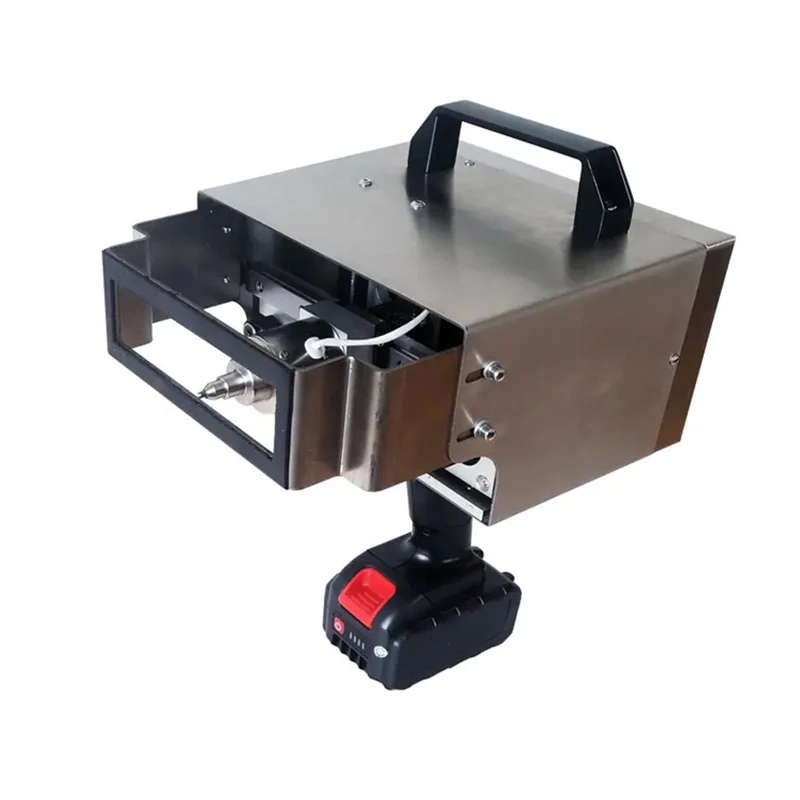
Four of the thirteen parameter rows are missing from the listing
The Hoting queue carries Product ID 1601251081243 as a car VIN number handheld dot pin operated marking machine with a lithium battery. Its parameter block publishes nine rows. One of its own detail images carries the supplier's full specification sheet, headed detailed product parameter, and that sheet has thirteen rows.
The four rows that the published listing leaves out are the four that say what the machine can do:
| Row on the supplier's parameter image | Value | Present in the published listing |
|---|---|---|
| Standard working area | 90 by 30 millimetres, and 120 by 30 millimetres | No |
| Marking speed | 50 millimetres per second maximum, or 3 to 4 characters per second at a 3 millimetre character height | No |
| Printed content | Letters, numbers, characters, logos, Chinese characters, serial numbers | No |
| Repeated accuracy | 0.01 millimetres | No |
The rows that stay are the ones that describe the box: machine weight, marking depth, pin hardness, machine power, power supply, working environment, and the model number. So a buyer reading the listing alone knows how heavy the machine is and how deep it can mark, and does not know the size of the area it can mark in one pass, how fast it marks, what characters it can produce, or how accurately it repeats. For a machine whose stated purpose is marking a vehicle identification number, the working area is the one specification that decides whether the purchase is viable, and it is the first row the listing dropped.
The omission is worth naming because it is systematic rather than accidental. Four rows that answer the buyer's question were removed and four rows that answer the freight forwarder's question were kept, and the four that were kept are the four that appear in a machine template. When a listing and its own specification sheet disagree about how much to disclose, the sheet is the document to quote in the purchase order, and asking for it by name is the first step of this purchase.
Two machines inside one model number
The record gives the model number as XY/SD-4-9030XY/SD-4-12030, which is two model numbers written end to end with nothing between them. The parameter sheet separates them with a space and, more usefully, pairs each one with a working area, which lets the naming rule be read off: the four digits are the window in millimetres, width followed by height, divided at the two digit boundary.
| Model | Digits read as window | Working area on the parameter sheet |
|---|---|---|
| XY/SD-4-9030 | 90 by 30 | 90 millimetres by 30 millimetres |
| XY/SD-4-12030 | 120 by 30 | 120 millimetres by 30 millimetres |
Two consequences follow, and both cost money if they are missed. First, the quotation has to name which of the two models it covers, because they are different machines with different windows and they cannot be priced as one. Second, the carton label in the record's own packing image reads XY/SD-4-12030 with a quantity of one unit, which tells a buyer what the supplier's own default configuration is and what the record's photographs were taken of. A buyer who wants the smaller window to fit a confined chassis area has to say so, because the default is the larger one.
The height of both windows is the same, 30 millimetres, and only the width changes. That is the useful part of the naming rule: the choice between the two models is a choice about how long a line of text can be marked in a single pass, not about how many lines, and the record's stated marking depth of up to 1.5 millimetres is unaffected by the choice.
The question the window has to answer: will a VIN fit
A vehicle identification number is seventeen characters. Whether either model can mark it in one pass is pure arithmetic on the window width, and the answer depends on two numbers the buyer controls: the character height the customer or the applicable requirement calls for, and the spacing between characters.
The window divided by seventeen gives the space available for each character cell, including the gap after it, and the character height is then the cell divided by the ratio the machine's font uses:
| Cell to height ratio | Cell in the 90 by 30 window | Cell in the 120 by 30 window | Maximum character height, 90 by 30 | Maximum character height, 120 by 30 |
|---|---|---|---|---|
| 1.0, condensed with no gap | 5.29mm | 7.06mm | 5.3mm | 7.1mm |
| 1.2, tight spacing | 5.29mm | 7.06mm | 4.4mm | 5.9mm |
| 1.5, normal spacing | 5.29mm | 7.06mm | 3.5mm | 4.7mm |
Read the middle row as the practical case. At tight spacing the 90 by 30 model marks a seventeen character VIN at about 4.4 millimetres high, and the 120 by 30 model at about 5.9 millimetres. If the requirement is a character height of five millimetres, both models can do it, the smaller with less margin. If the requirement is seven millimetres, neither can do it in one pass at that spacing and the width needed is about 143 millimetres, which is beyond both windows, so the text would have to be marked in two passes or the character spacing compressed below normal.
The same arithmetic reversed gives the number of characters each window holds at a given height, which is the figure to use when the job is not a VIN:
| Character height | Characters in the 90 by 30 window, tight spacing | Characters in the 120 by 30 window, tight spacing | Characters in the 90 by 30 window, normal spacing | Characters in the 120 by 30 window, normal spacing |
|---|---|---|---|---|
| 3mm | 25 | 33 | 16 | 22 |
| 4mm | 18 | 25 | 12 | 16 |
| 5mm | 15 | 20 | 10 | 13 |
| 6mm | 12 | 16 | 8 | 11 |
| 8mm | 9 | 12 | 6 | 8 |
The record's own speed reference uses a character height of three millimetres, and at that height the 90 by 30 window holds sixteen characters at normal spacing, which is one short of a VIN and would force a two pass mark or a compressed font. At the same height the 120 by 30 window holds twenty two, which leaves room. That single line is the best argument for the larger model, and it comes from the record's own figures rather than from anything the listing says.
The record's sample images confirm the scale of the job it was photographed for. The marked strings visible in them run from about ten characters to eighteen, including the eighteen digit string in the first sample, the fifteen character string beside it, and two vehicle identification numbers with a star character at each end, one of them on a rusted panel. The star is a conventional start and stop delimiter, and it adds two characters to the count that the window has to hold, which is worth remembering when the requirement is written: a seventeen character VIN with delimiters is nineteen characters of marking, and at a four millimetre height with normal spacing the 90 by 30 window holds twelve.
The pin hardness figure cannot be read as it is written
The record states a pin hardness of HRC 92. That value cannot be a Rockwell C reading. The Rockwell C scale is defined for hardened steel and its practical range runs from about 20 to about 70, because the indentor and the load are chosen so that the scale covers steel; a reading of 92 exceeds what the method can express. Cemented carbide, which is what a dot peen marking pin is made of, is specified on a different scale, Rockwell A, and a carbide marking pin reads about 91 to 93 on that scale.
The likeliest explanation is a single letter. The value 92 is a normal figure for a carbide marking pin, and 92 is on the edge of the practical range for the A scale, so the pin is almost certainly a carbide pin and the scale letter is wrong. The three scales are related but not interchangeable, and the approximate equivalents below show why the distinction is worth a question rather than a shrug:
| Scale | Practical range | What it is used for | Approximate equivalents |
|---|---|---|---|
| Rockwell C, HRC | about 20 to 70 | Hardened and tempered steels | HRC 70 is about HV 1030 and about HRA 86 |
| Rockwell A, HRA | about 60 to 90 | Cemented carbides and very hard materials | HRA 90 is about HV 1300, HRA 92 about HV 1500 |
| Vickers, HV | about 1 to 3000 | The laboratory scale used to compare the two above | HV 1500 is far above the practical top of the C scale |
The equivalents above are approximate conversions and are given only to show that the two Rockwell scales are not the same measurement. Nothing in this purchase turns on the last digit; three other numbers turn on the scale being stated correctly. The first is the pin material and its grade, because carbide grades for marking pins differ in cobalt content and grain size and a grade chosen for hardness is not the grade chosen for resistance to chipping. The second is the pin diameter, which decides the dot size and therefore the smallest character the machine can produce legibly. The third is the impact frequency, which with the pin diameter decides whether the mark is a fine dotted line or a series of overlapping craters.
The hardness that actually constrains the purchase is not the pin's, it is the workpiece's. A carbide pin of this class marks ordinary structural and sheet steels without difficulty, and its wear accelerates sharply once the workpiece passes roughly the mid forties on the Rockwell C scale. So the question to put to the supplier is not what the pin hardness is, but what workpiece hardness the pin is rated to mark at a stated pin life, and what the replacement pin costs. If the machine is bought to mark vehicle identification numbers on chassis and body panels, the workpiece is mild or high strength sheet steel and the answer will be comfortable; if it is bought to mark hardened components, the pin becomes a consumable and its price belongs in the quotation.
Marking speed: two figures joined by the word or
The parameter sheet gives the marking speed as 50 millimetres per second maximum, or 3 to 4 characters per second at a character height of 3 millimetres. The two figures are not the same measurement expressed twice, and the arithmetic shows they cannot be.
At a three millimetre character height with a cell of about four and a half millimetres, a head travelling at fifty millimetres per second would lay down roughly eleven characters in a second. The stated character rate is three to four per second, which is about a third of that. So the fifty millimetres per second figure describes the speed at which the head can traverse, and the character rate describes what the machine actually delivers when it is forming dots in steel, where the head spends most of its time dwelling at each dot rather than travelling. For planning a job the character rate is the figure that matters, and the traverse rate is a machine capability that only matters if the marking is spread over a long distance.
The character rate converts directly into the marking time for a job, which is the number to compare against the takt time of the line the machine will work on:
| Length of the text | Marking time at 4 characters per second | Marking time at 3 characters per second |
|---|---|---|
| 8 characters | 2.0 seconds | 2.7 seconds |
| 10 characters | 2.5 seconds | 3.3 seconds |
| 17 characters, a VIN | 4.3 seconds | 5.7 seconds |
| 19 characters, a VIN with delimiters | 4.8 seconds | 6.3 seconds |
| 25 characters | 6.3 seconds | 8.3 seconds |
| 40 characters, two lines of twenty | 10.0 seconds | 13.3 seconds |
Two conclusions follow from the table. A seventeen character VIN takes between four and six seconds of marking, which on its own is not the constraint: a hundred vehicles a day would need under ten minutes of marking. The constraint is everything around it, which is positioning the machine against the panel, finding the datum, holding the five point eight kilogram unit steady, and checking the result. So the cycle time of a handheld marking operation is decided by the fixture and the operator, not by the machine's marking rate, and that is the argument for spending money on a template or a jig before spending it on a faster machine.
The other conclusion is that the character rate was measured at a three millimetre character height, and the marking time grows with character size because each character needs more dots. A seven millimetre character height roughly doubles the dots per character compared with three millimetres, so a seventeen character VIN at seven millimetres should be planned at eight to twelve seconds rather than four to six, and the supplier should be asked for the rate at the height actually required.
Marking depth, and the thickness of the panel behind it
The record states a marking depth of 0.01 to 1.5 millimetres, depending on the material. That is a capability range, not a setting, and the phrase depending on the material is doing important work in it. What the range means in practice is shown by setting it against the thickness of the panel being marked, because the depth is a fraction of the material and the fractions matter differently at different thicknesses:
| Depth marked | Fraction of a 1mm panel | Fraction of a 3mm panel | What it means in service |
|---|---|---|---|
| 0.01 to 0.05mm | under 5 per cent | under 2 per cent | A surface texture rather than a groove, and the shallow end of the range is unlikely to survive surface dressing |
| 0.1 to 0.3mm | 10 to 30 per cent | 3 to 10 per cent | The band in which a mark is permanent without weakening the panel |
| 0.5mm | half the panel | 17 per cent | Deep, and on a one millimetre panel it begins to displace material around the mark |
| 1.0 to 1.5mm | more than a one millimetre panel has | 33 to 50 per cent | Only reachable on a thick section, and not a sensible target on body skin |
The upper end of the stated depth range therefore belongs to thick castings and heavy sections, and cannot be transferred to a body panel however the machine is set. The question to ask is what depth is achievable on a panel of the thickness actually being marked, at what character height, and how many passes are needed, because the answer changes with both and the record gives a single range for all of them.
There is also a relation between depth, pin diameter and machine power that the record does not state and that decides the practical limit. Driving a pin to a given depth in a given steel needs a fixed amount of energy per dot, and a heavier dot pattern needs more of it. With a stated machine power of 250 watts the energy available per dot is finite, so the depth range quoted at the top end is presumably measured on softer material at a low character height. Ask for a matrix rather than a range: depth against material hardness against character height, with the number of passes named. A supplier who can produce that matrix knows the machine; a supplier who cannot is quoting a template.
Two hundred and fifty watts, and a battery nobody specified
The record gives the machine power as S250 W, which reads as 250 watts with a stray character in front of it, and the parameter sheet writes it as 250 W. Three questions follow from that figure, and none of them can be answered from the record.
The first is whether 250 watts is rated or peak. A dot peen head draws a short high current pulse at each dot and idles between dots, so a peak figure and a continuous figure for the same machine differ by a factor of several, and the battery life calculation depends on which one was quoted. The second is the supply voltage, because the current drawn at 250 watts is 13.9 amperes at 18 volts and 6.9 amperes at 36 volts, and that decides the gauge of the internal wiring and the class of the switchgear. The third is the duty cycle at the top of the stated working environment, because 250 watts of dissipation inside a five point eight kilogram handheld housing is a thermal duty cycle as much as an electrical one.
The battery itself is the largest gap in the record. The power supply is given as Li-battery, and the record states no voltage, no capacity in ampere hours, no number of packs, no runtime and no charge time. The detail image shows a pack with four indicator lamps and a red switch, so the pack is a removable type with a state of charge display and no more can be read from it. Since runtime is the first thing an operator will ask about, the calculation has to be done from an assumed pack, and it is set out below with every assumption labelled so that the supplier can correct it rather than answer it:
| Assumed pack | Energy in the pack | Continuous running time at a 250W draw | Running time if 250W is peak and the average draw is 100W |
|---|---|---|---|
| 18V, 4.0Ah | 72 watt hours | 17 minutes | 43 minutes |
| 18V, 5.0Ah | 90 watt hours | 22 minutes | 54 minutes |
| 21.6V, 4.0Ah | 86 watt hours | 21 minutes | 52 minutes |
| 36V, 4.0Ah | 144 watt hours | 35 minutes | 86 minutes |
None of the four rows is a specification of this machine, because the record states no pack. What the table shows is the size of the decision: the same machine, depending on the pack and on whether the quoted power is peak or continuous, runs for between seventeen minutes and an hour and a half. The questions to settle it are the pack voltage, the capacity in ampere hours, how many packs are supplied, the charge time from empty, whether charging can be done while the machine is in use, and whether a second pack can be bought separately. Two packs and a fast charger are worth more to a workshop than a larger machine, because a four to six second marking cycle means the machine is idle most of the time and the binding constraint is charge, not power.
Repeated accuracy of 0.01mm on a machine that weighs five point eight kilograms
The parameter sheet gives the repeated accuracy as 0.01 millimetres, which is ten microns. On a bench machine with a motorised stage that figure describes the positioning repeatability of the mechanism, and it is a meaningful number. On a handheld machine it describes only the mechanism inside the head, because the position of the mark on the vehicle is set by the operator's hands.
The distinction decides what to buy. If the requirement is that a mark appears at a defined position on every panel to within a tolerance, then the accuracy that matters is the accuracy of the fixture that locates the machine, and a hand held unit with ten micron internal repeatability will still place marks wherever the operator puts them. That is why the first accessory to ask about is not a second battery but a template: a plate or frame that locates the head against a datum on the panel, so that the mark lands in the same place every time. If no template is offered, ask whether the machine has a datum edge or a locating pin on its base, and ask what the supplier's own customers use for repeat work.
The weight belongs in the same section, because it is the other half of the ergonomic problem. Five point eight kilograms is a substantial one handed load, and the marking position for a vehicle identification number is frequently low, under a chassis rail or inside an engine bay, where the operator is reaching and cannot use body weight to steady the machine. Three questions follow: what is the weight of the head alone as distinct from the total, does the housing have a handle on top as the listing images show and a second grip for the other hand, and is a counterbalance or a support arm offered. The detail image shows a top handle and a screen on the top face, which is a two handed arrangement rather than a single grip, and the supplier should confirm how the unit is intended to be held while marking.
Working environment of minus five to forty degrees, with a lithium battery
The record states a working environment of minus 5 to 40 degrees Celsius. That range is a reasonable ambient band for a machine, and it is not a complete specification for a machine with a lithium battery in it.
Lithium ion cells discharge in cold conditions with a substantial loss of available capacity, so minus five degrees describes a reduced runtime rather than a fault, and the question is how much of the rated runtime survives at minus five. The more important point is charging. Lithium ion cells are normally charged only above zero degrees Celsius, because charging a cold cell causes metallic plating on the anode that permanently reduces capacity, and a charger that will attempt to charge at minus five degrees is a charger that will shorten the pack's life. So the lower limit of the stated range applies to operation and not to charging, and the supplier should state the charge temperature range separately.
The upper limit raises a different question. Forty degrees Celsius is a normal summer ambient in many of the markets this machine is sold into, and a handheld housing dissipating up to 250 watts has no fan in any of the record's images. Ask for the duty cycle at forty degrees, meaning how many seconds of marking followed by how many seconds of rest, and ask whether the housing is warm enough to need a glove or a rest between panels. This is the kind of figure that appears only when the machine is used, and it is worth asking before a fleet of them is bought.
What the record's own samples show, and one compliance point in them
Two of the eight detail images are collections of marked workpieces, and they are the most informative pages in the record because they show the machine doing the job rather than the machine itself.
| What the sample images show | Read from the image | Why it matters to a buyer |
|---|---|---|
| A long string of digits | An eighteen digit string, and beside it a fifteen character alphanumeric string | The machine is being shown on identifiers longer than a VIN, which supports the window calculation above |
| Vehicle identification numbers | Two VIN format strings, each with a star character at both ends, one of them marked on a panel with visible surface rust | The star delimiters add two characters to the window requirement, and the rusted panel shows that surface condition does not stop the mark |
| Marking on a curved surface | A cylinder marked with a VIN format string, held in a fixture of dark blocks | Curved work needs a fixture to stop the head walking, and the image shows the kind of fixture that is needed |
| Marks on a mould or die segment | A plate carrying tyre size data, the word supersport, a serial, and a UTQG grading line | Shows the machine being used on tool steel, which is harder than body panels and tests the pin above the mild steel case |
| A nameplate example | A short alphanumeric string and a serial with star delimiters on a brushed metal plate | Useful for a buyer whose job is nameplates rather than vehicles, since the characters are small and the plate thin |
| Two third party automotive marks among the samples | A three pointed star device and a vehicle manufacturer's word mark, both in the demonstration photographs | A compliance point rather than a product point, and it is set out below |
The compliance point is that the demonstration images carry two third party automotive trademarks as sample marks. They are there to show capability, which is a normal way for a factory to demonstrate a marking machine, but a distributor or a reseller who reuses these images in their own listing, catalogue or website is publishing someone else's trademark in a commercial context, and that is the situation a brand owner's enforcement team acts on. If the images are to be reused, replace the automotive marks with the buyer's own marks or with neutral strings, and keep the machine photographs rather than the sample sheets. Where the samples cannot be changed, ask the supplier for written permission to use the image.
The gallery shows machines that are not the machine being sold
One of the detail images is headed product shows and carries photographs of several different machines: a blue cased unit on a base plate with a touchscreen, a white desktop unit with a window in the top face, a unit with a handwheel on a column above the marking head and an adjustable table below it, and the silver handheld battery unit that this listing actually offers.
Three of those four are not the product. A gallery that mixes a column machine with a handwheel, a desktop machine and a handheld machine under one heading tells a buyer that the supplier sells a family of marking machines and that the record was assembled from the family's photographs. That is common and it is not dishonest, but it means the photographs cannot be used to verify what will be delivered, and the same caution applies to the blue unit in the same image, whose case carries a red name plate reading a Jinan CNC equipment company's name in Chinese characters, with a product list and a Jinan telephone number. The name plate on that machine belongs to a different maker, which confirms that the gallery contains other manufacturers' equipment.
The packing image is the one that does describe this purchase, and it is worth reading closely because it is unusually concrete. It shows the sequence: the silver handheld unit with its top handle and screen, an operation manual titled for a handheld marking machine, accessory bags, then the unit seated in a silver aluminium flight case lined with foam, then a black edge guard placed over the case, and finally a yellow carton carrying a FRAGILE label. The carton label reads the model as XY/SD-4-12030 and the quantity as one unit, with a customer name field left as a placeholder.
Two things can be taken from that page. The pack is a single unit flight case rather than a bulk carton, which is good for handling and expensive per unit, and it means a sample order arrives protected. And the model on the label is the larger window of the two, which is the second independent indication in this record that the 120 by 30 model is the default. Ask whether the flight case is supplied with every unit or only with samples, whether the accessories include spare pins and a pin wrench, and what the packed weight and dimensions are, since none of those figures appear in the record.
What the description text says about the seller, and its defects
The record's description text names the supplier as Hengshui Mengshang Trading Co., Ltd. and describes it as a supplier of what it calls product machine, CNC carbide inserts, turning tools and milling tools, with TEBAK as its brand, adding that it insists on high quality, competitive price and excellent service and that it is a leading supplier of OEM work. The sentence ends mid word at letter O E D.
Three observations. The company describes itself as a supplier rather than a manufacturer of marking machines, and the gallery contains other makers' machines, so the buyer should establish whether the machine is built or traded, and who the producer is, before relying on the supplier for spare parts and repairs. The company's stated field of activity is machine tools and cutting tools, which is adjacent to but not the same as marking equipment, so the depth of the supplier's own technical support for this product is worth checking with a specific question, such as what the pin part number is. And the same description text carries several text defects that a buyer should read as a warning about documentation quality rather than as a product fault: the model number appears as XY/SD minus minus 12030 with a doubled dash, the battery is written as li battary, the machine power as a stray character followed by 250 W, and the working environment as minus 5 to 40 C with an equals sign left in front of it. One of the marketing images carries a footer reading factory direct, then a phrase that reads as a generation of hair, then life long maintenance; the middle phrase is a machine translation artefact and not a claim about the product.
The practical consequence is that a purchase order built by copying the record's parameter lines word for word will contain those defects, and a supplier who later disputes a specification will be able to point at the same garbled line. Restate every specification as a number with a unit and a tolerance in the order itself, and require the confirmation to come back in the same form.
Questions to put to the supplier before ordering
- Is the quotation for the XY/SD-4-9030 with the 90 by 30 millimetre window, or for the XY/SD-4-12030 with the 120 by 30 millimetre window, and what is the price of each?
- Is the working area a single pass area or a stitching area, and if it stitches, what is the maximum single pass length?
- What character height and spacing does the machine's font use, and what is the maximum character height for a seventeen character VIN in one pass in each window?
- What is the marking rate at character heights of 3, 5 and 7 millimetres, stated in characters per second?
- Is the 50 millimetres per second figure a traverse speed or a marking speed, and over what distance was it measured?
- What is the pin material and grade, and on which hardness scale is the 92 figure measured?
- What is the pin diameter, what is the impact frequency, and what is the dot pitch at the standard setting?
- What workpiece hardness is the pin rated to mark, and at what pin life, expressed in metres of marking?
- What is the price of a replacement pin, and how many pins are supplied with the machine?
- Is the 250 watts a rated or a peak figure, and what is the average draw during marking?
- What is the battery pack voltage and capacity in ampere hours, and how many packs are supplied?
- What is the runtime on one pack at the standard marking setting, and what is the charge time from empty?
- Can the machine be operated while charging, and can a second pack and a second charger be bought separately?
- What is the charge temperature range, as distinct from the stated operating range of minus 5 to 40 degrees Celsius?
- What is the duty cycle at 40 degrees Celsius ambient, in seconds of marking followed by seconds of rest?
- What is the weight of the marking head alone, and what is the weight of a battery pack alone?
- How is the machine intended to be held during marking, and is a strap, a support arm or a counterbalance available?
- Is a template, a locating plate or a datum edge available for repeat marking at a defined position?
- What depth is achievable on a panel of a specified thickness at a specified character height, and how many passes does it take?
- What are the cut tolerances on the mark position, and what is the repeated accuracy figure measured against?
- Does the flight case shown in the packing image come with every unit or only with sample orders, and what are the packed weight and dimensions?
- Which accessories are supplied, and does the set include spare pins, a pin wrench, a charger and the operation manual?
- Is the machine manufactured or traded, and who is the producer?
- What is the warranty period and what does it cover, and are spare parts held in stock?
- What is the price, the minimum order quantity, the trade term and the production lead time?
Questions one, three, six, ten and eleven are the ones that decide whether a quotation can be compared with another. Without the model, the machine cannot be matched to the job; without the character height and the rate, the line cannot be planned; without the pin scale, the consumable cost is unknown; and without the battery, the machine has no stated working duration at all.
Incoming inspection when a machine arrives
- Confirm on the carton label and on the machine's nameplate that the model is the one ordered, since the record's own default is the larger window.
- Open the flight case and check the contents against the packing list, listing the manual, the charger, the spare pins, the pin wrench and any template separately.
- Weigh the machine as delivered and compare it with the 5.8 kilogram figure, recording whether the pack was fitted at the time of weighing.
- Measure the working area by marking a test plate and measuring the extreme dot positions in both directions, and compare with 90 by 30 or 120 by 30 millimetres as ordered.
- Mark a seventeen character string at the intended character height and count the characters that fit in one pass before the machine reaches the end of its travel.
- Mark a test plate at the required depth and measure the depth with a depth gauge or a dial indicator on a surface plate.
- Measure the character height and the character spacing actually produced, and compare with the requirement rather than with the setting.
- Time ten seventeen character marks and divide, to establish the real marking rate at the height actually being used.
- Load an unused battery, run the machine at the standard setting on scrap material, and time how long the pack lasts, recording the ambient temperature.
- Time the charge from a fully discharged pack to full, and check the charge indicator against a known interval of running.
- Run the machine at the ambient temperature the workshop actually reaches, whether hot or cold, and note any change in rate, depth or the appearance of the mark.
- Inspect the pin under magnification for chipping after the test, and note the marking distance the pin has done.
- Test the mark on both a flat panel and a curved surface, and note whether the head walks on the curve without a fixture.
- Test the mark on the hardest material the machine is expected to mark, and record the depth achieved and the pin condition afterwards.
- Check the mark for readability at the viewing distance the inspection will use, and check that it survives a wipe with an oily rag and a light abrasion.
- Record the serial number of the machine, keep the test plates, and photograph the mark and the settings beside the machine's serial plate for the reference file.
The fourth, fifth, sixth and ninth checks are the ones that convert this record's parameter lines into a specification, because they measure the working area, the character capacity of one pass, the depth and the runtime on the actual machine rather than reading them from a sheet. All four can be done in an afternoon with scrap material.
Answers to the questions this record raises most often
Which model is being sold?
Two are named in one model number, XY/SD-4-9030 and XY/SD-4-12030, and the difference is the working area, 90 by 30 millimetres against 120 by 30 millimetres. The record's own carton label reads the larger model, so that appears to be the default, and the quotation should name which one it covers.
Will it mark a seventeen character VIN in one pass?
It depends on the character height and the spacing, not on the machine alone. At tight spacing the smaller window allows about 4.4 millimetres character height for seventeen characters and the larger about 5.9 millimetres. At normal spacing the smaller window holds about twelve characters at four millimetres and the larger about sixteen, so the larger window is the one to quote for VIN work with delimiters.
Is the pin hardness of HRC 92 a real figure?
Not as a Rockwell C reading, because that scale is practical only to about 70. A figure of 92 is normal on the Rockwell A scale, which is the scale used for cemented carbide, so the value is almost certainly an A scale reading with the wrong letter. Ask which scale, and ask for the pin material, diameter and impact frequency.
How fast does it mark?
The record gives two figures, a maximum of 50 millimetres per second and 3 to 4 characters per second at a 3 millimetre character height. They are different measurements, and the character rate is the one to plan with: a seventeen character VIN takes about 4 to 6 seconds at a 3 millimetre height and roughly double that at 7 millimetres.
How long does the battery last?
The record states only lithium battery, with no voltage, no capacity and no runtime, so the figure cannot be read from it. On an assumed 18 volt 4 ampere hour pack the continuous time at 250 watts is about seventeen minutes, and if 250 watts is a peak figure with an average draw near 100 watts the same pack lasts about forty three minutes. Ask for the actual pack and the actual runtime.
Can it mark at 1.5 millimetres deep?
The upper end of the stated depth range needs a thick section and a hard enough pin, and on a one millimetre panel a 1.5 millimetre depth is not available at all because the panel is thinner than the mark. Ask for a matrix of depth against material hardness and character height rather than a single range.
Is a five point eight kilogram handheld machine practical?
For short marks in accessible positions, yes, and the record's images show a two handed arrangement with a top handle and a screen. For a working day under a chassis rail the weight is a real load, and the accessory that decides the success of the job is a template or a support rather than a lighter machine.
What does the machine arrive in?
The record's own packing image shows an aluminium flight case lined with foam, an operation manual, accessory bags, a black edge guard and a yellow carton marked fragile, with the carton label reading XY/SD-4-12030 and a quantity of one unit. Whether the case is supplied with every order should be confirmed.
Who is the seller?
The description text names Hengshui Mengshang Trading Co., Ltd. with TEBAK as its brand, and describes itself as a supplier of machine tools and cutting tools. One of the gallery images carries a different equipment maker's name plate and telephone number, so confirm which entity invoices and who supports the machine afterwards.
What is not in this record at all?
The battery voltage, capacity, quantity, runtime and charge time; the pin material, grade, diameter and impact frequency; the marking rate at character heights other than three millimetres; the single pass length if the area stitches; the depth achievable per material and character height; the duty cycle at the top of the temperature range; the charge temperature range; the head weight; the template or fixture; the packed weight and dimensions; the price; the minimum order quantity; the warranty terms; and the identity of the producing plant.
Source, scope and what this guide does not claim
This guide is based on the Hoting queue record for Product ID 1601251081243, a car VIN number handheld dot pin operated marking machine with a lithium battery, and on the eight detail images that accompany it. All eight images were examined.
The published parameter block supplies the product name as handheld electric marking machine, the model number as the two models written together, the marking depth as 0.01 to 1.5 millimetres depending on the material, the pin hardness as HRC 92, the power supply as lithium battery, a field reading user provided NON, the machine power as a stray character followed by 250 watts, the working environment as minus 5 to 40 degrees Celsius, and the machine weight as 5.8 kilograms.
Four further rows are taken from the record's own parameter image, which is headed detailed product parameter and carries thirteen rows, and they are identified in the text as coming from that image rather than from the listing: the standard working area of 90 by 30 millimetres and 120 by 30 millimetres, the marking speed of a maximum 50 millimetres per second or 3 to 4 characters per second at a 3 millimetre character height, the printed content list of letters, numbers, characters, logos, Chinese characters and serial numbers, and a repeated accuracy of 0.01 millimetres.
Five further items are read from other images in the record and are identified as such. The marketing page describes the unit as a handheld lithium battery marking machine and lists no need for a computer and no air pump required among its points, and its footer carries a phrase that reads as a generation of hair, which is a translation artefact. The second image shows a screen fitted in the top face and two knurled knobs at the marking head. The use scheme and sample pages show marked strings from about ten to eighteen characters, including two VIN format strings with star delimiters, one mark on a rusted panel, one mark on a curved surface held in a fixture, and marks on a mould or die segment carrying tyre size data. The product shows page carries photographs of a blue cased unit with a touchscreen and a Jinan equipment company's name plate, a white desktop unit, a column unit with a handwheel, and the handheld unit. The packing page shows the aluminium flight case, the foam, the operation manual, the accessory bags, the edge guard and the yellow carton, whose label reads the larger model and a quantity of one unit.
The description text supplies the supplier's name as Hengshui Mengshang Trading Co., Ltd., its stated field as machine tools, CNC carbide inserts, turning tools and milling tools, its brand as TEBAK, and a sentence that ends mid word.
Several passages are the author's arithmetic or reading rather than published data, and are set out here so they are not mistaken for specifications. The millimetre equivalents of the two model numbers are read from the two working areas on the parameter sheet. The character cell figures are the window width divided by seventeen, which is 5.29 millimetres in the smaller window and 7.06 millimetres in the larger, and the character heights are those cells divided by the stated cell to height ratio. The characters per window in the second table are the window width divided by the product of the character height and the ratio. The marking times are the string length divided by the stated character rate. The depth fractions are the depth divided by the panel thickness. The battery running times are the stated energy divided by the stated power, with the energy being voltage multiplied by capacity. The statement that a seventeen character VIN with delimiters is nineteen characters long follows from the star delimiters visible in the record's own sample image.
Unless a figure appears in the lists above, it is not in this article because it is not in the record. This record states no battery voltage, capacity, quantity, runtime or charge time, no pin material, grade, diameter or impact frequency, no marking rate at any character height other than three millimetres, no stitching or single pass length, no depth figure per material, no duty cycle, no charge temperature range, no head weight, no template or fixture, no packed weight or dimensions, no price, no minimum order quantity, no trade term, no lead time, no warranty, no spare parts list (except that spare pins are visible in the packing image), no certificate and no identified producing plant.
A buyer can close the whole specification with five requests and one measurement: which model and window is quoted, the character height and rate at the height required, the pin scale, material, diameter and price, the battery pack voltage, capacity and runtime, and the identity of the selling entity. The measurement is one test mark on scrap at the required depth and character height, with the depth gauged and the characters counted, which settles the working area and the depth in one afternoon through the TEBAK sales inquiry channel.
Key specifications
- Product name on the record
- Handheld Electric Marking Machine
- Model number on the record
- XY/SD-4-9030 and XY/SD-4-12030, written as one string without a separator
- Standard working area on the record's own parameter image
- 90mm x 30mm for the 9030, 120mm x 30mm for the 12030
- Marking depth on the record
- 0.01 to 1.5mm, depending on the material
- Marking speed on the record's own parameter image
- 50mm per second maximum, or 3 to 4 characters per second at a character height of 3mm
- Printed content on the record's own parameter image
- letters, numbers, characters, logos, Chinese characters, serial numbers
- Repeated accuracy on the record's own parameter image
- 0.01mm
- Pin hardness on the record
- HRC 92
- Power supply on the record
- Li-battery
- User provided on the record
- NON
- Machine power on the record
- 250 W, written as S250 W
- Working environment on the record
- -5 to 40 degrees Celsius
- Machine weight on the record
- 5.8KG
- Battery voltage, capacity, quantity, runtime and charge time
- not stated in the record or in any of its eight images
- Packing as shown in the record's own image
- aluminium flight case with foam, operation manual, accessory bags, then a yellow carton marked FRAGILE
- Model and quantity on the carton label in the record's own image
- XY/SD-4-12030, one unit