
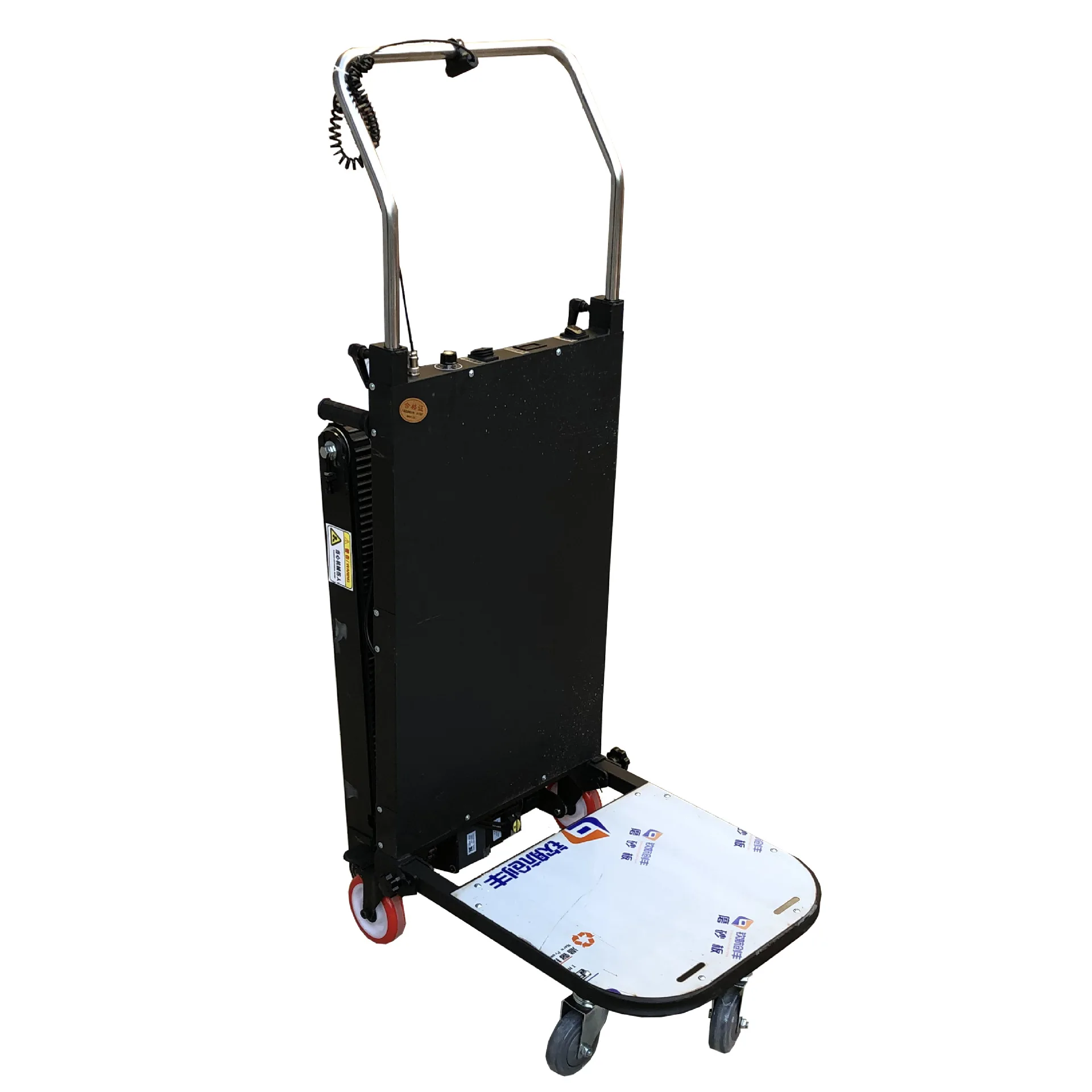
Source-controlled product identity
The Hoting queue identifies Product ID 1601310439566 as an electric climbing trolley for stair climbing and load handling. The source title describes a battery crawler stair-climbing dolly cart with belt, and the structured fields identify the product as an Electric Trolly.
The source confirms the following values: product size 54*62*122cm, folded size 122*54*36cm, charger voltage AC 100-240V, 50/60HZ, battery option 24AH/36AH, power 1500w and lithium-battery wording 36/48V. The title also contains 3000W and 400/500kg load wording, but those values are not present in the structured parameter list and are therefore listing claims that require supplier confirmation rather than verified specifications.
This guide is for B2B buyers evaluating powered stair climbers, electric material-handling trolleys, battery crawler carts and belt-driven load transporters. It does not treat the listing title as proof of safe working load, stair geometry, battery runtime, climbing speed, braking performance, motor rating, certification or suitability for a particular site.
Recorded specification table
| Field | Recorded value | Procurement interpretation |
|---|---|---|
| Product ID | 1601310439566 | Keep this ID on the quotation, nameplate record, inspection report and shipping documents. |
| Product name | Electric Trolly | Confirm the formal model name, spelling, model code and exact configuration. |
| Product size | 54*62*122cm | Confirm measurement order, tolerance, protruding parts and whether this is operating size. |
| Folded size | 122*54*36cm | Confirm folding procedure, locked position, transport envelope and handling weight. |
| Charger voltage | AC 100-240V, 50/60HZ | Confirm charger output, plug, current, charging time and destination-market conformity. |
| Battery | 24AH/36AH | Confirm whether these are options, nominal voltage, chemistry, pack dimensions and BMS. |
| Power | 1500w | Confirm continuous or peak rating, motor count, controller rating and duty cycle. |
| Lithium battery | 36/48V | Confirm whether voltage is 36V or 48V and which battery capacity pairs with each. |
| Title load claim | 400/500kg | Request a rated safe working load with stair angle, load center and test method. |
| Title power claim | 1500W/3000W | Reconcile the 3000W title claim with the structured 1500w field before ordering. |
Resolve the title-versus-parameter conflict
The title includes “1500W/3000W” and “400/500kg load,” while the structured fields record 1500w, 24AH/36AH and 36/48V. Treat these as possible configurations, not a single verified machine specification.
Ask the supplier to issue a configuration matrix showing model code, motor power, controller, battery voltage, battery capacity, rated load, stair angle and included belt or track assembly. Each combination should have its own drawing, nameplate photograph, test result and quotation line.
Do not accept a quotation that combines 1500W, 3000W, 400kg and 500kg without explaining which values apply to which configuration. The purchase order should identify one exact configuration and state which values are guaranteed.
Request a signed technical data sheet that distinguishes continuous power from peak power and working load from maximum test load. A maximum value without a safety factor, operating condition or test method is not sufficient for material-handling procurement.
Measure the destination stairway
Before selecting a stair climber, survey every route where the trolley will operate. Record clear stair width, tread depth, riser height, stair angle, landing length, landing width, door width, doorway height, handrail position, overhead clearance and floor condition.
Measure the narrowest point rather than relying on building drawings. Include door closers, skirting, pipes, fire equipment and temporary obstacles. Compare the complete operating envelope with the recorded 54*62*122cm product size.
Ask whether the 54cm and 62cm dimensions include handles, wheels, belt housings, control levers or load supports. Confirm the orientation of each dimension and whether the product size changes when the trolley is prepared for stair climbing.
For the folded size of 122*54*36cm, confirm which components are folded and whether the trolley can be safely carried or stored in this state. Do not assume that folded size represents a safe lifting weight or that the machine can be operated while folded.
Load definition and center of gravity
The title contains 400/500kg load wording, but the source does not define safe working load. Request the rated load for ascending stairs, descending stairs, level-floor travel, landings, ramps, turning and stopping.
Define the load center of gravity, load dimensions, base condition, tie-down method and maximum overhang. A compact dense load and a tall unstable load can impose very different forces even when their mass is identical.
Test the intended pallet, crate, appliance or equipment rather than a compact test weight alone. Record load movement, belt contact, frame deflection, wheel lift, slip, operator force and braking behavior.
Ask whether 400kg and 500kg refer to different battery or motor configurations. Confirm the required safety margin and whether the rating changes with stair angle, wet surfaces, stair nosing, uneven treads or repeated duty.
Stair-climbing mechanism and belt specification
The title describes a crawler stair-climbing dolly cart with belt, but the source does not provide belt material, width, tread pattern, tension, service life, replacement method or contact pressure.
Request a drawing of the belt or crawler assembly and identify drive sprockets, idlers, tensioners, guards and wear surfaces. Confirm whether the belt contacts the tread and nosing continuously and how the machine passes from level floor to the first stair.
Test different stair surfaces, including painted concrete, stone, wood, metal nosing, wet or dusty treads and worn edges. Record slip, belt damage, vibration, noise and loss of contact.
Ask for the minimum tread depth, maximum riser height, maximum stair angle and minimum landing length. These values are not supplied and must be demonstrated with the buyer's route or an equivalent test rig.
Motor, controller and drive system
The structured field records power as 1500w, while the title includes 1500W/3000W. Request motor model, motor quantity, continuous power, peak power, rated current, stall protection, controller voltage and duty-cycle limits.
Confirm whether the 36V/48V wording refers to motor voltage, battery nominal voltage or selectable configurations. Ask for wiring diagrams, connector ratings, fuse protection, over-current protection and low-voltage cutoff.
Test starting under load, stopping on an incline, reversing, changing direction and recovering from a short pause. Measure motor and controller temperature during a representative duty cycle.
Request the control interface and fault codes. Confirm whether the operator can control ascent speed, descent speed, emergency stop, reverse, brake release and battery status without releasing the load.
Braking, holding and emergency control
Powered stair movement requires predictable holding and stopping. The source provides no brake type, holding force, emergency stop behavior or fail-safe state.
Ask whether the trolley has an electromagnetic brake, mechanical brake, regenerative braking, belt lock or another holding system. Confirm what happens after power loss, controller fault, battery depletion, emergency-stop activation and control release.
Test a loaded trolley at the maximum approved stair angle in both directions. Record stopping distance, rollback, operator reaction, load shift and recovery procedure. Use a controlled test area and qualified personnel.
Confirm whether the machine can be parked on a landing or incline. Request wheel chocks, parking brake, stabilizers or other securing equipment where applicable.
Battery and charger procurement
The source records battery options as 24AH/36AH and lithium-battery wording as 36/48V. It does not specify chemistry, nominal energy, cell manufacturer, pack dimensions, BMS, weight, charge time, runtime, cycle life or transport documents.
Ask the supplier to map each battery capacity to its voltage and machine configuration. Require nominal voltage, nominal capacity, usable energy, maximum continuous discharge, peak discharge, low-temperature behavior and battery weight.
Confirm whether the battery is removable, how it is locked, whether a spare pack is available and whether the machine can operate during charging. Ask for the connector, fuse, BMS protections, indicator accuracy and replacement procedure.
The charger input is recorded as AC 100-240V, 50/60HZ. Confirm output voltage, output current, plug type, charge time, charging temperature range, ventilation, protection functions and destination-market documentation. Do not infer charger output from the input voltage.
Request lithium-battery shipping and safety documents applicable to the destination. Confirm labeling, packaging, transport classification, storage state of charge and long-term storage procedure through the supplier.
Runtime and duty cycle
No runtime or travel speed is provided. Define the route as number of stairs, vertical rise, loaded mass, ascent and descent cycles, landing transfers, waiting time and ambient conditions.
Run a repeatable battery test using the buyer's intended load and route. Record starting state of charge, ending state of charge, cycle time, motor temperature, controller temperature, battery temperature and any power reduction.
Repeat the test with the smallest and largest approved battery configurations. Confirm whether the 24AH and 36AH options provide different duty cycles and whether 36V and 48V versions use different chargers or controllers.
Ask what happens at low battery. The machine should provide a controlled warning and a safe stopping or recovery procedure rather than stopping unexpectedly on stairs.
Operator ergonomics and training
Map the operator's position, handle height, control force, line of sight, communication with assistants and access to the emergency stop. Measure whether the operator can maintain a stable stance during ascent and descent.
Request a training syllabus covering route survey, loading, tie-down, startup, speed control, braking, emergency stop, battery handling, fault recovery and maintenance.
Test a normal operator workflow with protective footwear and gloves. Check control visibility, grip, vibration, noise, repetitive effort and the ability to stop before a stair edge or landing obstruction.
Confirm whether two-person operation is required for specific loads or stair routes. Do not treat the term “electric trolley” as proof that one operator can safely move every listed load.
Factory acceptance test proposal
- Verify Product ID 1601310439566, exact model code and the configuration matrix.
- Reconcile 1500W/3000W title wording with the structured 1500w power field.
- Reconcile 400/500kg title wording with the supplier's rated safe working load and test conditions.
- Verify product size 54*62*122cm and folded size 122*54*36cm, including measurement orientation and tolerances.
- Verify charger input AC 100-240V, 50/60HZ, charger output, plug, current and charge time.
- Verify battery options 24AH/36AH and voltage options 36/48V, including the exact pairing for the quoted unit.
- Inspect motor, controller, wiring, fuses, connectors, guards and fault-protection functions.
- Measure belt width, tread, tension, contact, wear surfaces and replacement procedure.
- Test level-floor travel, transition to stairs, ascent, descent, landing transfer and return to level floor.
- Run the buyer's load at the permitted mass, center of gravity, dimensions and tie-down arrangement.
- Test braking, rollback prevention, emergency stop, power loss, low battery and controller fault recovery.
- Measure runtime, cycle count, speed, temperatures and state-of-charge change on the intended route.
- Confirm minimum tread depth, maximum riser height, maximum stair angle and minimum landing requirements.
- Verify manuals, training, spare belts, batteries, charger documents, warranty and destination-market compliance.
- Attach measured results, approved configuration, photographs and serial-number records to the purchase order.
RFQ checklist
- Product ID 1601310439566 and exact model code.
- Configuration matrix for 1500W/3000W, 400/500kg, 24AH/36AH and 36/48V claims.
- Continuous motor power, peak power, motor count, controller rating and duty cycle.
- Rated safe working load for ascent, descent, landings, ramps, turns and level-floor travel.
- Load center, maximum load dimensions, overhang, tie-down method and safety factor.
- Operating size 54*62*122cm and folded size 122*54*36cm with tolerances and orientation.
- Belt or crawler material, width, tread pattern, tension, guards, wear parts and replacement.
- Minimum tread depth, maximum riser height, maximum stair angle and landing requirements.
- Battery voltage, capacity, chemistry, usable energy, weight, BMS, connector and replacement price.
- Charger input AC 100-240V, 50/60HZ, output, current, charge time, plug and documents.
- Runtime, travel speed, cycle count, temperature limits and low-battery behavior.
- Brake type, holding ability, emergency stop, rollback prevention and power-loss behavior.
- Product dimensions, folded dimensions, net weight, packed size and lifting points.
- Training, operator count, PPE, maintenance, spare parts, warranty and service response.
- Battery transport, electrical, machinery and destination-market compliance documents.
Safety and compliance
A stair-climbing trolley carries a potentially heavy load on an inclined route. Complete a site-specific risk assessment before use. Verify load stability, route condition, operator competence, emergency access and the ability to recover the machine safely.
Never exceed the supplier's verified safe working load or use an unapproved load center. Secure loads against sliding, tipping and falling. Keep people clear below and beside the trolley during ascent and descent.
Inspect belts, drive components, brakes, guards, handles, fasteners, battery connectors and tie-down points before each shift. Remove the unit from service if there is belt damage, unusual noise, brake slip, control fault, battery swelling or structural damage.
Charge and store the lithium battery according to the supplier's instructions and applicable local rules. Use the specified charger, protect the battery from impact and moisture, and isolate a damaged or overheating pack.
The source does not provide CE, UKCA, UL, UN 38.3, MSDS, machinery or battery certification. Request model-specific documents for the destination market; no certification is claimed in this guide.
Buyer decision framework
This product has verified dimensional, charger-input, battery-option, power and voltage fields, but the listing contains unresolved configuration claims. The most important purchase gate is the reconciliation of 1500W versus 3000W and 400kg versus 500kg.
Approve the order only after the supplier identifies one exact configuration, demonstrates the trolley on a representative stair route with the buyer's load, verifies braking and emergency behavior, and provides battery, charger, machinery and destination-market documentation.
Frequently asked questions
Is the rated load 400kg or 500kg?
The title contains both values, but the source does not establish which configuration each belongs to. Request a model-specific safe working load and test condition.
Is the motor 1500W or 3000W?
The structured field records 1500w while the title includes 1500W/3000W. Reconcile the difference in a written configuration matrix before ordering.
What are the trolley dimensions?
The recorded operating size is 54*62*122cm and the folded size is 122*54*36cm. Confirm dimension order, tolerances, protruding components and actual transport envelope.
What battery does it use?
The source records 24AH/36AH and 36/48V. Ask the supplier to specify the exact voltage-capacity pairing, chemistry, usable energy, charger and runtime.
Can it climb every staircase?
No. Stair compatibility depends on tread, riser, angle, landing, surface, load and machine configuration. Measure the route and require a representative witnessed test.
Source and contact
This guide is based on the Hoting queue record for Product ID 1601310439566. The recorded fields are 54*62*122cm product size, 122*54*36cm folded size, AC 100-240V 50/60HZ charger input, 24AH/36AH battery, 1500w power and 36/48V lithium-battery wording. Before purchase, request the exact configuration, verified load and power ratings, stair limits, brake performance, battery documents, safety test, spare parts, warranty and destination-market requirements through the TEBAK sales inquiry channel.
Key specifications
- Product Size
- 54*62*122cm
- Folded Size
- 122*54*36cm
- Charger Voltage
- AC 100-240V, 50/60HZ
- Battery
- 24AH/36AH
- Product name
- Electric Trolly
- power
- 1500w
- Lithium battery
- 36/48V