
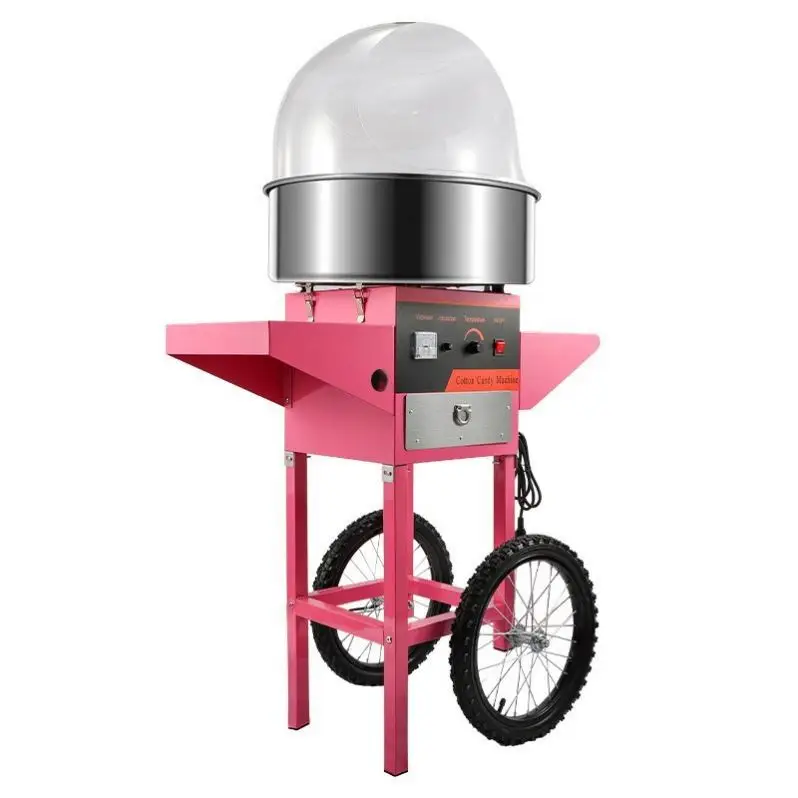
Source-controlled product identity
The Hoting queue identifies Product ID 1601391238365 as a TEBAK commercial candy floss machine for cotton candy production. The structured source records color Pink, material Stainless Steel, yield “1/30 Sec” and motor power 30W.
The yield field is reproduced exactly as supplied, but its meaning is unresolved. It may describe a cycle, a production interval or a formatting error; it must not be converted into a verified output rate. The source does not provide voltage, frequency, heater power, bowl diameter, spinner dimensions, sugar charge, actual grams per hour, warm-up time, operating temperature, controls, guard dimensions, net weight, packing size or certification.
This guide is for amusement parks, fairs, cinemas, shopping malls, event caterers, food trucks, dessert counters, party-rental businesses and concession distributors. The right purchase decision depends on expected service hours, sugar format, electrical supply, cleaning routine, operator access, food-contact requirements and tested output.
Recorded specifications
| Field | Recorded value | Buyer action |
|---|---|---|
| Product ID | 1601391238365 | Require the same ID on the quotation, nameplate, inspection report and shipping documents. |
| Color | Pink | Confirm whether pink is the standard body finish, a coating, or a configurable option. |
| Material | Stainless Steel | Identify which parts use stainless steel and confirm food-contact surfaces and grade. |
| Yield | 1/30 Sec | Ask the supplier to correct or define the unit and provide a timed grams-per-hour test. |
| Motor power | 30W | Confirm whether this is spinner motor input only or the total machine power. |
| Voltage | Not provided | Confirm voltage, frequency, phase, plug, current and destination-market electrical requirements. |
| Heating system | Not provided | Request heater power, control method, warm-up time, temperature range and safety cut-off. |
| Bowl and spinner | Not provided | Request bowl diameter, spinner size, clearance, guard and replacement-part codes. |
| Output mass | Not provided | Test finished candy floss mass per hour using the buyer’s sugar and operator workflow. |
Resolve the yield field before comparing suppliers
“1/30 Sec” is not a usable production specification by itself. Ask the supplier whether the intended value was one serving per 30 seconds, one batch per 30 seconds, 1/30 of a kilogram, or another unit. Request the corrected specification in the quotation and on the inspection sheet.
For concession work, measure finished candy floss mass per hour rather than only counting sticks. Record the sugar mass loaded, warm-up time, operating time, finished product mass, waste, operator count and rejected servings.
Run the test with the exact sugar type, color or flavor mix and serving stick used by the buyer. Different sugar particle size, moisture and additives can affect spinning behavior and output.
Separate theoretical cycle time from sustained service capacity. A machine that produces one attractive serving during a demonstration may require cooldown, cleaning, sugar loading or spinner adjustment during a busy event.
Define the operating environment
Commercial candy floss equipment can be used in fixed counters, mobile carts, kiosks and temporary event booths. Measure the available counter, cart or table, operator standing area, customer queue side, ventilation path and cleaning access.
The source does not provide overall dimensions or weight. Request unboxed dimensions, packed dimensions, net weight, gross weight, handle or lifting points and the required operating clearance around the bowl and controls.
Confirm whether the pink body is intended for indoor use, outdoor temporary use or both. Ask about protection from rain, dust, wind and direct sun. Do not place an electrical machine outdoors unless the site and power protection are suitable.
Plan a stable level surface. Spinning equipment should not rock, slide or contact nearby objects. Keep customers away from the rotating spinner and hot surfaces with a suitable barrier or supervised service layout.
Electrical specification and motor-power clarification
The source records 30W motor power but no voltage or total connected load. A motor rating alone does not define the machine’s electrical requirements because heating, lighting, controls and accessories may add load.
Request a nameplate photograph and wiring document showing voltage, frequency, phase, rated current, plug, protective earth and total input power. Confirm whether the 30W value applies only to the spinner motor.
For mobile or event use, confirm extension-cord, breaker, residual-current protection and generator requirements with the site electrician. Do not choose a generator from the 30W motor figure without the heater and startup load.
At commissioning, inspect the cable, plug, switch, earth connection, strain relief, heater wiring and motor guard. Test stable operation at the buyer’s actual supply voltage.
Heating, spinner and candy formation
The source names a cotton-candy or candy-floss machine but provides no heater specification. Ask for heater power, heating method, temperature control, warm-up time, recovery time and over-temperature protection.
Confirm whether the heating system is separately switched from the spinner motor. Ask whether the machine has a fuse, thermostat, thermal cut-out or other fault response. Do not infer temperature performance from the 30W motor field.
Inspect the spinner head for balance, burrs, sugar buildup and removable parts. Request the spinner material, cleaning method, alignment procedure and spare spinner code.
Test start-up, steady production, sugar refill and shutdown. Record vibration, noise, heat around the bowl, candy texture and the ability to keep the serving area clear.
Food-contact and material review
“Stainless Steel” is a product-level material field, not a complete food-contact declaration. Ask which parts are stainless steel: bowl, spinner head, frame, fasteners, sugar hopper, guard and support surfaces.
Request the grade or material designation for every food-contact surface, surface finish, weld finish and cleaning compatibility. Confirm whether paint, plastic, seals or lubricants can contact sugar or finished candy.
Set a cleaning schedule for the bowl, spinner head, guard, sugar residue and frame. Define tools and detergents that will not scratch or contaminate the surfaces.
Before commercial service, run a blank cleaning check and inspect for loose metal, burrs, flakes, oil or residue. The source provides no food-contact certification, so do not claim compliance without matching documents.
Sugar format, sticks and serving method
Specify the sugar format in the RFQ: granulated sugar, floss sugar, flavored mix, colored sugar or another formulation. Record particle size, moisture control, additives and storage requirements.
Confirm whether a serving stick, paper cone, bag, scoop, sugar measure and protective cover are included. The source does not list accessories. Ask how much sugar is required per serving and how the operator should refill safely.
For branded events, test color consistency, flavor carryover and the effect of changing sugar varieties. Clean the spinner and bowl between flavors when cross-contact matters.
Keep sugar dry and covered. Define a maximum fill level and a procedure for removing sugar before transport or cleaning.
Operator workflow and service speed
Map one complete serving: power-on, warm-up, sugar measure, loading, spinning, stick insertion, collection, bagging, customer handover and shutdown. Count every operator action when estimating capacity.
Ask whether the buyer needs one operator or two during peak periods. A machine may have a fast spinner but still be limited by loading, wrapping, cashless or queue operations outside the machine itself.
Design the serving side so customers do not reach over the bowl. Keep the operator’s hands, sleeves and loose clothing away from moving parts. Use a barrier or display configuration that preserves visibility without allowing contact.
Run a peak-period simulation. Measure servings per hour, finished mass, sugar consumption, waste, cleaning interruptions and operator fatigue.
Cleaning, maintenance and spare parts
Candy floss sugar can accumulate on the spinner, bowl, guard, controls and motor area. Request a daily cleaning procedure, deep-cleaning interval and parts that may be removed without exposing electrical components.
Confirm whether the bowl, spinner head, belt, motor, heater, switch, fuse, controller and guard are replaceable. Request part numbers, prices, lead times and installation instructions.
Ask how to inspect motor bearings, spinner balance, fasteners, cable strain relief and heater condition. Record acceptable vibration and noise behavior, and stop-use criteria for abnormal movement.
Never spray liquid into the motor, switch, heater or control area. Isolate and cool the equipment before cleaning or servicing.
Factory acceptance test proposal
- Verify Product ID 1601391238365, model, color and quoted configuration.
- Resolve the “1/30 Sec” yield field and record the corrected unit.
- Verify stainless-steel parts, food-contact surfaces, material designations and finish.
- Confirm voltage, frequency, phase, plug, current, earth and total connected load.
- Confirm 30W as motor power or total power and document the distinction.
- Record bowl diameter, spinner size, guard, clearance and overall dimensions.
- Run a cold-start warm-up test and record heater behavior and temperature control.
- Run a timed production test with the buyer’s sugar, stick and serving format.
- Measure accepted servings per hour, finished mass, sugar consumption and waste.
- Check candy texture, color, winding consistency and serving repeatability.
- Test sugar refill, shutdown, cleaning and restart procedures.
- Inspect vibration, noise, hot surfaces, cable, plug, earth and motor guard.
- Verify protective cover, customer barrier, emergency stop or isolation method.
- Confirm accessory list, spare parts, manual, warranty and packing documents.
- Record the approved first-article serving and the rejection criteria.
RFQ checklist
- Product ID 1601391238365 and exact model code.
- Pink finish, coating or body-material description and available variants.
- Stainless-steel parts, grades, food-contact surfaces and cleaning compatibility.
- Correct meaning and unit for the recorded “1/30 Sec” yield field.
- Tested servings per hour and finished grams per hour under defined conditions.
- Voltage, frequency, phase, plug, current, earth and total connected power.
- 30W definition: spinner motor input, motor rating or total machine input.
- Heater power, warm-up, temperature control, recovery and thermal protection.
- Bowl diameter, spinner dimensions, guard, clearance and operating footprint.
- Sugar type, particle size, moisture limits, additives and recommended measure.
- Included sticks, bags, scoops, covers, tools and spare components.
- Cleaning, sanitation, maintenance, vibration and noise instructions.
- Packed size, net/gross weight, shipping protection and lifting requirements.
- Warranty, spare-part pricing, service response and destination-market documents.
Safety and compliance
This equipment combines a rotating spinner, heat, electrical power and food handling. Keep hands, hair, loose clothing and utensils away from moving parts. Use a customer barrier or supervised layout in public service areas.
Isolate electrical power and allow hot parts to cool before cleaning, removing sugar buildup or servicing. Do not bypass guards, thermal protection, fuses or grounding. Stop operation if the spinner vibrates, the cable is damaged or the heater behaves unexpectedly.
Keep sugar, packaging and combustible materials away from hot surfaces and electrical openings. Use food-hygiene procedures suitable for the site, and do not allow wet cleaning liquid into electrical parts.
Request model-specific electrical, machinery, food-contact and destination-market documents. The source does not provide CE, ISO or other certification, so none should be claimed without matching evidence.
Buyer decision framework
This candidate has four recorded starting fields: Pink color, Stainless Steel material, “1/30 Sec” yield and 30W motor power. The yield unit, total power, heater, bowl, output and electrical configuration remain unresolved.
Approve the order only after the supplier corrects the yield specification, documents the complete electrical load, demonstrates a timed test using the buyer’s sugar and confirms cleaning, guarding, food-contact and spare-part details.
Frequently asked questions
What is the machine output?
The source records “1/30 Sec”, but does not define the unit. Request a corrected yield specification and a timed servings-per-hour and grams-per-hour test.
Is the machine made entirely of stainless steel?
The product-level field says Stainless Steel, but the source does not identify every component or grade. Ask for a parts and food-contact material list.
Is 30W the total machine power?
The field is labeled Motor Power, so it may refer to the motor only. Confirm heater power and total connected load before selecting electrical protection or a generator.
What voltage does it use?
The source does not provide voltage. Request voltage, frequency, phase, plug, current and protective-earth requirements for the destination market.
Is the pink color customizable?
The recorded color is Pink. Ask whether it is standard, coated or configurable, and require the finish to be stated in the quotation.
Source and contact
This guide is based on the Hoting queue record for Product ID 1601391238365. Recorded fields are Pink, Stainless Steel, “1/30 Sec” yield and 30W motor power. Before purchase, request the corrected yield unit, complete electrical and heating data, bowl and spinner dimensions, sugar compatibility, timed output test, guarding, food-contact materials, spare parts, warranty and destination-market documents through the TEBAK sales inquiry channel.
Key specifications
- Color
- Pink
- Material
- Stainless Steel
- Yield
- 1/30 Sec
- Motor Power
- 30W