
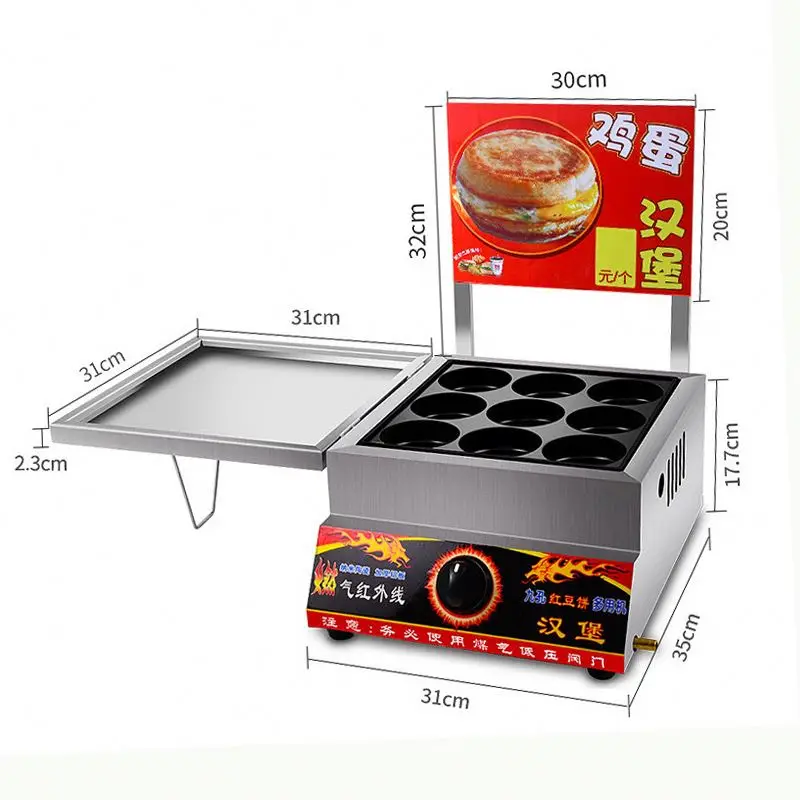
Source-controlled product identity
The Hoting queue record describes a commercial food machine listing for a 9-hole egg hamburger, egg hamburger pot and red bean cake application. The structured source fields provide only three confirmed logistics values: dimensions of 355*270*185 mm, net weight of 8kg and carton packing.
The title contains the claims “9-hole” and “gas type.” It also names egg hamburger and red bean cake applications. These are listing statements, not a complete technical specification. The source record does not confirm the number of cavities, cavity dimensions, gas type, inlet pressure, heat input, burner design, valve, ignition, body material, plate coating, temperature range, warm-up time, cycle time, output, certification or included accessories.
Product ID 1601276333703 should appear on the quotation, nameplate, gas label, inspection report and packing list. This guide helps importers, food-equipment distributors, snack-stall operators and commercial kitchen buyers evaluate the machine without turning unverified listing language into a safety or capacity promise.
Recorded values versus listing claims
| Information | Source status | Buyer action |
|---|---|---|
| Dimensions | 355*270*185 mm | Confirm whether these are machine dimensions with handles, valves, feet and fittings installed. |
| Net weight | 8kg | Confirm bare-machine net weight and separately request gross weight and carton dimensions. |
| Packing | Carton | Request carton grade, inner protection, quantity per carton, marks and drop-test method. |
| 9-hole | Title claim; not in structured parameters | Count cavities on the actual unit and provide cavity drawing, spacing and usable depth. |
| Gas type | Title claim; gas specification absent | Confirm LPG or natural gas, pressure, connector, regulator and destination-market requirements. |
| Egg hamburger / red bean cake | Application claim | Request tested recipes, batter quantity, release method and food-contact cleaning procedure. |
| Plate material | Not supplied | Confirm food-contact material, coating, thickness, hardness and replacement availability. |
| Temperature and output | Not supplied | Request operating range, uniformity, warm-up time, cycle time and measured throughput. |
| Ignition and safety | Not supplied | Confirm ignition, flame failure protection, shut-off valve, ventilation and emergency procedure. |
| Compliance | Not supplied | Request documents for the exact gas configuration and destination market. |
Define the food application before ordering
Egg hamburger, filled egg cake and red bean cake can differ in batter viscosity, filling quantity, cooking time and release behavior. Before requesting a quotation, define the product shape, target weight, cavity size, number of pieces per cycle, daily operating hours and acceptable variation between cavities.
Ask the supplier to distinguish the machine's physical cavity count from its usable production count. A title that says 9-hole does not establish that all nine cavities heat evenly or that all nine pieces can be released at the same time.
Prepare a sample specification using the buyer's own batter and filling. Record the batter mass per cavity, filling mass, preheat condition, cooking time, surface color, internal doneness, release force and cleaning time. A supplier demonstration using a different recipe is useful but does not replace a buyer-specific test.
For resale, separate the machine's application language from verified performance. The commercial listing can describe intended snack uses while the datasheet identifies only the values that have been measured and approved.
Gas configuration and fuel safety
The title says gas type but does not identify the fuel. Confirm whether the machine is designed for LPG, natural gas or another fuel, and whether separate versions use different burners, jets, valves and labels.
Request rated gas pressure, gas consumption, heat input, inlet connector, hose specification, regulator requirement and permitted installation orientation. Do not connect a machine to a gas source based only on a generic listing title.
For factory acceptance, inspect the nameplate and gas label. Leak-test every connection with an approved method. Verify ignition, flame stability, flame-out shutoff and restart behavior according to the supplier's manual and local rules. Record the test pressure and ambient conditions in the inspection report.
Confirm whether the buyer or an authorized technician must install the regulator, hose and connector. The quotation should identify which gas fittings are included and which must be sourced locally. Do not assume a supplied fitting is approved for the destination country.
Burner layout and heating uniformity
No burner layout, burner material, flame pattern or heating power is supplied. Ask for a drawing showing burners relative to the plate and cavities. Confirm whether each cavity has independent heating, shared heating or a zone arrangement.
Test all claimed cavities with the same batter and a calibrated temperature method. Record warm-up time, plate temperature at each cavity, recovery after loading, left-to-right variation and front-to-back variation.
Measure temperature at stable operating conditions rather than relying on a surface appearance. If the machine uses a manual gas valve, request the adjustment range and an operating procedure that prevents unstable flames.
Ask how the operator should respond to yellow flame, flame lift, unusual odor, delayed ignition, uneven browning or a blocked burner. These instructions belong in the manual and should be reviewed before commercial use.
Cavities, plates and product geometry
The title uses 9-hole, but cavity diameter, depth, spacing, edge radius and plate thickness are not provided. Request a dimensioned plate drawing and a sample of the finished food product.
Confirm whether the plate is fixed, hinged, interchangeable or removable. Request hinge travel, handle clearance, locking method, opening angle and replacement-plate procedure. If the buyer needs multiple snack shapes, ask whether additional plates are available and whether they require a different heating setting.
Inspect the cavity edges for burrs, sharp corners and areas that trap batter. Confirm the food-contact surface, coating system, release treatment and maximum cleaning temperature. Do not call a surface non-stick, food-grade or stainless steel unless the supplier provides a material or coating statement.
Measure cavity-to-cavity weight variation after filling. Record whether the operator can fill all cavities consistently and whether the lid or upper plate compresses the batter evenly.
Food-contact materials and cleaning
The source record does not identify the plate or body material. Request the material for every food-contact surface, coating type, thickness, finish and declaration applicable to the destination market.
Ask for a cleaning procedure that covers cooled surfaces, gas isolation, removable parts, crumbs, oil, batter residue and cleaning agents. Verify whether the plate may be immersed or whether it must be wiped in place.
Run a cleanability check after a normal production cycle. Record time to remove residue, access around hinges and burners, drain or crumb paths and any coating damage after the approved method.
For distributor training, convert the supplier's procedure into a short operator checklist. Include cool-down, gas shutoff, surface inspection, cleaning, drying and storage steps. Avoid promising dishwasher compatibility or corrosion resistance without evidence.
Temperature, cycle time and throughput
No temperature range, heat-up time, recovery time or cycle time is supplied. Request these values under a defined ambient temperature, batter recipe, gas pressure, plate load and measurement method.
Throughput should be calculated from the tested cycle, not from the cavity claim alone. Record loading time, cooking time, opening and release time, cleaning interruptions and the number of saleable pieces per cycle.
Test a start-up sequence and a continuous sequence. A machine may produce acceptable first batches while losing heat during repeated loading. Record cavity temperatures and product results throughout the run.
Ask how the operator controls doneness when the batter or filling changes. If the machine has no calibrated temperature indicator, define a visual and timed process only after validating it with the buyer's recipe.
Gas appliance installation and workplace layout
The recorded dimensions are 355*270*185 mm. Confirm the measurement reference and add space for gas hose routing, regulator, handles, lid movement, ventilation and operator clearance.
Request the machine footprint, support requirements, level tolerance, heat-clearance distance and safe position of the gas cylinder or building gas connection. The compact dimensions do not establish a safe installation envelope.
Confirm ventilation requirements, combustion-air needs, exhaust route, fire protection and local inspection obligations. The buyer should have the installation reviewed by a qualified gas professional where required.
Check that the work surface is stable and heat resistant. Prevent the hose from contacting hot surfaces or moving parts. Keep combustible packaging, oil and loose materials away from the burner and exhaust area.
Packaging, logistics and incoming inspection
The source lists carton packing and a net weight of 8kg. Request gross weight, carton dimensions, carton quantity, inner protection, moisture barrier, shock indicators and pallet information.
Because the machine may include gas fittings and coated food-contact plates, inspect for dents, coating scratches, bent hinges, missing valves, loose fasteners and damaged handles immediately after unpacking.
Photograph the carton marks, product label, accessories and plate surfaces. Match the product ID, gas version, cavity configuration and included fittings against the purchase order before commissioning.
Ask for spare plates, valves, knobs, hoses, regulators, igniters and seals where applicable. These parts are not listed in the source record and must be priced and identified in the RFQ.
Factory acceptance test proposal
- Verify product ID 1601276333703, exact model, nameplate and gas-fuel version.
- Measure machine dimensions and net weight with the agreed handles, valves and plates fitted.
- Inspect carton packing, inner protection, marks, gross weight and accessory list.
- Count the claimed cavities and record cavity dimensions, spacing, depth and plate drawing.
- Verify gas connector, regulator, hose specification, rated pressure and gas consumption.
- Perform approved leak, ignition, flame stability, flame-out shutoff and restart checks.
- Measure warm-up time, stable plate temperature, cavity uniformity and recovery after loading.
- Run the buyer's egg hamburger or red bean cake recipe and record batter, filling, cycle and release results.
- Inspect food-contact surfaces, coating, burrs, hinges, handles, cleaning access and residue removal.
- Run a continuous production sample and record saleable pieces, variation, interruptions and gas behavior.
- Review manual, safety documents, destination compliance, spare parts, warranty, MOQ and lead time.
RFQ checklist
- Product ID 1601276333703, exact model, current nameplate photograph and gas version.
- 355*270*185 mm: confirm bare-machine or operating dimensions and provide a drawing.
- 8kg: confirm net-weight definition; provide gross weight, carton size and carton quantity.
- Carton packing: grade, inner protection, moisture control, marks and shipping inspection method.
- 9-hole claim: cavity count, cavity diameter, depth, spacing, plate thickness and replacement plate.
- Gas type: LPG or natural gas, pressure, consumption, heat input, connector, hose and regulator.
- Burner layout, burner material, valve, ignition, flame failure protection and shut-off procedure.
- Temperature range, warm-up, recovery, uniformity, measurement method and cycle time.
- Food-contact material, coating, thickness, surface finish, cleaning method and declaration.
- Recipe test: batter mass, filling mass, cooking time, product weight, release and surface result.
- Throughput test: pieces per cycle, saleable yield, operator time and continuous-run conditions.
- Handle, hinge, lid, plate lock, heat-clearance, ventilation and installation requirements.
- Manual, gas-safety, food-contact and destination-market compliance documents.
- MOQ, sample cost, lead time, spare parts, warranty, service contact and inspection terms.
Buyer decision framework
This listing is a compact commercial food-machine candidate with source-backed dimensions of 355*270*185 mm, net weight of 8kg and carton packing. Approve it for commercial use only after the supplier confirms the fuel configuration, burner safety, plate and cavity design, food-contact materials, tested recipe results and destination-market documentation.
For a snack-stall operator, prioritize safe installation, stable heating, fast cleaning and repeatable product release. For a distributor, prioritize separate gas variants, replacement plates, spare valves, manuals and clear carton labeling. The 9-hole and gas-type wording can guide an RFQ, but neither claim should replace a measured acceptance test.
Frequently asked questions
Is the machine definitely a 9-hole model?
“9-hole” appears in the listing title, but the structured source parameters do not confirm the cavity count. Request a cavity drawing and count the actual delivered plate.
Which gas does it use?
The source title says gas type but does not identify LPG, natural gas, pressure or connector. Obtain the exact gas specification before ordering or connecting the machine.
Is the plate stainless steel or non-stick?
No plate material or coating is recorded. Ask for food-contact material, coating and cleaning documentation for the exact model.
What is the production capacity?
No validated cycle time or throughput is supplied. Test the buyer's batter and filling, then record cycle, release time and saleable yield.
Is 8kg the shipping weight?
8kg is recorded as net weight. Request gross weight and carton dimensions separately for freight and warehouse planning.
Source and contact
This guide is based on the Hoting queue record for product ID 1601276333703. Before purchase, request the current quotation, gas nameplate, burner and valve data, cavity drawing, food-contact statement, recipe test, safety manual, compliance documents, packing list, spare-parts offer, warranty and final machine photographs. For sourcing questions, contact the TEBAK sales team through the site's current inquiry channel.
Key specifications
- Dimensions
- 355*270*185 (mm)
- net weight
- 8kg
- Packing
- Carton