
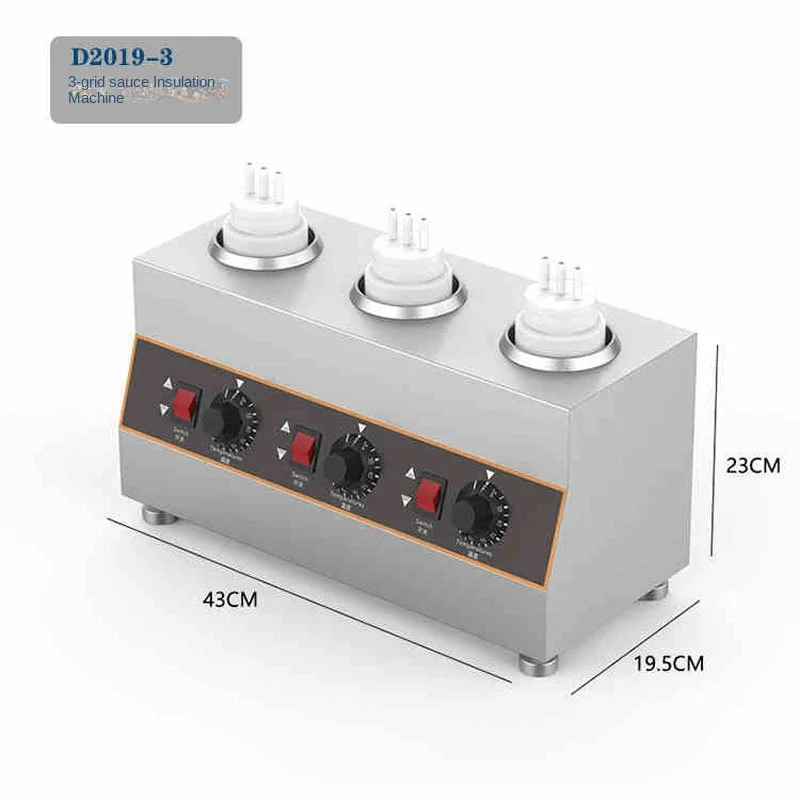
Source-controlled product identity
The Hoting queue identifies Product ID 1601274453805 as a commercial sauce bottle warmer for chocolate, cheese, butter and oyster sauce. The listing describes it as an electric hot sauce bottle heater and a countertop appliance for professional kitchens or catering service.
The source description says the product is intended to keep sauces, gravies and other liquid condiments at a serving temperature. It also describes stainless steel construction, compact placement on countertops or buffet tables and adjustable temperature control. These are listing descriptions, not a complete tested specification.
No structured parameters are supplied for voltage, wattage, temperature range, heating method, number of bottles, bottle dimensions, bottle material, warm-up time, holding uniformity, thermostat accuracy, dimensions, weight or certification. These missing items are not inferred and must be confirmed before purchase.
This guide helps B2B buyers evaluate a sauce bottle warmer for restaurants, catering operations, food trucks, buffet service, dessert counters and condiment stations. It focuses on sauce compatibility, bottle fit, food hygiene, heat control, workflow and acceptance testing.
Recorded information and procurement status
| Field | Recorded source information | Procurement status |
|---|---|---|
| Product ID | 1601274453805 | Keep this ID on the quotation, sample request, inspection report and shipping documents. |
| Product type | Commercial sauce bottle warmer / electric hot sauce bottle heater | Confirm exact model name, configuration and included accessories. |
| Named applications | Chocolate, cheese, butter, oyster sauce | Test each actual sauce; do not assume one sauce setting works for all. |
| Other intended contents | Sauces, gravies and liquid condiments | Request viscosity, particulate, oil, sugar and acidity limits. |
| Construction description | Stainless steel construction is described | Request material grade and component-by-component material schedule. |
| Temperature control | Adjustable temperature control is described | Request setpoint range, measured product temperature, accuracy and calibration. |
| Placement | Countertops or buffet tables | Confirm footprint, clearances, ventilation, spill control and surface temperature. |
| Voltage and power | Not supplied | Confirm destination voltage, frequency, phase, current, wattage and plug. |
| Capacity and bottle fit | Not supplied | Request bottle count, bottle diameter, height, neck, pump and pouch compatibility. |
| Compliance | Not supplied | Request electrical, food-contact, material and destination-market documents. |
Define the sauce before selecting the warmer
Sauce name alone is not enough for a heating specification. Chocolate, cheese, butter and oyster sauce can differ in viscosity, fat, sugar, salt, water content, particulate level and temperature sensitivity.
Provide the supplier with the actual sauce name, product code, viscosity or flow description, package size, bottle material, fill level and serving temperature target. If a sauce contains solids, spices, meat, seafood or particulates, include their size and concentration.
Ask whether the warmer heats the bottle, a removable water bath, a metal shelf, a cartridge or another surface. The heat path affects temperature uniformity and may create hot spots near the bottle wall.
Confirm whether the unit is designed for holding temperature or for heating cold sauce. Request warm-up time from the actual storage temperature and the time required to reach the target serving condition.
Do not accept “keeps sauce warm” as a complete performance claim. Define product temperature range, temperature variation within the bottle, recovery after dispensing and the maximum allowable time outside the validated range.
Bottle, pouch and dispenser compatibility
The source calls the product a sauce bottle warmer, but it does not define bottle dimensions or closure types. Provide bottle diameter, height, base shape, neck size, cap, pump, nozzle and label position for every package that will be used.
Confirm whether the heater accepts one bottle or multiple bottles, and whether each position has independent temperature control. Request an internal layout drawing with minimum clearance around every bottle.
Ask whether plastic, glass, metal bottles, squeeze bottles, pouches or sauce containers are allowed. Obtain the maximum surface temperature and material compatibility guidance for each package.
Test bottle stability during pump operation. A bottle that fits when stationary may tilt, deform or move when a user presses a pump or pulls a squeeze bottle from the station.
Confirm how the unit handles a nearly empty bottle, a full bottle, a bottle with a blocked nozzle and a bottle that has leaked into the warming area. Define the cleaning and replacement procedure for each event.
Temperature control and food quality
The listing describes adjustable temperature control but provides no range, accuracy, sensor position or calibration method. Request the controller setpoint range and the actual temperature measured in the sauce at the center and near the container wall.
For chocolate, confirm that the selected process does not cause scorching, separation, bloom, hardening or excessive viscosity change. For cheese, test texture, skin formation, separation and pumpability over the complete service period.
For butter, verify melting behavior, oil separation, temperature recovery and the condition of the container after repeated dispensing. For oyster sauce and other viscous condiments, test flow through the actual dispenser and nozzle.
Set separate approved parameters for each sauce. Do not transfer a chocolate setting to cheese, butter or oyster sauce without a product test.
Ask whether the controller displays air temperature, surface temperature, bath temperature or product temperature. A display value is not a food-temperature guarantee unless the measurement point and calibration are defined.
Hygiene and material checks
The description mentions stainless steel construction, but no grade or surface schedule is supplied. Request the stainless grade for the tray, shelf, housing, bottle supports, fasteners and any surface that may contact sauce or splash.
Identify every food-contact and splash-contact material, including silicone, rubber, plastics, coatings, adhesives and lubricants. Request food-contact declarations appropriate to the destination market.
Inspect corners, seams, tray edges, bottle recesses, drain paths and controls. The design should avoid trapped sauce, standing water and inaccessible residue.
Request a cleaning and sanitation procedure covering power isolation, cooling, bottle removal, tray removal, chemical compatibility, rinse, drying and inspection. Confirm whether any part can be immersed and whether the electrical section is protected from spills.
Define cleaning frequency for chocolate, cheese, butter and oyster sauce. High-sugar, high-fat and high-salt products may require different cleaning intervals and chemicals.
Countertop and service-station layout
The source describes countertop or buffet-table placement but supplies no footprint, height, weight or service clearance. Request a dimensioned drawing showing bottle positions, controls, cable exit, ventilation and spill containment.
Measure the available counter depth, counter height, overhead clearance, user approach and access to electrical outlets. Keep hot surfaces, cables and sauce nozzles away from customer contact paths.
Confirm whether the appliance is intended for staff-only service or self-service. Self-service may require additional guarding, tip resistance, clear temperature labeling, drip control and cleaning frequency.
Test the unit beside the actual food line. Observe bottle replacement, dispensing, wiping, refilling, cleaning and queue flow. A compact warmer can still become a bottleneck if the bottle cannot be changed without moving adjacent equipment.
Ask about ambient temperature, humidity, drafts and ventilation limits. These conditions can affect heat recovery and sauce holding temperature.
Electrical and thermal safety questions
Voltage, frequency, phase, current and rated power are not provided. Request the exact electrical specification for the destination country, including plug, cable, grounding, fuse, breaker and over-temperature protection.
Ask for accessible-surface temperature, bottle-contact temperature, heater shutoff behavior and cool-down time. Confirm whether the unit prevents overheating when empty or when a bottle is removed.
Test an empty position, a full bottle, a blocked bottle, a spill and an interrupted power supply. Verify that the appliance does not restart heating unexpectedly after power returns.
Request electrical enclosure protection and guidance for operation near sinks, wet counters and washdown areas. Do not infer splash resistance from stainless steel housing.
Ask for alarm behavior, thermostat failure response, sensor failure response and maintenance access. Record whether the operator can identify an unsafe condition without opening the unit.
Workflow and service output
Define the required service output using the actual sauce, bottle and dispenser. Record the time to reach the approved serving condition, time to recover after several dispenses and the number of servings per bottle.
Test one bottle and the maximum planned number of bottles. Measure product temperature at the first, middle and last service period. Record viscosity, flow, appearance and residue.
Check whether the dispenser must remain inside the warmer or whether the bottle is removed for serving. Confirm whether the heating position interferes with pump stroke, nozzle access or label visibility.
For catering and buffet use, test transport, setup, refill, cleaning and end-of-service handling. Confirm whether the unit has a stable base, carrying method and safe cool-down procedure.
Do not claim improved customer experience or reduced waste without a measured trial. Compare baseline sauce service with the warmer using the same bottle, product and staff workflow.
Factory acceptance test
- Verify Product ID 1601274453805, exact model, configuration and included accessories.
- Measure footprint, height, weight, bottle clearance, cable exit, ventilation and service access.
- Verify destination voltage, frequency, phase, current, rated power, plug, grounding and protection.
- Fit every planned bottle, closure, pump, nozzle, pouch or container and record clearances.
- Run chocolate, cheese, butter and oyster sauce samples as applicable using actual production packages.
- Record initial product temperature, target serving temperature, warm-up time and recovery after dispensing.
- Measure product temperature at the center, edge and bottom of the container; record variation.
- Test temperature setpoint changes, sensor behavior, display accuracy, overshoot and calibration.
- Check texture, separation, scorching, skin formation, flow, nozzle blockage and package deformation.
- Test full, half-full, nearly empty, blocked and leaking bottle conditions.
- Test spill containment, cleaning, removable parts, sanitation chemicals, drying and inspection access.
- Test empty operation, bottle removal, sensor failure, over-temperature protection and power recovery.
- Measure accessible surface temperature, noise, electrical current and cool-down time.
- Verify food-contact declarations, electrical documents, manuals, risk information and certificates.
- Attach test photographs, temperature logs, sample results, serial number and deviations to the order.
RFQ checklist
- Product ID 1601274453805, exact model name and intended sauce applications.
- Heating method, heat path, number of positions, independent controls and removable components.
- Voltage, frequency, phase, current, rated power, plug, grounding, fuse and breaker.
- Temperature setpoint range, measured product range, accuracy, sensor position and calibration.
- Warm-up time, recovery time, holding-time guidance and maximum ambient conditions.
- Bottle count, diameter, height, neck, base, material, pump, nozzle and pouch compatibility.
- Maximum and minimum container volume, fill level and stable operation during dispensing.
- Tray, shelf, bottle support, housing and fastener material grades.
- Food-contact declarations for metal, plastic, silicone, rubber, coatings, adhesives and lubricants.
- Cleaning, sanitation, immersion, splash, spill containment and washdown limitations.
- Over-temperature protection, dry-run behavior, sensor failure, alarm and restart prevention.
- Countertop footprint, ventilation, cable length, service clearance and carrying method.
- Temperature and flow test results for the buyer's chocolate, cheese, butter and oyster sauce.
- Accessories, spare parts, training, warranty, service response and lead time.
- Factory acceptance procedure and destination-market compliance documents.
Buyer decision framework
This sauce bottle warmer listing provides a clear application direction and describes stainless construction, compact countertop placement and adjustable temperature control. It does not provide the measured performance data needed for a purchase decision.
Move from inquiry to quotation only after the supplier provides the electrical specification, temperature data, bottle drawing, sauce compatibility limits, cleaning method, safety controls and compliance documents.
Approve the order after a witnessed trial uses the actual sauce, bottle, dispenser and service workflow. The trial should verify temperature uniformity, warm-up, recovery, flow, appearance, cleaning and safe operation.
Compare suppliers using validated sauce quality, package compatibility, temperature stability, cleaning time, service access, energy use and support. Do not compare by a generic “warmer” label or a claimed adjustable control alone.
Frequently asked questions
Which sauces are named in the source?
The source names chocolate, cheese, butter and oyster sauce, and also refers to sauces, gravies and liquid condiments.
Is the warmer suitable for every sauce?
No suitability matrix is provided. Test each sauce's viscosity, particulate level, fat or sugar behavior, target temperature, bottle and dispenser.
Is the housing stainless steel?
The description says stainless steel construction, but it does not provide a grade or component schedule. Request written material details.
Does it have adjustable temperature control?
The source describes adjustable temperature control but does not provide the range, accuracy, sensor location or calibration method.
What is the voltage and power?
Neither is supplied in the source record. Request the exact destination-market electrical specification before ordering.
How many bottles fit?
Capacity and bottle dimensions are not supplied. Request a dimensioned internal layout and test every planned package.
Source and contact
This guide is based on the Hoting queue record for Product ID 1601274453805. The recorded description covers commercial sauce warming for chocolate, cheese, butter, oyster sauce, gravies and liquid condiments, plus stainless construction, compact placement and adjustable temperature control. Before purchase, request exact specifications, sauce and bottle testing, food-contact documents, electrical data, safety details, acceptance testing and warranty terms through the TEBAK sales inquiry channel.