
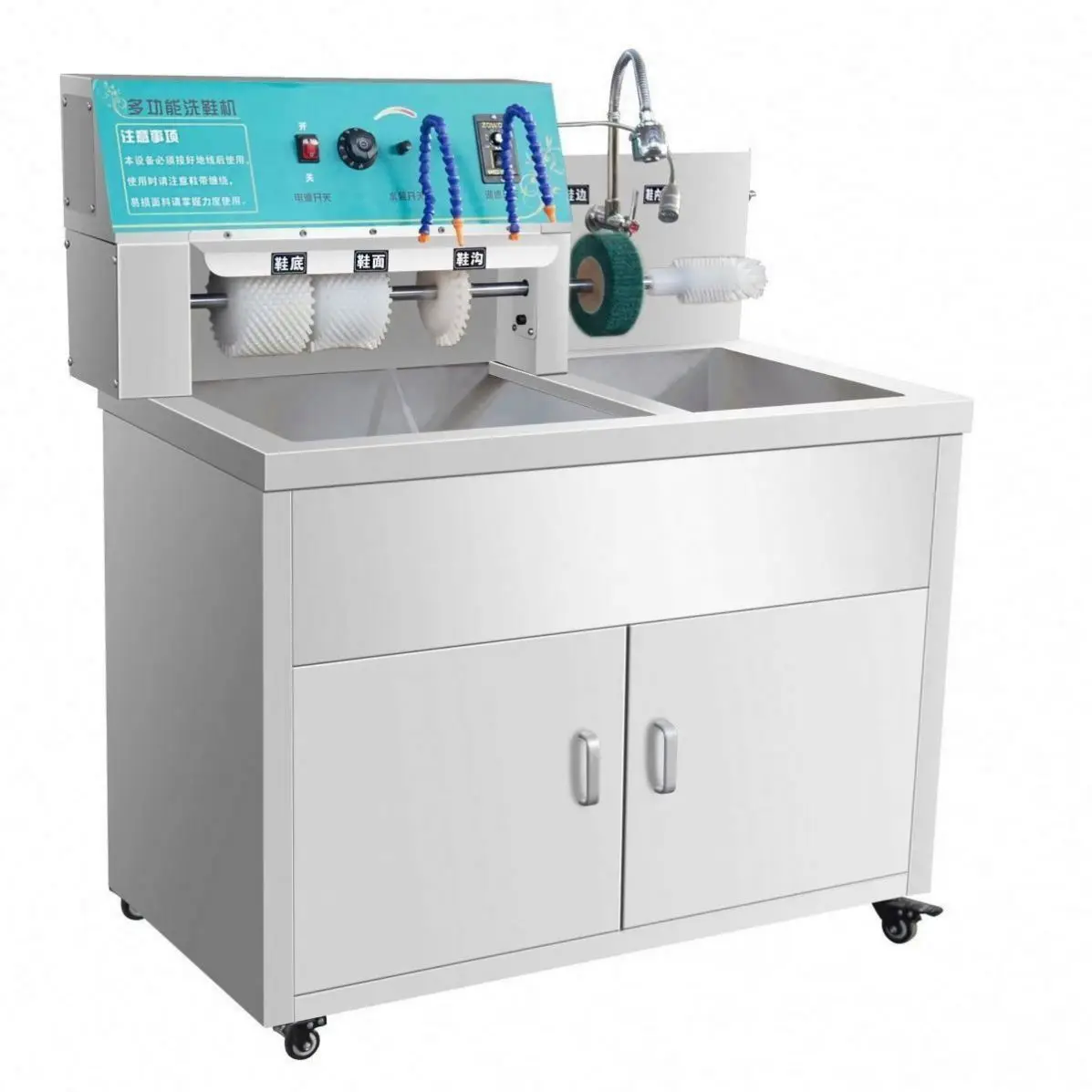
Three product names, and none of them matches the photographs
The listing title calls this a Commercial Stainless Steel Fully/Semi-Automatic Leather Shoe Polishing Machine, and then appends Street Washing Equipment. The parameter block calls it nothing at all. The photographs show a machine whose own control panel is printed, in Chinese, 多功能洗鞋机 — multi-function shoe washer.
Those are not synonyms. A polisher buffs a finished leather surface with wax or cream and never touches it with water. The machine in these photographs has two stainless sinks, a gooseneck tap, a soap dispenser, four rotary brushes and a drain — it is a wet cleaning station. Put a pair of leather Oxfords through it and you will not have a polished shoe at the end; you will have a ruined one.
The gallery then contradicts the title a second time. A panel headed "Suitable for a variety of fabric shoes" shows sneakers, canvas shoes, casual shoes, board shoes, mesh cloth shoes and hiking shoes. Every one of them is a textile or mesh shoe. There is no leather sample anywhere in the listing.
This guide therefore describes what the machine actually is, station by station, and then works through the numbers that decide whether it can be installed in your building — because the listing publishes five parameters, and four of them are not dimensions.
What the photographs actually show
The unit is a freestanding stainless cabinet on four castors, two of them braked. Above the cabinet sits a working deck with two basins, and above that a brush rail. A control panel is cantilevered on the left; the tap and dispenser are on the right. Two doors close the lower cabinet, which is where the plumbing and the motor compartment live.
The control panel carries three things: a power rocker switch marked on/off, a rotary dial for speed, and a breaker-style switch. Above them, in Chinese, is a precautions block. Laid out on a rail in front of the operator is the brush set, and each brush carries a printed label naming the part of the shoe it serves.
The four brush stations, and what each one is for
The labels are the most useful engineering detail in the entire listing, because they tell you the machine was designed around a sequence rather than a single action.
| Station | Label on the machine | Hardware | What it does |
|---|---|---|---|
| Sole station | “sǔ dǐ” — labelled sole | Two wide cylindrical brushes on a front rail | Cleans the tread and the sole edge before the upper is touched |
| Upper station | “sǔ miàn” — labelled upper | The second wide brush pair, same rail | The main fabric cleaning station; the label names the shoe upper explicitly |
| Groove station | “sǔ gōu” — labelled groove | Narrow brush between the wide ones | Reaches the welt line and the gap between upper and sole |
| Side wheel | Unlabelled | Green wheel plus a white cylindrical brush mounted on the right-hand column | Edge and sidewall work, reachable without turning the shoe |
The sequence matters commercially. The sole station is dirtiest and most abrasive, so it comes first and should be a different brush from the upper station — otherwise grit from the tread is transferred straight onto the fabric. A machine with one brush doing both jobs will wear uppers out early. Ask the supplier whether the brushes are separately replaceable, what they cost, and what the recommended replacement interval is, because on a station used daily the brushes are the running cost, not the electricity.
The printed precautions are the operating manual
Three lines of Chinese text sit on the control panel above the switches. Translated, they read:
- This equipment must be connected to a proper earth before use.
- When using, pay attention to shoelaces tangling.
- For delicate fabrics, control the force you apply.
Each line is a design admission. The first tells you the machine is metal-bodied, water-adjacent and expects a protective earth — which in a wet commercial space means an RCD-protected circuit, not just a three-pin plug. The second tells you there is no lace guard or interlock; a lace caught in a rotating brush at the sole station will pull the shoe, and possibly the operator's hand, toward the rail. The third tells you the brush pressure is operator-controlled rather than machine-controlled, which is why there is a speed dial and why training matters more than the datasheet.
None of this appears in the listing's own copy. It is printed on the machine, in a language the export buyer may not read, and it is the closest thing to a safety section the listing has.
Which shoes, and the leather problem
The shoe-type panel is explicit: sneakers, canvas, casual, board, mesh cloth and hiking shoes. These share a property — the upper is a textile, mesh or coated synthetic that tolerates water and mechanical agitation.
Leather does not. Water-swollen leather loses its finish, and mechanical brushing on a wet upper lifts the grain. The control panel's own warning about "delicate fabrics" is the manufacturer acknowledging that the brush force is strong enough to damage a soft upper if the operator is careless. So the title's "Leather Shoe Polishing" describes a machine this is not, and a job this machine should not be given.
The practical consequence for a buyer is a scoping question, not a technical one: if your requirement is polishing leather in a hotel lobby, this is the wrong product and no amount of specification work will fix it. If your requirement is washing fabric footwear — a gym, a sports club, a workwear laundry, a shoe-care shop — this is the right class of machine, and the rest of this guide applies.
3.6 kW: the number that decides your electrical installation
Power is the only real engineering figure the parameter block publishes, and it is high for a brush machine. 3.6 kW is not a plug-in appliance load in most of the world, and the listing does not state the voltage or the phase, which means the buyer has to work backwards.
| Supply | Current at 3.6 kW (A) | What it means on site |
|---|---|---|
| 220 V, single phase | 16.4 | A 16 A socket is at its limit before starting current |
| 230 V, single phase | 15.7 | Still above a comfortable 16 A continuous rating |
| 240 V, single phase | 15.0 | Exactly at a 15 A continuous circuit once derated |
| 380 V, three phase | 5.5 | Per phase, balanced load at unity power factor |
| 110 V, single phase | 32.7 | Not connectable to a standard 15 A or 20 A branch circuit |
Two conclusions follow directly from that table. First, on a 220–240 V single-phase supply the machine draws 15–16.4 A, which sits exactly at the rating of a standard 16 A circuit — a circuit you should not load to 100% continuously, and certainly not in a wet room where nuisance tripping has a safety dimension. Budget for a dedicated 20 A circuit with RCD protection, and confirm with the supplier whether the machine's starting current exceeds its running current.
Second, if the unit is offered in a 380 V three-phase version, the per-phase current falls to about 5.5 A, which is far easier to accommodate in a commercial building. Ask which version you are being quoted before you sign, because the photograph in the listing does not show a nameplate and the parameter block does not say.
The 110 V row is included deliberately: at 32.7 A this machine cannot run on a North American 15 A or 20 A branch circuit at all. If you are specifying for a 120 V market, the machine must be a 240 V model on a dedicated circuit, or the whole discussion is academic.
Where 3.6 kW probably goes — and why you must ask
A brush rail with four small gearmotors does not consume 3.6 kW. Brushes of this size turn slowly and are geared for torque, not power; a typical brush motor in this class is a fraction of a kilowatt. So a 3.6 kW total implies something else on the same supply: a water heater, a warm-air blower for drying, or both.
This matters because it changes the installation and the running cost. A heater needs a water connection with adequate flow and a drain that tolerates hot water; a blower needs a vent path and adds noise. It also changes the cycle: a machine that heats water has a warm-up period before the first shoe, which is the difference between opening the shop and serving the first customer.
The listing does not break the 3.6 kW down, so the honest answer is that you cannot tell from the listing what the machine is doing with its power. Ask for the load schedule: motor rating per station, heater rating if fitted, blower rating if fitted, and total connected load versus running load. A supplier who cannot produce that breakdown has not measured the machine.
"Stainless steel" is not a specification
The parameter block says the material is stainless steel — spelled "Stainless Steal" in the listing, which is a small thing that tells you nobody proofread the export copy. The bigger issue is that no grade is given, and in a machine that is wet every working hour, grade is the specification that decides the machine's life.
The two grades that dominate this kind of fabrication are 304 and 201. Both are called stainless steel. 201 contains manganese in place of part of the nickel, costs less, and in a continuously wet, mildly chlorinated environment it will show surface rust — typically at welds, at the sink radius and around fasteners, which are exactly the places a customer sees. 304 is the baseline for commercial wet equipment; 316 is the upgrade for chloride-heavy environments such as coastal sites or heavy disinfectant use.
Ask for the grade in writing for the body panels, the two basins and the brush rail, plus the surface finish (brushed or mirror) and the thickness. A basin that flexes under a full load of water will crack its weld eventually, and thickness is the number that predicts it.
Water, drain and the things nobody quotes
A wet station is a plumbing project with a brush rail attached, and the listing says nothing about plumbing. Before you can quote an installation you need:
- Inlet requirement — pipe size, minimum pressure, hot and cold or cold only, and whether the heater (if fitted) is fed from the mains or from a tank.
- Basin capacity in litres, for both sinks. This drives both water consumption per shift and the structural load on the floor.
- Drain — outlet diameter, gravity or pumped, and whether a trap and a solids strainer are supplied. A shoe washer discharges grit and lint; a plain drain will block.
- Water consumption per cycle — the number that decides your monthly utilities and your environmental compliance in water-restricted markets.
- Overall dimensions and weight — neither is published. You cannot plan a doorway, a lift or a floor loading without them.
- Noise level — unpublished, and relevant if the unit goes near a reception or a fitting room.
Every item on that list is a question the supplier must answer before shipment, not after arrival. On a freestanding unit with castors the temptation is to treat installation as "wheel it in and connect a hose"; the electrical and drainage work is what actually delays a project.
CE and ISO 9001 are not the same kind of claim
The certification row reads "CE/ISO9001", which bundles two very different things. ISO 9001 certifies a quality management system at the factory — it says something about how consistently the product is made, and nothing about whether this particular machine is safe. CE is a declaration that the product meets the applicable European directives, and it is issued by the manufacturer on its own responsibility, supported by a technical file.
So neither line, as written, is evidence you can file. What you want instead is:
- the EU Declaration of Conformity naming this machine and the directives applied (machinery, low voltage, EMC as applicable);
- the harmonised standards cited;
- the test report behind the electrical safety claim, with the laboratory named;
- for a wet appliance in many markets, the relevant IP rating of the electrical enclosure — unpublished here.
For a machine that combines mains electricity, water and an operator standing in front of it, "CE" as a two-letter line item is the weakest possible form of the claim. Ask for the declaration, not the logo.
Freestanding does not mean plug-and-play
"100% Freestanding" in the parameter block is accurate and useful: the unit needs no floor anchor, no wall bracket and no pit. Four castors, two braked, mean it can be repositioned for cleaning underneath — a genuine advantage in a wet room.
It also means the machine has no built-in water treatment, no drain pump (probably), no floor fixing to resist a hose pulling on it, and no enclosure beyond the cabinet doors. In practice a freestanding wet unit needs: a locked-off water connection with an isolator, a drain it cannot be pulled away from, a dedicated electrical circuit as above, and a floor with a fall to a gully. None of that ships with the machine.
Two design details visible in the photographs are worth confirming in writing: whether the castors are rated for the loaded weight (unknown, because weight is unpublished), and whether the cabinet interior is accessible for servicing without removing panels.
The commercial terms that are actually published
Unlike the engineering data, the trade terms are clear and quotable. One panel in the gallery sets them out:
| Term | As published |
|---|---|
| Quotation time | Within 24 hours of inquiry |
| Samples | Available for reference |
| Custom design | Offered, with in-house drawing team |
| Payment | 30% deposit, 70% before shipping; T/T, PayPal, Western Union |
| Lead time | About 15 working days, depending on order quantity |
| Delivery terms | EXW, FOB or CIF, buyer's choice |
Two of those deserve emphasis. Lead time of about 15 working days is stated with the honest caveat that it depends on order quantity — treat 15 days as the floor for a single unit and ask for the batch curve. 30% deposit and 70% before shipping is the standard structure, but note what it means: you pay the balance before you have seen the machine. For a first order of a capital item, negotiate either a pre-shipment inspection with photos and a video of the unit running, or a small retention released after installation.
Nothing in the listing states a minimum order quantity or a price, so this page will not invent either. For a machine in this class the price moves with the stainless grade, the electrical version, the brush set and the crating, and those four variables are exactly the ones still unpublished.
Site acceptance: what to check before you sign off
- Nameplate first. Photograph it and confirm voltage, phase, rated power and the actual model designation. If the nameplate says something the listing never mentioned, resolve it in writing before installation.
- Measure the unit and weigh it, then compare with the drawing the supplier should have provided. Publish those numbers internally for the next order.
- Run it dry on the intended circuit and confirm the breaker holds through start-up, not just running.
- Run it wet with a full basin and check for leaks at every joint, at the tap base and at the drain, for a full cycle.
- Test all four stations with a pair of scrap sneakers: sole, upper, groove and side wheel. Confirm the brushes are separately replaceable and that a spare set is on site.
- Check the earth with a continuity tester from the frame to the plug earth pin. The panel's own warning makes this mandatory, not optional.
- Time a full cycle including fill, wash, rinse and any drying, and record it as your service-time baseline.
- Read the shoe-type panel against your actual customer base and write a short use policy — no leather, laces tied or removed, delicate uppers at reduced speed. The machine's warnings are the basis for that policy.
RFQ checklist
Send this as a table with your site details filled in. The gaps are the point: every row is something the listing does not answer.
| Item to confirm | Why it decides the order |
|---|---|
| Electrical version: voltage, phase, rated current | 3.6 kW needs a dedicated circuit; 110 V markets cannot use it as published |
| Load breakdown: motors, heater, blower | The published total does not say what consumes it |
| Stainless grade for panels, basins and brush rail | 201 versus 304 decides whether it rusts in a wet room |
| Panel thickness and surface finish | Predicts basin weld life under load |
| Overall dimensions and net weight | Neither is published; needed for access, floor loading and freight |
| Basin capacity (litres) and water consumption per cycle | Utilities cost and environmental compliance |
| Inlet size, pressure, hot/cold requirement | Plumbing design before delivery |
| Drain size, gravity or pumped, strainer included | Grit and lint block a plain drain |
| Brush specification, replaceable or not, spare set price | The main running cost of a wash station |
| IP rating of the electrical enclosure | Wet-room safety and local inspection |
| EU Declaration of Conformity and test report | "CE/ISO9001" as a line item is not evidence |
| Noise level dB(A) | Placement near customer-facing areas |
| Cycle time: fill, wash, rinse, dry | Service capacity per hour and staffing |
| Warranty duration and what field installation covers | The after-sales row promises field installation without defining scope |
| MOQ, FOB price per electrical version, carton dimensions | None of these are published |
What we will and will not quote from this page
The electrical arithmetic on this page is calculated from the one engineering figure the listing publishes, and the calculation is shown so you can check it. The station descriptions are read from the machine's own labels. The trade terms are transcribed from the listing's own panel. Nothing here is inferred from a photograph where a number was needed.
What we will not do is guess dimensions, weight, water consumption, brush speed, voltage or price. Those six numbers determine whether a wash station can be installed and what it costs to run, and the listing publishes none of them. A guide that filled them in would read better and be worthless.
One further note on listing hygiene, since it affects how you evaluate this supplier: the gallery includes a business card naming an individual sales manager, a mobile number and a personal mailbox — not the company's own sales address. For a capital purchase, insist that the quotation, the drawings and the warranty come on company letterhead with a company contact, so that the paperwork survives staff turnover.
Send the checklist above with your site's voltage, drain position and daily shoe volume, and the reply can be a configured quotation rather than a brochure.
Key specifications
- After-sales Service Provided
- Video technical support, Field installation, Online support
- Power
- 3.6KW
- Material
- Stainless Steal
- Installation
- 100% Freestanding
- Certification
- CE/ISO9001
Frequently asked questions
- Is this a shoe polishing machine or a shoe washing machine?
- It is a washing machine. The control panel is printed 多功能洗鞋机 (multi-function shoe washer) and the machine has two stainless basins, a tap, a soap dispenser, a drain and four rotary brushes. The title's 'Leather Shoe Polishing' describes neither the machine nor a job it should be given.
- Can it clean leather shoes?
- The listing's own shoe panel shows sneakers, canvas, casual, board, mesh cloth and hiking shoes — all textile or mesh uppers. The control panel warns to reduce force on delicate fabrics. Leather should not be washed and brushed in a machine of this type; it loses its finish and the grain lifts.
- What electrical supply does 3.6 kW need?
- At 220 V single phase the machine draws about 16.4 A, which is at the limit of a standard 16 A circuit — budget a dedicated 20 A circuit with RCD protection. At 380 V three phase the per-phase current is about 5.5 A. At 110 V it would need 32.7 A and cannot run on a normal branch circuit.
- Why is 3.6 kW so high for a brush machine?
- Brush gearmotors in this class are a fraction of a kilowatt each, so the published total implies additional loads such as a water heater or a drying blower. The listing does not break the figure down, so ask for a load schedule with motor, heater and blower ratings separately.
- What grade of stainless steel is it?
- The listing says only 'stainless steel' (spelled 'Stainless Steal'). No grade is given. In a continuously wet machine the grade matters: 201 is cheaper and will show surface rust at welds and around fasteners, 304 is the normal baseline for commercial wet equipment, and 316 is the upgrade for chloride-heavy sites.
- What are the brush stations for?
- The machine labels four: sole, upper, groove and an unlabelled side wheel. The sole station takes the abrasive dirt first, the upper station cleans the fabric, the narrow groove brush reaches the welt line, and the side wheel handles edges. Brushes should be separately replaceable — ask for the spare set price and the replacement interval.
- Does it need special plumbing?
- Yes, but the requirements are not published. You need inlet size and pressure, basin capacity in litres, drain size and whether it is gravity or pumped, water consumption per cycle, and a strainer for grit and lint. None of these appears in the listing, and all of them affect installation cost.
- What are the payment and delivery terms?
- As published: quotation within 24 hours, samples available, 30% deposit and 70% before shipping by T/T, PayPal or Western Union, lead time about 15 working days depending on quantity, and EXW, FOB or CIF at the buyer's choice. No MOQ or price is stated.