
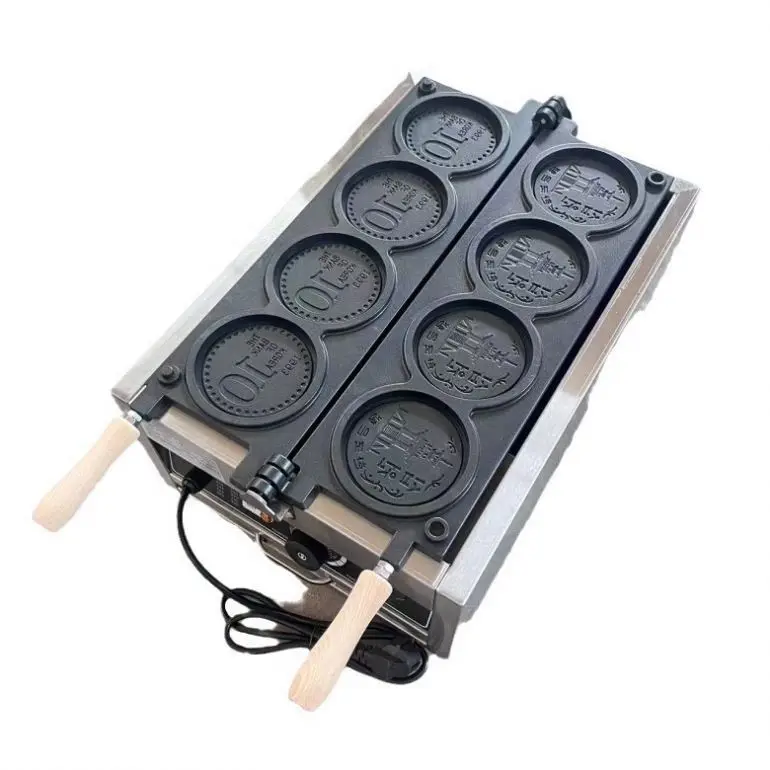
Source-controlled product identity
The Hoting queue record describes a TEBAK commercial coin waffle maker for round-shape waffles and snack production. The structured fields provide six procurement facts: stainless-steel material, 15Kg weight, 3KW power, 110-240V / 50-60HZ supply, 365*675*260mm dimensions and 1pcs/CTN packing. The title adds “4 coin,” “round shape,” “crispy cheese cookie maker” and other marketing terms. This guide keeps those title claims separate from the structured specifications.
Product ID 1601391196572 must appear on the quotation, nameplate photograph, drawing, test record, packing list and spare-parts list. The source record does not provide mold diameter, cavity count confirmation, temperature range, heat-up time, temperature uniformity, output rate, plate coating, control method, plug, current, noise, food-contact documents, certification, MOQ, warranty or lead time. These missing values are RFQ and acceptance-test items.
Verified fields and listing claims
| Source field | Recorded value | Buyer action |
|---|---|---|
| Material | Stainless Steel | Confirm which parts use stainless steel, grade, finish, food-contact suitability and cleaning limits. |
| Weight | 15Kg | Confirm net or gross weight, weighing method, packed weight and lifting requirements. |
| Power | 3KW | Confirm rated input power, current at each voltage, circuit protection and test condition. |
| Volts | 110-240V / 50-60HZ | Confirm auto-ranging or selectable operation, phase, plug, earthing and destination configuration. |
| Dimensions | 365*675*260mm | Confirm L*W*H order, measurement points, feet, handles, protrusions and required clearance. |
| Packing | 1pcs/CTN | Request carton dimensions, gross weight, protection, marks and export packing details. |
| Title claims | 4 coin, round shape, waffle and cookie terms | Confirm cavity pattern, mold, recipe suitability, plate configuration and actual product output. |
Electrical configuration for 110-240V / 50-60Hz
The supplied voltage field is broad: 110-240V / 50-60HZ. Ask the supplier whether this is one auto-ranging machine, a manually selected voltage design or separate configurations. Confirm phase, rated current, maximum current, plug, cable, earthing and recommended protective device. Do not select a plug or circuit from the voltage range alone.
Because the structured power field is 3KW, request current measurements at the buyer’s actual voltage. A 3KW load may require different current protection at 110V and 240V. Record start-up current, steady-state current, allowable voltage tolerance, extension-cable limits and generator compatibility if mobile service is planned.
Inspect the nameplate, wiring diagram and cable entry. Confirm that the machine’s heating elements, controller and switchgear match the quoted voltage configuration. Test power interruption and restart behavior; the plates should not re-energize unexpectedly after a supply return.
Request electrical safety records appropriate to the destination market, including protective-earth, insulation or leakage checks where applicable. Keep general company quality claims separate from product-level electrical evidence.
What 3KW means for production planning
The 3KW value is a structured source specification, but it does not establish heat-up time, recovery time or output rate. Ask whether 3KW is total rated input power for both plates, a nominal heater rating or another value. Request the heater layout, control zones and duty-cycle behavior.
Run a heat-up test from ambient conditions and record supply voltage, input current, power draw, time to the approved cooking temperature and temperature stability. Repeat after loading a normal batch. Record recovery time between batches instead of using a marketing throughput estimate.
Confirm whether both cooking plates heat simultaneously and whether the controller cycles power independently. Measure the temperature on each working surface during empty and loaded operation. Uneven heat can change browning, texture and food-safe holding decisions.
Check circuit loading when other counter equipment is operating. A buyer should confirm the site’s available capacity, protective device and ventilation before placing several 3KW machines on one circuit.
Dimensions, weight and counter installation
The structured dimensions are 365*675*260mm. Request the supplier’s dimension drawing and confirm the order of length, width and height. Clarify whether the measurement includes feet, handle, hinge, rear cable, control panel or open-lid clearance.
The recorded weight is 15Kg. Confirm that it is net product weight rather than gross packed weight. Measure the delivered unit during inspection and record the scale, packaging state and any detachable plate or tray. The buyer’s counter and operator should be able to support and move the machine safely.
Allow clearance for lid opening, loading, unloading, cleaning, cable routing and ventilation. A 260mm closed height does not establish the working height when the upper plate is open. Request open-position dimensions and minimum wall clearance.
Test stability while opening the lid, removing cooked waffles and cleaning the plates. Check feet, handles, hinges and lid balance. Confirm whether a splash guard, grease tray, stand or counter bracket is included or optional.
Confirm the “4 coin” and round-shape claims
The title says “4 coin” and “round shape,” but the structured record does not provide a mold drawing. Ask for a top-and-bottom plate layout showing cavity count, cavity diameter, depth, spacing, plate split and finished product dimensions.
Clarify whether “coin” describes small round waffles, a particular mold pattern or a supplier marketing term. Request sample products made with the quoted plate and record diameter, thickness, weight, browning and release behavior. Do not assume the title defines the output shape accurately.
Confirm whether the plates are fixed, removable, interchangeable or custom-made. Ask for plate material, surface treatment, coating, replacement price, lead time and approved cleaning tools. A change of plate can affect heat distribution, power demand and finished product size.
Test one production cycle with the buyer’s batter or recipe. Record fill quantity, spread, cooking time, temperature, release, edge quality, center doneness and plate cleaning. Keep recipe performance separate from machine capability because batter formulation and operator loading affect results.
Temperature control and cooking repeatability
No temperature range, display accuracy, thermostat type or timer value is supplied. Request the control method, setpoint range, sensor location, display resolution, accuracy, hysteresis and calibration procedure. Clarify whether the controller regulates each plate separately.
Map temperature across the plate surface before loading and after repeated cycles. Record center, edge and cavity temperatures with a calibrated instrument. Repeat at several setpoints or operating modes that the buyer intends to use.
Test recovery after the upper plate closes, after a cold batter load and after repeated batches. Record time to return to the target band and the variation between cavities. Do not publish a cooking time or temperature as a guaranteed performance number unless it is tied to a defined recipe and test condition.
Confirm timer behavior, alarm, end-of-cycle indication and manual override. Check whether the heater turns off, cycles or remains active when the lid is opened. The operator should be able to stop heating safely before cleaning or clearing a stuck product.
Materials, coating and food-contact surfaces
The material field says stainless steel, but it does not identify the steel grade or the parts covered. Request material identification for the housing, plates, tray, hinges, fasteners and any food-contact coating. If a coating is used on the mold, request its composition, temperature limit, abrasion guidance and food-contact documents.
Inspect plate surfaces for scratches, pits, sharp edges, exposed fasteners and coating defects. Check that hinges and plate seams do not create food traps. Record the approved detergents, sanitizers, brushes and maximum cleaning temperature.
Ask whether the plates are safe for immersion, dishwasher cleaning or spray cleaning. Do not infer washability from stainless-steel appearance. Electrical components must be isolated from water and cleaning chemicals according to the manual.
Keep product-contact evidence specific to the exact model and plate configuration. A general factory quality statement or an ISO9001-related company claim does not replace food-contact documentation for the machine’s working surfaces.
Cleaning, hygiene and operator workflow
Request a daily cleaning procedure covering power isolation, cool-down, plates, hinges, handles, crumbs, batter residue, control panel and cable. Define which parts are removable and whether a tool is needed. Ask for the time required between batches and at closing.
Run a cleaning trial using the buyer’s actual batter and toppings. Record residue at plate edges, hinge areas and cavities, and verify that the approved cleaning method removes it without damaging the surface.
Inspect the machine for grease or batter paths into electrical areas. Confirm seals, plate joints, control-panel protection and cable entry. A food-service appliance should be easy to inspect before the next production period.
Create an operator checklist: preheat status, plate condition, batter quantity, timer, heat setting, PPE, cable condition, product release, cleaning and emergency isolation. Provide training material in the buyer’s language where required.
Output, batch testing and service profile
The source does not provide output per hour, cooking time or maximum load. Do not infer capacity from “4 coin.” Define the buyer’s required batch size and measure it with the approved mold and recipe.
Run a representative service simulation: preheat, load, cook, open, unload, close and repeat. Record cycle time, recovery, operator actions, power draw and finished product consistency. Repeat after the machine reaches a stable operating temperature.
Test the lowest and highest planned batter loads. Record overflow, underfill, sticking, uneven color, deformation and cleaning time. Keep recipe changes out of the machine acceptance decision unless the recipe is part of the agreed supply package.
Confirm the intended duty profile: occasional snack service, kiosk, restaurant counter, catering or continuous commercial use. Request a rated operating cycle, rest period, thermal limit and service interval for the quoted configuration.
Packing and logistics
The packing field says 1pcs/CTN. Request carton length, width, height, gross weight, inner protection, moisture barrier, shock protection, carton marks and pallet requirements. Confirm that the package protects plates, hinges, controls and cable during international transport.
Compare the packed dimensions with the recorded product dimensions. Ensure that the 15Kg value is not mistakenly used for shipping weight. Obtain a packing list that identifies one machine per carton, accessories, manuals and spare parts.
Ask whether the unit ships with the correct destination plug or bare leads, and whether assembly or voltage selection is required after arrival. Include unpacking, electrical inspection, plate cleaning, warm-up and first-batch testing in commissioning.
Request spare parts for heater, sensor, thermostat, timer, switch, hinge, handle, plate, tray, feet, cable and controller. Confirm part numbers, prices, availability and replacement instructions before purchase.
Customization and commercial terms
The queue record does not state customization options. Ask whether the supplier can change plate pattern, cavity size, voltage version, plug, controller, color, logo, packaging or accessories. Each change should have a drawing, revision, surcharge, MOQ and lead time.
Require a pre-production sample or first-article approval for custom plates. The approved sample should carry product ID 1601391196572 and the same nameplate, electrical configuration and cooking surfaces as the batch.
Request MOQ, sample charge, production lead time, inspection terms, warranty, after-sales response and spare-parts policy. Confirm whether a custom mold remains the buyer’s property and how it is stored or replaced.
Factory acceptance test proposal
- Verify product ID 1601391196572, model, nameplate, voltage version and plate configuration.
- Confirm material scope, 15Kg net-weight method, 3KW rated power, 110-240V / 50-60Hz operation and 365*675*260mm measurement reference.
- Measure start-up current, steady-state power, protective earth and restart behavior at the destination voltage.
- Map temperature across both plates and record heat-up, stabilization and recovery after loading.
- Verify the “4 coin” and round-shape claims with a dimensioned mold drawing and sample products.
- Test batter loading, cooking time, release, browning, cavity consistency, overflow and residue.
- Inspect plate material, coating, welds, hinges, food-contact surfaces and cleaning compatibility.
- Test timer, thermostat, alarms, manual override, power isolation and over-temperature protection.
- Run a representative service cycle and record output, power draw, operator actions and surface temperatures.
- Review manuals, food-contact evidence, electrical tests, packing, spare parts, warranty and commercial terms.
RFQ checklist
- Exact model and product ID 1601391196572 on quotation, nameplate, drawing and packing list.
- Material grade and part list for housing, plates, tray, fasteners and food-contact surfaces.
- Net versus gross weight; verify the structured net-weight claim of 15Kg and packed weight separately.
- 3KW definition, heater layout, current at 110V and 240V, start-up current and circuit protection.
- 110-240V / 50-60Hz configuration: auto-ranging or selectable, phase, plug, cable, earthing and tolerance.
- 365*675*260mm dimension order, measurement points, open-lid clearance and ventilation requirements.
- “4 coin” cavity count, round-mold drawing, cavity diameter, depth, spacing and finished product size.
- Temperature range, sensor, accuracy, display, timer, hysteresis, calibration and recovery time.
- Plate material, coating, food-contact documents, replacement cost and approved cleaning chemicals.
- Cooking cycle, recommended batter load, output test, product diameter, thickness and recipe conditions.
- Safety functions: over-temperature cutoff, fuse, earth, switch, restart prevention and hot-surface warnings.
- Carton dimensions, 1pcs/CTN packing, gross weight, protection, marks, MOQ, lead time and warranty.
Buyer decision framework
This listing is a starting point for sourcing a commercial coin-style round waffle maker. The source-backed scope includes stainless-steel material, 15Kg weight, 3KW power, 110-240V / 50-60Hz, 365*675*260mm dimensions and 1pcs/CTN packing. The title’s 4-coin, round-shape and crispy snack terms require model-specific confirmation. Approve the machine only after electrical configuration, mold dimensions, temperature behavior, food-contact surfaces, cleaning process, representative output and destination-market documentation pass the agreed acceptance plan.
Frequently asked questions
Is the machine automatically compatible with every voltage from 110V to 240V?
The source lists 110-240V / 50-60Hz but does not define the configuration. Confirm auto-ranging or selectable operation, phase, plug, current and protective requirements for the destination.
Does “4 coin” confirm four round waffles per cycle?
It is a title claim, not a structured mold specification. Request a plate drawing and sample measurement before treating it as a cavity count or output promise.
Is 3KW the heater power?
3KW is the recorded power field, but the source does not define whether it is total input power or another rating. Confirm heater layout, current and test condition on the nameplate and datasheet.
Can the stainless-steel machine be washed with water?
Do not assume washability. Request the cleaning procedure, removable-part list, electrical isolation method and restrictions on immersion or spray cleaning.
What does 1pcs/CTN mean?
It records one piece per carton. Ask for carton dimensions, gross weight, protective materials, carton marks and the complete accessory packing list.
Source and contact
This guide is based on the Hoting queue record for product ID 1601391196572. Before purchase, request the current quotation, nameplate photograph, electrical data, mold drawing, temperature map, food-contact documents, cleaning procedure, acceptance samples, packing list, spare-parts offer and final machine photographs. For sourcing questions, contact the TEBAK sales team through the site’s current inquiry channel.
Key specifications
- Material:
- Stainless Steel
- Weight
- 15Kg
- Power:
- 3KW
- Volts:
- 110-240V / 50-60HZ
- Dimensions:
- 365*675*260mm
- Packing
- 1pcs/CTN