
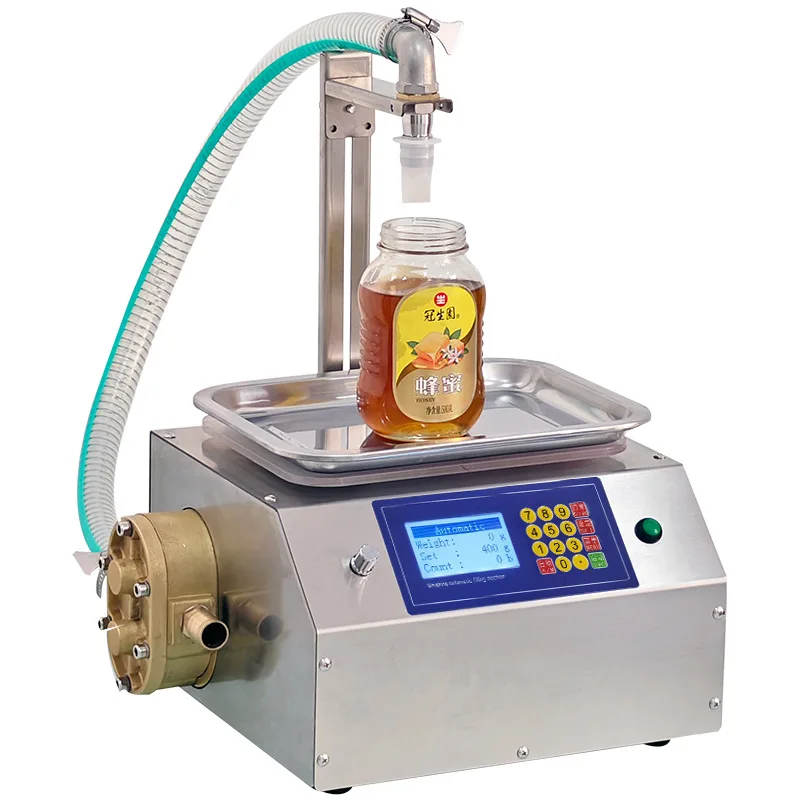
This page sells four machines, and the parameter block mentions one
The title names a single model: CSY-L15. The description repeats it and gives one specification set. But four of the eight gallery images are model panels, and they describe four different fillers with four different pumps: CSY-L15 and CSY-L15+ on a brass gear pump running at 7 and 14 litres per minute, CSY-L13 on a peristaltic pump at 8 litres per minute, and CSY-M90, a micro peristaltic unit at 90 millilitres per minute. A fifth model, CSY-1200, is recommended in passing.
That is not a cosmetic problem. A gear pump and a peristaltic pump handle completely different products, wear differently, and are cleaned differently. Buying "the filling machine" without deciding which pump you are buying is how a honey line ends up with a tube pump that surges, or a reagent line ends up with a brass gear pump that cannot meter half a gram.
The table below is transcribed from the four panels, with the description's own numbers kept separate because they do not agree with them.
The four models, transcribed from their panels
| Model | Recommended range | Pump | Filling head | Max flow | Error claim | Ceiling |
|---|---|---|---|---|---|---|
| CSY-L15 | 10–5,000 g | Brass gear pump | Duck-bill, 20 mm | 7 L/min | < 2 g | Max fill weight 10 kg |
| CSY-L15+ | As L15 | Brass gear pump | Duck-bill, 20 mm | 14 L/min | < 2 g | Max fill weight 10 kg |
| CSY-L13 | 0.03–10 kg | Peristaltic, 8 L/min | 12 mm | 8 L/min | < 2 g | Max fill weight 10 kg |
| CSY-M90 | 0.5–10 g | Micro peristaltic | 3 mm, changeable to 1.5 mm | 90 mL/min | ≤ 0.1 g | Max fill weight 300 g |
Two things in that table are worth more than the rest. First, the error claim is absolute, not proportional: under 2 g on the L-series and 0.1 g on the M90, regardless of how much you are filling. Second, the L15+ exists and is not mentioned in the title — it is the same machine with twice the pump displacement, which matters if your product is thick and your jar is large.
20–8000 g or 10–5000 g? Both appear on the same page
The description text states a filling range of 20–8000 g. The L15 panel states a recommended range of 10–5000 g, with an absolute ceiling of 10 kg. Those are different machines to a buyer planning production.
The reconciliation is probably this: the panel is the recommendation and the description is the outer limit. But a recommendation of 5 kg and a ceiling of 10 kg implies the top half of the range is available and not advised — which is exactly the sort of thing that should be stated in one place, not inferred from two.
Practical consequence: if your jar is 5 kg of honey, you are at the top of the recommended band and every cycle runs long. If your jar is 8 kg, you are inside the description's claim and outside the panel's recommendation, and the machine may fill it — slowly, and with the pump at its limit. Plan the line around 5 kg and treat 8 kg as an exception you have tested.
What 7 litres per minute actually means per jar
The nominal pump figure is the easiest number on the page to misuse, because it is a displacement, not a fill rate. Seven litres per minute is 116.7 millilitres per second. On a water-like product that is the whole story; on honey it is not, because the same panel says ordinary honey runs about 10 seconds per kilogram.
| Fill weight | At 7 L/min, water-like | At the panel's honey rate | Gross fills per hour (honey) |
|---|---|---|---|
| 500 g | 4.3 s | 5 s | 720 |
| 1,000 g | 8.6 s | 10 s | 360 |
| 5,000 g | 42.9 s | 50 s | 72 |
Now put the two published numbers side by side and something interesting appears. A rate of 10 seconds per kilogram is 100 grams per second, or 6 kg per minute. If the pump is simultaneously moving 7 litres per minute, then each litre has to weigh 857 grams for both statements to hold. That is lighter than water. Honey is not.
So the two figures cannot both describe the same product. Either the 7 L/min is the pump's free-flow displacement — what it moves with no restriction and nothing viscous in it — or the 10 s/kg figure is measured on a warm, thin batch. Both are normal ways for a supplier to quote, and neither is a lie. But it means the number to plan on is the seconds per kilogram for your own product, measured yourself, not the litres per minute on the panel.
The ±2 g error is only meaningful at the top of the range
An absolute error of 2 g means something very different at 10 g than at 5 kg:
| Fill weight | Relative error at ±2 g |
|---|---|
| 10 g | ±20.00% |
| 20 g | ±10.00% |
| 100 g | ±2.00% |
| 500 g | ±0.40% |
| 1,000 g | ±0.20% |
| 5,000 g | ±0.04% |
At the bottom of the recommended band the tolerance is a fifth of the fill. No gravimetric filler holds that on a production line, and nobody should expect it to: the ±2 g figure is a statement about the machine's repeatability at working weights, not a promise about 10 g doses.
If your product is sold in 20 g or 50 g units, the L-series is the wrong family and the M90 is the right one — its 0.1 g error is 1 percent at 10 g and 20 percent at half a gram, which is why its panel puts the recommended floor at 0.5 g and not lower.
The M90 is a laboratory instrument, and the arithmetic says so
Ninety millilitres per minute is 1.5 millilitres per second. That is a sensible rate for a reagent bottle and an absurd one for a food jar:
| Fill weight | Fill time at 90 mL/min | Gross fills per hour |
|---|---|---|
| 0.5 g | 0.33 s | 10800 |
| 1.0 g | 0.67 s | 5400 |
| 10 g | 6.67 s | 540 |
| 100 g | 66.67 s | 54 |
| 300 g | 200.00 s | 18 |
At 300 g the pump needs over three minutes per bottle. Even allowing for the fact that the machine stops on weight and therefore wastes no time, that is a bench instrument for sample work, not a filler for a bottling run. Its panel is honest about the application — dilute potions, liquid test kits, chemical reagents — and honest about its own limit: maximum viscosity generally no more than cooking oil.
The L13 panel criticises itself, and you should read that closely
The peristaltic model's panel ends with a line that suppliers rarely volunteer: "Disadvantages: large jitter, expensive price, expensive supplies pipe, non-essential not recommended."
That is worth more than a page of marketing copy. It tells you three operational facts in one sentence: the tube pump surges in use, so fills are less steady than on a gear pump; the machine costs more; and the tube is a consumable that has to be bought repeatedly. On a peristaltic filler the tube is the wearing part — it fatigues, it takes a set, and eventually it splits mid-fill. The panel's own guidance is to use the L15 instead unless you specifically need a peristaltic pump.
You need one when the product must never touch a pump body: aggressive chemicals, abrasive slurries, or anything where cross-contamination between batches is unacceptable. Then the tube-only wetted path is the reason to pay for it, and the jitter and the tube cost are the price of that isolation.
Two different "weights" that look like a contradiction
The description lists 15 kg in a column headed weight, and then, in the detail text, says "the maximum weight of this machine is 10KG". Read literally those two sentences contradict each other by five kilograms.
The panels resolve it. Every model panel states "the maximum weight is 10 kg" in the context of filling and of the error specification — so 10 kg is the maximum fill weight, the ceiling on what one cycle can dose. The 15 kg is the machine's own mass, which is what you need for freight and for a bench that can carry it. Once the two are separated, both numbers are correct and neither is a typo.
That distinction matters at the bench: a 15 kg bench filler standing on a weighing platform must not share a table with something that vibrates, because the scale is measuring the jar, not the machine's own movement.
Freight: 49 litres of carton against 15 kilograms of machine
The package size is given as 40 × 35 × 35 — centimetres, by the scale of the machine — which is 49,000 cm³, or 49 litres of carton. Volumetric weight for air freight is conventionally carton volume divided by a factor of 6,000 or 5,000 depending on the carrier:
- At 6,000 cm³/kg: 8.2 kg volumetric
- At 5,000 cm³/kg: 9.8 kg volumetric
Both are below the 15 kg actual weight, so under either convention this shipment is charged on actual weight and the carton is not the problem. That is a useful result to have in advance, because it means an air shipment and a sea shipment differ in cost by the rate, not by a volumetric penalty. Ask for the carton's measured dimensions anyway — a 40 cm figure recorded to the nearest centimetre can easily be 42 on a real box.
The brass pump and the acid-resistance claim need reconciling
The L15 panel states "high temperature resistance, acid and alkali resistance, solvent resistance" and, four lines later, "adopt the gear pump of brass material". Those two statements sit oddly together, because the pump body is the part in continuous contact with the product.
Before you put edible oil, honey or anything acidic through this machine at production volume, ask for a written statement of:
- the wetted materials list, part by part — pump body, gears, seals, hose, duck-bill head;
- a food-contact declaration naming the regulation that applies in your market, if the product is food;
- the seal material, because that is what usually fails first on a hot fill;
- which products the acid and alkali claim actually covers, in writing, rather than as a list of generic properties.
This is not a technicality. A filler is the one machine in a food line where the product spends time inside the mechanism, and a missing declaration is a problem you discover at an audit rather than at delivery.
What will destroy the pump, in the supplier's own words
The L15 panel closes with a warning that should be printed on the machine: "Paint, wax, gypsum water can not use the machine, after solidification will plug the pump."
That is the general rule for any positive-displacement filler. A gear pump meters by trapping a fixed volume between rotating teeth; anything that cures, dries or settles inside those clearances stops the pump doing its job, and the failure is not gradual. It sets overnight and the machine is scrap on Monday. The same logic applies to any product with a filler that settles out, to anything that crystallises on cooling, and to anything that skins in air.
The practical test is simple and costs one jar: fill a sample, leave the residue in the pump overnight without cleaning, and see whether the machine still turns freely in the morning. If it does not, the cleaning routine you need is a flush after every session, not once a day.
Changeover and cleaning decide the real cost
None of the panels states a cleaning procedure or a changeover time, and for a filler those two numbers decide how many products you can run on one machine.
- Gear pump. Product sits in the pump body and the hose. A product change means a flush through the whole wetted path; a sticky product means a warm flush. Ask what volume of flush liquid per changeover, because on small batches the flush can cost more than the product.
- Peristaltic. The tube is the wetted path, so changeover is a tube change — fast, but the tube is a consumable and its cost per change belongs in the calculation.
- Both. The duck-bill head and the nozzle are where dried product hides. Ask whether the head is removable without tools.
A machine that fills correctly but takes forty minutes to clean between products is a machine for one product. Decide how many products you actually run before you choose the pump.
Incoming inspection for a bench filler
- Weigh the machine. It should be close to the 15 kg stated; a large discrepancy means a different configuration arrived.
- Confirm which pump is fitted and compare it to the panel for the model on the invoice. Gear and peristaltic are visually obvious.
- Check the filling head diameter against the model (20 mm duck-bill, 12 mm, or 3 mm for the M90).
- Run a five-point weight ladder on your own product at low, middle and high fills, ten repetitions each, and record the spread. That measured spread replaces the ±2 g claim.
- Time the fills at each weight and write down seconds per kilogram for your product. That is your line rate.
- Leave product in the pump overnight once, deliberately, then flush and check for binding. Better to learn the cleaning requirement on a sample than on a production run.
- Verify the wetted-material declaration matches what is in the box.
RFQ checklist
| Question | Why it decides the purchase |
|---|---|
| Which model: L15, L15+ or L13? | Gear versus peristaltic, 7 versus 14 L/min — different products entirely |
| Is the range 20–8000 g or 10–5000 g? | The description and the panel disagree |
| Seconds per kilogram on our product, measured | The only figure that sets line rate |
| Wetted materials list, part by part | Food contact and chemical compatibility |
| Food-contact declaration for our market | Needed before a food line can pass audit |
| Seal material and its temperature limit | First part to fail on hot fills |
| Maximum viscosity in a measurable unit | The panels say "not more than cooking oil" — that is not a number |
| Tube cost and life for the L13 | Recurring consumable; the panel calls it expensive |
| Flush volume per changeover | Decides whether small batches are economic |
| Spare duck-bill head and hose | Both wear; both stop the line |
| Measured carton size and gross weight | Freight and bench planning |
| Price and MOQ per model | None of the four panels states either |
What we will and will not quote from this page
The model table, the ranges, the pump types, the head diameters and the flow figures are transcribed from the listing's own four panels; the description's 20–8000 g and 220 V / 200 W figures are quoted separately because they are not on those panels. The fill times, hourly outputs, relative-error figures and the 857 g/L reconciliation are arithmetic on those published numbers, and the arithmetic is shown so it can be checked.
What this page will not supply: a price, a minimum order, a lead time, a hopper volume (there is no hopper — the pump draws through a hose from your own container), a scale resolution, a food-contact certification or a measured throughput on your product. Those come from the supplier and from your own first five weighings.
Send the checklist with your product, its viscosity behaviour at fill temperature, your jar sizes and your batch pattern, and the answer can be a model rather than a photograph.
Key specifications
- Model number
- Weight | Package size | Detail description
- CSY-L15
- 15kg | 40*35*35 | 1. Filling range: 20-8000g 2. Use: honey, sesame paste, various oils, glue, autumn pear paste, edible oil, sweet flour paste, chocolate paste, lubricating oil, grease, bean paste and other paste and sticky liquid 3. The maximum weight of this machine is 10KG 4. Flow rate :7L/ min 5
Frequently asked questions
- Which model is this listing actually selling?
- All four appear in the gallery. CSY-L15 is the one named in the title and the description, but CSY-L15+ (same machine, 14 L/min instead of 7), CSY-L13 (peristaltic, 8 L/min) and CSY-M90 (micro peristaltic, 90 mL/min) all have their own specification panels. Confirm the model on the invoice and check the pump fitted matches it.
- Is the filling range 20–8000 g or 10–5000 g?
- Both are printed on the page. The description says 20–8000 g; the L15 panel says recommended 10–5000 g with a 10 kg ceiling. Plan production around 5 kg and treat anything above it as a tested exception.
- What does 7 L/min mean in practice?
- It is 116.7 millilitres per second of displacement. The same panel says ordinary honey runs about 10 seconds per kilogram, which is 6 kg per minute. Both can only be true if a litre of the product weighs about 857 g, which is lighter than water — so the litres-per-minute figure is a free-flow displacement, not a fill rate. Measure seconds per kilogram on your own product.
- Is ±2 g accurate enough for small bottles?
- Not at the low end. Two grams is 20 percent of a 10 g fill and 0.04 percent of a 5 kg fill. If your unit dose is 20–50 g, use the M90, whose 0.1 g error is 1 percent at 10 g and which is rated down to 0.5 g.
- Why does the L13 panel list disadvantages?
- Because it is a peristaltic machine and the panel is candid: large jitter, expensive price, expensive supply tube, not recommended unless needed. Choose it when the product must not touch a pump body — aggressive chemicals, abrasive slurries, or strict batch isolation.
- The description says weight 15 kg and maximum weight 10 kg. Which is right?
- Both, for different things. The panels use 10 kg as the maximum fill weight per cycle; 15 kg is the machine's own mass, which is what freight and bench loading depend on.
- What must never go through this pump?
- The panel names paint, wax and gypsum water, and gives the reason: after solidification they plug the pump. The same applies to anything that cures, settles or crystallises inside the pump clearances.