
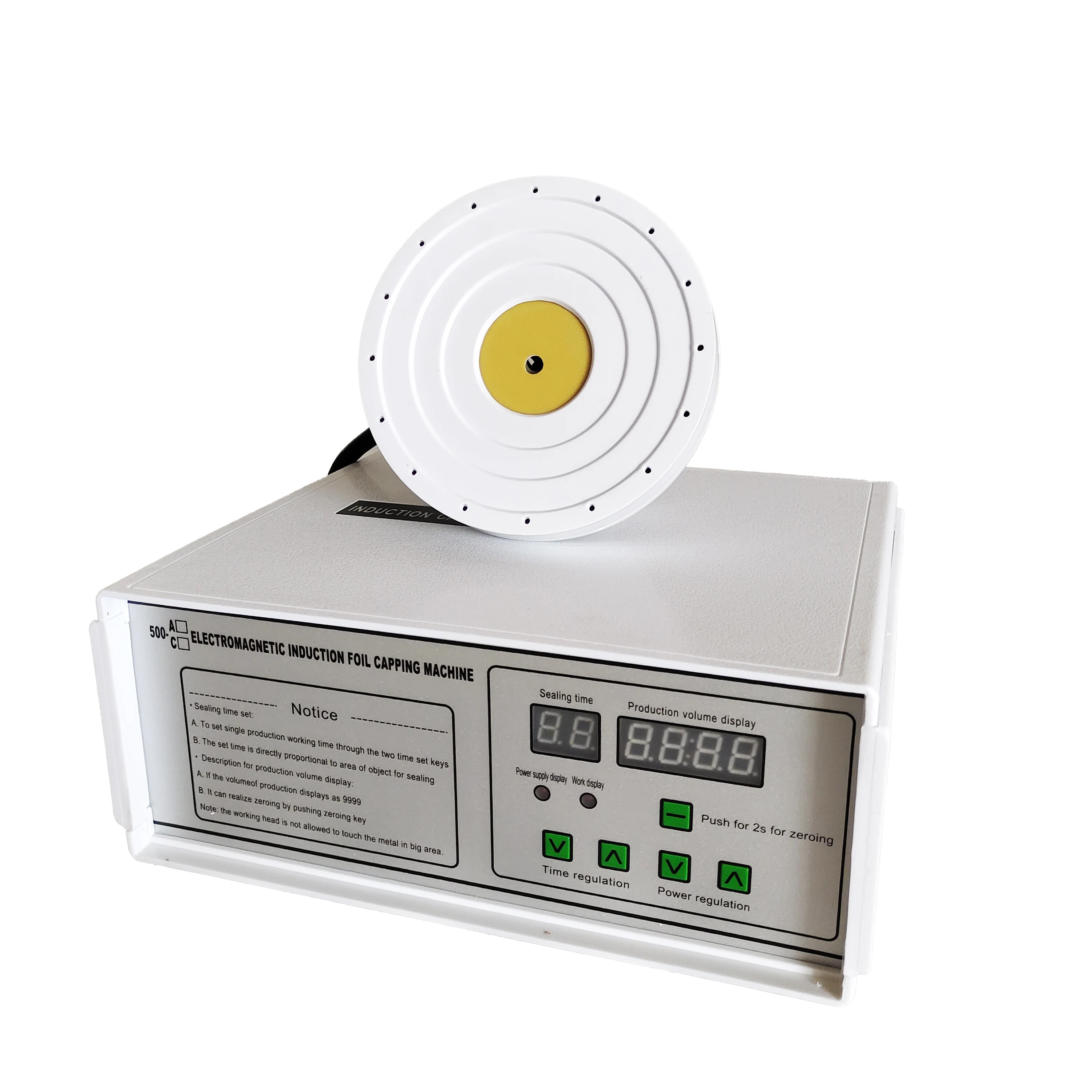
Source-controlled product identity
The Hoting queue identifies Product ID 1601242484711 as a manual hand-held induction, or electromagnetic, aluminum foil sealing machine, listed under the model designation DF-500C and a sealing range stated as 20-130MM. The listed application is foil sealing of plastic honey bottles.
The structured parameter array for this record is empty. There is no recorded voltage, power, frequency, weight, machine dimension, sealing time, head diameter, bottle height limit, duty cycle, control mode, certification, minimum order quantity, lead time, warranty term or packing data. Consequently this guide does not present a specification table built from unverified numbers. It records the two title-level data points, explains how this machine class is evaluated, and converts every missing field into an item that must be confirmed in writing before an order is placed.
Two caution notes apply to the title itself. First, the phrase "20-130MM" is not self-defining. It could describe the applicable container mouth diameter, the effective diameter of the induction sealing head, or the overall head assembly size. A 130mm figure is large for a hand-held sealing head held by an operator for a repeated cycle, so the meaning of the range must be confirmed rather than assumed. Second, the words manual and hand-held describe the working method, not a production rate. No line speed, cycle time or hourly output is provided anywhere in the record.
Recorded data points, reproduced without reinterpretation
| Field | Recorded value | Origin |
|---|---|---|
| Source Product ID | 1601242484711 | Hoting queue record |
| Model | DF-500C | Source product title |
| Sealing range | 20-130MM | Source product title |
| Working method | Manual, hand-held | Source product title |
| Working principle | Induction, electromagnetic, aluminum foil | Source product title |
| Listed application | Plastic honey bottle sealing | Source product title |
| Structured parameter array | Empty | Source record |
Only the model code and the numeric range are treated here as hard data points from the supplier's own listing. Everything else in this guide is either an explanation of how induction foil sealing works, or an explicit question that the buyer must put to the supplier. Nothing is invented to fill the empty parameter array.
How hand-held induction foil sealing actually works
Understanding the physics of the process is what allows a buyer to ask competent questions about an otherwise undocumented machine, so it is worth setting out plainly.
An induction foil sealer generates a high-frequency alternating magnetic field in a work coil inside the sealing head. The operator places the head over a capped container. Inside the cap is a liner that consists of a layer of aluminum foil bonded to a polymer or wax film. The magnetic field induces circulating currents in the aluminum foil, the foil heats, and the heat transfers into the polymer layer, which melts and fuses to the rim of the container. When the container cools, the foil liner is bonded to the rim and the cap can be removed with the foil remaining sealed to the container mouth.
Three consequences follow, and each one drives a purchase question.
The process requires an inductively active liner inside the cap. A plain plastic cap with no foil liner cannot be sealed by this method, no matter how the machine is adjusted. The buyer must therefore specify the liner construction, the foil thickness and the polymer film type, and must confirm that the caps actually purchased will contain the correct liner.
The process requires the container material and the rim geometry to survive the thermal cycle without distortion. Thin-wall plastic honey bottles with a wide mouth are a demanding combination, because the rim is the part that must absorb the heat and then hold the bond under the weight of the contents. The buyer must confirm the container polymer, the wall thickness at the rim, and the maximum acceptable sealing temperature.
The process depends on the magnetic field reaching the foil through the cap and the container wall. Head position, head distance from the cap, and the presence of any ferrous metal nearby all affect the result. For a hand-held unit specifically, the repeatability of the operator's timing and placement becomes part of the process capability.
Sealing diameter, and why the 20-130MM range matters
The recorded range is 20-130MM. Before ordering, the buyer should establish which of the following the range describes, because the answer determines whether the machine suits the intended bottle.
- The range of container mouth diameters that can be sealed with the supplied head.
- The range that can be covered by purchasing additional heads of different sizes.
- The physical diameter range of the induction head or coil assembly itself.
- The diameter range of the bottle body rather than the mouth.
If 20-130MM describes the sealable mouth range, the buyer must confirm whether one head covers the whole span or whether the span is covered by several interchangeable heads, how many heads are included in the quoted price, and the unit price of each additional head size.
If the figure describes the head assembly size, then the practical sealable mouth range is smaller and must be requested separately. A wide-mouth honey jar and a narrow-neck sauce bottle generally require different heads, so the buyer should list every container format in the production plan with its mouth diameter before asking for a quotation.
Hand-held operation and real throughput
The record describes the machine as manual and hand-held, and supplies no output figure. This is the single most important planning gap for a buyer who intends to use the machine in production rather than for occasional or sample sealing.
With a hand-held unit, the cycle consists of placing the capped bottle in position, bringing the head down or over the cap, holding it for the sealing interval, removing the head, and allowing the seal to set before the bottle is handled further. Only the sealing interval is determined by the machine setting. The placement, hold and transfer times are determined by the operator and the workplace layout.
Ask the supplier for the recommended sealing time range for the buyer's specific container and foil liner, the achievable cycles per minute for one operator under a stated method, and whether the machine can run continuously or must be rested after a number of cycles. Where the supplier cannot provide a tested figure, plan a trial on the buyer's own bottles and measure the result directly rather than accepting an estimate.
Where the production volume is high or the format is stable, a hand-held unit is usually the wrong tool, and a conveyor or bench-mounted automatic induction sealer should be considered instead. This guide makes no claim that the hand-held machine is suitable for any particular volume.
Electrical, thermal and duty-cycle unknowns
The record lists no electrical data at all. The following must be obtained in writing, because none of it can be inferred from the model code.
- Supply voltage, phase and frequency, and whether the quoted unit is built for a single supply or is selectable.
- Rated input power and the current draw at the stated supply.
- Working frequency of the induction generator, and whether that frequency is fixed for all head sizes or matched to the head.
- Duty cycle and the recommended rest interval, together with the thermal protection arrangement, if any.
- Cooling method, whether natural convection, forced air or liquid, and the ambient temperature range assumed.
- Control of the sealing interval, whether by a fixed timer, an adjustable dial with a scale, or a preset program.
- Start and stop logic, and whether the head is energised continuously while held or triggered per cycle.
- Protection class, earthing requirement, cable and plug standard, and fuse or breaker rating.
For any induction sealer, the duty cycle matters as much as the power rating. A unit that performs well for twenty bottles may behave differently on a continuous shift, and the record provides no duty-cycle information to judge this.
Foil liner and cap specification
Because the sealing result is created in the liner rather than in the machine alone, the liner specification belongs in the purchase discussion alongside the machine.
The RFQ should request the recommended liner construction for the buyer's container, including the aluminum foil thickness or grade, the sealant polymer layer, the construction type such as a two-piece or three-piece liner, and the temperature at which the sealant activates. It should also request the recommended sealing time and head distance for that liner, and the supplier's recommended storage conditions and shelf life for the caps containing the liner.
Ask what happens when the sealing interval is too short, too long, or the head is held too far from the cap. A competent supplier will describe the failure modes, which are typically incomplete bonding, a partially sealed rim, scorching or deformation of the container rim, or distortion of the cap. Ask for the supplier's recommended acceptance criteria for each failure mode, because those criteria become the basis of the incoming inspection plan.
Operator safety and workplace requirements
The record supplies no safety information, so the buyer must request it. For an induction sealer the relevant items are the strength of the magnetic field at the operator's normal hand position, any recommended separation distance, the thermal protection around the head, the surface temperature reached during a normal cycle, and any restriction on use near pacemakers or implanted medical devices.
Ask also about the weight and balance of the hand-held head, because a unit that is comfortable for a short demonstration can become fatiguing over a full shift, and operator fatigue directly affects seal consistency. If a support arm, stand or bench mounting is available, request it as an option and record whether it is included or separately priced.
Confirm the electrical protection arrangement, the earthing requirement, and the emergency stop or power interruption behaviour of the unit.
RFQ checklist
- Exact model DF-500C and the product ID 1601242484711, with a photograph of the nameplate.
- Written definition of the 20-130MM range, and whether it describes the mouth, the head or the assembly.
- Number of sealing heads included and the price of each additional head size.
- Complete list of container formats in the buyer's production plan with mouth diameter and container material.
- Supply voltage, phase, frequency, rated power, current draw and plug standard.
- Induction working frequency and whether it is matched to each head size.
- Duty cycle, recommended rest interval, cooling method and ambient temperature range.
- Sealing interval control method and the resolution of the adjustment.
- Recommended sealing time and head distance for the buyer's container and liner.
- Liner construction, foil grade, sealant polymer and activation temperature.
- Failure modes when the interval or the head distance is incorrect, with acceptance criteria.
- Surface temperature of the head during a normal cycle and the thermal protection provided.
- Magnetic field guidance and any restriction near implanted medical devices.
- Weight and balance of the hand-held head, and whether a stand or support arm is available.
- Machine weight, dimensions and packing dimensions, which are not provided in the record.
- Certification, conformity documents and the electrical nameplate details for the destination market.
- Included accessories, spare parts and consumables, and what is priced separately.
- MOQ, sample and trial terms, unit price at the target quantity, lead time and shipping terms.
- Warranty period, service response time and the price of the most likely wearing parts.
Acceptance and factory tests
Because the source record contains no performance data, the acceptance test is the only way the buyer can establish that the delivered unit performs as required. Agree it in writing before the order is placed.
Run the trial on the buyer's own bottles, caps and liners wherever possible. Where that is not feasible, use samples that share the same polymer, the same rim geometry and the same liner construction, and record the exact samples used.
For each container format, record the sealing interval setting, the head distance, the number of cycles attempted, the number that bonded correctly, and the failure mode of the rejects. Inspect the seal by removing the cap and checking the integrity of the foil bond around the full circumference, and by performing a leak or hold test appropriate to the product.
Repeat the trial after the unit has been running for a period that represents a realistic shift, so that any thermal drift in performance is observed rather than discovered in production. Record the ambient temperature during the test.
Verify the nameplate against the ordered electrical specification, confirm the earthing, check the emergency stop behaviour, and record the serial number and control revision of the tested unit so that the delivered unit can be compared with it.
Packaging, shipping and after-sales
The record contains no packing data. Request the packed dimensions, packed weight and the packing method, including whether the sealing head is separately protected and whether spare heads are shipped in the same carton.
Request the operating manual, the wiring diagram, the recommended maintenance schedule and the spare-parts list, and confirm the language of the documentation supplied.
Confirm the warranty period, what is covered and what is excluded, the response time for technical questions, whether remote support is available, and the procedure and lead time for obtaining replacement heads and consumables after the warranty period expires.
Buyer decision framework
This record supplies a model code, DF-500C, a stated range of 20-130MM, and a description as a manual hand-held induction aluminum foil sealing machine for plastic honey bottles. It supplies no performance, electrical, dimensional or certification data.
The purchase decision therefore rests on four written answers. What exactly does the 20-130MM range describe and which heads are included. What liner and container combination has the supplier verified with this unit, and at what sealing interval. What is the achievable throughput for one operator on the buyer's own bottle, stated as a tested figure rather than an estimate. And what electrical supply, duty cycle and safety data apply to the delivered unit.
A supplier who answers those four questions in writing, and who is willing to run a trial on the buyer's own containers, is offering something more valuable than a lower price on an undocumented unit. Where the four answers cannot be obtained, the buyer should treat the machine as suitable only for low-volume or trial work, and should plan accordingly.
Frequently asked questions
What does the 20-130MM range refer to?
The source title only states the range. It must be confirmed whether it describes the sealable container mouth diameter, the effective head diameter, or the overall head assembly size, and whether one head covers the whole range or several interchangeable heads are required.
Does the machine come with the foil liners?
The record does not state this. Caps with a suitable foil liner are consumed in production, so confirm whether liners or lined caps are included, whether they are offered separately, and what specification is recommended for the buyer's containers.
Can it seal any plastic bottle?
No such claim is supported by the record. The container polymer, the rim wall thickness and the rim geometry all affect whether a clean bond can be formed, so the specific bottle must be tested.
What is the output per hour?
The record states manual, hand-held operation and provides no output figure. Ask for a tested cycles-per-minute figure for one operator on the buyer's own container, or measure it during a trial.
What electrical supply does it need?
The record provides no electrical data. Voltage, phase, frequency, rated power, current draw and plug standard must all be confirmed in writing.
What is the machine weight and size?
Neither is recorded in the source. Request the machine weight, dimensions, packed dimensions and packed weight, and confirm whether a stand or support arm is available for the hand-held head.
Are there certifications?
The record lists none. Request the available certification set, the electrical nameplate details and the conformity documents applicable to the destination market.
Source and contact
This guide is based on the Hoting queue record for Product ID 1601242484711, whose structured parameter array is empty. It reproduces the model designation DF-500C and the stated range 20-130MM exactly as they appear in the source, and it deliberately does not construct a specification table from numbers that were never supplied.
Request the range definition, head list, liner recommendation, electrical data, duty cycle, safety information, drawings, trial results and spare-part prices through the TEBAK sales inquiry channel before placing an order.
Key specifications
- Source Product ID
- 1601242484711
- Model (from source title)
- DF-500C
- Recorded sealing range (from source title)
- 20-130MM
- Structured parameters
- None supplied in the source record - see the confirmation checklist below