
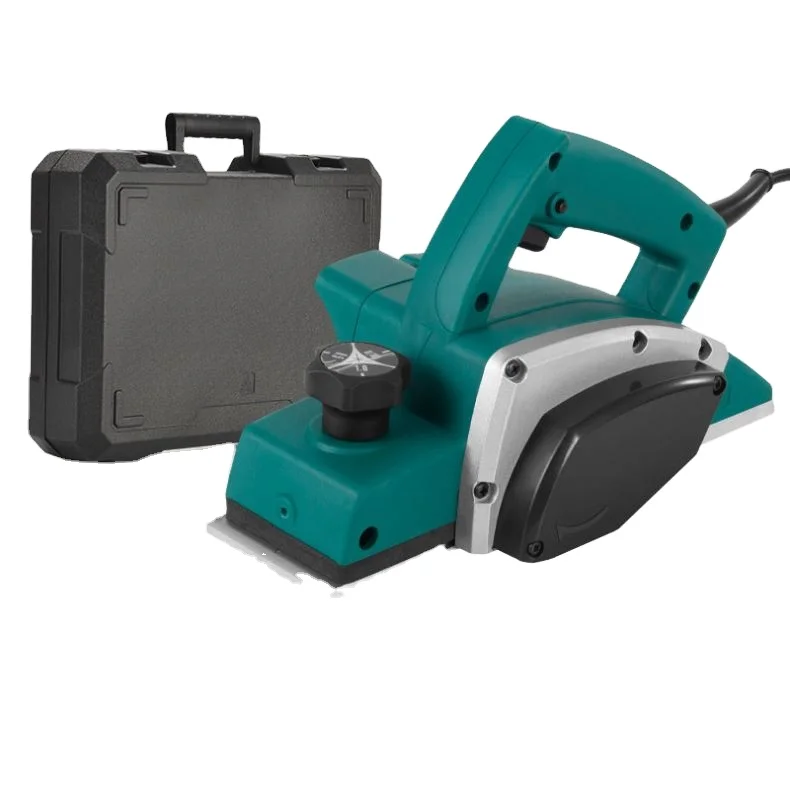
Source-controlled product identity
The Hoting queue record identifies this product as an electric manual wood planer for handheld edge and surface trimming. The supplied structured specification describes the Blue version as 110V/220V, 28.5x17x17cm, 800W, 2mm depth, copper motor, 3.0kg and an aluminium body. These are the source-backed values for RFQ and inspection planning.
The title uses home, handheld, portable and multifunctional positioning language. Those terms describe the listing presentation, not a complete performance guarantee. The source record does not provide planing width, no-load speed, feed rate, blade size, blade material, dust-port dimensions, duty cycle, sound level, vibration, plug type, certification or packaging details. Each missing item should be confirmed before the buyer approves a production or resale order.
Product ID 1601368258813 should appear on the quotation, motor label, datasheet, inspection record and packing list. This guide is intended for importers, distributors, woodworking workshops, furniture component producers and tool buyers comparing a compact electric planer for controlled edge and surface work.
Recorded specifications versus open RFQ fields
| Information | Recorded source value | Buyer action |
|---|---|---|
| Product variation | Blue | Confirm whether other colors or electrical versions use the same motor, housing and parts. |
| Voltage | 110V/220V | Confirm whether the unit is dual-voltage selectable or a single-voltage variant, and specify destination plug. |
| Dimensions | 28.5x17x17cm | Confirm whether these are product dimensions, packed dimensions or an image-derived listing value. |
| Power | 800W | Clarify input power, rated output, current, duty cycle and test condition. |
| Depth | 2mm | Confirm maximum cut depth, adjustable range, scale resolution and repeatability. |
| Motor | Copper | Request motor nameplate, winding specification, thermal protection and supplier definition of copper motor. |
| Weight | 3.0kgs | Confirm net weight, gross weight and whether the blade, fence and cable are included. |
| Material | Alu | Confirm the aluminium parts, alloy or grade, surface treatment and wear parts. |
| Planing width | Not supplied | Request blade width and maximum supported board width before calculating productivity. |
| Speed and feed | Not supplied | Request no-load speed, loaded speed, feed guidance and suitable wood species. |
| Dust extraction | Not supplied | Confirm dust outlet size, adapter, chip direction and whether a bag is included. |
| Compliance | Not supplied | Request destination-market documents for the exact voltage and model. |
Define the buying job before comparing suppliers
A handheld planer removes material from a timber surface or edge. The buyer should first specify whether the job is edge straightening, face leveling, chamfering, fitting a door or preparing a component for joining. These operations place different demands on depth control, fence support, blade width and repeatability.
Write the purchase requirement as a measurable process: timber species, moisture condition, board width, board length, starting surface condition, target thickness or edge angle, maximum pass depth, acceptable step marks and expected daily usage. Do not use the word “multifunctional” as a replacement for a process specification.
For a distributor, identify the target market voltage and plug before selecting a batch. A 110V/220V title may represent two different SKUs rather than an adjustable product. Ask the supplier to show the switch, label, wiring and manual for each version.
For a workshop, define whether the tool is a finishing tool, a rough-removal tool or a portable repair tool. The recorded 2mm depth should be treated as a maximum claim pending verification, not as a recommended pass depth for every material.
Voltage and electrical configuration
The record states 110V/220V. Confirm whether the tool has a voltage selector, a dual-voltage motor, or separate 110V and 220V models. Ask for the exact model suffix and nameplate photograph for each option.
Request rated current at 110V and 220V, frequency range, plug type, cable length, insulation class, earthing method and protective-device recommendation. Confirm whether the 800W figure is input power at one voltage or applies to both versions.
At factory acceptance, run the correct destination version under an agreed load. Record start behavior, current, speed stability, housing temperature and switch operation. Test restart prevention after a simulated power interruption only according to the supplier's safety procedure.
Do not change a 110V tool to 220V using an external transformer without a written electrical assessment. The buyer should receive the correct factory configuration, plug and manual for the destination market.
800W motor and copper specification
The source lists 800W and a copper motor. Ask the supplier to define whether the 800W value is rated input, maximum input or motor output. Request duty-cycle data and the conditions used to measure it.
“Copper motor” should be supported by a nameplate or technical statement. Confirm winding material, thermal protector, bearing type, insulation, cooling route and replacement-part availability. A copper winding claim does not establish torque, runtime or service life without a test condition.
Run a repeatable sample test with the buyer's target timber. Record pass depth, feed pressure, current, temperature, noise, vibration and surface finish. Compare multiple units from the same batch to detect motor or blade variation.
Request the overload response and maintenance instructions. A compact motor can be damaged by excessive depth, damp timber, resinous wood, blunt blades or slow feeding. The quotation should include the permitted duty cycle rather than only the headline wattage.
2mm depth claim and adjustment control
The listed depth is 2mm. Confirm whether this is the maximum adjustable cut, the nominal recommended cut or a marketing value. Ask for the adjustment mechanism, scale increments, lock, zero reference and actual depth repeatability.
Use a calibrated flat reference board to measure material removal at several settings. Record the setting, measured depth at the left and right sides, feed direction and surface result. Repeat after changing blades and after the tool reaches operating temperature.
For rough stock removal, agree a conservative pass schedule with the supplier. For finishing work, specify a smaller target pass and a maximum step or snipe at the board entry and exit. The tool should not be approved only because it reaches a static 2mm setting.
Check whether the depth scale remains readable after the tool is used with dust and vibration. Confirm replacement adjustment parts, spring or detent condition and the method for calibrating the base.
Planing width, blade and pass capacity
Planing width is not included in the structured source fields. Request the blade length, usable cut width, blade type, blade material, thickness, mounting pattern and included quantity.
Ask whether the product uses disposable double-edge blades, resharpenable blades or a proprietary cartridge. Confirm the expected edge condition, spare-blade availability, lead time and safe blade-change procedure.
Measure the actual cut width with the fence removed and installed. A wide board may require overlapping passes; the buyer should define the maximum acceptable ridge between passes. If the tool is intended for narrow edges, verify that the base and fence provide stable support.
Inspect the front and rear shoe alignment. A planer can create a step or snipe when the front and rear bases are not coplanar or when the operator rocks the tool. Include a flatness and snipe check in the factory inspection.
Handheld ergonomics and control
The listing positions the product as handheld and portable. Confirm handle location, grip size, trigger, lock-on behavior, switch access, balance, cable exit and the ability to place the tool safely after use.
The recorded product weight is 3.0kgs, but ask whether this is net weight of the bare tool or includes fence, cable, blade and accessories. Measure the complete operating weight and check whether the balance changes when the dust adapter is fitted.
Run a representative workpiece test for operator fatigue. Record the number of passes, surface quality, wrist position, vibration and heat at the handles. A compact dimension does not automatically mean the tool is suitable for long continuous work.
Confirm guards around the blade and the safe resting position. The manual should explain how to disconnect power before inspection, blade replacement, jam clearing or cleaning.
Materials and surface quality
The source record identifies an aluminium material entry and a wood planer application. The tool's actual timber range is not specified. Ask for recommendations for softwood, hardwood, laminated board, plywood and reclaimed wood, including limits for knots, nails, paint, glue and moisture.
Test each target material with agreed blades and pass settings. Inspect flatness, tear-out, burn marks, chatter, edge squareness, snipe and thickness variation. Record timber grain direction and feed direction because they strongly affect surface quality.
For painted, glued or reclaimed stock, request a contamination warning and blade replacement rule. Metal fasteners can damage blades and create a safety event. Do not represent the tool as suitable for mixed reclaimed timber unless that use has been tested and approved.
For boards wider than the tool's verified capacity, define a jointing or fixture method. Never infer width from the product dimensions of 28.5x17x17cm.
Dust extraction and workplace controls
No dust outlet size or collection accessory is supplied. Request the outlet diameter, adapter type, chip ejection direction, bag inclusion and compatible extraction flow requirement.
Test dust control using the target timber. Record blockage, chip discharge, visibility, cleanup time and whether the adapter interferes with the fence or grip. A tool can remain portable while still requiring external extraction for safe workshop use.
Specify the workplace controls in the RFQ: eye protection, hearing protection, respiratory protection, extraction, cable routing and housekeeping. Ask for the manual's warning on dust, resin and hot chips.
Do not claim a dust-free operation or a specific noise level without measurement. If the buyer sells the tool into a regulated market, request the required safety and EMC documentation for the exact variant.
Dimensions, packaging and logistics
The record gives 28.5x17x17cm. Confirm whether the value describes the bare product and whether the blade, fence, cable, adapter and manual are excluded. Request a dimensioned drawing and the packed carton dimensions.
The listed weight is 3.0kgs, but gross weight, carton count, inner packaging and pallet information are not supplied. Ask for net weight, gross weight, carton dimensions, carton quantity, stacking limits and drop-test or packaging specification.
For a multi-voltage shipment, keep 110V and 220V versions physically and commercially separated. Mark cartons with voltage, model, color, quantity and destination plug. The packing list should match the nameplate and quotation.
Confirm MOQ, sample availability, production lead time, spare-blade supply, warranty term, after-sales contact and inspection terms. These are procurement fields, not values that can be inferred from the product title.
Factory acceptance test
- Verify product ID 1601368258813, Blue version, model marking and exact voltage variant.
- Check nameplate voltage, frequency, power, current, plug, cable and earthing information.
- Verify complete weight and dimensions with the agreed accessories fitted and separately record packed data.
- Confirm 800W definition, motor winding statement, thermal protection and duty-cycle limit.
- Measure depth adjustment, zero position, maximum setting and repeatability; verify the 2mm claim under an agreed method.
- Measure blade length, usable planing width, blade type, mounting and spare-blade availability.
- Run softwood and hardwood samples, recording pass depth, feed, current, temperature, vibration and surface finish.
- Check edge squareness, base flatness, snipe, tear-out, chatter and thickness variation across the workpiece.
- Verify handle, trigger, lock, guard, resting position, cable and restart prevention behavior.
- Test dust outlet, adapter, chip direction, blockage behavior and workplace extraction connection.
- Review manual, safety warnings, destination documents, accessories, packaging, warranty, MOQ and lead time.
RFQ checklist
- Product ID 1601368258813 and Blue version with a photograph of the actual nameplate.
- 110V and 220V options: exact model suffix, frequency, current, plug, cable, selector or separate SKU.
- 800W definition, motor winding material, thermal protection, duty cycle and replacement motor availability.
- 2mm depth: maximum or recommended value, adjustment range, increment, lock, scale and repeatability.
- Planing width, blade size, blade material, blade mounting, spare quantity and replacement cost.
- No-load speed, loaded speed, feed guidance, wood species and maximum recommended pass conditions.
- 28.5x17x17cm: bare tool or complete operating size; provide a dimensioned drawing.
- 3.0kgs: net or complete operating weight; provide gross carton weight and carton dimensions.
- Aluminium body: part list, material definition, finish, wear areas and corrosion protection.
- Dust outlet diameter, adapter, collection bag, extraction flow guidance and chip direction.
- Handle geometry, trigger, lock-on, blade guard, resting position, vibration and noise test conditions.
- Material test results for softwood, hardwood, plywood, laminate and reclaimed timber limitations.
- Manual, safety, EMC and destination-market documents for the exact voltage variant.
- MOQ, sample cost, lead time, warranty, spare blades, service contact, inspection and packing terms.
Buyer decision framework
This product is a compact electric wood-planing candidate with source-backed values of 110V/220V, 28.5x17x17cm, 800W, 2mm listed depth, copper motor, 3.0kgs and aluminium material. Approve it for a defined edge or surface-planing process only after the supplier verifies the voltage configuration, planing width, blade system, depth repeatability, material test and safety documentation.
For workshop use, prioritize surface quality, blade supply, dust control, balance and duty cycle over the headline “high power” or “multifunctional” language. For resale, separate voltage variants, accessories and documentation in the commercial specification so buyers receive the correct configuration.
Frequently asked questions
Is the tool genuinely dual voltage?
The source record states 110V/220V but does not explain whether this is a selector-based tool or two variants. Request the exact nameplate, wiring and model suffix before ordering.
Is the maximum cutting depth definitely 2mm?
2mm is the recorded depth value. Confirm whether it is a maximum or recommended setting and verify it with a measured factory test.
What is the planing width?
The structured source record does not provide planing width. Ask for blade length and usable cut width; do not infer it from the overall dimensions.
Does 800W describe motor output?
The source lists 800W but does not define input or output. Request the nameplate and rated-load test conditions.
What timber can be planed?
The source record does not provide a complete wood-species or moisture range. Request sample results for the buyer's actual softwood, hardwood, board or reclaimed material.
Source and contact
This guide is based on the Hoting queue record for product ID 1601368258813. Before purchase, request the current quotation, nameplate photograph, electrical datasheet, blade and width details, measured depth test, material samples, dust-control information, manual, destination documents, packing list, spare-parts offer, warranty and final machine photographs. For sourcing questions, contact the TEBAK sales team through the site's current inquiry channel.
Key specifications
- Version
- Blue
- Voltage
- 110V/220v
- Dimension
- 28.5x17x17cm
- Power
- 800w
- Depth
- 2mm
- Motor
- Copper
- Weight
- 3.0kgs
- Material
- Alu