
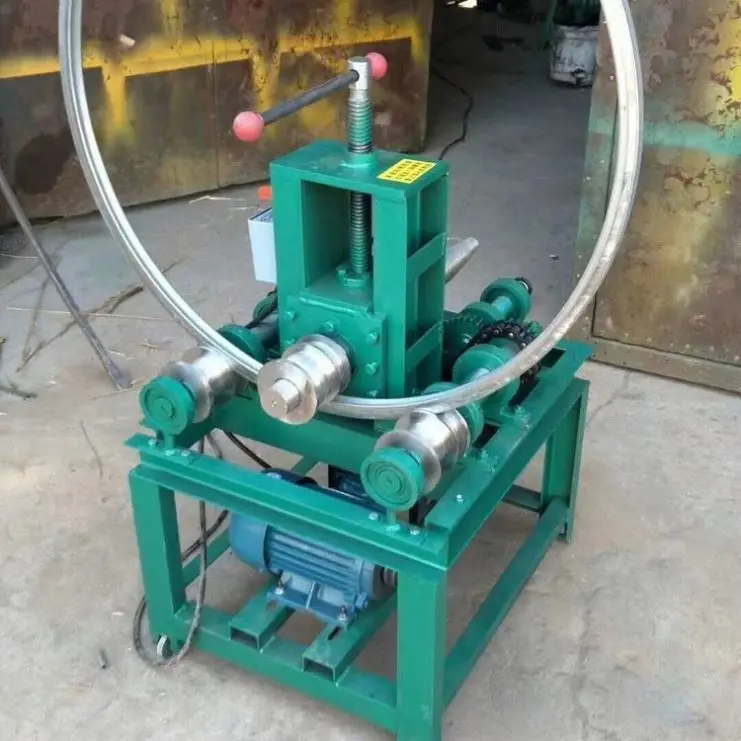
The product page publishes no parameters at all
This is worth stating before anything else, because it changes how you have to read the page. The parameter block on this listing is empty. There is no table of fields, no power figure, no capacity, no dimensions, no weight, no voltage. The description runs to 800 characters, and after the title line and three navigation headings it turns into a company profile that is cut off mid-sentence at “TEBAK relies on a”.
So where are the specifications? They are inside the photographs. Two of the eight images are spec panels, typeset as orange-and-grey tables and rendered as flat pictures. Everything this page tells you about the machine is there, and nowhere else.
That matters for two reasons. First, image text is not searchable, not translation-friendly and not extractable by any procurement system, so a buyer comparing five suppliers will simply skip this one. Second, and more seriously, a table that exists only as a picture cannot be corrected by the seller later without re-uploading an image, which is why the errors in it have survived.
What the pictures actually specify
Transcribed from the two spec images, exactly as printed. Five panels appear across the gallery, and they are not five different machines.
| Panel | Model | Motor | Supply | Wall thickness | Round tube | Square tube | Radius row |
|---|---|---|---|---|---|---|---|
| Type 38 | Type 38 | 1.1 kW | 380V–220V | 0.5–1.2 mm | 16–25 mm | 15–40 mm | ≥20r |
| Type 63 | Type 63 | 1.5 kW | 380V–220V | 0.5–1.5 mm | 19–63 mm | 20–60 mm | ≥20r |
| Type 76 | Type 76 | 2.2 kW | 380V | 0.5–2.5 mm | 19–79 mm | 20–60 mm | ≥20rr |
| 76 adjustable | 76 adjustable | 2.2 kW | 380V | 0.5–2.5 mm | 19–79 mm | 20–60 mm | ≥20rr |
| 76 aggravating type | 76 aggravating type | 3.0 kW | 380V | 0.5–3.5 mm | 19–79 mm | 20–60 mm | ≥20rr |
Die lists, printed beneath the tables: round mould 19 / 22 / 25 / 32 / 38 / 51 / 63 / 76, square mould 20 / 25 / 30 / 40 / 50 / 60. Those die sizes are the most useful numbers in the whole listing, and we will come back to them.
Every panel names the product the same way: “Electric pipe bender”. Not electrohydraulic. Not hydraulic. Electric.
Five panels, four machines
Compare rows three and four of the table above. Type 76 and 76 adjustable agree on every single row: 2.2 kW, 380 V, 0.5–2.5 mm wall, 19–79 mm round, 20–60 mm square, the same radius row, the same two die lists. They are one machine under two names.
That leaves four genuine configurations, each with a different motor and a different wall-thickness ceiling:
- 1.1 kW — smallest, round to 25 mm, wall to 1.2 mm
- 1.5 kW — round to 63 mm, wall to 1.5 mm
- 2.2 kW — round to 79 mm on paper, wall to 2.5 mm
- 3.0 kW — round to 79 mm on paper, wall to 3.5 mm
“76 aggravating type” is a translation of the Chinese 加重型, heavy-duty pattern. It is the only one that will take a 3.5 mm wall, and it is the only one with a 3.0 kW motor. If your tube is thick, this is the only panel that applies to you, and it is the fourth one down a gallery — which is a fair measure of how easy this listing makes specification.
So the first question to the seller is not “what is the price”, it is “which of the four does this price refer to”. A 1.1 kW and a 3.0 kW machine differ by nearly a factor of three in motor, by 2.3 mm in wall capacity, and by the whole upper half of the diameter range.
The title says electrohydraulic. Nothing in the machine is hydraulic.
The product title calls this an electrohydraulic metal pipe bending machine. The seller's own five spec panels call it an electric pipe bender. The photographs settle which one is right, and they settle it clearly.
What the images show, with the seller's own callouts attached to them:
| Visible component | Seller's label | What it implies |
|---|---|---|
| Blue three-phase motor under the frame | Pure copper motor | Electric drive, not hydraulic |
| Geared reduction box between motor and rolls | Reducer enlarged | Mechanical speed reduction |
| Spur gear pair and roller chain | Gear chain thickened | Mechanical transmission |
| Vertical screw with a T-handle on the head | Screw thickened | Manual pressure, applied by hand |
| Concave profile rolls on horizontal shafts | Mould thickening | Roll forming, not draw bending |
| Pile of sealed ball bearings | Bearing, long service life | Bearing quality claim |
| Caliper measuring a chain link | Thickened and widened chain | Chain quality claim |
There is no hydraulic cylinder in any image. No pump, no reservoir, no valve block, no pressure gauge, no hose, and no control panel. A hydraulic machine cannot be built without those parts, and they are not hidden — the gallery shows the frame from four angles with the motor and gear train in open view.
The one place a hydraulic pressure could have appeared is the table row whose label reads “Elec-Pres-tricity sure”. That is two words interleaved — Electricity and Pressure — collapsed into one cell by a broken table, and the value beside it is the voltage. If a pressure row existed, its number is gone.
So the honest description is: a motorised three-roll section bender with manual screw pressure. That is a perfectly legitimate machine. It is not the machine in the title, and the difference is not cosmetic — a manual screw means the operator sets the forming pressure by feel and by repetition, and the setting is not reproducible from part to part the way a hydraulic gauge is.
What a roll bender does, and the three things it cannot do
Three rolls, two below and one above, all horizontal, with concave dies matching the tube's outside diameter. The tube is fed between them, the top roll is screwed down to press it into the lower pair, and the driven rolls pull it through so it leaves as a continuous arc. That is how rings, arches, hoop frames and large-radius sweeps are made.
Three consequences follow directly from that geometry, and they decide whether this machine can do your job at all:
- It makes continuous curvature, not elbows. A pipe elbow is a bend with a defined angle and a straight tangent on each side. A roll bender produces an arc of constant curvature along the whole length it passes. To get a 90-degree elbow with tangents you must mark the start and stop, and the transition at each end will be a gradual easing, not a sharp tangent point.
- One radius per setup. Because the radius comes from the roll spacing plus screw pressure rather than from a programmed path, a part that changes radius along its length — or needs two different radii — requires the part to be re-fed and re-set. That is a skill operation, not a repeatable one.
- Repeatability lives in the operator. There is no digital readout in any photograph, no radius scale, no stop. Two operators, or one operator on a Monday, will not produce identical radii from the same screw setting. If your drawing carries a radius tolerance, budget for a gauge and a trial piece per batch.
If your requirement is a small number of arcs and rings, this is the right and inexpensive tool. If your requirement is 500 identical elbows with a ±1 mm radius tolerance, this is the wrong class of machine and no amount of care will fix it.
“Bending radius ≥20r” and “≥20rr”: neither is a unit
This is the single most important row in the table and it cannot be read as printed. Two panels say ≥20r; three say ≥20rr. There is no unit, and “rr” is not a quantity in any notation.
Three readings are possible, so let us test all three against plain geometry, where R is the centreline bend radius and D the tube outside diameter.
| Reading | What it would mean | 63 mm tube | 76 mm tube | Verdict |
|---|---|---|---|---|
| A. R ≥ 20 mm absolute | A 20 mm minimum radius | R must exceed D/2 = 31.5 mm, so impossible | R must exceed 38 mm, so impossible | Fails for every tube above 40 mm |
| B. R ≥ 20 × tube radius | Ten times the diameter | R ≥ 630 mm | R ≥ 760 mm | Possible, but absurdly gentle |
| C. R ≥ 2r, i.e. one diameter | R/D = 1 | R ≥ 63 mm | R ≥ 76 mm | Destroys the wall, see below |
Reading A is arithmetically impossible for the larger tubes the same table claims to bend, because a 20 mm radius is smaller than the 63 mm tube's own half-diameter. Reading B would mean a machine that can only produce radii ten times the tube size, which no roll bender of this type is limited to. Reading C is geometrically possible but, as the next section shows, it removes a third of the wall on the outside of the bend.
The likely explanation is that the cell was copied between panels and corrupted — which is also why the unit disappeared when “rr” appeared. But the buyer cannot act on a likely explanation. Ask for one sentence instead: for each die size, what is the minimum centreline radius in millimetres, at each wall thickness? A supplier who cannot answer that has not bent tube.
The dies are the product, and the range exceeds the dies
Every panel prints the same two die lists: round 19 / 22 / 25 / 32 / 38 / 51 / 63 / 76 and square 20 / 25 / 30 / 40 / 50 / 60. These are not accessories. A three-roll bender forms the tube in a groove cut to one outside diameter, so one die set bends one tube size. A 38 mm tube in a 32 mm die will ovalise; a 32 mm tube in a 38 mm die will flatten at the crown.
Which means the price of the machine is not the price of the capability. Eight round dies and six square dies is fourteen die sets. If the quotation includes one, you have one tube size. Ask explicitly how many dies are in the price, and what each additional die costs, because that number often approaches the machine's own price for a small unit.
And the claimed ranges do not match the die lists in two places:
| Claim | Die list | Gap |
|---|---|---|
| 76 models: round tube 19–79 mm | Largest round die 76 mm | 3 mm of the claimed range has no die |
| Type 38: square tube 15–40 mm | Smallest square die 20 mm | 5 mm at the bottom has no die |
| Type 63 / 76: square tube 20–60 mm | Square dies 20–60 mm | Consistent |
Neither gap is fatal, but both are the kind of thing that turns into an argument after the deposit. If you need 78 mm tube or 16 mm square tube, neither is in the die list, and you should establish that before you buy rather than after.
Wall thickness is quoted independently of diameter, and the corners are impossible
Each panel gives a wall range and a diameter range as if they were independent. They are not: what a tube will tolerate in bending is governed by the ratio of diameter to wall, D/t. The published extremes produce ratios no bending process will accept.
| Model | Largest tube | Thinnest wall offered | D/t at that corner |
|---|---|---|---|
| Type 38 | 25 mm | 0.5 mm | 50 |
| Type 63 | 63 mm | 0.5 mm | 126 |
| Type 76 / 76 adjustable | 79 mm | 0.5 mm | 158 |
| 76 aggravating type | 79 mm | 0.5 mm | 158 |
| 76 aggravating type | 79 mm | 3.5 mm (its own maximum) | 22.6 |
A shop rule of thumb, not a standard, is that unsupported bending becomes difficult above a D/t of roughly 20 to 30, and needs internal support beyond that. Even allowing generous latitude, a ratio of 126 or 158 is an order of magnitude past the point where a 0.5 mm wall will simply collapse between the rolls. The number is not a capability; it is a copy of the thinnest wall the machine's smallest die can handle, printed against the largest die's diameter.
Read the table this way instead: the wall range applies at the small end of the diameter range. At 63 mm you want 1.5 mm and upward; at 79 mm you want 2.5 mm and upward. The heavy-duty panel's own 3.5 mm ceiling at 79 mm gives D/t of 22.6, which is a credible working point.
What the bend costs you in wall
Bending a tube stretches the outside of the curve and compresses the inside. The outside stretch is fixed by geometry alone: the extrados strain equals D divided by twice the centreline radius, which is the same as one over twice the radius-to-diameter ratio. With constant volume, the wall thins by the same strain divided by one plus the strain.
| Radius / diameter | Strain at the outside | Wall lost | On a 1.5 mm wall |
|---|---|---|---|
| 1.0 | 50.0% | 33.3% | 1.50 → 1.00 mm |
| 1.5 | 33.3% | 25.0% | 1.50 → 1.13 mm |
| 2.0 | 25.0% | 20.0% | 1.50 → 1.20 mm |
| 2.5 | 20.0% | 16.7% | 1.50 → 1.25 mm |
| 3.0 | 16.7% | 14.3% | 1.50 → 1.29 mm |
This is why reading C of the radius row failed. A radius equal to one diameter loses a third of the wall on the outside of the bend, and the inside of the same bend will be wrinkled or collapsed because a roll bender has no mandrel to support it. The minimum radius is a wall-thickness decision before it is a machine decision.
The same geometry gives you the lengths you need for cutting stock, which is the other thing buyers get wrong on a first order. A 90-degree bend consumes arc length equal to the centreline radius times 1.571:
| Tube | R/D = 1.5 | R/D = 2.0 | R/D = 3.0 |
|---|---|---|---|
| 19 mm | 44.8 mm arc | 59.7 mm arc | 89.5 mm arc |
| 38 mm | 89.5 mm arc | 119.4 mm arc | 179.1 mm arc |
| 63 mm | 148.4 mm arc | 197.9 mm arc | 296.9 mm arc |
| 76 mm | 179.1 mm arc | 238.8 mm arc | 358.1 mm arc |
And for a closed ring, the circumference is 2πR: at R/D = 2, a 38 mm tube needs 478 mm of developed length, a 63 mm tube needs 792 mm, and a 76 mm tube needs 955 mm. Add the straight leg lengths on top. Ordering tube on the outside diameter alone, without this arithmetic, is how a first job ends up short.
Power, torque, and the number that decides whether it will bend your tube
The panels give motor power: 1.1, 1.5, 2.2 and 3.0 kW. Power is not force. What bends tube is torque at the roll, and torque equals power divided by angular velocity. The listing never states the roll speed, and that omission makes the power figures almost impossible to use.
| Motor | at 5 rpm | at 10 rpm | at 20 rpm | at 30 rpm |
|---|---|---|---|---|
| 1.1 kW | 2,101 N·m | 1,050 N·m | 525 N·m | 350 N·m |
| 1.5 kW | 2,865 N·m | 1,432 N·m | 716 N·m | 477 N·m |
| 2.2 kW | 4,202 N·m | 2,101 N·m | 1,050 N·m | 700 N·m |
| 3.0 kW | 5,730 N·m | 2,865 N·m | 1,432 N·m | 955 N·m |
The same 1.5 kW motor delivers 2,865 N·m at 5 rpm and 716 N·m at 20 rpm — a four-fold spread from a number the seller has not published.
Now compare that against what the material actually needs. For fully plastic bending the required moment is the yield strength times the plastic section modulus Z, which for a circular tube is four thirds of the difference of the outer and inner radii cubed. Taking 205 MPa as the minimum 0.2% proof strength of annealed 304 stainless, which is the usual reference value for that grade:
| Tube | Section modulus | Moment required | 1.5 kW motor is adequate if roll speed is |
|---|---|---|---|
| 19 × 1.0 mm | 324 mm³ | 66 N·m | up to roughly 30 rpm |
| 38 × 1.2 mm | 1,626 mm³ | 333 N·m | up to roughly 30 rpm |
| 63 × 1.5 mm | 5,674 mm³ | 1,163 N·m | only at 10 rpm or slower |
| 63 × 3.5 mm | 12,405 mm³ | 2,543 N·m | not adequate at any usable speed |
| 76 × 2.0 mm | 10,955 mm³ | 2,246 N·m | only near 5 rpm |
Read across the last two rows: a 1.5 kW machine, which is the Type 63, is marginal for 63 × 1.5 stainless and cannot do 63 × 3.5 at all. That is why the heavy-duty panel exists with a 3.0 kW motor. But it is also why roll speed must be on the quotation: at 2,865 N·m a 3.0 kW unit covers 63 × 3.5 with margin, and at 955 N·m it does not.
The moment figures are an order-of-magnitude check with the yield strength stated, friction and springback ignored, and the tube treated as a thin-walled circular section. They are not a substitute for a trial bend. They are enough to tell you which panel applies to your tube.
Electrical supply: the larger models are three-phase only
This is a small detail that stops installations. Type 38 and Type 63 print 380V–220V. All three 76 panels print 380V alone, meaning three-phase.
| Motor | 380 V three-phase | 220 V single-phase |
|---|---|---|
| 1.1 kW | 2.5 A per phase | 7.4 A |
| 1.5 kW | 3.4 A per phase | 10.0 A |
| 2.2 kW | 4.9 A per phase | 15.3 A |
| 3.0 kW | 6.7 A per phase | 20.1 A |
Power factor 0.8 and efficiency 0.85 are assumed; the division is not. A 1.5 kW Type 63 on a 220 V single-phase supply draws about 10 A, which is 63% of a 16 A circuit — workable, with little room for anything else on the same breaker. A 3.0 kW heavy-duty unit on single phase would need 20 A, which in most workshops means a dedicated circuit or a different supply.
Note also that the panels list the voltage rather than the phase, so “380V–220V” does not explicitly promise single-phase operation. Ask for the motor nameplate photograph. It shows voltage, phase, current and speed in one image, and speed is the number you need for the torque calculation above.
Stainless steel behaves differently from mild steel here
The title promises stainless steel, and the machine can bend it, but three things change when the tube is 304 rather than mild steel.
It work-hardens. Each pass through the rolls raises the yield strength of the material you have just deformed, so a second pass to tighten a radius meets stiffer metal than the first. Where mild steel would take three passes, stainless may take five and want more screw pressure each time. That is the practical reason a 1.5 kW machine is marginal on 63 mm stainless and comfortable on the equivalent mild steel.
It springs back more. Stainless has a higher ratio of yield strength to elastic modulus than mild steel, so it returns further after the rolls release. On a roll bender you compensate by over-rolling and checking against a template — there is no readout to dial the compensation into, which is why the trial piece matters more here than on any other material.
It may need annealing between passes. For radii near the tight end, 304 work-hardened by a first pass can crack on the second. Inter-pass annealing is not a machine capability and cannot be bought as an option; it is a process step that has to exist in your shop, or the radius has to be relaxed until it is not needed.
If your part is stainless and the radius is tight, ask the seller for a video of the exact die and wall thickness you intend to run. Not a video of the machine turning, which proves nothing, but one showing the finished bend with a radius gauge against it.
Square tube is a different job, not a different die
The listing offers square tube up to 60 mm and lists six square dies, which suggests the same machine does both. Mechanically that is true, but square tube brings four problems the round-tube specification does not address.
- The dies must match the corner radius, not just the flat. A square die cut for a sharp-cornered box section will mark a radiused one, and vice versa. The listing gives the outside size — 20, 25, 30, 40, 50, 60 — and says nothing about corner radius or wall.
- The flat sides buckle before the corners yield. Where a round tube ovalises gradually, a square tube's inner flat will dent along a line. Nothing on the page discusses internal support for square sections.
- Twist is the usual failure, not ovality. Roll benders twist square tube because the two driven rolls act on the flats unevenly. Expect to need guide rolls or a fixture, neither of which appears in the photographs.
- The wall range is quoted for round tube. Square tube of the same wall is far less tolerant, and the 0.5 mm figure that already fails for round tube at 63 mm is meaningless for a 60 mm square section.
Type 38's square claim of 15–40 mm is the one that should be read most carefully, since the smallest square die listed anywhere is 20 mm. Either a 15 mm die exists and is not shown, or the range is wrong at the bottom.
What the eight photographs are, and what none of them shows
All eight gallery images are content-unique — no two are the same file, and none is reused from another listing. That is better than much of this catalogue and worth saying. But the gallery's composition explains why the page reads as it does.
| Image | Content | Value to a buyer |
|---|---|---|
| 1 | Three-quarter view of the machine on its stand | Shows the three-roll layout and the screw head |
| 2 | Same machine with callouts: mould, screw, gear chain, reducer, pure copper motor | The clearest statement that the drive is mechanical |
| 3 | Pile of sealed ball bearings, captioned “long service life” | Component claim, no bearing designation visible |
| 4 | Close-up of dies, screw thread and chain | Confirms screw pressure and chain drive |
| 5 | Gear and chain close-up with a caliper across a link | Marketing measurement, no specification |
| 6 | Type 76 panel and machine | Specification |
| 7 | Type 63 and Type 38 panels | Specification |
| 8 | 76 adjustable and 76 aggravating panels | Specification |
Three of eight images carry the only real data on the page, and they contradict each other and themselves. What no image shows is equally telling: no bent sample in any material, no radius gauge, no finished ring or arch, no dimensioned drawing, no nameplate, no control or readout, and no photograph of a square tube being formed despite the square range being half the claim. For a bending machine, a photograph of a bend with a radius gauge against it is worth more than the other seven images combined.
What to put in the request for quotation
Sixteen questions, in the order that resolves the most uncertainty first. A seller who answers all of them has a machine; a seller who answers the first four and stops has a photograph.
| # | Question | Why it decides the purchase |
|---|---|---|
| 1 | Which of the four models does the quoted price cover? | Five panels, four machines, one price |
| 2 | Motor nameplate photograph | Gives voltage, phase, current and speed |
| 3 | Roll speed in rpm | Without it the kW figure cannot be converted to torque |
| 4 | Minimum centreline radius in mm, per die, per wall thickness | The published row has no unit |
| 5 | Is the pressure screw manual or powered? | Title says hydraulic, photographs show a T-handle |
| 6 | How many die sets are included, and the price of each extra die | One die bends one tube size |
| 7 | Is a 79 mm round die available, and a 15 mm square die? | Both ranges exceed the die lists |
| 8 | Guaranteed D/t limit for your material and wall | The 0.5 mm wall fails at 63 and 79 mm |
| 9 | Square die corner radius and wall capacity | Outside size alone does not define a square die |
| 10 | Video of a bend in your tube and wall, with a radius gauge | The only real proof of capability |
| 11 | Springback guidance for 304 at your radius | No readout exists to compensate with |
| 12 | Machine mass and footprint | Nothing on the page; it decides the floor and the crate |
| 13 | Packing dimensions and gross weight | Needed for any freight quotation |
| 14 | Warranty length and what it excludes | No warranty field exists on this listing |
| 15 | Spare die and chain availability and lead time | Chain and dies are the wear items |
| 16 | Whether the machine can be supplied for 220 V single phase | The 76 models are 380 V only |
Questions 4, 5 and 10 are the three that most often change the answer. A radius in millimetres, a screw that is described honestly, and a video of a bend in your own material will tell you more than any specification table on this page.
What this machine is genuinely good for
Strip away the title and the corrupted table, and what remains is a useful, inexpensive tool: a motorised three-roll bender that forms arcs and rings from tube up to roughly 60 mm for the small models and 76 mm for the large ones, in walls from about 1 mm up, controlled by a hand screw and read by eye.
It is the right machine for a fabricator making gates, arches, hoop frames, handrails with large-radius sweeps, and rings in small batches, where the radius is checked against a template and adjusted by feel. In that setting the absence of hydraulics is not a defect — it is the reason the machine costs what it costs, and a manual screw is easy to maintain and impossible to leak.
It is the wrong machine for production elbows, for multi-radius parts in one setup, for thin-wall large-diameter tube, and for any drawing that carries a radius tolerance a person cannot hold by hand. It is also, on the evidence of its own photographs, not an electrohydraulic machine, and a buyer who orders it expecting hydraulic pressure control is going to be disappointed at unpacking rather than at quotation.
None of that is hidden. The panels say “electric pipe bender” four different times. The problem is that the only place they say it is inside a photograph, and the title says something else.
Frequently asked questions
- Is this an electrohydraulic pipe bending machine?
- On the evidence of the listing itself, no. All five of the seller's own specification panels name the product 'Electric pipe bender', and the photographs show a three-phase motor, a gear reducer, a spur gear and chain drive, and a hand-operated screw for forming pressure. There is no hydraulic cylinder, pump, reservoir, valve, gauge or control panel in any of the eight images, so the word electrohydraulic in the title is not supported.
- Which model does the listed price refer to?
- That cannot be determined from the page, which shows five panels and four distinct machines: 1.1 kW with wall to 1.2 mm, 1.5 kW with wall to 1.5 mm, 2.2 kW with wall to 2.5 mm, and 3.0 kW with wall to 3.5 mm. 'Type 76' and '76 adjustable' are the same machine under two names. Ask which configuration the quotation covers before comparing prices.
- What does the bending radius figure of 20r or 20rr mean?
- It has no unit as printed, so it cannot be read directly. Taken as 20 mm absolute it is impossible for any tube above 40 mm, because the radius would be smaller than the tube's own half-diameter. Taken as twenty times the tube radius it would mean a 63 mm tube could not be bent below a 630 mm radius. Ask for the minimum centreline radius in millimetres for each die and each wall thickness.
- Can it bend thin-wall tube at the large diameters?
- Not at the published extremes. The panels quote a 0.5 mm minimum wall independently of diameter, which gives a diameter-to-wall ratio of 126 at 63 mm and 158 at 79 mm. Unsupported bending generally becomes impractical above a D/t of roughly 20 to 30. Treat the wall range as applying at the small end of the diameter range, and ask for a guaranteed D/t limit in writing.
- Will it make 90-degree elbows?
- It produces continuous arcs, not elbows with defined angles and straight tangents. A three-roll bender feeds tube through to a constant curvature, so the ends of a bend ease in gradually rather than starting at a tangent point. For repeated elbows to a tolerance, a rotary draw bender with a bend die and mandrel is the correct machine.
- Do I need a different die for each tube size?
- Yes. The tube is formed in a groove cut to one outside diameter, so one die set bends one tube size. The listing shows eight round dies from 19 to 76 mm and six square dies from 20 to 60 mm, which means fourteen die sets to cover the headline ranges. Establish how many are included in the price and what each additional die costs.
- What electrical supply does it need?
- Type 38 and Type 63 state 380V to 220V; all three 76 panels state 380V alone, which means three-phase. A 1.5 kW machine on 220 V single phase draws about 10 A, and a 3.0 kW machine would need about 20 A single phase. Ask for the motor nameplate photograph, which also gives the roll speed needed to work out the available torque.