
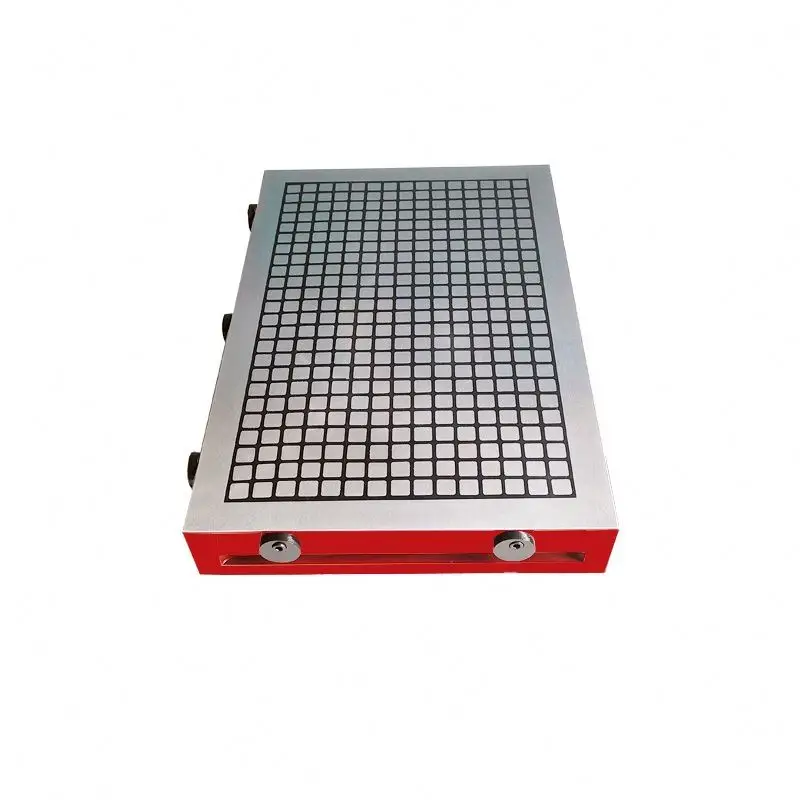
The parameter block on the page is a header with no rows
This is the entire published parameter block, verbatim:
| item | value |
|---|---|
| no rows | |
A header and nothing under it. The description above it repeats the title and then adds “Product Description — item — value”, which is the same empty table described in words. After that comes a company profile about CNC carbide inserts and turning tools that appears on dozens of unrelated listings in this catalogue, including a hydrogen generator.
So the page publishes one number: 200 x 500 in the title. Everything else about this chuck — how hard it holds, how thick it is, what it weighs, what pole pitch it uses, whether it needs a controller — is absent.
The real table is inside the eighth photograph
Image eight of the gallery is a spreadsheet screenshot. It lists twenty-two sizes with width, length, height and weight, and a single merged “suction” cell reading ≥40KG that spans every row.
| Model | Width mm | Length mm | Height mm | Weight kg |
|---|---|---|---|---|
| 150*150 | 150 | 150 | 80 | 13.5 |
| 150*300 | 150 | 300 | 80 | 27 |
| 200*200 | 200 | 200 | 80 | 24 |
| 200*300 | 200 | 300 | 80 | 36 |
| 200*400 | 200 | 400 | 80 | 48 |
| 200*500 | 200 | 500 | 80 | 60 |
| 300*300 | 300 | 300 | 80 | 54 |
| 300*400 | 300 | 400 | 80 | 72 |
| 300*500 | 300 | 500 | 80 | 90 |
| 300*600 | 300 | 600 | 80 | 108 |
| 300*800 | 300 | 800 | 80 | 144 |
| 400*400 | 400 | 400 | 80 | 96 |
| 400*500 | 400 | 500 | 80 | 120 |
| 400*600 | 400 | 600 | 80 | 144 |
| 400*800 | 400 | 800 | 80 | 192 |
| 500*500 | 500 | 500 | 80 | 150 |
| 500*600 | 500 | 600 | 80 | 180 |
| 500*800 | 500 | 800 | 80 | 240 |
| 500*1000 | 500 | 1000 | 80 | 300 |
| 600*600 | 600 | 600 | 80 | 216 |
| 600*800 | 600 | 800 | 80 | 288 |
| 600*1000 | 600 | 1000 | 80 | 360 |
Two things are worth extracting immediately. Every size is 80 mm thick, which sets how much Z travel you give up; and the size range spans 150 x 150 up to 600 x 1000, an area ratio of 26.7 times, inside one listing.
The title names only the 200 x 500. If you want that one, the table gives you height 80 mm and weight 60 kg — the first real numbers on the whole page.
The weight column is arithmetic, not measurement
Take the 200 x 500 at 80 mm. The volume is 200 x 500 x 80 = 8,000,000 mm³ = 8,000 cm³. Divide the published 60 kg by it and you get 7.500 g/cm³.
Now do it for all twenty-two rows. Every single one comes out at exactly 7.500 g/cm³ — the same to four decimal places, from the 13.5 kg of the 150 x 150 to the 360 kg of the 600 x 1000. The spread across twenty-two sizes is zero.
| Size | Published kg | Volume cm³ | Implied density |
|---|---|---|---|
| 150 x 150 | 13.5 | 1,800 | 7.500 |
| 200 x 500 | 60 | 8,000 | 7.500 |
| 500 x 1000 | 300 | 40,000 | 7.500 |
| 600 x 1000 | 360 | 48,000 | 7.500 |
Real chucks are not solid blocks: they contain magnet assemblies, pole pieces, a coolant-tight shell and often hollow sections, so their true density is below solid steel. A column that lands on one round number for every size was calculated, not weighed.
This matters for two practical reasons. Carbon steel is about 7.85 g/cm³, so a genuinely solid body of that size would weigh 62.8 kg — 4.7% more than published. And if the body is hollow, the crate weight differs again. Use the table as a planning figure, then get the actual crate gross weight before you book freight.
“Suction ≥40KG” is one number for all twenty-two sizes, and it is two hundred times too small
The suction column is a single merged cell. It reads ≥40KG whether the chuck is 150 x 150 or 600 x 1000 — the same force for a 13.5 kg plate and a 360 kg plate.
Take it literally and the arithmetic collapses. On the 200 x 500 face, which is 1,000 cm², forty kilograms force is 392 N, or 0.39 N/cm². That is 0.04 kgf/cm².
Published figures for industrial magnetic chucks sit nowhere near that. Manufacturers quote up to about 16 kgf/cm² as the theoretical ceiling (roughly 157 N/cm²), and commonly around 180 psi, which is about 124 N/cm². Against a realistic 8 to 12 kgf/cm², the published figure is 200 to 300 times smaller, and about 400 times below the theoretical maximum.
So the column is not the holding force. It may be a minimum workpiece weight, a shipping classification, or a placeholder somebody forgot to fill in. Either way, the page contains no usable force figure.
| If the face really held… | Over 1,000 cm² | In tonne-force |
|---|---|---|
| 80 N/cm² | 80,000 N | 8.2 |
| 100 N/cm² | 100,000 N | 10.2 |
| 120 N/cm² | 120,000 N | 12.2 |
Those are the numbers you would normally compare against, and none of them appear anywhere on this page.
What actually resists the cutter is friction, not attraction
This is the part that most buyers get wrong, and it is the reason the missing force figure is more than a documentation gap.
A magnetic chuck pulls the workpiece normal to its face. A milling cutter pushes sideways. The force keeping the part from sliding is not the attraction; it is friction at the interface, which is the coefficient of friction multiplied by the normal force.
| Holding force | Coefficient | Shear resistance | In kgf |
|---|---|---|---|
| 80 N/cm² | 0.15 | 12,000 N | 1,224 |
| 100 N/cm² | 0.15 | 15,000 N | 1,530 |
| 120 N/cm² | 0.15 | 18,000 N | 1,835 |
| 100 N/cm² | 0.10 | 10,000 N | 1,020 |
| 100 N/cm² | 0.20 | 20,000 N | 2,039 |
A chuck advertised as holding ten tonnes is, in the direction the cutter pushes, a one-and-a-half tonne grip. That is still a lot — but it is the number to compare, and it is not the number on any datasheet.
Coolant makes it worse. A wet interface is a lubricated interface:
| Interface | Coefficient | Shear resistance at 100 N/cm² |
|---|---|---|
| Dry and clean | 0.18 | 18,000 N |
| Light coolant film | 0.12 | 12,000 N |
| Flood coolant | 0.08 | 8,000 N |
Flood coolant more than halves the resistance compared with a dry joint. Any chuck that is going to run wet needs its holding force quoted, not guessed.
Cutting force versus shear resistance: do the margin yourself
Tangential cutting force is roughly spindle power divided by cutting speed. At 15 kW and 250 m/min that is 3,600 N; at 150 m/min it is 6,000 N; a 22 kW cut at 150 m/min is 8,800 N.
| Spindle | Cutting speed | Tangential force |
|---|---|---|
| 7.5 kW | 250 m/min | 1,800 N |
| 11 kW | 250 m/min | 2,640 N |
| 15 kW | 250 m/min | 3,600 N |
| 15 kW | 150 m/min | 6,000 N |
| 22 kW | 150 m/min | 8,800 N |
Against a 100 N/cm² chuck on a full 200 x 500 face, the margin works out at about 5.6x with a clean dry joint, 4.2x at a coefficient of 0.15, and 2.8x at 0.10 — all against a 15 kW cut at 250 m/min.
That margin is adequate but not enormous, and it disappears in two situations: a small part covering only a fraction of the face, and a heavy roughing cut with coolant. Both are common. If your process is either, you need the real holding force, and you need to know how it is distributed across the pole field.
The plate is 200 x 500; the pole field inside it is smaller
Every photograph shows a plain machined border around the pole grid. The nominated 200 x 500 is the plate, and the magnets only act inside that border.
A 10 mm border on all four sides leaves 180 x 480 mm, which is 86,400 mm² — 86.4% of the titled area. Every force calculation above is then 13.6% optimistic before you start.
The listing never says whether 200 x 500 refers to the plate or to the pole field, and it never gives the border width. That is the first dimension to ask for, because it changes the effective area and therefore every force figure you compute.
Pole pitch: the number that decides whether small parts hold at all
The grid visible in the photographs is a square-pole design with a fairly fine pitch, and the size of those squares sets the smallest workpiece that can be held.
The principle is simple. Flux has to travel from a north pole, through the workpiece, and back to a south pole. A part that spans only one pole has nowhere for the flux to return, so it sees very little force. A part has to bridge at least two, and preferably three, pole pitches before it approaches the rated figure.
That single rule decides most of the practical questions a buyer has. Fine-pole chucks, with pitches down to a millimetre or so, exist precisely because small and thin parts need them. A standard-pitch chuck will hold a 200 mm block with its full rated force and will barely hold a 20 mm washer.
The listing gives no pole pitch, no pole size, no pole count and no minimum workpiece size. If you machine small parts — and most people buying a 200 x 500 plate for a vertical mill do — this is the specification that decides whether the purchase works, and it is not on the page.
Electro-permanent, permanent, or electromagnetic? The catalogue says all three
These are three different products with three different installation requirements, and this catalogue uses all three names for what appears to be one family:
| Type | How it holds | How you release it | Needs a controller |
|---|---|---|---|
| Permanent magnetic | Always magnetised | Hand lever or sliding pole pieces that shunt the flux | No |
| Electromagnetic | DC current through a coil | Switch off — and it drops the part | Power supply, continuously |
| Electro-permanent | Reversible magnets, set by a current pulse | Reverse pulse | Yes, a magnetising controller |
The title of this listing says electro permanent. Two sibling listings of the same family say permanent magnetic chuck table. A third says electro-permanent … electro-controlled. The photographs show round electrical connectors on the end face — two on the long version, one on the square one — which means at least those units are wired, and therefore not passive permanent chucks.
The distinction is not academic. A permanent chuck arrives complete and needs nothing. An electro-permanent chuck without its controller is not a working tool. If you order assuming the first and receive the second, you have a 60 kg plate you cannot switch on.
Get the answer in writing, with the model number, before you pay.
The controller is a separate listing
This catalogue carries two listings titled external magnetic controller, complete specifications — and both have an empty parameter block as well.
So the controller exists, is sold separately, and is documented no better than the plate. That combination is the single most common way an electro-permanent chuck purchase goes wrong: the plate arrives, the controller does not, and the controller has to match the chuck's coil configuration.
Three questions before ordering. Is the controller included in the quoted price? Which controller model drives this plate, and how many circuits does it have — the photographs show units with one connector and units with two, so a two-circuit plate needs a two-channel controller. And what is the switching time, because an electro-permanent chuck needs a pulse to change state and that pulse comes from a capacitor bank in the controller.
80 mm thick and 60 kg: what that costs you
Two consequences follow directly from the size table, and both are easy to overlook.
Z travel. An 80 mm plate on the machine table removes 80 mm from the distance between spindle nose and table. On a small vertical mill with 400 mm of Z that is a fifth of the travel, and it changes which tools and which job heights remain reachable. Check it against your machine before ordering, not after.
Handling. Sixty kilograms is a two-person lift at best and a crane job in practice, especially on and off a machine table with the spindle in the way. The photographs show elongated slots in the side faces, which look like lifting or clamping points — but the listing does not say what they are rated for, and no lifting eyes are mentioned. Assume you need a hoist and a proper lifting plan.
Thin workpieces on a standard pole pitch
Thickness matters as much as footprint. A thin plate cannot carry enough flux between adjacent poles before it saturates, so it holds far below the rated force even when it covers the whole face. The usual shop rule is that parts thinner than roughly 8 to 10 mm need a fine-pole chuck, and that very thin sheet simply cannot be held magnetically without distortion.
There is a second, quieter problem. A magnetic chuck pulls the part flat. If the part is not flat to begin with, the chuck bends it against the face, you machine it in that bent state, and it springs back when released. For thin parts, that is a tolerance problem no holding force figure will reveal.
Neither the minimum workpiece thickness nor the flatness and parallelism of the pole face is published. Both are standard datasheet items for this class of tool, typically quoted in hundredths of a millimetre over a stated length.
Coolant, sealing and residual magnetism
Three more numbers that a magnetic chuck datasheet normally carries, and this page does not.
Sealing. The body has to keep coolant and swarf out of the magnet assembly. Chucks are usually rated to a dust-and-water ingress level, and that rating is the difference between a tool that lasts ten years and one that fails in the first wet season. Nothing here states it.
Residual magnetism. After switching off, the workpiece keeps a small field. That matters if the part is measured, handled near sensitive electronics, or passed to a second operation where chips will cling to it. A demagnetising figure in millitesla, or a statement that the controller includes a demagnetising cycle, is normal. Neither appears.
Duty cycle. An electro-permanent chuck holds with no current, which is its main advantage over an electromagnetic one — no heat in the plate, no risk of dropping the part during a power cut. But switching state takes a pulse, and if you switch many times an hour the controller's recharge time sets your cycle. Ask for it.
What to put in the request for quotation
| # | Question | Why it decides the purchase |
|---|---|---|
| 1 | Permanent, electromagnetic, or electro-permanent — stated explicitly | The catalogue uses all three names; the installation differs completely |
| 2 | Is the controller included, and which model? | It is listed separately, with an empty parameter block |
| 3 | Holding force in N/cm² or kgf/cm², with the test method | The only published figure is ≥40 kg for all 22 sizes |
| 4 | Pole pitch in mm, and minimum workpiece size and thickness | Sets whether small or thin parts hold at all |
| 5 | Is 200 x 500 the plate or the pole field, and what is the border width? | A 10 mm border costs 13.6% of the effective area |
| 6 | Flatness and parallelism of the pole face, with tolerance and length | Sets the accuracy you can hold on the part |
| 7 | Ingress protection rating | Decides survival under flood coolant |
| 8 | Residual magnetism after demagnetising, in mT | Matters for measurement and second operations |
| 9 | Number of magnetising circuits and connector type | Photographs show one- and two-connector versions |
| 10 | Actual weighed weight and crate gross weight and dimensions | The weight column is volume x 7.5 g/cm³, not a scale reading |
| 11 | Height confirmation, 80 mm, and Z clearance needed | Costs 80 mm of travel on every job |
| 12 | Lifting points and their rated capacity | 60 kg on and off a machine table |
| 13 | Warranty, and whether the magnet assembly is covered | No warranty field exists |
| 14 | Price per size, since 22 are listed | The title names one size; the table sells twenty-two |
Questions 1 and 3 are the ones that decide whether the tool works. Everything else is about whether it works well in your particular shop. A supplier who cannot answer either of them is selling a photograph.
What this plate is good for
For five-sided machining of a flat ferrous part on a vertical mill, a 200 x 500 plate is a sound size: large enough to take two or three small parts at once, small enough to leave usable table. The build looks substantial, the pole field is fine enough to be useful, and if it is genuinely electro-permanent it will hold without power and without heating the plate — both real advantages over an electromagnetic chuck.
What is missing is everything that would let you specify it. No holding force, no pole pitch, no thickness of part it suits, no flatness tolerance, no sealing rating, no statement of which of the three magnetic architectures you are actually buying — and a parameter block with a header and no rows, while the only real table sits in the eighth photograph, where its weight column turns out to be arithmetic at 7.5 g/cm³ and its one force figure reads the same for a 13.5 kg plate and a 360 kg one.
The photographs show a real, competently made tool. The listing does not describe it. Ask the fourteen questions, get answers 1 and 3 in writing, and this is a straightforward purchase.
Frequently asked questions
- How much does a 200 x 500 magnetic chuck weigh?
- The size table in the eighth photograph gives height 80 mm and weight 60 kg for the 200*500. But that column is not a measurement: all twenty-two sizes divide exactly into 7.500 g/cm3, from the 13.5 kg 150*150 to the 360 kg 600*1000. With carbon steel at about 7.85 g/cm3 a genuinely solid body of that size would weigh 62.8 kg, so treat 60 kg as a planning figure and ask for the weighed value and the crate gross weight.
- What holding force does it have?
- The page does not give one. The size table has a single merged suction cell reading >=40KG across all twenty-two sizes. Taken literally on the 200 x 500 face, which is 1,000 cm2, that is 0.39 N/cm2 or 0.04 kgf/cm2, which is 200 to 300 times below the 8 to 12 kgf/cm2 that industrial magnetic chucks normally quote, and about 400 times below the 16 kgf/cm2 theoretical ceiling. Ask for the figure in N/cm2 or kgf/cm2 with its test method.
- Is it electro-permanent or a plain permanent chuck?
- The title says electro permanent, two sibling listings say permanent magnetic, and a third says electro-controlled. The photographs show round electrical connectors on the end face, which means at least some of the photographed units are wired and are not passive permanent chucks. The difference matters because an electro-permanent chuck needs a magnetising controller, which this catalogue lists separately, and a permanent chuck needs nothing.
- What is the difference between attraction and holding?
- Attraction acts normal to the face; a milling cutter pushes sideways, so the part is restrained by friction, which is the coefficient of friction times the normal force. At 100 N/cm2 over a 200 x 500 face the attraction is 100,000 N but the shear resistance is only 10,000 to 20,000 N depending on the interface, and a flood-coolant film can push it down to 8,000 N. That is the number to compare with cutting force, and it is never on a datasheet.
- Will it hold small parts?
- That depends on the pole pitch, which is not published. Flux has to run from a north pole through the workpiece to a south pole, so a part must bridge at least two and preferably three pole pitches to approach the rated force. A part smaller than that sees very little holding force however strong the chuck is. Ask for the pole pitch in millimetres and the minimum workpiece size and thickness.
- How thick is it, and does that matter?
- Every size in the table is 80 mm thick. That removes 80 mm from the Z travel between spindle nose and table, which on a small vertical mill can be a fifth of the available travel. It also means a 60 kg lift on and off the machine table, so plan for a hoist; the side slots in the photographs look like handling points but their rating is not stated.
- Why is the parameter block empty?
- It contains only a header row reading item and value, with no data underneath, and the description paraphrases the same empty table. The actual specifications exist only inside the eighth gallery image. That is also why the height, weight and the twenty-two available sizes cannot be found by reading the page.