
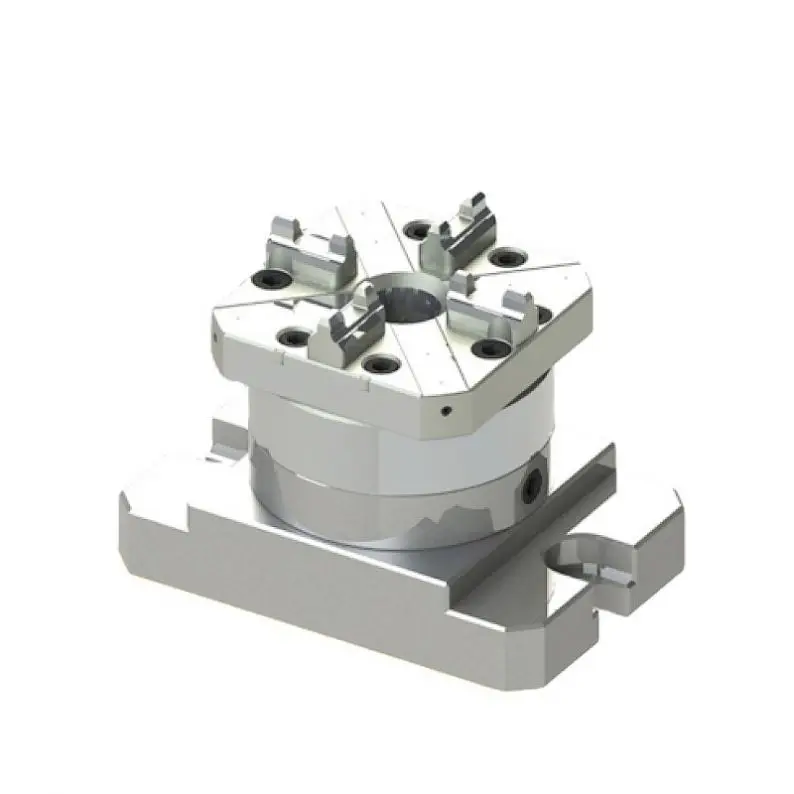
Twenty models, three numbers each
The parameter block on this page is the entire listing: twenty rows of model number against outline dimensions, in millimetres. Nothing else. No clamping force. No repeatability. No interface dimensions. No air consumption. No weight. No material. No warranty.
That is not a specification for a zero-point chuck, it is a size chart for a family of them. The one thing a workholding device is bought for — how hard it holds and how repeatably it lets go and re-grip — is not on the page at all.
The twenty models span a wide range: the smallest outline is 80 × 80 mm at 6,400 mm² and the largest is 410 × 310 mm at 127,100 mm², a factor of 19.9 in footprint. Treating these twenty as one product with one price and one capability is the first mistake a buyer can make here.
The title names a size that belongs to two other models
The title reads: “Specification Size 130 * 85 * 94 Model SY-ER012 80 square CNC Pneumatic Chuck”. Three separate claims sit in that one line.
| Claim in the title | What the table says | Consistent? |
|---|---|---|
| Size 130 × 85 × 94 | SY-ER012 is 130*85*94 | yes |
| Model SY-ER012 | exists in the table | yes |
| 80 square | the only 80 × 80 models are SY-ER011 (80*80*66) and SY-ER014 (80*80*17) | no |
An 80 mm square chuck and a 130 × 85 mm chuck are different products with different footprints and different mounting. “80 square” has been carried over from a sibling listing for a separate 80 × 80 pneumatic chuck, and it does not describe SY-ER012. Before ordering, the width and length are the two numbers to read back to the seller, because the title and the table disagree about them.
Four pairs of models cannot be told apart
Eight of the twenty models share identical published dimensions with another model:
| Dimensions | Models | What the buyer must ask |
|---|---|---|
| 410 × 310 × 87 | SY-ER005, SY-ER006 | same product or two variants? |
| 145 × 100 × 72.5 | SY-ER007, SY-ER017 | same product or two variants? |
| D138 × 81 | SY-ER008, SY-ER018 | same product or two variants? |
| 145 × 100 × 118 | SY-ER010, SY-ER020 | same product or two variants? |
If they are the same product under two part numbers, the range really has sixteen distinct sizes, not twenty. If they differ in something the table does not show — jaw type, air port position, top plate, stroke — then the difference is exactly the information you are buying and it is absent. A fifth near-pair, SY-ER009 at 162 × 99.5 × 151 and SY-ER019 at 162 × 86 × 151, differs by 13.5 mm in one figure and by nothing else.
For a buyer specifying a pallet with a fixed grid of chucks, the duplicate part numbers matter: mixing SY-ER005 and SY-ER006 in one pallet is safe only if they are dimensionally and functionally identical, and the page does not establish that.
The one real specification is a single image, and it has a unit error
Eight images accompany the listing. Five are renders, application collages or marketing slides. One carries an actual specification list, reproduced here as printed:
| Field | Value as printed | Note |
|---|---|---|
| Main material | High quality chrome steel, 57~60 HRC | a hardness range, which is more than most listings give |
| Use pressure | 6 kg | “kg” is not a pressure unit |
| Main body conditioning | Vacuum heat treatment and deep cooling | consistent with 57–60 HRC |
| Surface | Nano-coating, light golden colour, rust-proof | — |
| Accessory A | SMC pneumatic components, NSK accessories, aerospace grade lubricants | brand names, no part numbers |
| Accessory B | German Haas spring, seal ring series | brand claim, no part number |
| Application | Face locking screws, suitable for CNC machine tools | — |
Five of the seven fields are qualitative. Two are technically meaningful — the hardness range and the heat treatment — and one is numerically broken. Six pages of marketing and one short list, and the short list is the most useful thing in the listing.
“Use pressure 6 kg” and what it means in bar
Pressure written as “6 kg” is a common shorthand in Chinese machine tool listings for 6 kgf/cm², which is the ordinary shop air pressure. Converted properly:
| Written as | Read as | MPa | bar | psi |
|---|---|---|---|---|
| 6 kg | 6 kgf/cm² | 0.588 | 5.88 | 85.3 |
So this is a normal 6 bar pneumatic device, which is what a workshop compressor supplies. Two things are still missing. First, whether 6 kgf/cm² is the minimum, the nominal or the maximum — a chuck that needs at least 6 bar behaves very differently on a compressor that sags to 5 bar at the far end of a line. Second, and far more important, the force that 6 bar produces, which is the next section.
Clamping force is absent, and the geometry caps it
Clamping force follows from pressure and piston area: F = p × A. The pressure is stated as 6 kgf/cm². The piston area is not stated, and it cannot be inferred from outline dimensions except as an upper bound, because the piston sits inside the body.
Taking the whole outline as piston area gives an absolute ceiling. Real numbers are lower, often much lower:
| Model | Outline | Outline area | Ceiling at 6 kgf/cm² |
|---|---|---|---|
| SY-ER011 | 80 × 80 | 6,400 mm² | 3,766 N |
| SY-ER012 | 130 × 85 | 11,050 mm² | 6,502 N |
| SY-ER016 | 125 × 125 | 15,625 mm² | 9,194 N |
| SY-ER005 / 006 | 410 × 310 | 127,100 mm² | 74,786 N |
Those ceilings assume every square millimetre of the footprint is pressurised piston, which no chuck achieves; a body needs walls, jaw guides, air passages and mounting holes. A realistic single circular piston for a 130 × 85 mm body is 70 mm across, giving 2,264 N at 6 kgf/cm². Even the largest circle that fits, 85 mm, gives 3,339 N.
Which means the clamping force of the model in this listing's title lies somewhere between roughly 2.3 kN and 6.5 kN, and the page does not say where. That is a 2.8-fold range on the number that decides whether the chuck holds under a heavy cut.
A 130 × 85 mm body cannot reach 10,000 N at 6 bar
Ten thousand newtons is the clamping force EROWA publishes for its PowerChuck P, and it is the figure most buyers carry in their heads when they read the word Erowa. At 6 kgf/cm² that force would require:
| Quantity | Value |
|---|---|
| Piston area needed for 10,000 N | 16,995 mm² |
| Equivalent circular piston diameter | 147.1 mm |
| SY-ER012 outline | 130 × 85 = 11,050 mm² |
A 147 mm piston does not fit in a 130 × 85 mm body, so the SY-ER012 cannot reach 10 kN at 6 bar under any internal design. The full-rectangle ceiling is 6,502 N; the 10 kN class begins around the SY-ER016 at 125 × 125 mm, and comfortably only with the large floor-standing models.
This is not necessarily a fault. Chucks of this size are typically 2–6 kN devices, and that is enough for the light milling and EDM work they are sold for. The problem is that the listing uses a brand name that implies a force class it does not state and, at this size, cannot meet. Ask for the clamping force in newtons per model, at the stated pressure.
0.002 mm appears on the page, but not as repeatability
One image is a “Why choose us” slide. It states:
“The fully automated production line has gone through more than ten inspection processes such as plane inspection to ensure that the workpiece accuracy is ±0.002mm”
Read carefully, ±0.002 mm there describes the accuracy to which the factory machines its parts, verified by plane inspection. It is a manufacturing tolerance. It is not a statement that the chuck re-grips a pallet to within 0.002 mm, which is a different measurement: the spread of workpiece position over repeated clamp and unclamp cycles, usually measured over fifty cycles with an indicator.
The coincidence is unfortunate, because 0.002 mm is exactly the repeatability figure EROWA publishes for its zero-point chucks. A buyer skimming the gallery will see 0.002 mm and assume repeatability. The listing never claims it, and the two measurements are not interchangeable: a chuck can be machined to two microns and still re-grip to ten.
Repeatability, as a number, is missing from the page. It is the one specification to insist on.
The circular models are too small for an EROWA pallet
Four models are round: SY-ER008 and SY-ER018 at D138 × 81, SY-ER013 at D138 × 97.5, and SY-ER015 at D100 × 49.5. EROWA's ITS system and PowerChuck P pallets are published at ø115 mm and ø148 mm.
| Model | Body diameter | EROWA ø148 pallet |
|---|---|---|
| SY-ER008, SY-ER018 | 138 mm | cannot contain it, 10 mm short |
| SY-ER013 | 138 mm | cannot contain it, 10 mm short |
| SY-ER015 | 100 mm | cannot contain it, 48 mm short |
A 148 mm pallet cannot sit inside a 138 mm body, so if “Erowa” here means the ø148 system these four models are not that system's chucks. They may be compatible with the smaller ø115 pallet, which would fit inside 138 mm, or with a third-party interface the listing never names.
The number that settles it is the centring diameter of the chuck, and the pull-stud thread it accepts. Neither is published. Using a brand name in a title does specification work that only a dimension can actually do.
Material and heat treatment: the credible part of the listing
Chromium steel taken to 57–60 HRC through vacuum heat treatment followed by deep cooling is a coherent recipe. It is what a wear-resistant fixture body or a bearing-grade component gets, and 57–60 HRC is a genuinely hard surface — harder than most machine tool fixtures, which are typically case-hardened to 58–62 HRC only on wear faces.
The question is which parts. If the jaws and the reference faces are 57–60 HRC and the body is softer, everything is normal. If the entire body is through-hardened to that level, it is brittle, difficult to tap and drill for mounting, and prone to cracking under an impact — and the “face locking screws” in the application line would be threading into very hard material.
| Ask | Why |
|---|---|
| Which components are 57–60 HRC | Through-hardened body and case-hardened wear faces are different machines |
| Core hardness of the body | Below the surface, if the hardness is a case |
| Grinding, not just heat treatment, of the reference faces | Hardness without grinding does not give flatness |
| Flatness and parallelism of the mounting face, in mm | Sets how the chuck sits on your pallet |
Deep cooling after hardening is a real process, used to convert retained austenite and stabilise dimensions. Its presence in the list is a point in the seller's favour, and it is the sort of claim a competent fixture shop makes and a trader copies.
Three company names on one product page
The description ends with the boilerplate of Hengshui Mengshang Trading Co., Ltd., the same paragraph about CNC carbide inserts and milling tools that appears on unrelated listings across this catalogue.
Two of the eight images carry a different company's name: Dongguan Xiangxiang Precision Fixture Co., Ltd., described as a company integrating R&D, production and sales, on a slide headed “Why choose us” and again on a slide headed “When purchasing fixture equipment” which ends “Choose Xiangxiang to solve all the above problems”.
And the listing uses the EROWA name, a Swiss clamping-system brand, in its title.
Three identities — a trading company, a fixture factory in another province, and a European brand — on one page. That is not automatically wrong; traders resell factory products and compatible tooling is normal. But it does mean the seller is not the manufacturer, so a warranty question goes through a trader, and a technical question about repeatability has to travel to a factory the seller may not control. Ask who performs warranty repair and where.
Installation: what else has to be right
A pneumatic chuck is part of an air circuit and a pallet system, and the listing treats it as a standalone object. The items you will need and will not find here:
| Item | Why it matters | Published? |
|---|---|---|
| Air consumption per cycle | Sizes the compressor and the receiver; a pallet of twenty chucks cycling together draws a lot at once | no |
| Fail-safe behaviour | Spring-closed and air-opened holds on pressure loss; air-closed releases. On a machining centre the difference is a scrap part or a flying one | no |
| Air quality required | Filtered, dried, lubricated or not; SMC components have their own requirements | no |
| Air port size and position | Determines whether the chucks can be manifolded under a pallet | no |
| Mounting hole pattern | A pallet grid is designed around it | no |
| Stroke of the jaws | Sets the range of workpiece sizes one chuck accepts | no |
| Weight | Twenty chucks on a pallet is a crane question | no |
The weight absence is worth quantifying. Bounding-box volume times the density of steel gives an upper bound: the SY-ER012 envelope is 1,039 cm³, or 8.15 kg if the body were solid; at a plausible 60% fill it is about 4.9 kg. The largest model, SY-ER005, envelopes 11,058 cm³ and would be 86.8 kg solid, perhaps 52 kg real. A pallet carrying twenty of those is a tonne of fixture, and the page gives no weight at all.
What to put in the request for quotation
| # | Question | Why |
|---|---|---|
| 1 | Which single model, and is it the 130 × 85 SY-ER012 or the 80 × 80 chuck | The title names both |
| 2 | Clamping force in newtons, per model, at 6 kgf/cm² | The defining number, absent from the page |
| 3 | Repeatability in mm, measured over at least 50 clamp cycles | The 0.002 mm on the page is a machining tolerance |
| 4 | Centring diameter and pull-stud thread | Decides whether it mates with the Erowa or 3R interface you already own |
| 5 | Which EROWA system, if any, this is compatible with | ø148 cannot fit a 138 mm body |
| 6 | Is 6 kgf/cm² a minimum, nominal or maximum | Compressor pressure sags at the end of a line |
| 7 | Fail-safe direction on air loss | Spring-closed or air-closed changes the risk profile |
| 8 | Air consumption per cycle, and port size and position | Manifolding a pallet |
| 9 | Mounting hole pattern and bolt size | The pallet is designed around it |
| 10 | Jaw stroke and the workpiece range it covers | One chuck per part size otherwise |
| 11 | Weight per model | Twenty chucks is a rigging question |
| 12 | Which parts are 57–60 HRC and what the body core hardness is | Through-hardened and case-hardened behave differently |
| 13 | Flatness and parallelism of the mounting face | Sets how it seats on your pallet |
| 14 | Are SY-ER005/006, 007/017, 008/018 and 010/020 the same part | Eight of twenty models are indistinguishable |
| 15 | Spare jaws, seals and spring, with part numbers | Seals are the wear item on a pneumatic chuck |
Questions 2 and 4 are the ones that decide the purchase. Everything else can be settled after the first two answers, because a chuck with the wrong interface cannot be installed and a chuck with insufficient force cannot be used.
What this chuck is good for, and what it is not
The application photographs are the most honest part of the listing. They show rows of these chucks bolted to machine tables and pallets, holding small blocks, with a hand pushing one along a rail to demonstrate the air release. That is what the product is: a small, cheap, pneumatically released fixture for holding many small parts at once on a pallet, so that a machine can run unattended through a batch.
| Good fit | Poor fit |
|---|---|
| Many small parts on one pallet, light milling | Heavy roughing where 2–6 kN is not enough |
| EDM electrodes and small mould inserts | Any job where the existing pallet is EROWA ø148 and must interchange |
| Fixture sets where cost per station dominates | Five-axis work needing a certified repeatability figure |
| Shops that can measure the result themselves | Shops that must show an inspection certificate to a customer |
For the first column this range is a sensible buy at the right price, and the material spec suggests the seller is not simply drop-shipping a mystery object. For the second column, the missing numbers are disqualifying rather than inconvenient: no clamping force, no repeatability, and no interface dimension adds up to a device you cannot design a pallet around without asking.
Key specifications
- SY-ER001
- 102*102*72.5
- SY-ER002
- 300*102*87
- SY-ER003
- 460*102*87
- SY-ER004
- 330*290*87
- SY-ER005
- 410*310*87
- SY-ER006
- 410*310*87
- SY-ER007
- 145*100*72.5
- SY-ER008
- D138*81
- SY-ER009
- 162*99.5*151
- SY-ER010
- 145*100*118
- SY-ER011
- 80*80*66
- SY-ER012
- 130*85*94
- SY-ER013
- D138*97.5
- SY-ER014
- 80*80*17
- SY-ER015
- D100*49.5
- SY-ER016
- 125*125*64.5
- SY-ER017
- 145*100*72.5
- SY-ER018
- D138*81
- SY-ER019
- 162*86*151
- SY-ER020
- 145*100*118
Frequently asked questions
- What is the clamping force of this Erowa-type chuck?
- It is not published. Pressure is given as 6 kgf/cm2 but piston area is not, so force cannot be read off the page. Taking the whole outline as piston area sets an absolute ceiling: 6,502 N for the 130 x 85 mm SY-ER012 and 3,766 N for the 80 x 80 mm models. A realistic 70 mm piston gives about 2,264 N. Ask for the force in newtons per model.
- Can the SY-ER012 reach 10,000 N like a real EROWA PowerChuck?
- No. At 6 kgf/cm2, 10,000 N needs 16,995 mm2 of piston area, equivalent to a 147 mm diameter piston. The SY-ER012 body is 130 x 85 mm, so a 147 mm piston cannot fit inside it. Even treating the entire rectangle as piston gives 6,502 N. The 10 kN class starts around the 125 x 125 mm model and is comfortable only on the large floor-standing sizes.
- The page says 0.002 mm. Is that the repeatability?
- No. That figure comes from a factory slide describing plane inspection ensuring workpiece accuracy of plus or minus 0.002 mm, which is a machining tolerance on the parts. Repeatability is a different measurement: the spread of workpiece position over repeated clamp and unclamp cycles. The listing never states repeatability, and a chuck machined to 2 microns can still re-grip to 10 microns.
- Will it fit an EROWA ITS or 3R pallet?
- Unknown, and one group is doubtful. The circular models are D138 and D100, while EROWA publishes its ITS and PowerChuck P pallets at 115 mm and 148 mm. A 148 mm pallet cannot sit inside a 138 mm body. The numbers that settle compatibility are the centring diameter and the pull-stud thread, neither of which is published, so ask for both before ordering.
- Why do the dimensions say 130 x 85 x 94 but the title says 80 square?
- Because the title combines two products. SY-ER012 is 130 x 85 x 94 mm in the table, and the only 80 x 80 models are SY-ER011 at 80 x 80 x 66 and SY-ER014 at 80 x 80 x 17. Confirm width and length in writing before ordering, since an 80 mm square chuck and a 130 x 85 mm chuck need different mounting.
- Are SY-ER005 and SY-ER006 the same chuck?
- The listing gives both as 410 x 310 x 87 mm and says nothing else, so they cannot be distinguished. The same applies to SY-ER007 and SY-ER017, SY-ER008 and SY-ER018, and SY-ER010 and SY-ER020. Eight of the twenty models fall into four indistinguishable pairs, which matters if you are designing a pallet grid that mixes them.
- What does 'use pressure 6 kg' mean?
- It is shorthand for 6 kgf/cm2, which converts to 0.588 MPa, 5.88 bar or 85 psi, the ordinary shop air pressure. The listing does not say whether that is a minimum, nominal or maximum, which matters on a compressor that sags at the far end of a line, and it does not give air consumption per cycle or whether the chuck is spring-closed and air-opened or the reverse.