
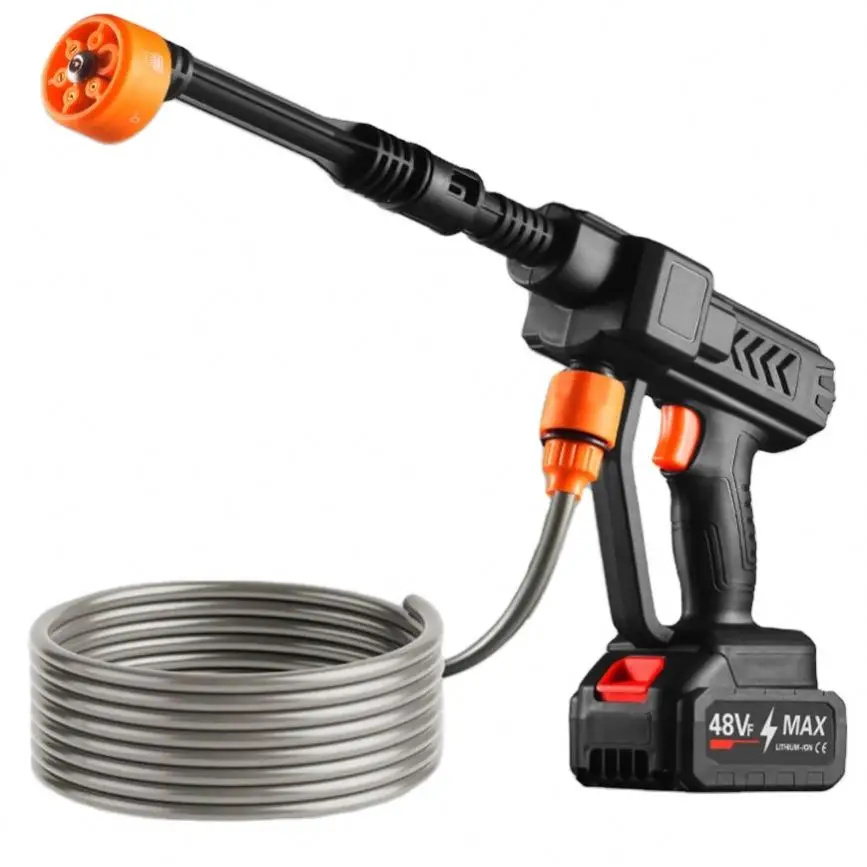
Source-controlled product identity
The Hoting queue identifies Product ID 1601391471279 as a cordless portable electric car pressure washer, listed under the title "Factory High Pressure Portable Cordless Wireless Electric Cleaning Car Pressure Washing Water Spray Gun Car Washer Machine". The description repeats the same product under a shorter title and then gives a parameter block containing exactly two rows.
The claim in the title is a performance claim. High pressure, portable, cordless and wireless are all statements about how the tool performs and how it is used, and the record contains no performance data at all. What it contains is a product name and a housing material. That gap is the whole subject of this guide, because a buyer of a battery pressure washer is buying pressure, flow and run time, and none of those three appears anywhere in the record.
This article sets out what the two recorded rows do and do not tell a buyer, derives the relationship that makes the missing numbers necessary, explains the water supply architectures the buyer must choose between, and lists the questions that must be answered before this product can be quoted to a customer or stocked on a shelf.
The two recorded parameters, verbatim
| Parameter | Recorded value |
|---|---|
| Product name | Mini Car Pressure Washer |
| Body material | ABS |
Below the table the record has a heading reading "PACKING SHIPPING" with no packing or shipping data under it, and a company introduction.
Read the two rows together and note what they establish. The product name tells the buyer that this is a small car washer rather than a workshop machine, which is consistent with the title's language about portability and cordless operation. The second row tells the buyer what the outer shell is made of. Neither row tells the buyer anything about the pressure the tool delivers, the water flow it delivers, the energy source that powers it, how long it runs, where the water comes from, or what happens when water meets the parts that are not the shell.
Why "high pressure" is not a specification
The title claims high pressure, and a buyer who compares products on that phrase alone will be misled, because pressure by itself does not clean anything. Cleaning comes from the energy in the water jet, and the energy in a jet depends on both the pressure and the flow rate. The hydraulic power delivered by a jet is the product of the two:
jet power = pressure x flow rate
That product is the figure that describes cleaning performance, and the two factors can be traded against each other. A tool can be built to deliver a narrow jet at high pressure and a low flow, or a wider jet at lower pressure and a higher flow. Both could honestly be described as high pressure in a listing, and they behave completely differently: the first cuts at a spot, the second rinses a panel. A buyer who is quoted only a pressure figure cannot tell which one they are being offered.
For a battery-powered washer there is a second reason no single number settles the question, and it is the reason a cordless machine cannot simply be compared with a mains-powered one on pressure. The energy available in a battery is finite, and the jet power drawn from the water cannot exceed what the battery and the motor can supply. Because jet power is pressure times flow, the energy budget is shared between the two, so a unit that quotes a high pressure figure is usually achieving it by cutting the flow rate, and the run time that matters depends on how long the battery can sustain that product. The buyer should therefore ask for pressure and flow together, at the nozzle, and for the run time at that setting, and should treat any quotation of one figure without the other as incomplete.
Pressure and flow are also easy to quote at the wrong point. Ask whether the figures are measured at the pump outlet or at the nozzle, because a long or narrow hose loses pressure between the two, and whether they are maximum figures or continuous figures. And ask for the measurement condition, since performance is usually quoted with a fully charged battery and a full water supply, which is not the condition at the end of a wash.
Water supply: the architecture question that decides whether the tool is usable
A cordless washer with a small body cannot carry much water, so the record says nothing about the question that decides the whole product: where the water comes from. There are three common architectures for a tool of this kind, and each has consequences a buyer must plan for.
The first is a unit that draws from an external container through a suction hose, typically from a bucket. This gives unlimited water as long as the operator refills the bucket, and it is the lightest and cheapest architecture because the tool carries no water. Its requirements are that the pump must be self-priming or primed by hand, that the suction hose must be fitted with a filter to protect the pump from grit, and that the suction lift is limited, which means the bucket has to sit within a certain height of the tool. If the pump cannot run dry, running the container empty damages it, which is a real risk when an end user is washing a car and not watching the bucket.
The second is a unit with an onboard tank. This is the most self-contained and the most convenient to hand to an end user, and its limitation is capacity: the tank runs out before the wash is finished on a dirty car, and the capacity figure, which the record does not give, then decides how many refills a wash takes. Ask for the tank volume in litres and the water consumption in litres per minute together, because the two divide to give the minutes of continuous washing per fill, which is the figure a buyer needs and the figure a listing never provides.
The third is a unit intended to connect to a tap or a garden hose. This is the fastest to use where a tap exists and useless where it does not, which contradicts the portability claim unless the buyer's customers all have an outdoor tap.
Ask which architecture the product uses, and if it is a bucket-draw unit ask for the suction lift, the filter and the priming requirement; if it is a tank unit ask for the tank volume and the refill method; if it takes a tap connection ask for the connector type and the maximum inlet pressure it tolerates, since a tap-fed unit can be damaged by mains pressure if it is designed to draw rather than to be pressurised.
The battery: the second thing the record does not mention
The title says cordless and wireless, which means the product is battery powered, and the record states no battery data whatsoever. For a product whose entire value is that it has no cord, this is the most important omission after pressure and flow.
Ask for the battery chemistry, the nominal voltage, the capacity in amp hours and, if the supplier cannot or will not give watt hours, compute it from voltage times amp hours, since the wait-hours figure is what determines how much washing the tool can do. Ask how many cells and whether the pack is removable and replaceable, because a tool with a fixed battery becomes scrap when the battery dies while a removable pack can be replaced or a spare carried. Ask whether the pack is a standard platform shared with the supplier's other tools or proprietary to this unit, since a proprietary pack means the buyer depends on that one supplier for replacements for the life of the product.
Ask for the run time per charge at a stated pressure and flow, not a run time on its own, for the reason given above: the same battery will last a long time at low flow and a short time at high flow, and a run time quoted without the setting cannot be used to plan anything. Ask for the charge time, and whether the charger accepts the mains voltage and frequency of the destination market, because a charger built for one market does not work in another and may not be safe there. Ask also whether the tool can run from a vehicle's twelve volt socket, which is a feature car owners value when there is no mains supply nearby.
Finally, because the product ships with a lithium battery, ask for the battery's transport documentation, its packaging and its labelling, and confirm with the freight forwarder what is required on the intended route. A battery that cannot be documented may stop a consignment, and that risk sits with the importer rather than the factory.
"Body material ABS" describes the shell, not the parts that meet water and pressure
The one material fact in the record is that the body is ABS. ABS is a common, economical, easily moulded plastic and a reasonable choice for the housing of a consumer tool. It also tells the buyer nothing about the parts that decide whether the tool survives, because the shell does not carry pressure and does not touch the water in any demanding way.
Ask what the pump is: the type, whether it is a diaphragm, a plunger, a piston or a rotary pump, and what its service life is in hours. Ask what the seals and valves are made of, since these are the parts that fail first in a tool that runs intermittently and is then stored, and a seal that swells or hardens in water at pressure will leak. Ask what the nozzle is made of, because a nozzle is a precision orifice and a soft or poorly finished one erodes and loses its spray pattern; a hardened or stainless nozzle is worth asking about specifically.
Ask about the hose and the connectors: their material, their length, whether the connector is a standard quick coupling or a proprietary fitting, whether it can be replaced with a locally available part, and whether spare seals and O-rings are supplied. A tool whose only quick coupling is proprietary and whose seals are unobtainable becomes unusable on the day the first seal fails, and that day arrives sooner in a tool that is used outdoors.
Two properties of ABS are worth raising as questions rather than as criticisms, because they matter to where the product is sold and stored. ABS is not inherently resistant to prolonged ultraviolet exposure, so a tool that lives in a car boot or on a balcony may chalk or become brittle over time unless the grade is stabilised for that use; ask whether the grade is UV stabilised. ABS also softens at a relatively low temperature compared with engineering plastics, so ask for the grade's heat resistance if the tool will be stored in a hot vehicle or sold in a hot climate, where an unvented car interior gets much hotter than the outdoor air temperature. Neither question is a specification the record contains; both are questions a buyer should put to the supplier before choosing the product for those conditions.
Duty cycle, heat and the parts that fail silently
A small battery washer is a tool that runs a motor and a pump inside a sealed plastic shell, which is the condition in which heat accumulates. Ask for the duty cycle: whether the tool is rated for continuous running or for a stated run and rest pattern, and what happens when the limit is exceeded. Ask whether there is thermal protection that cuts the motor, because a tool that simply overheats instead of shutting down will fail in the hands of an end user who is washing a car on a warm day.
Ask also about dry running. This is the failure mode most likely to be reported as a quality complaint, because the end user does not think about the water supply until the spray weakens, and by then a pump without dry-run protection has already been damaged. Ask whether the pump tolerates running with no water, and whether there is a low-water or dry-run cut-out.
Ingress protection, electrical safety and how the product reaches a market
This is a tool in which water and electrical power are present at the same time, so the questions about protection and insulation are not optional extras. Ask for the ingress protection rating of the machine and specifically of the battery compartment, the motor and the switch, and ask whether the tool is double insulated. Ask which safety marks and test reports the machine carries, and for the reports themselves rather than a statement that they exist, and ask whether the charger and the battery carry their own approvals, since a charger is often sourced separately from the tool.
Ask for the operating manual and the warning labels in the language of the destination market, and for what the manual says about the jet. A jet from a pressure washer can inject water through skin, and this hazard is handled through instruction and labelling rather than through the machine, so a buyer selling into a market needs the manual to be right and in the right language. Ask also what the warranty states about water ingress and about a pump that has been run dry, because both are common exclusions and a buyer should know them before promising anything to a customer.
The accessories that decide whether the tool can actually do the job
The record shows no accessories, and for this class of product the accessories are a large part of the value. Ask what is included: which nozzles, whether the nozzle is adjustable or fixed, whether there is a foam or detergent function and whether detergent is drawn through a separate bottle, whether a brush or a rotating brush head is available, whether an extension wand is available for reaching a roof, and what length of hose and suction hose are supplied.
Ask also what consumables the buyer will need to stock: nozzles, seals, O-rings, filters, the suction hose and its filter, and spare batteries. For a product sold to end users, the availability of these parts is part of the product's reputation, and a buyer who plans to stock the item should plan the spares order at the same time.
What the record leaves out about packing and delivery
The record has a heading for packing and shipping with nothing under it. For a battery tool this is more than an administrative omission, because the battery changes the shipping requirements. Ask for the carton dimensions and the quantity per carton, the gross weight, and whether the machine, the charger, the battery and the accessories ship in one carton or separately. Ask whether the battery ships installed, in the tool or in a separate inner box, and whether the carton carries the battery handling labels required on the intended route. Ask for the trade term and the lead time, and for the minimum order quantity, none of which appears in the record.
What the company introduction does and does not establish
The description ends with a company introduction naming Hengshui Mengshang Trading Co., Ltd., describing it as a supplier of product machines, CNC carbide inserts, turning tools and milling tools, stating that TEBAK is its own brand, and asserting quality control standards "based on" a truncated reference beginning with the characters ISO900. The text ends there.
Two things are worth separating. The first is that a truncated reference beginning ISO900 is not a certificate; even if it reads ISO9001, the phrase "based on" describes an intention rather than a certified management system. A buyer who needs a certificate should ask for the certificate, its scope and its validity. The second is that the recorded product range is machine tools and cutting tools, which does not include a battery pressure washer, so the buyer should ask who manufactures this product, whether the factory is the same one that makes the cutting tools, and who holds the test reports. Ask also who handles a warranty claim across borders and who pays the freight in each direction, since a battery tool returned for a pump failure is a real cost.
What a buyer should request before ordering
- Working pressure and flow rate together, both at the nozzle, with the measurement condition and whether they are maximum or continuous figures.
- Run time per charge at that stated pressure and flow, and the charge time.
- The water supply architecture: bucket draw with suction lift and priming requirement, onboard tank with its volume in litres, or tap connection with its tolerances.
- Water consumption in litres per minute, so that tank volume and run time can be related to the minutes of washing available per fill.
- Pump type and its rated life in hours, and whether it is self-priming and dry-run protected.
- Seal, valve, nozzle, hose and connector materials, and whether the connectors are standard.
- Battery chemistry, nominal voltage, capacity in amp hours and watt hours, number of cells, whether the pack is removable and whether it is a proprietary or shared platform.
- Charger input voltage and frequency, and whether a version for the destination market exists.
- Whether the tool can run from a twelve volt vehicle socket.
- Spare battery, nozzle, seal and filter prices and lead times, and the list of spare parts the buyer should stock.
- Duty cycle, thermal protection and behaviour on overheating.
- Ingress protection rating of the machine and of the battery compartment, and whether the tool is double insulated.
- Safety marks carried by the machine, the battery and the charger, with copies of the test reports.
- The operating manual and warning labels in the destination market's language.
- Warranty terms, and specifically the supplier's position on water ingress and on a pump that has been run dry.
- The accessories included: nozzles and whether they are adjustable, foam or detergent function, brush heads, extension wand, hose lengths and the suction filter.
- Carton dimensions, quantity per carton, gross weight, whether the battery ships installed, and the battery handling labels.
- Trade term, payment terms, minimum order quantity and lead time.
- The name of the manufacturer of the machine, the battery and the charger, and who holds the test reports for each.
Acceptance and incoming inspection
Because the record states no performance figures, the buyer's own measurements become the specification against which everything later is judged, and they should be taken on the first delivery.
Measure the jet. Set the tool to its highest setting with a fully charged battery and measure the flow directly, by timing how long it takes to fill a container of known volume, and record the pressure if a gauge is available. Take the measurement at the nozzle and not at the pump, and repeat it at the end of a full battery discharge to see how the flow falls as the battery empties. These two measurements, taken per unit on a sample, are the only way to know what the product actually delivers and whether later shipments match.
Measure the minutes of washing per fill. Fill the tank, or set up the bucket if the tool draws from one, and run the tool at the working setting until the supply is exhausted or the battery is flat, recording the time and the number of refills needed for one realistic wash. This figure is what a customer experiences and it is not obtainable from the supplier.
Run the tool dry deliberately, once, on a sample that the buyer can afford to sacrifice, and see whether it cuts out or damages itself. Refill and see whether it recovers. Then check the priming behaviour from empty, since a bucket-draw unit that will not prime is useless in the field.
Inspect the parts the record does not describe. Open the unit where it can be opened without voiding the warranty, identify the pump, the seals and the nozzle, and record their materials and any part numbers moulded or stamped on them. Photograph the connectors and note whether they are standard, then try to buy a replacement locally, because the availability of a replacement connector and a replacement seal determines whether the product can be supported.
Check the documentation and the labelling against the destination market, and test the charger's input rating by inspection rather than by plugging it into an incompatible supply. Finally, check the battery's transport documentation and labelling against what the consignment actually contains, since an undocumented pack is an importer's problem and not a factory's.
Buyer decision framework
The source for this guide is a record with two parameters, a product name and a housing material, a packing and shipping heading with no content, and a company introduction that ends mid-sentence.
The first decision is whether the product can be specified at all from what is recorded. It cannot. Pressure, flow, run time, water source and battery are absent, and the cleaning performance of a pressure washer is the product of pressure and flow, so the two figures must be obtained together and no quotation of one alone should be accepted.
The second decision is the water supply architecture, because it decides who can use the tool and how much washing it delivers per fill. A bucket-draw unit needs a filter, a priming routine and a nearby container; a tank unit trades capacity for convenience; a tap-fed unit contradicts the portability that the title claims.
The third decision is where the cost of ownership sits. The battery, whether it is removable and whether it is a shared platform, the availability of seals, nozzles and a standard connector, and the supplier's position on dry running together determine whether the product is supportable after the sale, and all of them are invisible in the record.
The purchase becomes a business once five answers are in hand: what pressure and flow it delivers at the nozzle and for how long, how the water reaches the pump, what the battery is and whether it can be replaced, which test reports and manuals exist for the destination market, and what the spares cost. Until then this record identifies a product category and a housing material, and nothing that a buyer can order against.
Frequently asked questions
What pressure does this washer deliver?
Not stated. The record gives only a product name and a housing material, and the title's claim of high pressure has no figure behind it. Ask for the working pressure and the flow rate together, at the nozzle, with the measurement condition.
Why do I need the flow rate as well as the pressure?
Because cleaning energy is the product of the two. A narrow high pressure jet at low flow and a wider lower pressure jet at higher flow can both be described as high pressure and behave completely differently. A pressure figure alone cannot be compared with another machine.
Is a cordless washer as powerful as a mains-powered one?
The energy available to a battery is finite and the jet power cannot exceed what the battery and motor supply. Because jet power is pressure times flow, a high pressure figure on a cordless unit is usually obtained by reducing flow, and the run time then depends on how long the battery sustains that product. Ask for pressure, flow and run time together.
Where does the water come from?
Not stated. Ask whether the tool draws from a bucket through a suction hose, carries an onboard tank or connects to a tap, and ask for the suction lift, the filter and the priming requirement, or the tank volume, depending on the answer. Ask for water consumption in litres per minute so that the litres per fill can be turned into minutes of washing.
What battery does it use?
Not stated, although the title says cordless. Ask for chemistry, voltage, capacity in amp hours and watt hours, whether the pack is removable, whether it is a proprietary platform or shared, the run time at a stated pressure and flow, the charge time, and the charger's input voltage and frequency for the destination market.
What does "body material ABS" tell me?
That the housing is ABS, which is the shell and not the parts that carry pressure or touch water. Ask separately about the pump type, the seal and valve materials, the nozzle material and the hose and connector materials, because those decide how long the tool lasts.
Can the pump be damaged by running out of water?
Not stated, and this is one of the most likely causes of a complaint. Ask whether the pump tolerates dry running and whether there is a low-water or dry-run cut-out, and test it deliberately on one sample during acceptance.
Is the tool safe to use with water and electricity together?
Ask for the ingress protection rating of the machine and of the battery compartment, whether the tool is double insulated, and which safety marks and test reports the machine, battery and charger carry. Ask for the manual and warning labels in the destination market's language.
What is included and what will I need to stock as spares?
Not stated. Ask which nozzles are included and whether they are adjustable, whether there is a foam or detergent function, whether brush heads and an extension wand exist, and the hose lengths. For spares, ask about nozzles, seals, filters, suction hoses and spare batteries, with prices and lead times.
Is the quality system certified?
The company text refers to quality control standards "based on" a reference that begins ISO900 and then ends. A phrase of that kind is not a certificate. Ask for the certificate, its scope and its validity if certification matters to the buyer.
Source and contact
This guide is based on the Hoting queue record for Product ID 1601391471279. Both recorded parameters are reproduced above verbatim, the product name "Mini Car Pressure Washer" and the body material "ABS", and the record contains no other specification. The title quoted at the start, describing the product as a factory high pressure portable cordless wireless electric car pressure washer and water spray gun, is reproduced from the record, as is the packing and shipping heading that has no data beneath it and the company introduction naming Hengshui Mengshang Trading Co., Ltd. and the TEBAK brand, which ends mid-sentence at a truncated reference beginning with the characters ISO900. No pressure, flow rate, run time, battery, water capacity, weight, dimension, certification, price or lead time appears in this article because the record contains none. The relationship between pressure, flow and jet power, the arithmetic relating tank volume and consumption to the minutes of washing per fill, and the general properties of ABS as a housing material are reasoning and general materials knowledge rather than claims about this product, and every point raised about the pump, seals, nozzle, hose, connectors, battery, ingress protection, documentation and spares is a question for the supplier rather than a statement of what the product has.
Request the working pressure and flow rate at the nozzle with the measurement condition; the run time per charge at that setting and the charge time; the water supply architecture with its suction lift, filter and priming requirement or its tank volume; the water consumption in litres per minute; the pump type and rated life and whether it is dry-run protected; the seal, valve, nozzle, hose and connector materials; the battery chemistry, voltage, capacity in amp hours and watt hours, whether the pack is removable and whether it is a shared platform; the charger input voltage and frequency; whether the tool runs from a twelve volt socket; the duty cycle and thermal protection; the ingress protection rating and insulation class; the safety marks and test reports for the machine, battery and charger; the manual and warning labels in the destination market's language; the warranty position on water ingress and dry running; the included accessories and the spare parts list with prices and lead times; the carton dimensions, quantity per carton, gross weight and battery shipping documentation; the manufacturer of the machine, battery and charger; and the trade term, minimum order quantity and lead time, quoted through the TEBAK sales inquiry channel before ordering.
Key specifications
- Product name
- Mini Car Pressure Washer
- Body material
- ABS