
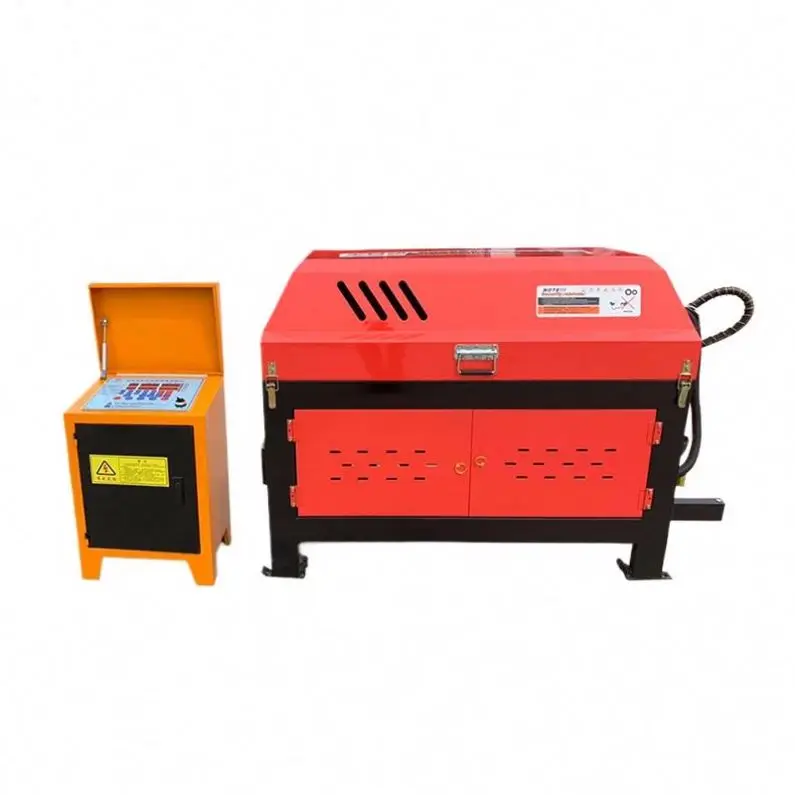
Source-controlled product identity
The Hoting queue identifies Product ID 1601247442332 as a portable hydraulic steel bar straightening machine and steel bar straightening and cutting machine. The source title mentions a 7.5KW model and customized 220V, while the structured product record lists a 380V 50HZ customized field. This conflict must be resolved in the quotation and nameplate before ordering.
The record contains four mode rows: YGT4-14(single motor), YGT4-12, YGT4-14(Dual motor) and YGT4-14(three motor). Weight, machine size, electric-box size, motor power, straightening rate and bar range are mode-dependent. This guide keeps those values mapped by position instead of presenting one mixed specification set.
The machine is relevant to rebar preparation, construction-steel processing, precast production, reinforcement fabrication, mesh and cage preparation, and job-site or workshop straightening where the selected model, incoming bar condition and local safety requirements are suitable.
The source does not provide cutting tolerance, hydraulic pressure, feed method, roller arrangement, maximum coil weight, working noise, duty cycle, certification or verified output under load. Those items are procurement and acceptance questions, not assumptions.
Mode-mapped specification table
| Field | YGT4-14 single motor | YGT4-12 | YGT4-14 Dual motor | YGT4-14 three motor |
|---|---|---|---|---|
| Mode | YGT4-14(single motor) | YGT4-12 | YGT4-14(Dual motor) | YGT4-14(three motor) |
| Weight | 240kg | 300kg | 570kg | 800kg |
| Machine size | 1300*650*950mm | 1700*650*1070mm | 1960*680*1050mm | 2820*720*1080mm |
| Electric box size | 380*320*610mm | 380*320*610mm | 360*240*820mm | 500*290*860mm |
| Motor power | 7.5kw | 9kw | 5.5+4kw | 7.5+4+4kw |
| Straightening rate | 35-50m/min | 35-50m/min | 45-65m/min | 45-65m/min |
| Round bar diameter | 6-12mm(small 12) | 6-12mm | 6-12mm | 6-14mm |
| Rebar diameter | 6-10mm(small 10) | 6-10mm | 6-10mm | 6-12mm |
The shared recorded motor speed is 2860r/min. The rated voltage field is 380V 50HZ Customized. Because the title says 220V customized, the buyer must specify the required supply in the RFQ and accept only the delivered configuration that matches the confirmed order.
Select the mode before comparing price
Do not compare the four rows as if they were one machine. The 240kg single-motor row, 300kg YGT4-12 row, 570kg dual-motor row and 800kg three-motor row have different footprints, power architecture, electrical boxes and bar ranges.
Start with the buyer's actual bar schedule. Separate round bar diameter, rebar diameter, material grade, coil or straight-bar input, incoming curvature and required finished length. The listed ranges are not a guarantee that every grade or coil condition will straighten correctly.
Use the single-motor row when the 6-12mm round-bar range and 6-10mm rebar range match the job and the 35-50m/min recorded rate fits the planned workflow. Confirm duty cycle and sample results.
Use the YGT4-12 row only after confirming what “12” means in the model and why its 9kw motor differs from the single-motor row. The source does not define the model naming convention.
Use the dual-motor or three-motor rows only after the buyer has confirmed the electrical capacity, foundation, handling route and production need. Their listed weights are 570kg and 800kg, with larger electrical and machine dimensions.
Do not choose the three-motor model solely because its rebar field reaches 6-12mm. Confirm straightening quality, feed stability, cutting integration and actual production rate using the buyer's material.
Request a mode-specific quotation. It must name one mode, one voltage, one power configuration, one dimension, one weight and one bar range.
Voltage and electrical preflight
The structured record lists 380V 50HZ Customized, while the product title mentions customized 220V. Treat this as a material electrical discrepancy.
Write the required supply on the RFQ: voltage, phase, frequency, current, grounding, incoming breaker and any transformer or control-voltage requirements. Do not let “customized” remain undefined.
Request a nameplate photograph and wiring diagram for the exact selected mode. The motor power fields range from 7.5kw to 7.5+4+4kw, so circuit sizing cannot be inferred from the title.
Confirm whether the listed power is installed motor power, rated input power or a combination of motors. For dual and three-motor rows, identify each motor's function.
Confirm the electric-box dimensions and mounting direction. The 380*320*610mm box appears on the first two rows, while the dual- and three-motor rows list 360*240*820mm and 500*290*860mm.
Ask for overload protection, emergency stop, phase protection, grounding, motor protection, control voltage and restart behavior after power loss. These safety fields are not provided.
Verify the buyer's site can receive the selected voltage. Never connect a 220V-configured machine to a 380V supply or the reverse without documented supplier approval and suitable electrical engineering.
At FAT, record no-load current, loaded current, motor rotation, emergency-stop response, insulation or grounding checks required by the buyer, and abnormal heating.
Bar range and material confirmation
The source provides separate round-bar and rebar fields. For the four rows, round bar is 6-12mm, 6-12mm, 6-12mm and 6-14mm. Rebar is 6-10mm, 6-10mm, 6-10mm and 6-12mm.
Do not merge the round-bar range with the rebar range. A machine listed for 6-14mm round bar is not automatically rated for 6-14mm rebar.
Ask the supplier to define the terms “round bar” and “rebar” for this machine. Request compatible steel grade, yield strength, surface condition, rib profile and coil or straight-bar input.
Confirm the smallest and largest diameter in the buyer's real material mix. Test at the lower limit, middle diameter and upper limit of the selected mode.
Inspect incoming bars for rust, scale, bends, welds, damaged ends and coil memory. These conditions can affect feeding and finished straightness.
Define straightness using a buyer-approved gauge, measurement span and tolerance. The source does not provide a straightness tolerance.
Record bar diameter with a calibrated gauge. Do not accept nominal supplier labels as proof when material tolerances are tight.
For ribbed rebar, verify that the rollers and feed path do not damage the ribs beyond the buyer's acceptable condition.
Ask whether the machine can handle short bars, long bars, coil pay-off or only a particular input arrangement. The source does not specify the feeding system.
Rate, capacity and test method
The listed straightening rates are 35-50m/min for the first two rows and 45-65m/min for the dual- and three-motor rows. These should be treated as recorded supplier values, not a universal output guarantee.
Ask whether the rate is no-load line speed, a maximum setting, a typical production rate or a tested rate under a stated bar condition.
Define production output separately from line speed. Output depends on bar length, cutting, coil handling, stops, operator actions, changeovers and rejected pieces.
Run a timed test with a known diameter and material. Record meters processed, accepted length, straightness results, stoppages, operator count and energy condition.
Test the machine at a conservative speed before increasing toward the listed range. Inspect whether straightness, surface condition and feeding remain acceptable.
Run first, middle and last samples after warm-up. This helps identify drift, heating, roller wear or coil changes.
Do not use a maximum-rate video as proof of production capacity. Require a signed test report tied to the selected model and material.
Confirm whether the machine includes cutting. The title and description mention a straightening and cutting machine, but the structured fields do not list cutter details, length tolerance or blade specifications.
Request cutter type, cut length range, cut tolerance, blade life, safe discharge and integrated-control behavior if cutting is required.
Machine layout and installation
Machine sizes range from 1300*650*950mm to 2820*720*1080mm. These are mode-specific values and should be used with the selected row only.
Measure the complete installation envelope, including electric box, pay-off, discharge, operator access, maintenance clearance and long-bar travel. The listed machine size alone is not a complete layout.
The heaviest listed machine is 800kg. Confirm loading equipment, floor capacity, anchor points, leveling method and delivery path before ordering.
For the 240kg and 300kg rows, confirm whether the machines are genuinely portable for the intended site or merely movable with lifting equipment.
Request a foundation or installation drawing. The source does not state anchor requirements, vibration isolation or floor flatness.
Confirm electric-box mounting, cable route and emergency-stop locations. Keep the control position accessible without entering the bar-feed danger zone.
Plan the pay-off and discharge areas so bars cannot strike workers, stored materials or building structures.
Keep a clear path for long bars and define a guarded zone around feed, straightening, cutting and discharge points.
Hydraulic and mechanical confirmation
The title calls the machine hydraulic, but the structured fields do not provide hydraulic pressure, pump flow, oil capacity, valve model or cylinder information. Ask the supplier to document the hydraulic system for the exact mode.
Request a hydraulic schematic, pressure setting, relief protection, oil grade, filtration, service intervals and leak-test method.
Identify every straightening roller, feed roller, guide, bearing and adjustment point. Ask how roller spacing and pressure are set for each diameter.
Confirm whether the single-, dual- and three-motor versions use different roller assemblies or only different drive configurations.
Inspect rollers for surface damage, alignment, runout and wear. A roller problem can be mistaken for a material or motor problem.
Ask for the safe procedure for threading a bar, removing a jam and changing a roller. Lockout and stored-energy controls must be clear.
Confirm lubrication points, grease type, bearing access, spare rollers and the expected service interval under the buyer's duty cycle.
Test emergency stop and restart behavior with the hydraulic and mechanical systems in a safe, unloaded state before a loaded test.
Straightness and finished-bar acceptance
Define the required finished-bar straightness before buying. The source contains speed and diameter fields but no straightness tolerance.
Agree the measurement length, support method, gauge, maximum deviation and sampling plan. The buyer's construction or fabrication standard should control the acceptance threshold.
Measure bars from each selected diameter and material condition. Record the machine mode, speed, roller setting and operator.
Inspect bar surface for roller marks, flattening, rib damage, scratches, cracks or excessive heat. Straightness alone is not enough if the bar surface is part of the structural requirement.
If cutting is included, measure cut length and end condition separately from straightening. A straight bar can still fail the cut-length requirement.
Use a retained sample from each FAT lot. Photograph or label the sample so later complaints can be tied to a known setup.
Ask the supplier to provide a setup chart by diameter. If no chart exists, document the buyer's approved settings during commissioning.
Maintenance, safety and operator controls
Request the complete manual, risk assessment, guarding drawing and maintenance schedule. The source record does not provide certifications or safety-device details.
Guard the feed, rollers, straightening chamber, cutter and discharge. Never reach into a moving bar path.
Use lockout procedures before removing a jam, changing rollers, servicing hydraulics or opening the electric box.
Keep operators outside the line of fire of long bars and cut pieces. Mark the danger zone on the floor.
Test emergency stops at commissioning and at the buyer's planned interval. Record whether the system stops all relevant motion.
Inspect hydraulic hoses, fittings, guards, cables, grounding, switches, rollers and fasteners before each shift.
Train operators on diameter changeover, speed selection, threading, safe discharge, jam removal and abnormal-noise response.
Keep a maintenance log with running hours, oil changes, roller inspections, blade changes and defects.
Request noise, vibration and oil-leak acceptance limits if the buyer operates near other workers or in a controlled facility.
Factory acceptance test
- Confirm Product ID 1601247442332 and the exact selected mode.
- Resolve 380V 50HZ customized versus the title's customized 220V before energizing the machine.
- Verify nameplate, wiring diagram, phase, grounding, rated current, motor power and each motor function.
- Verify mode-specific weight, machine size and electric-box size against the quotation and packing documents.
- Inspect rollers, guides, feed path, guards, cutter, hydraulic components and emergency stops.
- Thread a safe unloaded sample according to the supplier's documented procedure.
- Test the smallest, middle and largest diameter within the selected mode's recorded range.
- Test round bar and rebar separately; do not substitute one range for the other.
- Run a timed production test and record meters per minute, stoppages, operator count and accepted output.
- Measure finished straightness with the buyer's defined gauge and tolerance.
- Inspect surface condition, rib profile, roller marks, scratches, cracks and end condition.
- If cutting is included, test cut length, tolerance, blade condition, discharge and safe guarding.
- Test emergency stop, restart prevention, overload response and abnormal heating.
- Verify hydraulic pressure, oil, leaks, filters, service access and spare-part list.
- Measure loaded machine layout, access clearance, electric-box location and discharge safety zone.
- Sign acceptance only after the selected mode, voltage, bar range and test results agree with the purchase order.
RFQ checklist
- Exact model: YGT4-14 single motor, YGT4-12, YGT4-14 Dual motor or YGT4-14 three motor.
- Required electrical supply: voltage, phase, frequency, current, grounding and customized control voltage.
- Written resolution of the title's customized 220V and the structured 380V 50HZ field.
- Mode-specific weight, machine size, electric-box size, motor power and speed.
- Round-bar and rebar ranges, supported grades, rib profile and incoming material condition.
- Meaning, tolerance and test condition for 35-50m/min or 45-65m/min straightening rate.
- Meaning and test condition for 2860r/min motor speed.
- Hydraulic pressure, pump flow, oil, filtration, relief protection and leak test.
- Roller arrangement, guide drawing, adjustment method and replacement roller supply.
- Cutting function, blade details, cut length range, cut tolerance and discharge protection.
- Straightness tolerance, surface acceptance, sampling plan and retained-sample method.
- Foundation, lifting, anchoring, floor load, clearance and installation drawing.
- Guarding, emergency stop, overload protection, grounding, manual and certification.
- MOQ, sample, lead time, packaging, warranty, service response and spare-part prices.
Buyer decision framework
This source confirms a four-mode YGT4 steel bar straightening machine family with a customized voltage field, mode-specific weight and dimensions, motor power from 7.5kw to 7.5+4+4kw, motor speed 2860r/min, recorded straightening rates of 35-50m/min or 45-65m/min, and mode-specific round-bar and rebar ranges.
The most important purchasing decision is not the headline 7.5KW. It is the exact mode, electrical configuration, material range, straightness requirement, cutting requirement, installation envelope and verified sample result.
Compare suppliers using the same bar, speed, gauge, sample count and acceptance standard. Do not compare a 240kg single-motor machine with an 800kg three-motor machine as if the differences were only cosmetic.
Frequently asked questions
Which voltage is correct?
The structured record lists 380V 50HZ Customized, while the product title mentions customized 220V. Confirm the required voltage in writing and match the nameplate, wiring diagram and site supply before shipment.
What modes are available?
The source lists YGT4-14 single motor, YGT4-12, YGT4-14 Dual motor and YGT4-14 three motor. Request a mode-specific quotation and specification sheet.
What bar diameter can it process?
Round-bar and rebar ranges differ by mode. Round bar is recorded as 6-12mm for the first three rows and 6-14mm for the three-motor row; rebar is 6-10mm for the first three rows and 6-12mm for the three-motor row.
What straightening speed is listed?
The first two rows list 35-50m/min and the dual- and three-motor rows list 45-65m/min. Confirm whether these are tested production rates or maximum line speeds.
Does the machine include cutting?
The title and description mention straightening and cutting, but cutting specifications are not provided. Request cutter type, cut tolerance, blade life and discharge details.
What is the heaviest listed configuration?
The three-motor row lists 800kg and a machine size of 2820*720*1080mm. Confirm handling, foundation and clearance requirements for the selected model.
Source and contact
This guide is based on the Hoting queue record for Product ID 1601247442332. It preserves the four modes and their mapped electrical, dimensional, motor, speed and bar-range fields. Request the exact mode quotation, voltage confirmation, drawings, FAT plan, safety documents and spare-part list through the TEBAK sales inquiry channel.
Key specifications
- Source Product ID
- 1601247442332
- Mode
- YGT4-14(single motor) | YGT4-12 | YGT4-14(Dual motor) | YGT4-14(three motor)
- Rated voltage
- 380V 50HZ Customized
- Weight by mode
- 240kg | 300kg | 570kg | 800kg
- Machine size by mode
- 1300*650*950mm | 1700*650*1070mm | 1960*680*1050mm | 2820*720*1080mm
- Electric box size by mode
- 380*320*610mm | 380*320*610mm | 360*240*820mm | 500*290*860mm
- Motor power by mode
- 7.5kw | 9kw | 5.5+4kw | 7.5+4+4kw
- Straightening rate by mode
- 35-50m/min | 35-50m/min | 45-65m/min | 45-65m/min
- Motor speed
- 2860r/min
- Round bar diameter by mode
- 6-12mm(small 12) | 6-12mm | 6-12mm | 6-14mm
- Rebar diameter by mode
- 6-10mm(small 10) | 6-10mm | 6-10mm | 6-12mm