
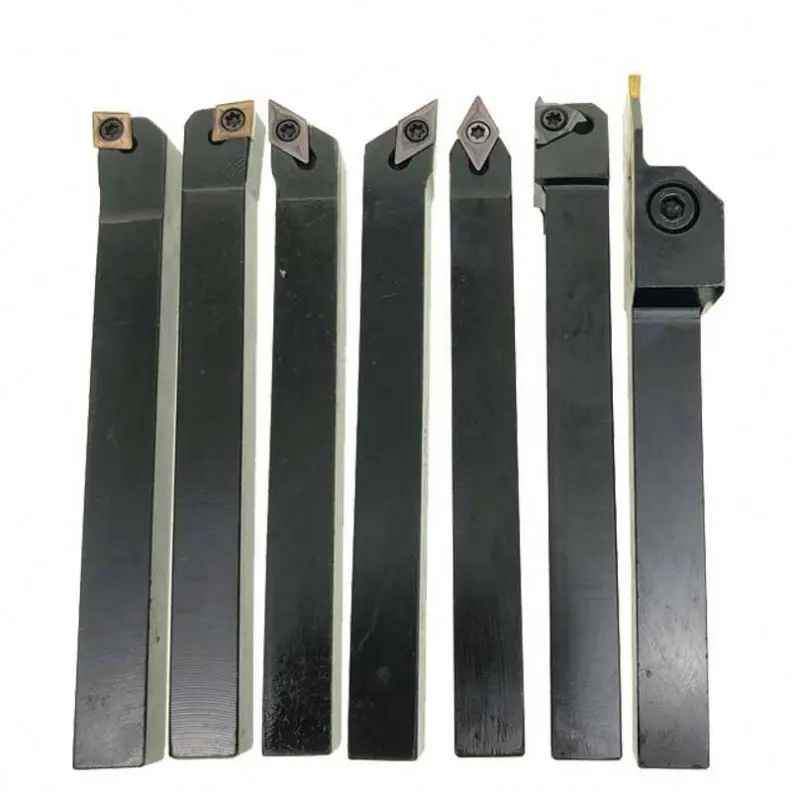
Four rows, and the colour is a picture
The parameter block has four rows and the four of them are a country, a brand, a colour and an application. None is a measurement. A tool holder is bought on its shank size, its insert seat, its clamping method, its hand, its material and its repeatability, and none of those six appears anywhere in the record's data.
The colour row is the one worth stopping at. It is labelled Color, and its value is the word Picture. A colour field exists so that a buyer can learn what colour the thing is; answering it with the word for an illustration is a deferral rather than an answer, and it is a deferral in a listing whose gallery is a set of photographs showing nine tools in the first image, eight in the second, eight in the third and eight in the fourth, across at least three different tool families. The buyer who follows the instruction to look at the picture finds more shapes, not one colour.
This is not a private quirk of one record. Twenty-seven of the five hundred and twelve records in this catalogue carry a colour row, and four of the twenty-seven answer it with a reference to the picture: three with the phrase As Picture and this one with the word Picture alone. The rest of the twenty-seven give real answers, and they give them in the ordinary way a supplier does: red, space silver, matt black, yellow painted, pink, green with yellow and red and blue and orange, or a note that the colour is made to the buyer's requirement. So the catalogue contains both habits, and this listing chose the one that tells a buyer nothing.
The only specification is a code etched into the steel
The first image is a photograph of nine tool holders laid on a wooden surface, and the last two of the nine are round bars rather than square ones. Two of the nine carry a code laser-etched along the shank, and both are legible: one reads S12M-SCLCR09, the other reads SNR0012M11. The fourth image shows eight more holders against a white background, and two of those carry codes that read S10K-SCL and SNR0010K, with the tail of each cut off by the edge of the frame or by the resolution.
These codes are the specifications a buyer needs, and they are also the specifications the record does not have. In the designation family these codes belong to, the numeral immediately after the hyphen in the square-shank series is the shank height in millimetres, so the S12M holders have a twelve millimetre shank and the S10K holders have a ten millimetre shank. In the round series the numeral after the letters is the bar diameter, so the SNR0012 bars are twelve millimetre boring bars and the SNR0010 bars are ten millimetre ones. That much follows from the codes as photographed. What the trailing digits specify, the size of the insert the seat accepts, is not something the pictures settle: the two round bars carry eleven, and whether that is an eleven millimetre inscribed circle or a code inside a series convention cannot be read off a photograph, so it is left as a question for the supplier rather than asserted here. The holders in the second and third images carry further etched codes that are not legible at the resolution delivered, so the code list for the seven shapes in the first image cannot be completed from the page.
What can be said with certainty is that the codes are the only place in the listing where a size, a series or a seat type appears, and that they are invisible to every search. Searching all five hundred and twelve records as text for SCLCR returns nothing. So does SNR00. So do CCMT, DCMT, TCMT, WNMG, CNMG, VBMT, MGMN, MGEHR, SDJCR and SER25, which are the designations of the insert families and holder series in this trade. So does the phrase boring bar. So does shank height. So does insert seat. So does screw clamp. The words right hand and left hand appear once in the whole catalogue, and the phrase tool holder nine times, and tool shank once. A buyer who searches this catalogue for the code etched on the tool they are trying to replace will find nothing, in five hundred and twelve records, because the trade's entire designation system exists on this page only inside a photograph.
That is what makes this listing harder to buy from than the ones before it, even though it is the first one in this run whose product is the kind of thing the company says it sells. A consumer buying a juicer can read a picture and know whether it is the juicer they want. A machinist buying a tool holder cannot: two holders that look identical in a photograph take different inserts, cut in different directions and fit different toolposts, and the difference is a letter.
Four tool families in one title, and the record's own field claims one
The title offers the buyer external circle turning, internal circle turning, threading and a lathe cutter, and calls the thing a tool shank. The photographs show three distinct kinds of tool: square-shank holders in the first, third and fourth images, two round-shank bars in the first and fourth images, and, in the second image, a holder carrying a narrow blade that projects forward from the shank, which is the shape of a parting or grooving tool. The etching on the round bars confirms the second family, since a twelve millimetre round bar with an insert at the end is a boring bar for internal work; the first family is external turning; and a blade holder is neither.
The record's own application row then narrows all of that to one thing: external turning inserts. So the title claims four categories, the pictures show three, and the field that exists to state the application states the narrowest one. A buyer looking for a boring bar for internal work, which the title and the photographs between them promise, has no field in which to ask for it, and a buyer who reads only the application row will not know the round bars are there at all.
The word shank is the fourth disagreement in the title. A shank is the part of a tool that goes into the holder; a holder is the body that carries the insert. The application row says external turning inserts, which makes the thing being sold a holder for inserts, while the title calls it a shank. The difference matters when the order is written, because a supplier reading shank may quote a blank bar and a supplier reading holder may quote a finished body with a seat and a clamp screw.
The company paragraph is right this time, and that is the story
The description's company section says the business is a main professional supplier in CNC carbide inserts, turning tools and milling tools, selling under the brand TEBAK. This listing sells a lathe tool holder. For the first time in this run of items, the paragraph describes the product on the page.
Measuring how rare that is turns the paragraph from a curiosity into a finding. Searching the five hundred and twelve titles for the words turning tool, carbide insert, milling tool or milling cutter returns eight records, of which this is one. So in the other five hundred and four the company paragraph describes a business other than the one the title sells, which is why the earlier items in this run found the paragraph naming cutting tools under titles selling juicers, shearing machines and ice cream makers. The paragraph is not boilerplate that happens to be wrong; it is a correct description of one particular line of business, attached to five hundred and twelve listings of which eight are in that line.
The second thing the comparison shows is that an accurate paragraph predicts nothing about the rest of the record. This listing's paragraph is right, and its specification is four rows of which none is a measurement, its colour is a picture, and its only real dimension is etched into a photograph. The catalogue's paragraph accuracy and its data quality are independent of each other, and a buyer who reads the paragraph for reassurance is reading the one field that tells them nothing about the machine.
The last image is a business card naming two other companies
The seventh gallery image is not a photograph of the product. It is a company card, one point two two megabytes of it, fifty-six per cent of the gallery's total weight, and it is used by this record alone. Read top to bottom it carries the brand TEBAK with a registered mark, then two company names, then a sales manager with a mobile number, two postal and electronic addresses and a website, then a second panel repeating the brand over a ten item product grid.
The two company names on the card are TEBAK Machinery Co.,Ltd and Hengshui Sanrenxing Trading Co.,Ltd. The description on this page names a third business, Hengshui Mengshang Trading, and the fifth gallery image is a photograph of a factory gate whose stone wall carries the same third name in gold Chinese characters, so the description and the gate photograph agree with each other and the card names two companies that neither of them mentions. The card gives a sales manager's name, a WeChat and WhatsApp number, a room number in a building in Hengshui, an email address at hssanrenxing.cn and a website at cntebak.com.
None of it can be found by search. The catalogue's text contains no occurrence of the card's website, no occurrence of its email domain, no occurrence of the phrase TEBAK Machinery, no occurrence of the sales manager's name, and two occurrences of the other company's name in records other than this one. So on this page there are three company names, of which the searchable text carries one; and a buyer who writes to the address on the card writes to an inbox that is not the one this project's other websites publish, which is worth a check by whoever manages those mailboxes, since a card that circulates with an unmonitored address loses orders silently.
The lower half of the card is the part a buyer of cutting tools should read closely. It brands TEBAK as a PTFE and technopolymers manufacturer, and the phrase is legible: PTFE&TECHNOPOLYMERS MANUFACTURING. Beneath it sits a grid of ten captioned products, and the captions name a CNC slideway sheet in the Turcite B material family, a CNC metal bubble level, a QKG 73 three inch machine vise, a CNC self centering vise, a two and three quarter inch boring head, a magnetic absorber rod, an automatic screw puller feeder, a grooving cut off cutter holder, a BT ER knife shank handle and a dial lever indicator magnetic stand base. So the brand's own card places this listing's product family, the grooving cut off cutter holder and the knife shank handle, alongside platen material for machine tools, a bubble level, two vises, a boring head and a dial indicator stand, and describes the business as a manufacturer of polytetrafluoroethylene and technical polymers.
That description appears in one image in one record. Searching the catalogue for the word Turcite returns nothing, for technopolymer nothing, and for PTFE and slideway two records each, neither of them this one, which are two listings about slideway material rather than about cutting tools. So the statement that the brand is a polymer manufacturer exists on this page inside a picture, is invisible to search, and is not repeated anywhere in the text of five hundred and twelve records.
Two further images are furniture rather than product. The fifth is the factory gate, a hundred and forty eight thousand six hundred and thirty seven bytes used by seventy seven records. The sixth is a panel of six questions and answers, four hundred and five thousand one hundred and eighty six bytes used by ten records, which supplies the commercial terms the description does not: a quotation within twenty four hours, samples on request, a design service, a payment schedule of thirty per cent deposit with seventy per cent before shipping by telegraphic transfer, PayPal or Western Union, a lead time of about fifteen working days depending on quantity, and delivery terms of EXW, FOB or CIF at the buyer's choice. None of those terms appears in the record's text, and the description carries no packing section of either of the two kinds this catalogue uses.
What the description field contains
The description is eight hundred characters. It opens with the heading product description, restates the record's own title, then prints a heading reading Specification and reproduces the four parameter rows label by label and value by value, then prints a heading reading Company Profile and gives the company paragraph, which takes five hundred and forty five characters, sixty eight per cent of the field. Then it stops.
It stops inside a word. The last characters are The quality control standar, and the word being written was standards. That is the catalogue's fixed window closing on the field rather than the writer finishing it, and the measurement shows how general it is: four hundred and seventy of the five hundred and twelve descriptions end with a letter rather than a full stop, a question mark or an exclamation mark, and only fourteen end with one of those three. In other words, ninety two per cent of the descriptions in this catalogue are cut off mid word or mid sentence, and this record is one of them. Reading a description to the end therefore tells a buyer nothing about where the supplier stopped writing and everything about where the field limit fell.
The heading reading Specification appears in sixty two records, so it is a template's label rather than a description of this listing, and the interesting thing about it here is what it introduces: four rows, of which the third is a restatement of the record's title in the form of the word Specification, and of which the fourth is the word Picture. A field that announces itself as the specification and then supplies a country, a brand, a picture and an application has told the reader where the specification would be if there were one.
What the listing does not state
The shank size in millimetres, in any field, although the codes etched on the tools imply at least two sizes and a third in the round series. The insert designation the seat accepts, and therefore the insert family, its shape, its clearance angle and its size. The hand of the tool, whether it cuts to the right or to the left. The clamping method, whether a top clamp and pin, a screw, or a lever. The shank length and the overhang available. The seat's position and the tool's lead angle. The shank material and its hardness, and any coating on the body. The screw and key sizes, which are what a buyer loses first. Whether the holder is sold with an insert, a key, a spare screw or a torque figure. Whether the round bars are sold as boring bars with a stated minimum bore diameter, which decides whether the tool fits the hole at all. The tolerance and repeatability of the seat. The number of pieces in the set, since the photographs show nine, eight, eight and eight tools across four images without saying which of them is being sold or at what quantity. Whether the nine shapes in the first image can be bought singly. Any material or hardness certificate, any coating certificate, and any statement of which standard the insert seat follows. The packing, which the description never mentions. And the price.
Incoming inspection on arrival
- Read the etched code on every holder before anything else and write it down, because the code is the identity of the tool and the page does not repeat it.
- Measure the shank in both directions and compare against the numerals in the code, which state the shank height in millimetres for the square series and the bar diameter for the round series.
- Check the hand: offer the tool to the work in the same direction the machine will turn, and confirm it cuts rather than rubs, since a left hand holder in a right hand operation fails on the first pass.
- Identify the insert the seat takes by comparing the seat's shape and the clamp screw position against the insert designation, and record it for the reorder, because a mismatch here is the most expensive kind of mistake in this trade.
- For the round bars, establish the minimum bore the bar will enter, and confirm it is smaller than the bore to be machined.
- Count the pieces actually delivered against the order, since the gallery photographs show up to nine tools at once and no quantity is stated anywhere in the record.
- Confirm which company is the seller on the invoice and the contract, because this page names three: the description and the gate photograph say Hengshui Mengshang Trading, and the card names TEBAK Machinery and Hengshui Sanrenxing Trading.
- Keep a photograph of each holder's code with the delivery note, so that a later reorder can be placed by code rather than by picture.
- Check the packing the goods actually arrived in, because the listing's own packing material section is empty and its commercial terms live in an image.
Questions buyers ask about this class of listing
What does S12M-SCLCR09 mean?
The two numerals after the hyphen state the shank height in millimetres, so this is a holder with a twelve millimetre shank, and the letters before and after the hyphen identify the insert shape, the clamping method, the holder style and the hand of the cut. The trailing two digits identify the insert size within that series. Only the shank height can be read off the photograph with confidence; ask the supplier to confirm the rest of the code in writing and to name the insert the seat takes.
Is it a square shank holder or a boring bar?
Both are in the gallery. The first image shows seven square-shank holders and two round bars, and the round bars carry codes beginning SNR followed by their diameter in millimetres, which is the boring bar family. Which of the two the price covers is not stated anywhere in the record.
Can one holder do external turning, internal turning and threading?
No single holder does all three. External turning needs a holder whose seat presents the insert to the outside of the work, internal turning needs a bar that enters a bore, and threading needs a seat ground for a threading insert. The title offers all three, the photographs show three kinds of tool, and the application row states external turning inserts only, so ask which of the three the quotation is for and ask for it by code.
What colour is it?
The colour row says Picture, and the pictures show black bodies with inserts in grey, in a copper tone and in gold, because the insert's colour is its coating and not a choice. Every holder in the gallery is a black oxide body. If the colour matters for a workshop's tool board, ask for a colour and expect the answer to be the black the photographs show.
Which company am I buying from?
Three appear on the page: Hengshui Mengshang Trading in the description and on the factory gate photograph, and TEBAK Machinery and Hengshui Sanrenxing Trading on the card in the last image. Ask for the selling entity to be named on the invoice and the contract, and check the bank details against the entity that invoices, not against the brand on the tool.
Is the seller a polymer manufacturer?
The last image says the brand is a PTFE and technopolymers manufacturer, and the same panel shows a slideway sheet in the Turcite B material family next to the cutting tool holders. Nothing in the record's own text mentions polymers. If the machine the holder is going on uses polymer slideway material, the same supplier may be able to quote both, but the listing itself sells a cutting tool and says nothing about polymers.
Why does the description end in the middle of a word?
Because the field is cut at a fixed length. Four hundred and seventy of the five hundred and twelve descriptions in this catalogue end mid word or mid sentence for the same reason. Treat the last line of any description here as an artefact of the field limit rather than as a statement the supplier chose to end.
What the first photograph actually shows, and what each shape is for
The first image is the most informative thing on the page, and it can be read without any code at all. It shows seven square-shank holders and two round bars, laid side by side, and the inserts mounted at their tips fall into recognisable shapes.
| What is visible | The family it belongs to | What it is for |
|---|---|---|
| Square-shank holders with a triangular insert | External turning or facing, depending on the lead angle | Turning the outside of a shaft or facing a shoulder |
| Square-shank holders with a rhombic insert, seated at an angle | External turning with a lead angle, or profiling | Turning and copying along a shoulder |
| A square-shank holder with a small square insert set into the corner | Facing or chamfering | Squaring the end of the work |
| Two round bars with the insert at the end of the bar | Boring, internal turning | Opening and finishing a bore |
| A holder in the second image with a narrow blade projecting forward | Parting off or grooving | Cutting a bar off or cutting a groove |
Two things follow from reading the picture this way. The first is that the nine tools in the first image are not nine variants of one thing; they are tools for at least four different operations, which is why a single holder cannot satisfy the title's four claims. The second is that the inserts differ in shape, so the seats differ, so the inserts are not interchangeable between the holders, and a buyer who orders from the picture without a code may receive a holder whose seat takes an insert they do not stock.
The picture also shows the inserts in different colours, from grey through a copper tone to gold, and that colour is a coating rather than a paint: the coating is the reason one insert lasts longer in steel than another, and it is the single most consequential thing about an insert that a photograph can show. None of it is named in the record.
Writing the order so that the right holder arrives
A tool holder order that cannot go wrong carries twelve fields, and this listing supplies one of them, the brand, and that one is not the operative one.
- The holder code in full, read off the tool or off the supplier's catalogue, with every letter and digit, because a single letter separates a right hand holder from a left hand one.
- The shank size in millimetres, both height and width, to match the toolpost.
- The hand of the cut, right or left or neutral.
- The insert designation the seat accepts, including the shape, the clearance angle, the tolerance class and the corner radius.
- The clamping method and the screw or key size, plus at least two spare screws.
- Whether the round bars are boring bars and, if so, the minimum bore they will enter and their overhang.
- The shank length and the maximum overhang the buyer intends to use.
- The insert's coating and grade for the material to be cut, since steel, stainless, copper and aluminium do not take the same grade, and the record's own fourth image names steel parts, stainless steel, copper and aluminium as the four materials.
- The quantity of each code, itemised, not a total, because the gallery shows up to nine tools without stating which are for sale.
- The insert quantity, whether inserts are included at all, and the price of a replacement insert.
- The packing and the delivery term, both of which the description omits and which the sixth image supplies only in general terms.
- The selling entity, to be named identically on the quotation, the invoice and the bank transfer, because this page carries three company names.
The fourth field is the one to spend time on. In this trade the insert designation is a compact code in which each position means something specific, and a holder is only useful with an insert that matches its seat. A quotation that names a holder but not the insert it takes is not yet a quotation, and this listing names neither.
Scope, sources and method
Every figure attributed to the tool comes from the product record for ID 1601255861657 in the catalogue file and from the eight images listed in that record, one main image and seven gallery images. The four parameter rows are quoted as printed, including the colour value reading Picture and the application value reading External Turning Inserts. The two codes quoted from the first image, S12M-SCLCR09 and SNR0012M11, and the two partial codes from the fourth image, S10K-SCL and SNR0010K, are transcribed from the etched lettering visible in those photographs; the tail of the two partial codes falls outside the frame or below the delivered resolution and is not guessed.
The reading of the code convention is stated with its limits. That the numeral after the hyphen in the square shank series is the shank height in millimetres, and that the numeral after the letters in the round series is the bar diameter in millimetres, is a reading of the codes as photographed and is presented as such. What the trailing digits specify, and the meaning of the leading and middle letters, is not asserted, because the record contains no second example of any code and the photographs cannot settle it.
The counts are searches of the five hundred and twelve records taken as text, case insensitively, with the search term stated beside each figure. The colour row census counted every parameter row whose label is colour or color in any spelling and tabulated its value. The truncation measurement counted descriptions whose final character is a letter as ending mid word or mid sentence and those whose final character is a full stop, question mark or exclamation mark as ending at a sentence end.
The gallery measurements are byte sizes read from the image files themselves and reuse counts computed by searching every record's main image and gallery list for the identical URL. The card, the gate and the question panel are reported with the counts measured in this catalogue and the byte sizes read from the files.
No machine was unboxed, assembled, mounted or run. No tool was tested in a cut, no insert was fitted, no torque was applied, no hardness or coating measurement was made, and no dimensional inspection was performed, because none of those can be done from a photograph. No supplier was contacted and no quotation was obtained. Nothing here is a substitute for the insert designation, which the record does not contain, or for the seller's identity, which the page gives three times in three different ways.
Key specifications
- Place of Origin
- China
- Brand Name
- TEBAK
- Color
- Picture
- Application
- External Turning Inserts