
A specification table that answers four questions with one sentence
The fourth of the eight images is headed Product information, and it is laid out as a specification sheet with six labelled rows. Two of the six carry a name: Product Name, which reads Body machine wool Electric Pusher, and Product brand, which reads TEBAK. The other four carry the names of quantities a buyer of this class of machine actually needs, and every one of the four is answered with the same five words.
| Row on the panel | Value printed |
|---|---|
| Rated voltage | Consulting customer service |
| Input power | Consulting customer service |
| Rated speed | Consulting customer service |
| Shear capacity | Consulting customer service |
This is a different thing from a listing that has no specification. A listing with no specification has not thought about the question. This panel has thought about the question four times, in the right order, using the standard vocabulary of the category, and then declined to answer each one. The phrase is a literal rendering of the Mandarin instruction to ask customer service, and as English it is not a value, not a range, and not a decision made elsewhere on the page.
One consequence is practical. Because the deferral lives in a picture rather than in a field, it cannot be searched and it cannot be compared. A search of all five hundred and twelve records for the phrase consulting customer service returns nothing at all, because the phrase exists only inside image files. The nearest thing in the data is a single record that words the same idea differently, and nineteen records that say please contact, and thirty-five that say customized or on request. The catalogue does have a small vocabulary for deferring to a human, and this listing's four deferrals sit outside it, in pixels.
What the catalogue's other listings do instead
The four withheld rows are not exotic. Two hundred and twenty volts appears in eighty-five records, one hundred and ten volts in forty, fifty hertz in twenty-three and sixty hertz in thirty-two. The word voltage itself appears in eighty-two. A wattage in watts appears in seventy-nine and a rating in kilowatts in forty. So a machine in this catalogue that runs from a wall socket is normally described with the two numbers that decide whether it will run in the buyer's country, and this catalogue states them hundreds of times.
The parity is worse than that, because the row labels here are not shared either. Rated voltage appears in nine other records, so it is a label the sender uses elsewhere, and Input power appears in two. The other two labels, rated speed and shear capacity, appear in no other record in the catalogue at all. They are this listing's own words, chosen for this panel, and they are still unanswered.
Four names for one machine
The listing never settles on what the object is called. The title calls it, in one breath, a Farm Agricultural Electric Wool Horse Hair Clipper, a Sharpening Machine and a Shearing Machine. The Model row calls it an Electric Wool Hair Clipper. The Product Name row inside the specification panel calls it Body machine wool Electric Pusher. The slug keeps the first of these.
The word Pusher is worth a sentence, because it explains why nobody would ever find this page by looking for it. Pushing is the colloquial Mandarin verb for using hair clippers, and the English word for the tool has been built out of the verb rather than out of the trade. Searching the entire catalogue of five hundred and twelve records for Pusher returns zero. The word clipper returns two records and the word shearer two, in a catalogue that devotes an eight photo grid to shearing animals. A buyer who wants a sheep shearing machine has almost no vocabulary overlap with the words this listing chose.
Electric and hand-driven at the same time
The title contains both Electric and Handdriven. Those are not two variants offered side by side; they are one string of search terms placed in the same product name. They cannot both describe the machine in the photographs, and neither of them does.
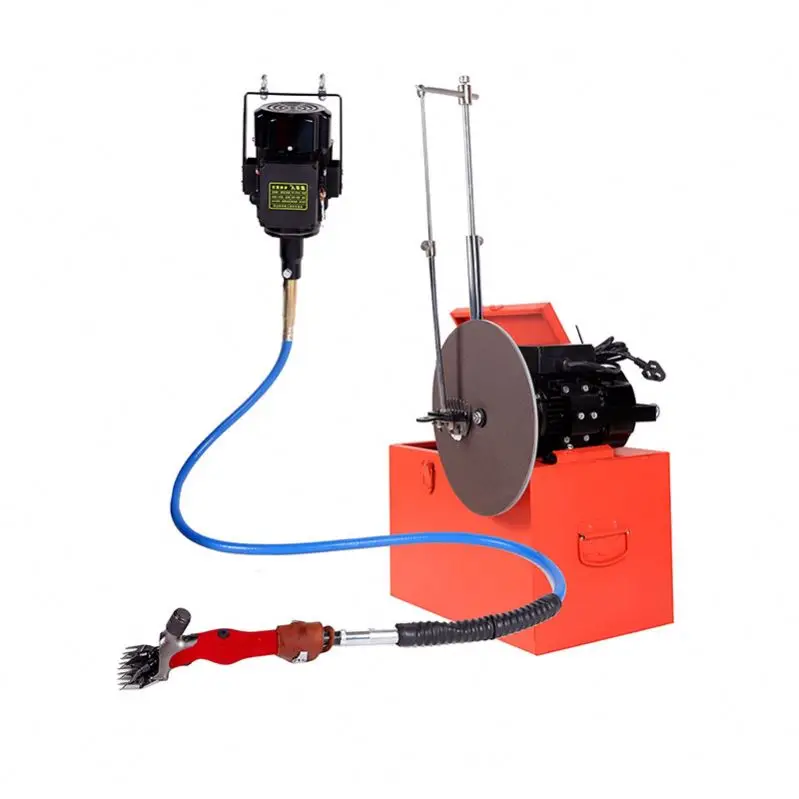
What the photographs show is a third thing: a stationary motor that sits on the ground with a yellow lifting eye and a capacitor housing, a flexible shaft some metres long, and a handpiece with a comb and a red grip that the operator holds. The motor is electric. The handpiece has no motor in it, so the machine is not a hand tool. The operator's hand drives nothing; the shaft does the driving. The category term is a flexible-shaft shearing machine, and the catalogue uses that phrase exactly once, in a different record.
The listing argues against its own title, too. The second image is a comparison panel headed Still shearing the wool the old way, with two photographs side by side. The left one is captioned Hand-Shearing Wool and the comment beneath it reads Low efficiency, effort, uneven quality level. The right one is captioned Electric shearing of wool and is described as High efficiency, effortless, neat and undamaged quality. So the listing's own marketing page dismisses hand shearing as inefficient and uneven, while the title offers Handdriven as though it were a feature.
The capacitor that turns a nicety into a requirement
On the motor housing in the first image there is a rectangular bulge with a lid on it, which is the capacitor compartment of a capacitor-run single-phase alternating current motor. That is a reading of the photograph and not a measurement, and it is offered as a reading. It matters because a capacitor-run motor cannot run from a battery and cannot run from a universal supply: it is built for one nominal voltage and one frequency, and it will be damaged or will simply not turn at the wrong one.
So Rated voltage is not a specification a buyer could reasonably decide later. For this machine it decides whether the unit can be plugged into the destination country's supply at all, whether a step-down transformer has to be bought, whether the plug has to be changed, and whether the motor's rated speed and therefore the cutting behaviour of the blade will be what the buyer expected. It is the single row on that panel on which the purchase depends, and it is the row that reads Consulting customer service.
Note also that a capacitor appearing on the motor does not make the machine certified. The catalogue contains no record whose text mentions a capacitor, three that mention single phase, and none at all that says electric motor.
The sharpening assembly that appears once
The title promises a Sharpening Machine. The sixth image, headed Product display, shows two assemblies. The lower one is the machine the rest of the gallery shows: a black motor on a bench, a green flexible shaft, and the red handpiece, laid out beside an accessory set that includes two open-ended spanners, a hooked spanner, an L-shaped key, a cylindrical sleeve, a small bottle, a fibre spool, a red-handled tool and the black ribbed hose sleeve.
The upper assembly is different, and it is the only place in the whole listing where anything to do with sharpening appears. It shows a motor mounted on a bracket with a blue shaft running down to a handpiece, and separately a large flat disc carried between two posts on a stand, sitting above an orange case with a handle on it. A large flat disc between two posts above a case is a grinding wheel on its own stand, which is what a blade sharpener looks like.
That assembly is not in the parameter block, which has three rows and mentions none of it. It is not in the Product information panel, which lists voltage, power, speed and shear capacity and no accessory. It is not in the accessory photograph in the same image as itself. And it is not in any shipment list, because the record has no shipment list. So a buyer who reads the title and orders a clipper sharpening machine has no way to know from this record whether the disc, the stand and the orange case are part of the order, whether they are a separate item, or whether they were left in the picture by mistake. Between the title saying Sharpening Machine and the page showing a sharpener exactly once, the only honest reading is that the question is open.
A family of four with twelve rows and no digit
The catalogue contains four listings for wool and animal-hair shearing: this one and three others. Their parameter blocks are, in order, two rows, three rows, seven rows and none at all, which is twelve rows in total across the family. Not one of the twelve contains a digit.
The seven-row one is the most instructive. Its rows are labelled Product name, Color, Type, Keywords, Function, Use and Feature, and they read Sheep Shearing Machine, Red, Sheep Clipper, Sheep Wool Shearing Machine, Sheep Trimmer, Goat Hair Cutting Machine, Wool Shearing Machine and Wool Shearing Machine. Six of the seven rows are the same product described six ways, and the seventh records that the machine is red. A seven-row parameter block therefore carries less information than a single row reading rated voltage with a number beside it.
The four listings also share photographs: two of them share two images, and the other pairs share one each. So they are recognised as one family by the gallery as well as by the vocabulary, and none of the four publishes a voltage, a wattage, a speed or a capacity. The family has twelve chances to state one measurement and takes none of them.
Two corrections to the previous two items
Two description facts were published against the wrong listings in the two preceding items of this series, and they were swapped with each other. Both are corrected here.
The first correction concerns the circular magnetic chuck, the item before last. That article said the description carried an empty heading reading PACKING SHIPPING with nothing beneath it. Reading the record again, that description contains no such heading. It is headed Packing & Delivery, and it has content: machine packing inside is plastic films and outside is fumigation wooden case; the case is described as strong enough to bear long shipping on the sea; a preservative film is said to keep salt sea water out of the machine; and a three-tier delivery suggestion follows, over one cubic metre or one hundred kilograms by sea, below that by air, and below half a cubic metre or fifty kilograms by express. The packing section of that listing is therefore not empty at all. It is one of only nine records in the whole catalogue that describe the packing materials.
The second correction concerns the cordless washer, the item immediately before this one. That article attributed to it the statement that the website price is the machine's EXW price, and the three-tier delivery rule, and it analysed the wording of that rule. That sentence and that rule are not in the cordless washer's record. They are in the magnetic chuck's record, verified verbatim above. The cordless washer's description contains no EXW, no cubic metre figure and no packing material; its description does carry the bare heading, and that is the fact which belongs to it.
So the errors ran in opposite directions and both are worth naming. The chuck item understated its listing, describing a section that carries real commercial terms as an empty heading. The washer item overstated its listing, crediting it with a trade-terms paragraph that the record does not contain. Neither error changes a measurement, and both change what a buyer would conclude about what these two pages tell them.
The corrected counts are these. The exact phrase EXW price appears in one record out of five hundred and twelve, and that record is the magnetic chuck. The packing-materials sentence appears in nine, and the three-tier delivery rule in three, being that same chuck and two others. Under a search that accepts any of the three common spellings, seventy-three records carry a packing-and-shipping heading, and in sixty-five of them the heading is followed by nothing but the supplier's standard company paragraph; under the narrower test published in the previous item, which counts only headings followed by the word Company, the figure is forty-nine. This item is a member of that class, and so is the item before it, so the two most recent items are consecutive members of a set that comprises one record in seven.
What the listing does not state
Rated voltage and its frequency; input power; rated speed; shear capacity, the four quantities its own panel names. In addition: the motor's type beyond the capacitor that is visible; the length of the flexible shaft and the diameter of its core; the handpiece's mass, which decides whether one person can hold it through a full fleece; the blade's cutting width, tooth pitch, material and hardness; the comb's pitch and whether spares are supplied; the duty cycle, since a capacitor-run motor on continuous load is a different proposition from one on intermittent load; the noise level; the scope of supply, in particular whether the sharpening disc, its stand and the orange case are included; the country-specific voltage and plug; net and gross weight and the packing dimensions; any certification or test report; and the warranty.
The record states none of these, and its structured data contains three rows, none of which is a measurement. The single piece of quantitative information anywhere in the listing, in text or in image, is the existence of a capacitor, which is not a quantity.
What to establish before ordering
- The supply the motor is wound for, in volts and hertz, and whether it matches the destination supply without a transformer.
- The input power and the rated speed, so that the cutting behaviour can be compared with the alternative machines in this family.
- Shear capacity in animals per hour or in fleeces per hour, stated as a measurement rather than as a claim.
- Whether the sharpening assembly in the sixth image is part of the order, a separate purchase, or a photographic accident.
- The full scope of supply as a list, including spares, the spanners visible in the accessory photograph, and whether blades and combs are consumables that can be reordered.
- The handpiece mass and the shaft length, because a heavy handpiece through a long fleece is the most common complaint in this category.
- Packing materials, pack dimensions, net and gross mass, and the port of departure, so that freight can be quoted rather than guessed.
- The warranty period and which entity honours it, together with a photograph of the motor nameplate on the unit actually shipped.
What the description field contains
The description is seven hundred and ninety-nine characters, which is the second of the two lengths this catalogue's fixed window produces; four hundred and ten records stop at eight hundred and sixty-one at seven hundred and ninety-nine, and none is longer. Its structure is a heading reading Products Description, then the title repeated in full, then the three parameter rows restated label by label and value by value, then the packing-and-shipping heading with nothing under it, then the supplier's standard company paragraph, and then the window closes.
The closing words are Middle east, East Asia and. The same company paragraph appears in the previous item, and there the window closed inside the supplier's own company name, four characters before the word Limited. So two consecutive listings run the same boilerplate and the fixed window cuts it in two different places, neither of which is the end of a sentence. In this record the company paragraph is the only content in the field that was not copied from somewhere else on the same page, and it takes five hundred and twenty-four of the seven hundred and ninety-nine characters, so two thirds of the description field is supplier boilerplate and the product content is the other third.
It is also a paragraph about a different business. It lists the products as Product Machine, CNC Carbide inserts, Turning tools and Milling tools. This listing sells a shearing machine. The catalogue has four records that mention wool, two that mention a clipper, and three hundred and seventy-seven that carry this cutting-tool paragraph, so the paragraph is written once and applied to three quarters of the catalogue regardless of what is being sold.
What the animal grid claims, and what the listing's own data says
Two images are given over to the animals the machine is for. The first shows three sheep, captioned Sheep, Tibetan sheep and Lake sheep. The second shows a cashmere goat, a Small Tail Han Sheep, a Tan Sheep, a dog, a Highland cow and a horse, captioned Cashmere goat, Small Tail Han Sheep, Tan Sheep, Dog Shearing, Cattle Shearing and Horse Shearing.
The Model row says Electric Wool Hair Clipper. The title says the machine is for a horse's hair. So the structured data covers wool and horse hair, while the pictures claim cattle and dogs as well. Searching the catalogue for the words that appear on those captions, cashmere and tibetan return nothing at all and Pusher returns nothing at all, so the captions are as invisible to search as the specification table is.
Two of the photographs are also worth a buyer's caution. The animal shown under Cattle Shearing is a Highland cow, a breed that is not normally machine-sheared, and the one under Dog Shearing is a long-coated sheepdog. They are stock photographs illustrating a claim, and they are not evidence that the machine is used on cattle or on dogs. Whether a blade designed for sheep wool will cut cattle hair or dog coat is a question about tooth pitch and speed, and it is one of the four questions the specification panel declines to answer.
Incoming inspection on arrival
- Photograph the motor nameplate before connecting anything, and compare the volts and hertz on it with the supply, and with what the seller stated in writing.
- Confirm the number of blades, combs and the accessory items against the written scope of supply, and check that the shafts of the spanners in the accessory photograph match the fasteners actually used.
- Inspect the flexible shaft along its whole length for kinks and for a loose end fitting, and turn it by hand through a full rotation before running the motor.
- Record the mass of the handpiece on a scale, and run the machine under load for the length of a real job rather than for a few seconds, checking the motor housing temperature by hand at intervals.
- Check the cut on a test fleece for comb marks and second cuts, and adjust the blade tightness using the knurled adjuster, which the fifth image shows as the recommended adjustment.
- If a sharpening assembly is claimed as included, verify that the disc, its stand and the case are in the crate, and check the disc for true running before using it on a blade.
Questions buyers ask about this class of listing
Is a specification table that says Consulting customer service the same as no specification table?
Not quite, and the difference is useful. The panel tells you which four quantities the sender considers to define the machine, so it tells you what to ask. What it does not do is let you compare. A buyer holding four named but unanswered rows cannot decide between this machine and another, and cannot check on arrival whether what arrived matches what was sold.
Could the voltage be the same for every unit shipped?
Unknown, and it matters. A capacitor-run motor is wound for one nominal voltage and one frequency. If the seller holds several windings, the answer depends on the destination and the buyer must say which. If the seller holds one winding, then the row is withheld for a different reason. Either way it is a question to settle in writing before payment, not on arrival.
Is Handdriven a real variant?
The word appears once, in the title. Nothing else in the listing supports it, and the images show a motor. The listing's own comparison panel calls hand shearing inefficient and uneven. The most economical reading is that the word was added as a search term.
Is the sharpening machine included?
Nothing in this record answers it. The disc, its stand and the case appear in one photograph, in an assembly different from the one the rest of the gallery shows, and the scope of supply is not stated anywhere. Ask for the packed list in writing.
Does the four-listing family mean the machines are the same?
They share photographs and vocabulary, and their parameter blocks run from zero rows to seven. They are not described as one machine, and the row counts show that they were not written as one product either. Treat them as four listings to compare on the eight questions above, not as four configurations of one machine.
What does the company paragraph actually tell me?
That the seller applies one company paragraph across most of its catalogue, including machines that are not cutting tools. It does not tell you who manufactured this machine. Ask for the manufacturer name, the factory address and the nameplate photograph.
Scope, sources and method
Every figure below comes from the product record for ID 1601277035095 in the catalogue file and from the eight gallery images and the main image listed in that record. The specification panel values are quoted as printed, including the four deferred rows. The reading of the rectangular compartment on the motor housing as a capacitor is a reading of a photograph and is labelled as one wherever it appears; it is not a measurement and not a manufacturer's statement.
The catalogue-level counts were produced by searching all five hundred and twelve records as text, case-insensitively from this item onwards, with the search terms stated beside each figure so that the counts can be reproduced. Where a count depends on a rule rather than on a phrase, the rule is stated, which is why the packing-and-shipping figures are given as seventy-three and sixty-five with the narrower forty-nine shown alongside as the figure published previously. A search for a unit can return a word rather than a unit, and the only defence is to read the results back; a count taken from a truncated listing is no count at all.
No measurement in this article was taken by opening, weighing, measuring, powering or running the machine. No freight quotation was sought. The four withheld quantities are not estimated here, not inferred from comparable machines, and not replaced with typical values. This article is not food-safety, animal-welfare, electrical-safety or procurement advice, and it makes no claim about the legality of shearing any particular species in any particular jurisdiction.
What a flexible-shaft shearing machine is normally specified by
The class this machine belongs to is a stationary motor driving a handpiece through a flexible shaft, and the class has a settled way of being described. A buyer comparing two of them normally works from eight figures. Four of those eight are the four rows this listing's panel names and leaves blank, and the other four appear nowhere in the record either, so the buyer has to ask for eight things and not four.
- The mass of the motor unit and the mass of the handpiece, separately. The handpiece is what one person holds while bent over an animal, so its mass decides how long a shift can run, and a total shipping mass tells the buyer nothing about it.
- The length of the flexible shaft and the diameter of its core. Length decides how far the motor can stand from the animal and therefore how much cable and how many people are needed; core diameter decides how much torque reaches the cutter before the shaft starts winding up.
- The supply the motor is wound for, in volts and hertz, together with the input power. These are the two rows on this listing's panel that a buyer cannot postpone, because a capacitor-run motor is not tolerant of the wrong supply.
- The speed at no load and the speed under load, which is the row the panel calls rated speed. The difference between the two is what tells a buyer whether the machine will keep cutting through dirty or matted wool or will stall and leave second cuts.
- The cutting width, which is the width of the blade in millimetres. It sets the number of passes needed over one animal and therefore the labour cost per fleece.
- The comb pitch or tooth pitch, because a comb suited to fine wool is not the comb suited to a coarse coat, and this listing claims both wool and horse hair in the same sentence.
- The duty cycle, meaning how long the motor may run and how long it must rest. A capacitor-run motor on continuous load ages differently from one used intermittently, and the panel's silence on this is one of the four deferrals.
- The full scope of supply with spares named, including blades and combs as separately reorderable consumables, and a statement of whether the sharpening assembly is inside the crate.
None of the eight is a matter of preference. Each one maps to a job, a shift length or a cost, and each one can be stated as a number by any sender who has the machine on a bench. That is what makes the panel in the fourth image interesting: the sender demonstrably knows which quantities matter, because the panel is built from four of them.
Telling the four listings in this family apart
The catalogue holds four wool and animal-hair shearing listings, and they do not reference one another. Their titles approach the same machine from four directions. One calls itself a Horse Wool Trimmer and a Goat Wool Shearer and repeats the word Shearing twice in a row. The one with the most structured data calls itself a Flexible Shaft Sheep Horse Hair Cutting Machine and says Hanging Type. One carries no parameter rows at all. This one offers a Clipper, a Sharpening Machine and a Shearing Machine in a single line and files the machine under Electric and Handdriven at once.
Two details are worth connecting. The listing whose title says Hanging Type is the one with seven parameter rows, and the assembly in this listing's sixth image is precisely a motor hanging from a bracket with a shaft running down to a handpiece, so the description exists in the family and this listing simply does not use it. And the occurrence of Shearing twice in one title is the same habit as Electric and Handdriven here: the same word is repeated where a second, different word would have carried information.
Because the four pages share photographs and vocabulary but not data, a buyer who is choosing between them has to build the comparison manually. The eight items listed above are the rows to build it from, and the only one of the four that answers even part of them is the one with seven rows, which answers none of them and lists the colour instead.
Turning four deferrals into four questions with consequences
A deferred row is not a dead end, but it has to be converted into a question that has an answer the buyer can act on. For each of the four rows this listing names, there is a version of the question that a seller cannot answer vaguely.
| Deferred row | What to ask instead | What the answer decides |
|---|---|---|
| Rated voltage | The nameplate photograph of the exact unit to be shipped, showing volts and hertz, plus a written statement that the unit matches the destination supply without a transformer | Whether the machine can be plugged in at all, and whether the price needs a transformer added to it |
| Input power | The watts on that same nameplate, and the current drawn at the stated supply | Whether an existing circuit and extension lead are adequate, and whether the motor is the same class as the alternatives |
| Rated speed | The speed under load as well as at no load, in strokes or revolutions per minute, measured rather than quoted from a brochure | Whether the machine will hold speed through a matted fleece or stall and leave second cuts |
| Shear capacity | The number of animals or fleeces per hour with the sheep described, for example a stated body mass and wool length | The number of machines needed for a season's shearing, which is the cost the buyer is actually comparing |
Two habits make these answers easier to rely on. The first is to ask for all four in one written message with numbered questions, so that the reply can be checked item by item rather than assembled from a chat thread. The second is to make the answer part of the order: a line in the confirmation stating the four values, with the right to reject the shipment if the nameplate on arrival disagrees. A specification that a seller will not put in writing is not a specification, and a listing whose own panel names four quantities and declines all four is exactly the case where the written answer is worth asking for.
It is also worth saying what the deferral does not mean. It does not prove the machine is badly made, and it does not prove the seller cannot supply the figures. It means the figures are not on the page, which is a different problem with a different remedy: the remedy is a message, not a different supplier.
Appendix: where the nine images come from, and what the two packing headings contain
The gallery holds nine files, one main image and eight gallery images, and they are not all this machine's. Seven of the nine appear in no other record in the catalogue. The eighth, which is the payment and courier panel headed SHIPPING SERVICE carrying the logos of seven express carriers and seven payment marks, appears in one hundred and nineteen records. The ninth, which is the photograph of the works gate with the supplier's name carved into the wall, appears in eleven records.
The two borrowed images account for one million and twenty-four thousand seven hundred and twenty-six bytes of the one million eight hundred and sixty-eight thousand one hundred and seventeen bytes in the gallery, which is fifty-five per cent of it. The seven images that belong to this listing come to eight hundred and forty-three thousand three hundred and ninety-one bytes. So more than half the weight a buyer downloads when opening this page is supplier furniture that says nothing about the machine, and the specification panel that withholds four answers sits in the lighter half.
The catalogue also carries two different packing headings, and they behave differently. Seventy-three records use a heading of the pack-and-ship kind: in sixty-five of them the heading is followed by nothing but the supplier's standard company paragraph, and under the narrower test published in the previous item, which counts only headings followed by the word Company, forty-nine are empty. A separate one hundred and forty-four records use a heading reading Packing and Delivery, and of those only nine go on to say what the packing actually is, naming plastic film inside and a fumigation wooden case outside. This item belongs to the first family and sits in the sixty-five. The record that does give the packing detail, the magnetic chuck corrected above, is one of the nine.
The practical reading is that neither heading is a reliable sign of anything. A listing can carry the heading and say nothing, and a listing can carry the other heading and say what a buyer needs. The only way to know which one you have is to read what follows the heading.
Key specifications
- Brand
- TEBAK
- Model
- Electric Wool Hair Clipper
- Apply
- Manufacturing Plant, Farms, Home Use