
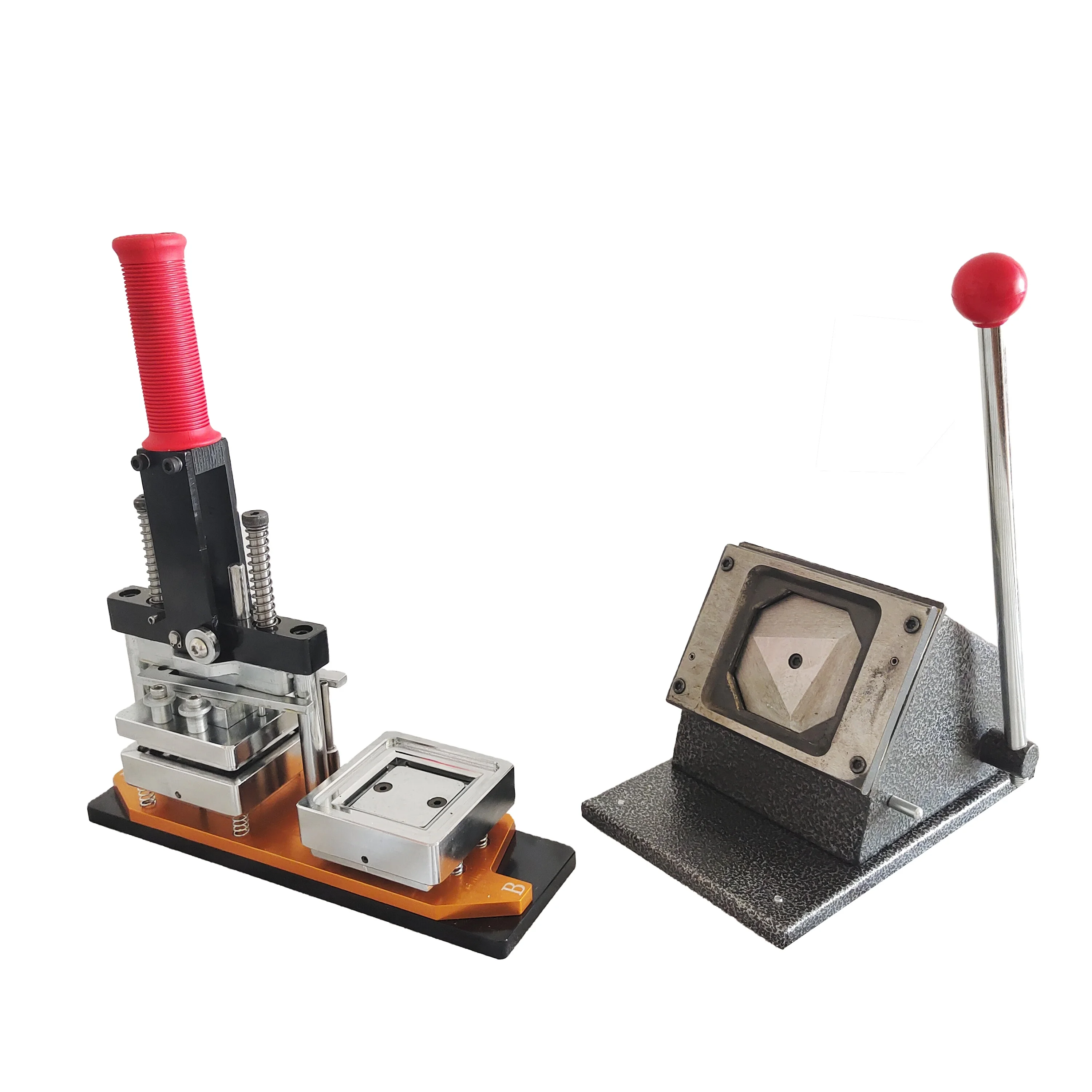
Source-controlled product identity
The Hoting queue identifies Product ID 1601250714152 as a fridge magnet and badge maker machine with interchangeable moulds, listed under the title "Fridge Magnet Component 2inch 63.5*63.5mm 50*50mm 80*53mm Magnets Badge Maker Machine Interchangeable Mold Magnets Paper Cutter".
This record sits next to another entry in the same queue that covers a single-size magnet making kit, and the two should not be read as one product described twice. The distinction is the centre of this article. A kit supplies a machine set up for one size together with a fixed quantity of blanks. This record describes a machine whose moulds interchange, offered against a list of eight component sizes, which is the purchase that makes sense for a workshop that intends to carry several shapes rather than one.
The record is thin in a specific way: it lists the sizes the machine and the components are available in, and it says nothing about the machine. There is no force, no mould mechanism, no cycle time, no power supply, no weight and no price. The size list is real information and is reproduced below in full; everything a buyer needs in order to judge the press has to be asked for.
The recorded specification, in full
The parameter block is a size matrix. Its first row is a header naming three things: a fridge magnet button making machine, a paper cutter and a fridge magnet. Each of the eight rows below it repeats one component size in all three columns. It is reproduced here exactly as recorded.
| Fridge Magnet Button Making Machine | Paper Cutter | Fridge Magnet |
|---|---|
| 50*50MM | 50*50MM | 50*50MM |
| 63.5*63.5MM | 63.5*63.5MM | 63.5*63.5MM |
| 53*80MM | 53*80MM | 53*80MM |
| 65*90MM | 65*90MM | 65*90MM |
| 115*40MM | 115*40MM | 115*40MM |
| 120*50MM | 120*50MM | 120*50MM |
| 127*41.5MM | 127*41.5MM | 127*41.5MM |
| 170*50MM | 170*50MM | 170*50MM |
The description repeats the same matrix in flat text and adds two entries that are not specifications. The packing entry states that professional, environmentally friendly, convenient and efficient packaging services will be provided, without giving any packing figures. The company profile names the supplier as a trading business dealing in product machines, CNC carbide inserts, turning tools and milling tools under its own brand.
Reading the size matrix: three columns, one number each
The record's table is easy to misread, and the misreading changes what the product appears to be.
Read as a two-column table, each row would say that a machine size, for example 50 mm by 50 mm, has as its value another size, and then a third. That reading produces pairs like "50*50MM | 50*50MM" that look like a mistake or like two different specifications joined by a separator.
The consistent reading is that the header row names three columns, a machine, a paper cutter and a magnet component, and that each of the eight data rows states one available size for all three. Under that reading the block says: the machine is offered in eight sizes, the paper cutter is offered in the same eight sizes, and the magnet component is offered in the same eight sizes. The repetitions are the listing format, not additional specifications.
Two consequences follow, and both should be raised with the supplier. First, a size list for the machine, the cutter and the component does not describe the machine itself, so nothing in the record states a force, a stroke, a mould change mechanism or a throughput. Second, whether the paper cutter genuinely needs eight different versions is not clear from the record: a cutter that trims printed sheets usually handles a range of sizes, so the eight rows under the cutter may describe the printed sheet sizes it can trim rather than eight distinct models. Ask which of the three columns represents a distinct physical item and which one represents a range.
The "2inch" label does not match 63.5 mm, and the arithmetic matters
The title describes this product as 2 inch, and the first two sizes in the list are 63.5 mm by 63.5 mm and 50 mm by 50 mm. Those figures do not agree with one another.
Expressed in inches, a 63.5 mm square is 2.5 inch, since 63.5 divided by 25.4 equals 2.5. A 2 inch button corresponds to 50.8 mm, so of the two sizes in the list, the one that reasonably carries a 2 inch label is the 50 mm square, which is 1.97 inch and is normally sold and bought as a nominal 2 inch size.
This is not pedantry. Button and magnet sizes in this industry are habitually named in inches, and a buyer ordering a 2 inch blank expects a blank that fits a 2 inch die. A buyer who reads the title as meaning that the 63.5 mm size is the 2 inch size will order the wrong component and the wrong mould, and the error will only appear when the pieces are pressed.
Ask the supplier to state each size both in millimetres and in the inch name it is sold under, to say which size the 2 inch label refers to, and to confirm that the 50 mm figure is nominal rather than a measured 50.8 mm. Where a nominal size is used, ask whether the die and the blank are matched to the nominal figure or to the measured one, because a blank that is 0.8 mm larger than its die will not seat.
The title's 80*53mm against the list's 53*80MM
The title gives one size as 80 mm by 53 mm. The parameter block and the description give the same size as 53 mm by 80 mm. The two figures are the same rectangle with its axes written in the opposite order.
Transposition of this kind is common in listings and is usually harmless, but on a printed component it decides the orientation of the artwork. A rectangle has a long axis and a short axis, and a design drawn for landscape orientation on a 53 by 80 blank does not fit the same blank rotated to portrait. A buyer who prepares artwork against the title and receives components matching the parameter block will find the design rotated on every piece.
Ask the supplier to state, for each rectangular size in the list, which figure is the width and which is the length, and to state whether the printed face is oriented along the long axis. Ask for a dimensioned drawing of the component and of the mould opening for one rectangular size, which settles both the axis order and the tolerance at once.
Interchangeable moulds: the central claim, and the questions it raises
Interchangeability is the reason to buy this machine rather than a fixed single-size press, so it deserves the most detailed questions. The record states the claim and gives no information about how it is achieved.
Ask how a mould is changed. A press that uses a drop-in die set that locates on pins can be changed by an operator in a few minutes with no adjustment. A press whose mould is bolted and aligned by hand can take considerably longer and may require a test piece after every change. The difference decides whether a workshop can run several shapes in one day or must dedicate a machine to one shape per run.
Ask what is included with the machine and what is bought separately. On presses of this kind the usual arrangement is that the machine comes with one die of the buyer's choice and that further dies are purchased individually, but the record does not say so. Ask for the die price for each of the eight sizes, the lead time for a die, whether dies are made by the supplier or bought in, and whether dies from other suppliers fit the machine, since the last question determines whether the buyer is locked to one supplier for tooling.
Ask how alignment and registration are set. On a magnet or badge, the printed design must sit squarely inside the rim and the rim itself must be even all round, and both depend on how the die locates the printed sheet. Ask whether the machine has an adjustable registration stop, whether the first piece of a run is checked and adjusted, and what the maximum registration error is.
Ask what the mould is made of and how long it lasts. A mould is a consumable with a finite life, and a buyer producing tens of thousands of pieces a year should know the expected life of a die, whether it can be reconditioned, and what a replacement costs.
What the machine itself must state, and the record states none of it
Beyond the mould system, a press is evaluated on figures that this record does not contain.
- Whether the press is manual, pneumatic or powered, and if powered, its power supply or air pressure and consumption.
- The pressing force, and the area over which it is applied, since a force figure without an area says little about whether a large size presses properly.
- The largest and smallest component the press can accept, and whether all eight listed sizes run on one machine or on more than one model.
- The cycle time per piece, and the force needed for each size, since the larger sizes in the list may need a different press from the smaller ones.
- Whether the die is heated, and if so to what temperature and whether the temperature is adjustable and measured.
- The machine's dimensions, weight and bench or floor footprint.
- The operating instructions, the assembly required on arrival, and whether installation and training are offered.
- The rated duty cycle and the throughput in pieces per hour for a stated size.
- Spare parts available, including springs, bushes, mould screws and any consumable in the press itself.
- Warranty period, what it covers, and how a claim is handled across borders.
One question deserves to be asked separately because it decides the shape of the whole operation: whether the eight sizes in the list can all be produced on the single machine offered here, or whether some sizes need a larger press. A size list assembled for a listing sometimes combines the outputs of two or three different machines. Ask the supplier to state which of the eight sizes this machine can press, at what force, and which would require a different model.
Badge and magnet: what the machine makes, and the back options
The title names both a badge maker and a fridge magnet, and the parameter block refers to a fridge magnet button making machine. In this product family the same press and the same front assembly are commonly used with different backs, so the buyer should establish exactly which backs are supported.
Ask which backs the machine can fit: a magnet back, a pin or brooch back, a key ring, a bottle opener, a mirror or a plain blank. Ask whether the back is fitted in the same pressing operation as the front or in a second step, since that changes the labour per piece and the number of operators needed. Ask whether the backs are bought from the same supplier, what they cost per thousand, and whether the back is included in the component price or priced separately. A buyer who assumes that a magnet back is included and finds that it is a separate purchase will find the cost per finished piece materially different from the first estimate.
Ask also about the magnet layer itself: the grade and thickness of the magnetic sheet, its pull force, and whether the magnet covers the whole back or only part of it. Pull force is what decides whether the finished souvenir holds a note on a fridge door or slides down it, and it is not in the record.
Packing, delivery and the entries that are not specifications
The packing entry in this record is a statement of intent rather than a specification: it promises packaging that is professional, environmentally friendly, convenient and efficient, and gives no dimensions, no weights, no carton or case type and no quantity per package.
That matters more than it may appear, because the machine is the item that determines how the shipment is packed. Ask for the carton or case dimensions and the gross weight of the machine as shipped, the number of machines per case, the packing method used for the dies and for any loose tooling, whether the machine is packed with the mould installed or separately, and whether the packing is timber, in which case the destination country's requirements for treated wood apply and should be confirmed before shipment.
The record states no delivery time at all. Ask for the lead time for the machine alone and for the machine with dies, distinguishing between a stock machine and one built with a die of the buyer's size, and ask separately for the lead time of additional dies, since a die ordered after the machine arrives will hold up production in a way that a die ordered with the machine does not. Ask also for the trade term, the port of loading, and who arranges export documentation.
Printing, which the record again does not address
A machine of this kind presses a printed front onto a rigid backing, so the printed piece is the part of the product that carries the design, and the record contains no printing information at all.
Ask whether the machine prints as well as presses, which it almost certainly does not, and then ask the two questions that decide the business. First, whether the supplier can supply printed components at the buyer's quantity, what the price per thousand is for each size, what the setup or plate cost is per design, how many colours are included, and what the minimum printed quantity is. Second, whether the supplier can supply the unprinted front, back and magnet components separately so that the buyer can have them printed locally.
Whatever the route, ask for artwork format and resolution, whether a digital proof and a physical pre-production sample are available, what colour tolerance applies between the approved proof and the production run, and how a design is kept between reorders, since a souvenir line usually carries several designs and re-orders them unevenly. For a pressed product the registration allowance is a property of the die, so ask what margin must be left around the printed design.
Buyer decision framework
The source for this guide is a record that lists eight component sizes for a machine, a paper cutter and a magnet component, states no machine specification, states no price and states no delivery time, and adds a general statement about packing.
The first decision is whether the buyer needs an interchangeable machine or a fixed one. Interchangeability is worth paying for when the buyer expects to sell several shapes, since it lets one press serve a range and lets stock be shifted between shapes as demand moves. A buyer who expects to sell one shape only should compare the price of this machine against a fixed press of the same size, and should ask for both prices, because the record gives neither.
The second decision concerns the die system, and it is the decision that carries the most risk. The buyer should establish the die price for each size, the die lead time, who makes the dies, whether third-party dies fit, and how registration is set, before ordering. A machine that can only be tooled by one supplier, at prices and lead times that are set after the sale, is a different proposition from one that accepts standard tooling.
The third decision concerns the size naming, which is where this record is most likely to mislead. The 2 inch label does not correspond to the 63.5 mm size, and the 80 by 53 figure in the title is the 53 by 80 size with its axes reversed. A buyer should have the intended size confirmed in both millimetres and inches, and should confirm the axis order for printed artwork, before any die is made.
The fourth decision concerns the size range and the press. The record does not say whether one machine presses all eight sizes, and the 170 mm size is substantially larger than the 50 mm size. Ask which sizes this machine covers and whether the larger ones require a different model, since buying a press that turns out to cover only the small sizes leaves half the intended range unproduced.
Where the supplier states the mould change method, the die prices and lead times, the force for each size, which sizes run on this machine, the back options and the printing route, the machine can be costed as a production asset. Where the answers are limited to the recorded matrix, the buyer knows only that eight sizes exist as components, which is a starting point for sourcing components but not enough to buy a press.
Frequently asked questions
Is the 63.5 mm size the 2 inch size?
No. A 63.5 mm square is 2.5 inch, since 63.5 divided by 25.4 is 2.5. A 2 inch button corresponds to 50.8 mm, so the 50 mm size in the list is the one that carries a nominal 2 inch name. Confirm with the supplier which size the 2 inch label refers to before ordering a die or a blank.
Is the size 80 by 53 mm or 53 by 80 mm?
The title says 80 by 53 and the parameter block and description say 53 by 80. These are the same rectangle with the axes written in opposite order. Ask the supplier which figure is the width and which is the length, and which way the printed face is oriented, since it fixes the artwork orientation.
How many sizes can one machine make?
Not stated. The record lists eight sizes against the machine column, but it does not say whether all eight run on one machine or whether the larger sizes need a different model. Ask which sizes this machine presses and at what force.
How are the moulds changed?
Not stated. Ask whether the die set drops in and locates on pins or is bolted and aligned by hand, how long a change takes, and whether a test piece is needed after each change.
Are the dies included?
Not stated, and no die price is given. Ask which dies are included with the machine, the price and lead time for each additional size, who manufactures them, and whether dies from other makers fit.
Can it make pin badges as well as magnets?
The title names a badge maker and the parameter block names a fridge magnet button machine. Ask which backs the machine can fit, including magnet, pin, key ring and others, whether the back is fitted in the same pressing step, and whether backs are included in the component price.
Is a paper cutter included?
A paper cutter appears in the header of the recorded matrix and is listed against the same eight sizes, but the record does not state what the cutter is, whether it is included with the machine, or whether it is one cutter or eight. Ask for its type, cutting width, blade details and whether it handles the largest size in the list.
What is the price and the lead time?
Not stated. The record gives no price for the machine, the cutter or the components, and no delivery time. Ask for the price per item at the buyer's quantity, the trade term, and separate lead times for the machine, the dies and any printed components.
Source and contact
This guide is based on the Hoting queue record for Product ID 1601250714152. The recorded size matrix is reproduced above in full and without alteration, with its header row naming a fridge magnet button making machine, a paper cutter and a fridge magnet, and eight rows covering the 50 by 50 mm, 63.5 by 63.5 mm, 53 by 80 mm, 65 by 90 mm, 115 by 40 mm, 120 by 50 mm, 127 by 41.5 mm and 170 by 50 mm sizes. The description in the record repeats those sizes and adds a general statement about packing services and a company profile. No machine specification, no price, no weight and no delivery time is stated for this product in this article, because the record contains none. The comments on the 2 inch label and on the axis order of the 80 by 53 size are arithmetic and textual observations on the recorded figures rather than quoted specifications.
Request the mould change method, the die prices and lead times for all eight sizes and who makes the dies, the pressing force and which sizes run on this machine, the power or air requirement, the cycle time and throughput, the back options and whether backs are included, the magnet grade and pull force, the component and machine prices at the buyer's quantity, the printing route with setup cost and sample, the carton or case dimensions and gross weight, and the lead times for the machine and the dies separately through the TEBAK sales inquiry channel before placing an order.
Key specifications
- Fridge Magnet Button Making Machine
- Paper Cutter | Fridge Magnet
- 50*50MM
- 50*50MM | 50*50MM
- 63.5*63.5MM
- 63.5*63.5MM | 63.5*63.5MM
- 53*80MM
- 53*80MM | 53*80MM
- 65*90MM
- 65*90MM | 65*90MM
- 115*40MM
- 115*40MM | 115*40MM
- 120*50MM
- 120*50MM | 120*50MM
- 127*41.5MM
- 127*41.5MM | 127*41.5MM
- 170*50MM
- 170*50MM | 170*50MM