
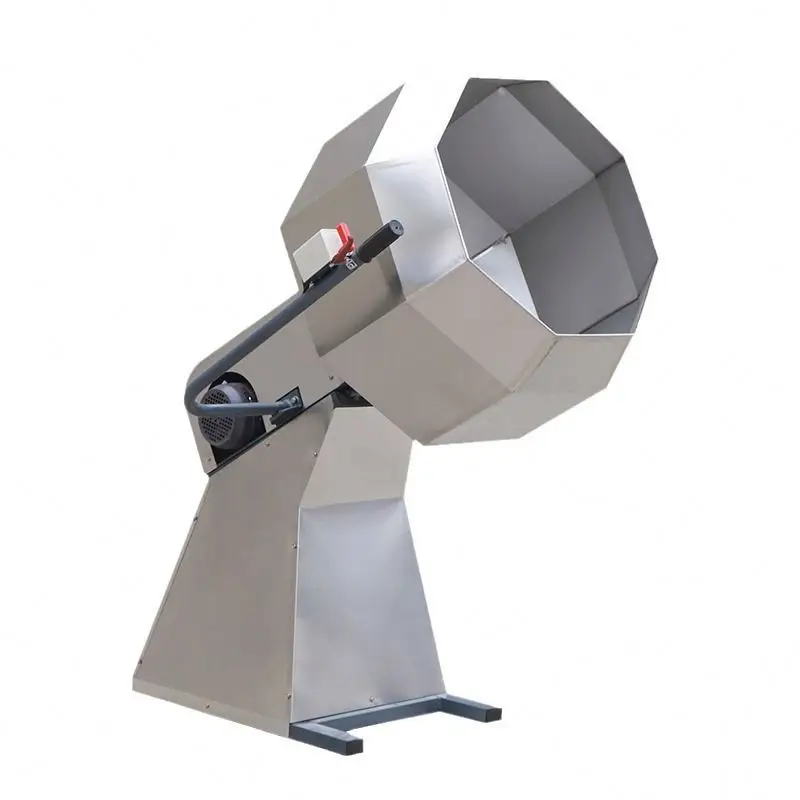
A listing with no parameters and no product description
The Hoting queue carries Product ID 1601276433140 as a fully automatic potato chips snack flavoring machine, also described in the title as a French fries seasoning machine and a nuts food seasoning processing machine. Its parameter block is empty. There are no parameters at all, not a short list and not an incomplete one, and a purchasing system that imports this record will receive a product with a title and eight photographs.
The description text does not fill the gap, because it is not about the product. It is a company profile, and it is worth saying exactly what it contains, since a buyer reading a listing for a machine will assume the text below the title describes that machine. The first sentence names the supplier as Hengshui Mengshang Trading Co., Ltd. and describes it as a main professional supplier in product machines, CNC carbide inserts, turning tools and milling tools, with the brand TEBAK. The text then states principles of high quality, competitive price and excellent service, claims many years of experience as an OEM and ODM manufacturer, states that 70 per cent of production is for export, lists customer regions as North America, Europe, South America, the Middle East, East Asia and Africa, cites ISO 9001 as the quality control standard, refers to an automatic machining centre and a testing method, and ends by saying the company has an outstanding team. The passage also carries several typographical errors, including productc for products, this filed for this field, testing testing for a repeated word, and OED for what is evidently intended as OEM.
Nothing in that text concerns the machine. There is no drum size, no capacity, no motor power, no voltage, no rotation speed, no mixing time, no machine dimension, no weight, no sheet thickness, no material grade beyond the word stainless, and no statement of what the machine is for beyond the three applications in the title. The profile also names a catalogue of cutting tools and inserts, which is a different product family from a food seasoning machine, so the text is a shared template applied to a listing it does not describe.
The consequence for a buyer is simple and worth stating plainly. For this record the specification does not exist to be read, and it has to be written. Everything that follows is therefore arranged around two questions: what the eight images do establish, and what a buyer must ask for because no part of the record states it.
What the images do establish, and the name they give the machine
The eight images are more informative than the text, and the first thing they establish is that the supplier's own name for the machine is not the name in the title. The headline of the first and largest image reads octagonal mixer, with a red banner reading rapid mixing and uniform mixing. The listing title calls the same machine a fully automatic flavoring machine, a seasoning machine and a seasoning processing machine. Those are not synonyms. A mixer describes a machine that tumbles a product and a coating together, which is what the photographs show. A flavoring machine in the trade usually describes a line that includes a seasoning applicator and often a weighing or conveying stage, which the photographs do not show.
The images also carry a block of dense illegible pseudo-text below the headline, of the kind design software generates as placeholder copy, left in place rather than replaced with specifications. That block is worth noticing because it marks the position in the layout where a specification table belongs, and it is empty.
| Feature | What the record's own images state | What is missing from that statement |
|---|---|---|
| The drum | An octagonal bucket, described as an octagonal design barrel whose material rotates to stir evenly and fully, with the interior shown and weld seams visible at the corners between the eight panels | Across-flats dimension, depth, volume, sheet thickness, whether the drum is removable |
| The handle | An operating handle described as an integrated pouring control hand brake and reverse switch to control pouring separately, with forward and reverse rotation of the barrel for discharge | How many positions the switch has, whether rotation speed is adjustable or fixed, what the brake is rated for |
| The drive | A power system described as a copper core motor and reducer, behind a guard, described as strong and stable operation and long service life | Power in kilowatts, voltage, phase, output speed, reducer type, lubrication, duty rating |
| The base | A thickened base, described as a stainless steel all inclusive base with thickening reinforcement, guaranteed smooth operation, standing on legs with a foot at each end | The thickness in millimetres, whether the feet are anchored or braked, whether castors are available |
The four features above are the whole of the machine's description as the record supplies it, and each is a qualitative statement where a buyer needs a number. The phrase thickened base is the clearest example: thickened relative to what, by how much, in what sheet, and how is it checked on arrival. None of those has an answer in the record.
Fully automatic, against a handle that is pulled by hand
The title begins with the words fully automatic, and the record's own image of the operating handle contradicts that description in a way that matters commercially. The handle is described as an integrated pouring control hand brake and a reverse switch, and the discharge is described as tipping the barrel by hand. An operator therefore loads the drum, starts a rotation, decides when the product is coated, stops the rotation, and tips the barrel to empty it. That is a manually operated batch machine.
The distinction is not pedantic, because it changes what a buyer must purchase and staff. In a manual tumbler the seasoning is weighed separately by the operator, in a jug or on a scale, and added through the drum opening by hand. In a line sold as fully automatic, the seasoning is metered by a screw feeder or a vibratory feeder, the feed rate is set from a control panel, the product is conveyed in and out, and the operator's role is to supervise. The two arrangements differ by the amount of equipment in the sale, by the labour content of each shift, and by the consistency of the seasoning pickup, which is the number that decides whether a packet of crisps tastes the same in March and in September.
So the question to ask is not whether the machine is automatic but which steps remain manual. Ask specifically: is the seasoning weighed and added by hand or by a powered feeder; is the product loaded by hand; is the discharge a hand-tipped barrel or a powered auger or a tipping mechanism driven by the machine; is the mixing time controlled by a timer or by the operator's judgement; and is the rotation speed fixed or variable. The answers turn the title into a description, and any quotation that repeats the words fully automatic without answering them should be treated as a quotation for a manual tumbler, which is what the photographs show.
Why the kilogram figure is meaningless without the product
No capacity is stated, and the arithmetic shows why a capacity figure in kilograms would have to be qualified anyway. The drum is an octagonal prism, so its volume follows from two measurements: the distance across the flats of the octagon, which is the width of the drum when measured between two opposite flat sides, and the depth from the open face to the back. The area of a regular octagon is about 0.828 times the square of the across-flats distance, so a drum measuring 60 centimetres across the flats has a face area of about 2,981 square centimetres, and with a depth of 40 centimetres it has a volume of about 119 litres. Both of those figures are the author's example rather than anything in the record, and they are given because they are the two dimensions the supplier must be asked for.
A volume is not a batch weight, because a tumble mixer is filled by volume rather than by mass and the mass depends entirely on the product. This is the point that makes a capacity claim unreadable on its own, and the range is wide enough to matter. A drum filled to about half its volume with a light puffed snack holds a very different mass from the same drum filled with nuts, which are among the densest products that go through a coating tumbler.
| Bulk density of the product | Mass in 60 litres of usable volume | Products at roughly this density |
|---|---|---|
| 30 g per litre | 1.8 kg | Very light puffed snacks |
| 50 g per litre | 3.0 kg | Loose potato crisps and thin snack pellets |
| 100 g per litre | 6.0 kg | Denser snacks and extruded pieces |
| 300 g per litre | 18.0 kg | Small hard pieces such as coated peanuts in part |
| 600 g per litre | 36.0 kg | Whole nuts and dense granules |
The same 60 litres of usable volume therefore holds 3 kilograms of crisps or 36 kilograms of nuts, a factor of twelve, and the machine does not change. The bulk density column is arithmetic applied to an illustrative range rather than a published table, and the product column is indicative; the figure that matters is the buyer's own. To obtain it, fill a one litre container level with the product in the state it enters the drum, weigh it, subtract the container, and read the result as grams per litre. Doing that once per product line gives the batch weight for any drum the supplier quotes, and it is also the number the seasoning percentage is calculated against.
Worked example, with the assumptions stated
Take the drum of the previous paragraph: 60 centimetres across the flats, 40 centimetres deep, 119 litres of geometric volume, filled to half depth, giving about 60 litres of usable volume. For loose crisps at 50 grams per litre the batch is about 3 kilograms. At a seasoning pickup of 4 per cent by mass the seasoning weighed for that batch is about 120 grams. For whole nuts at 600 grams per litre the batch is about 36 kilograms at the same fill, and the same 4 per cent pickup requires about 1.44 kilograms of seasoning. Two entirely different working scales, from one machine, decided by the product and not by the equipment.
Seasoning pickup, the arithmetic the machine does not do
Coating a snack means adding a measured mass of seasoning to a measured mass of product, and the useful figure is the pickup percentage. The machine tumbles; the arithmetic belongs to whoever sets the batch.
| Pickup rate | Seasoning per kilogram of product | Seasoning for a 3 kg crisp batch | Seasoning for a 36 kg nut batch |
|---|---|---|---|
| 2 per cent | 20 g | 60 g | 720 g |
| 3 per cent | 30 g | 90 g | 1,080 g |
| 4 per cent | 40 g | 120 g | 1,440 g |
| 6 per cent | 60 g | 180 g | 2,160 g |
| 8 per cent | 80 g | 240 g | 2,880 g |
Three things follow from the arithmetic that a buyer can use in a negotiation. The first is that the seasoning is a small percentage of the batch and is therefore weighed on a scale that suits grams, so a machine sold without a scale leaves a measurement the buyer must add. The second is that at 4 per cent a 120 gram addition to a 3 kilogram crisp batch is a quantity an operator can weigh accurately, whereas at the nut scale the same percentage is 1.44 kilograms and belongs on a platform scale. The third is that the pickup is only half the outcome, because the yield is the other half: seasoning that stays in the drum, on the drum walls, or in the air is seasoning the buyer paid for and did not sell, and the amount lost rises with the seasoning's fineness and with the static that dry seasoning powder carries. So the questions to ask are the percentage the design is intended for, how the seasoning is added, whether the drum has a baffle or a spray arrangement, and what proportion of a weighed addition is typically recovered as product coating rather than as dust or wall residue.
Why an octagon, and what the weld seams in the corners mean
The drum is octagonal rather than cylindrical, and the record's own image states the reason in the language of the trade: the octagonal design barrel and the material rotate at the same time to make the material stir evenly and fully. The mechanism is worth understanding because it explains what the shape is for. Inside a smooth cylinder rotating about its axis, a light product tends to slide along the wall rather than to tumble, and a sliding product mixes with the seasoning in a thin layer while the bulk of it stays where it was. An octagonal drum cannot let the product slide, because each flat panel picks the product up and then drops it as the panel passes the top, so the product cascades through the seasoning rather than being carried around with it. That cascade is the mixing action, and it is why seasoning drums are almost always faceted rather than smooth.
The shape has a cost, and the record's own photograph of the drum interior shows it. The eight panels meet at eight corners, and the photograph shows the seams between them, with the weld lines running from the rim to the back plate. Those seams are the places where seasoning dust lodges, where a cleaning brush cannot easily reach, and where a crack can start if the drum is loaded heavily or tipped while full. So the questions the photograph raises are specific: are the internal welds ground flush and polished, or left as welded; is the drum welded as one unit or bolted as panels; can the drum be removed from the frame for washing; and is the drum's open face fitted with a lid or a seal, since a drum that is open while rotating will throw a fraction of a light seasoning out of the front.
The lid question also settles a dispute that comes up when a supplier claims a machine is a flavoring machine rather than a mixer. A purpose built seasoning drum usually has a closable mouth, so that the seasoning can be added, the mouth closed, and the drum rotated without losing powder. The photographs in this record show an open octagonal mouth with the handle to one side and no lid visible. If there is no lid, the machine will tumble and coat, and it will also throw dust, and the buyer should ask whether a lid or a cover is supplied and whether the mouth is sized to accept the seasoning addition without stopping the rotation.
The drive, and the questions a nameplate would answer
The record's power system image shows a motor under a guard with a gearbox, described as a copper core motor and reducer and as strong and stable with a long service life. No nameplate figures are legible in the image, and the listing supplies none, so the drive of this machine is at present entirely unspecified, which is unusual for the single most expensive component in the assembly.
The figures that matter, and the reason each matters, are these. Power in kilowatts, because it sets both the batch the drum can turn and the electrical supply the buyer must provide. Voltage and phase, because a machine wound for one supply cannot be used on another without a change of motor, and a three phase machine cannot be plugged into a domestic single phase supply at all. Output speed in revolutions per minute, because the tumbling action depends on it: too slow and the product slides, too fast and it is pinned to the wall by centrifugal force and stops tumbling, which is the failure mode buyers discover after installation rather than before. Whether the speed is fixed or variable, and if variable, over what range and by what means.
The reducer deserves its own questions. A reducer between the motor and the drum is what allows a small fast motor to turn a large slow drum, and its type decides how it is maintained. A worm gearbox is compact and quiet and needs oil that must be changed; a planetary or helical gearbox is more efficient and usually dearer. Ask which type is fitted, whether the gearbox has an oil fill and drain plug, what oil is specified, what the change interval is, and whether the gearbox is sealed against the seasoning dust that will surround it. That last point is not a small one on a food machine, because a worm gearbox that weeps oil near a drum of crisps is a contamination risk that no amount of cleaning will fix.
The final question about the drive is the duty rating. A seasoning tumbler is loaded heavily at the moment it starts, when a full drum of product has to be lifted from rest, and the motor and gearbox must be sized for that starting torque rather than for the running load. Ask whether the machine can be started with a full drum, and ask what the maximum starting batch is. A supplier who can answer that has sized the drive; a supplier who cannot has quoted a motor.
Dust, washdown and the hygiene questions this machine invites
Seasoning powder is fine, dry, hygroscopic and slightly sticky, and it will find every opening in a machine that tumbles it. The record's images show the motor and reducer behind a guard at the side of the frame, with the guard open to the air, and they show the drum mount and shaft. So the questions to ask are about where the dust goes and how the machine is cleaned after a shift.
Ask whether the motor and the gearbox enclosure is rated for washdown, and if so to what standard, because the commonest way to destroy this class of machine is to hose it down. Ask whether the drum area and the drive area can be cleaned separately, so that a wet drum can be washed without water reaching the electrics. Ask whether there are places where powder accumulates that cannot be reached without dismantling, and ask which fasteners must be undone and how many, because a machine that takes twenty minutes to open will not be opened. Ask about the material of the drum, whether the stainless is a grade the supplier will name, and whether the drum's interior is a food contact surface that carries a declaration.
Two further items belong in this section. The first is electrical safety certification for the destination market, since a machine with a motor and a control switch sold into a regulated market needs it, and the record claims only ISO 9001 for the company, which is a quality management standard and not a product certification for this machine. The second is the food contact declaration for everything the product touches, which on this machine is the drum and any plastic part such as a lid seal or a handle grip.
The base, the feet and moving a machine that must not move
The record describes a thickened stainless steel all inclusive base and shows the machine standing on legs with a flat foot at each end. A tumbler that tips a full drum forward puts a substantial overturning moment on those feet, and that moment is resisted only by the machine's own weight and by however well the feet grip the floor. So the questions are practical: what is the mass of the machine, since a heavier machine is more stable and also harder to move; are the feet fixed to the floor or free standing; is there provision for bolting down; and is there a braked castor option.
The tension between the last two is worth naming, because a buyer will be offered castors as a convenience and they change the machine's behaviour. A mobile tumbler can be wheeled to a wash point, which is an advantage; the same machine can also walk across the floor as the drum turns, which is a defect. A braked castor resolves the contradiction if the brakes are rated for the load and if the floor is flat, so the question to ask is the load rating of the brake and whether the supplier recommends operation with the brakes applied. The related question is the height of the drum's open face above the floor, because a 3 kilogram batch of crisps can be tipped by hand and a 36 kilogram batch of nuts into a waist high drum is a manual handling risk, and the answer may determine whether the machine needs a platform, a chute or a bin beneath it.
The application collage, and the photograph that is not a canteen
The sixth image is an application page carrying six photographs above captions reading food city, unit canteen, school canteen, company canteen, chain catering and processing plant, with the heading one machine multi purpose simple operation support customization. The page is doing a specific job: it tells a buyer that the machine is sold for food service as well as for processing, and the caption one machine multi purpose is a claim worth testing.
Two observations follow. The first is that one of the six photographs is not what its caption says: the panel captioned unit canteen shows an open plan office with desks, chairs and partitions, and there is no food service equipment in it. A buyer should read the collage as design rather than as evidence of installed sites. The second is that the collage's applications are canteens and catering, while the listing's title is about potato chips, French fries and nuts, which are snack processing applications. The machine is the same in both readings, and the mismatch is not a fault, but it does mean the buyer must decide which of the two markets they are in and ask for the machine's configuration for that market rather than accept the collage's implication that one configuration serves both.
The multi purpose claim is testable in one question. A tumble mixer coats, which covers seasoning, oiling, glazing and dusting, and it can also mix loose ingredients such as a salad. It does not cook, it does not fry, it does not slice and it does not weigh. Ask the supplier to name the operations the machine performs and to name the operations it does not, and ask whether any of the operations require a different drum or a different speed. The answer will separate a genuine multi purpose machine from a picture of canteens.
The packing images belong to other records
Two of the eight images in this gallery are the generic shipping service page, carrying payment and carrier logos, and the generic plywood crate packing page, carrying stencilled export crates. Those two images are not about this machine, and they are not even distinctive of it. Counting the queue directly, the shipping service page appears among the detail images of 132 of the queue's product records and the plywood crate page appears among 45 of them, including the record for the stainless steel fridge magnet material, which is a raw material for a consumer product in an unrelated category. A buyer should therefore treat the gallery as containing, on inspection, four feature pages about the machine, one application collage, one dimension place holder that was never filled, and two pages of generic logistics material.
That leaves the packing of this machine unstated. Ask for the export packing as numbers: whether the machine travels assembled or partly dismantled, whether it is in a carton, a crate or both, the crate or carton dimensions, the gross weight, and whether the drum is braced or removed for transit. A machine with a large drum on a shaft is exactly the kind of item that arrives with a bent shaft if it is shipped unsupported, so the question about bracing is worth asking before the order rather than after the first delivery.
The specification to send, since the record does not contain one
Because this listing publishes no parameters, the practical step is to send the supplier a specification and ask them to fill it in and return it. The list below is written so that each line has a number for an answer, which is what makes it checkable on arrival.
| Item to be specified | Answer required as |
|---|---|
| Drum shape and construction | Octagonal, number of panels, one piece or bolted, removable from the frame yes or no |
| Drum across-flats | Millimetres, measured between two opposite flats |
| Drum depth | Millimetres, from the open face to the back plate |
| Drum geometric volume and working fill | Litres, with the percentage of geometric volume used as the working fill |
| Maximum and minimum batch by product | Kilograms, stated separately for the buyer's lightest and heaviest product |
| Rotation speed and adjustment | Revolutions per minute, fixed or variable, and the range if variable |
| Mixing time control | Timer yes or no, range in seconds or minutes |
| Motor | Kilowatts, voltage, phase, frequency, insulation class |
| Reducer | Type, ratio, lubrication, oil change interval |
| Starting under load | Whether a full drum can be started, and the maximum starting batch |
| Discharge | Hand tipped or powered, and the angle to which the drum tips |
| Seasoning addition | By hand or by feeder, and whether a feeder is included in the price |
| Drum mouth | Opening size in millimetres, and whether a lid or cover is supplied |
| Material and thickness | Grade of stainless for the drum, the frame and the base, and sheet thickness in millimetres for each |
| Internal weld finish | Ground and polished yes or no, and to what surface condition |
| Food contact | Declaration and standard for the drum and each non metallic food contact part |
| Electrical safety | Certification held, named, for the destination market |
| Ingress protection | Rating for the motor and control enclosure, and whether washdown is permitted |
| Cleaning | Parts removable without tools, number of fasteners to open the drive area |
| Machine dimensions | Length, width and height in millimetres, and the drum mouth height above the floor |
| Machine mass | Kilograms, net and in its packing |
| Feet and mobility | Fixed, bolted or castor, with the brake load rating if castors are offered |
| Packing | Assembled or dismantled, carton or crate, dimensions, gross weight, drum bracing method |
| Commercial terms | Price, minimum order quantity, trade term, lead time, warranty period, spare parts list and prices |
Twenty four items is a long list, and sending it has a value beyond the answers. A supplier who returns it with numbers is describing a machine that exists; a supplier who returns it partly filled is describing a machine that will be built to the buyer's numbers, which is a different conversation about price and risk. Either answer is more useful than a listing with an empty parameter block.
Incoming inspection when the machine arrives
- Compare the delivered machine with the quotation's specification sheet rather than with the gallery, and photograph the machine and its nameplate before unpacking it fully.
- Read the motor nameplate and record the power, voltage, phase, frequency and speed, then check them against the order and against the supply on site.
- Measure the drum across the flats and the drum depth with a tape or a caliper, and calculate the geometric volume as 0.828 times the square of the across-flats distance times the depth.
- Measure the sheet thickness of the drum wall, the drum back and the base with a micrometer or an ultrasonic gauge, and record each reading separately.
- Fill the drum with the buyer's own product to the intended working fill, weigh the product, and record the batch in kilograms together with the product's bulk density.
- Run the drum empty and time ten revolutions to obtain the rotation speed, and repeat with the drum part full to see whether the speed holds under load.
- Run a full batch and time the coating, noting whether the product cascades down the drum's panels or slides around the wall, since sliding means the speed or the load is wrong.
- Weigh the seasoning for a batch, add it, run the batch to completion, and then weigh the residue left in the drum and on any lid or cover, to establish the recovery rather than assuming it.
- Repeat the previous two checks three times and compare the pickup between runs, which is the only measure of whether the machine can hold a seasoning specification.
- Inspect the eight internal corner seams with a light, note whether the welds are ground and polished, and record any roughness, spatter or undercut.
- Try to remove the drum from the frame and note how many fasteners and how many minutes it takes, since that figure is the cleaning time for every shift.
- Inspect the motor and gearbox guard for openings through which seasoning dust can enter, and check the gearbox for oil at the seams and the shaft seal.
- Check whether the drum mouth has a lid or cover, and measure the opening to confirm the seasoning can be added without stopping the drum.
- Tip the drum through its full discharge angle with a full batch and watch the feet, to see whether the machine moves on the floor and whether the tipping requires more force than one person can apply safely.
- Measure the height of the drum mouth above the floor and compare it with the container the product is tipped into, to check the transfer can be made without lifting.
- Record the machine's own mass, the packing dimensions and the gross weight, and keep the readings with the photographs so the next order can be checked against this one.
The third, fourth, fifth and seventh checks are the ones that convert this record into a specification, because drum volume, sheet thickness, batch mass and the quality of the tumbling action are the four things the listing states in words such as octagonal, thickened and uniform, and all four can be measured in an afternoon.
Answers to the questions this record raises most often
Is this machine fully automatic?
The record's title says so and the record's own images do not. The images show an operating handle with an integrated pouring brake and a forward and reverse switch, and describe discharge by tipping the barrel, with no feeder, no conveyor and no weighing system shown. The practical test is to ask which steps remain manual, and specifically whether the seasoning is weighed and added by hand.
What is the capacity in kilograms?
Not stated, and a kilogram figure would need the product attached to it to mean anything. The drum is filled by volume, so the batch in kilograms is the usable volume multiplied by the product's bulk density, and the same drum holds roughly an order of magnitude more nuts than crisps. Obtain the across-flats distance and the depth, calculate the volume, then apply the density of the buyer's own product.
How is the volume of an octagonal drum calculated?
Measure across the flats rather than across the corners, square that figure, multiply by 0.828, and multiply the result by the depth. For a drum 60 centimetres across the flats and 40 centimetres deep that gives about 119 litres of geometric volume.
Why is the drum octagonal?
Because a faceted drum makes the product cascade rather than slide. A smooth cylinder lets a light product rotate with the wall, which mixes only the surface layer, while the flats of an octagon lift the product and drop it back through the seasoning. The shape is the mixing mechanism.
How much seasoning is needed per batch?
The batch mass multiplied by the pickup percentage. At 4 per cent a 3 kilogram batch needs about 120 grams and a 36 kilogram batch needs about 1.44 kilograms, so the two scales need different scales to weigh on. The percentage itself is a product decision and not a machine setting.
Does the machine weigh or dose the seasoning?
Nothing in the record states that it does, and none of the eight images shows a feeder or a scale. Assume by default that the seasoning is weighed separately and added by hand, and ask for a feeder quotation if the pickup needs to be repeatable.
What material is the drum?
Described as stainless, with no grade and no thickness. The base is described as stainless and thickened, also without a figure. Both figures need to be obtained and written into the order, because sheet thickness is invisible in a photograph and is the first thing to be reduced without notice.
Is the drum removable for cleaning?
Not stated. The drum is shown mounted on a shaft with the frame welded and bolted around it, so the question belongs in the order along with the number of fasteners involved. A drum that cannot be removed cannot be washed properly, and seasoning dust in a corner seam is what an inspection finds.
Can the machine be hosed down?
Not stated. The motor and reducer sit behind a guard that is open to the air, so the default assumption is that the drive area must be protected from water and that the drum must be cleaned separately. Ask for an ingress protection rating rather than accepting a claim that the machine is easy to clean.
What does the record omit entirely?
The parameter block is empty and the description is a company profile, so the record omits the drum dimensions and volume, the batch capacity, the motor power, voltage and phase, the rotation speed, the mixing time, the discharge mechanism, the sheet thicknesses, the stainless grades, the machine dimensions and mass, the ingress protection, the food contact declaration, the electrical certification, the packing, the price, the minimum order quantity, the lead time and the warranty.
Source, scope and what this guide does not claim
This guide is based on the Hoting queue record for Product ID 1601276433140, titled as a fully automatic potato chips snack flavoring machine, French fries seasoning machine and nuts food seasoning processing machine, and on the eight detail images that accompany it. All eight images were examined.
The listing itself supplies almost nothing to work from, and that is the first finding rather than a gap in this article. The parameter block contains no parameters at all. The description text is a company profile of the supplier, naming Hengshui Mengshang Trading Co., Ltd. and the TEBAK brand, describing the company's product machines, CNC carbide inserts, turning tools and milling tools, its export share, its customer regions, its ISO 9001 quality management standard and its machining centre, and containing the typographical errors noted in the text above; it contains no product information of any kind.
Everything stated about the machine therefore comes from the record's own images and is attributed to them in the text: the headline naming it an octagonal mixer with a banner about rapid and uniform mixing, together with a block of untranslated placeholder pseudo-text; the octagonal bucket page with the interior photographed and the corner weld seams visible, and the sentence about the octagonal design barrel rotating to stir evenly and fully; the operating handle page with the integrated pouring control hand brake and reverse switch, and the sentence about forward and reverse rotation for discharge; the power system page showing a motor and reducer behind a guard and describing a copper core motor and reducer; the thickened base page showing the stainless base on legs; the application page carrying six captioned photographs including the panel captioned unit canteen which shows an office; and two pages, the shipping service page and the plywood crate page, which contain generic logistics material rather than anything about this machine.
The claim that those last two pages are not distinctive of this record is established by counting the queue directly rather than by inference: the shipping service page appears among the detail images of 132 of the queue's product records and the plywood crate page appears among 45 of them, and both appear in the record for the stainless steel fridge magnet material, a raw material in an unrelated category.
Several passages are the author's arithmetic or reading rather than published data, and are set out here so that they are not mistaken for specifications. The octagon area factor of 0.828 applied to the square of the across-flats distance is the standard result for a regular octagon, and the 60 centimetre across-flats figure, the 40 centimetre depth, the resulting 119 litres and the half fill used in the worked examples are the author's illustrative dimensions and not measurements of this machine. The masses per litre in the bulk density table are arithmetic on an illustrative range of densities rather than a published table, and the products named beside each row are indicative only; the density that matters is the buyer's own, measured by filling a one litre container and weighing it. The seasoning quantities are the batch mass multiplied by the pickup percentage, and the recovery discussion is a question to ask rather than a measured value.
A buyer can close this specification with four measurements and one list. The measurements are the drum across-flats distance, the drum depth, the drum sheet thickness and the batch mass with the buyer's own product. The list is the specification table above, sent to the supplier with the request that it be returned with numbers, which is the only way to buy a machine whose listing states nothing, through the TEBAK sales inquiry channel.
Key specifications
- Parameters published with the listing
- none, the parameter block is empty
- Product description published with the listing
- none, the description text is a company profile of about 1,300 characters with no product content
- Product name on the listing title
- fully automatic potato chips snack flavoring machine, French fries seasoning machine, nuts food seasoning processing machine
- Product name on the record's own headline image
- octagonal mixer
- Drum, from the record's own images
- octagonal, eight stainless panels with weld seams visible at the corners
- Drum rotation, from the record's own image text
- forward and reverse rotation, controlled from the handle
- Discharge, from the record's own image text
- by tipping the barrel, using a pouring control hand brake integrated in the handle
- Drive, from the record's own image text
- copper core motor and reducer, described as long service life
- Base, from the record's own image text
- stainless steel all inclusive base, described as thickening reinforcement
- Applications shown in the record's own collage
- food city, unit canteen, school canteen, company canteen, chain catering, processing plant
- Drum dimensions, volume or batch capacity
- not stated in the listing, the description or any of the eight images
- Motor power, voltage or phase
- not stated anywhere
- Rotation speed
- not stated anywhere
- Mixing time
- not stated anywhere
- Sheet thickness of the drum or the base
- not stated; the base is described as thickened without a figure
- Machine dimensions and net weight
- not stated anywhere
- Packing, price, minimum order quantity, lead time, warranty
- not stated anywhere; the two packing images in the gallery are the generic shipping service and plywood crate pages that also appear in other records