
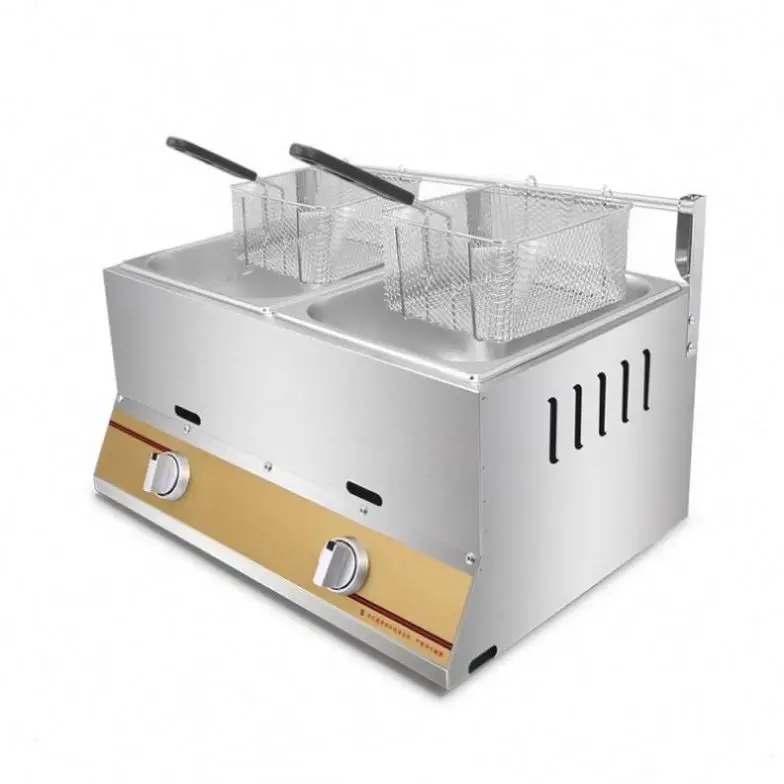
Source-controlled product identity
The Hoting queue identifies Product ID 1601390939435 as a gas fryer for commercial frying, listed under the title "Gas Fryer 12L Double Cylinder Gas Fryer Chicken Chips Fryer Tank Stainless Steel GC Provided Energy Saving Burner". The description repeats the title and then carries a parameter block with eleven rows, all of them populated.
This is one of the fuller records in the queue. It states a model number, a capacity, a material, a gas type, a supply pressure, a regulator description, product dimensions and weight and package dimensions and weight. For a buyer it is enough to plan freight and to start a conversation, and it is not enough to buy the machine, because the eleven rows describe the vessel and its shipping box and say almost nothing about the burner, the controls or the safety devices.
The first problem in the record is a contradiction between two of its own parts: the title calls the machine a double cylinder fryer and the parameter block calls it a one tank one basket fryer. Those are different machines with different kitchens and different prices, and one of the two is wrong.
The second problem is the row labelled air pressure. A fryer does not run on compressed air, and the figure given is a gas supply pressure. Reading it as a gas pressure, 2800 Pa converts to about 11.2 inches of water column, which is close to the propane regulator setting used in North America and to the settings used in several butane markets, and far from several others. That single number decides whether the machine can be connected to the gas supply the buyer has.
The third problem is what the record omits: nothing in it describes the burner, the heat input, the ignition, the thermostat, or the flame failure device that stops gas flowing when the flame goes out. On a gas frying appliance those are the parts that matter most.
The eleven recorded parameters, verbatim
| Parameter | Recorded value |
|---|---|
| Product Name | Gas 1 Tank 1 Basket Fryer |
| Model | 72A |
| Capacity | 12L |
| Material | Stainless Steel |
| Gas Type | Liquefied Gas |
| Air Pressure | 2800Pa |
| Gas Pressure Regulator | Gas low pressure regulator |
| Product Size | 550×390×360MM |
| Product Weight | 11KG |
| Package Size | 650×480×410MM |
| Package Weight | 13KG |
Below the table the record carries a company introduction, which is quoted at the end of this article.
Contradiction one: one tank or two
The title says double cylinder and the parameter block says one tank one basket. Until the supplier states which is correct, the buyer is comparing two different products.
A single tank fryer has one vessel, one basket and one burner, and it fries one product at one temperature at a time. A double tank fryer has two independent vessels, each with its own basket and burner, and it can run two different products or two different temperatures at once. In a kitchen the difference is operational as much as financial: a single tank forces the operator to fry chips and then wait, or to compromise by frying everything at one temperature, while a twin tank lets a fish basket and a chip basket run side by side without transferring flavour.
The difference also changes what 12L means. On a single tank machine 12L is the capacity of that one tank. On a twin tank machine a total of 12L is usually two tanks of 6L each, and the capacity per basket is what matters to an operator, since a basket that holds a useful load of chips is what makes the machine worth its footprint.
There is a third possibility that the title is using cylinder in the sense of burner rather than tank, so that double cylinder means two burners under one tank. That is a real arrangement and it changes the heat recovery rather than the batch flexibility. Ask which of the three applies, and ask for the number of tanks, the number of baskets, the number of burners and the oil capacity of each tank separately. A photograph of the machine from above with the lid open answers most of it.
Contradiction two: air pressure that is not air
The row reads Air Pressure 2800Pa. A frying appliance does not consume compressed air, so the first thing to establish is what the row actually describes. It is almost certainly the gas supply pressure the appliance expects at its inlet, and the row has been mislabelled.
Taken as a gas supply pressure, the figure is meaningful and it is also convertible into the units used in the buyer's market, which is where it becomes useful. One inch of water column is about 249 pascals, so 2800 Pa is about 11.2 inches of water column. That figure sits close to the propane regulator setting used in North America, which is 11 inches of water column or about 2,740 Pa, and it is also within the range used for butane in several markets, where 28 to 30 millibar, that is 2,800 to 3,000 Pa, is common. It is well below the 37 millibar, about 3,700 Pa, used for propane in some other markets.
The consequence is practical. Whether this machine can be installed in a given kitchen depends on the gas family available there and the pressure the local regulator delivers, and 2800 Pa is not a universal setting. Ask the supplier for the appliance's rated inlet pressure in both pascals and the buyer's local unit, for the permissible range rather than a single figure, and for the injector or jet size fitted, because the jet is what sets the heat input at a given pressure and jets are not interchangeable between gas families.
The record also states the gas type as Liquefied Gas, which is a family rather than a specification. Liquefied petroleum gas and natural gas are different fuels that burn at different rates and need different jets and different pressures, and an appliance set for one cannot be connected to the other without conversion. Ask which of the two the machine is built for, whether the other is available as an option, and if so what the conversion involves and whether it is done at the factory or in the field. Ask also whether the machine is designed for propane, butane or a mixture, because the two have different behaviour in cold weather, with butane performing poorly as temperatures fall.
Ask what the supply pressure range is, what the permissible range around 2800 Pa is, and whether the appliance includes a regulator or expects the buyer to supply one that suits the local cylinder and the local regulations.
The regulator row, and the hardware that goes with it
The regulator row reads "Gas low pressure regulator", which names a category rather than a part. A regulator has an inlet range that its cylinder pressure must fall within, an outlet pressure that it holds, a flow capacity that must exceed the appliance's consumption, and a connection standard that must match the cylinder and hose in the buyer's market.
Ask whether a regulator is included in the package and if so what its outlet pressure and flow rating are, what cylinder connection it uses, and whether it is approved for the destination market. Ask whether a hose is included, of what material and what length and diameter, and whether it carries an approval for the destination market. Ask whether the connection at the appliance is a standard thread that local fittings can match, or whether the buyer will need an adaptor that may not be available locally.
The hose, the regulator and the connections are the parts of a gas installation that are most often specified by local rules, and the buyer should establish early whether the parts that arrive with the machine can legally be used in the destination market or must be replaced with locally approved items. That question is for the supplier and for the buyer's own gas fitter and compliance adviser rather than something to be settled from a listing.
The safety questions a gas fryer has to answer
Nothing in the eleven rows describes a safety device, and on a gas frying appliance that is the most important gap in the record.
The central device is the flame failure protection, usually a thermocouple or a flame supervision device that senses the burner flame and shuts off the gas supply when the flame is not lit. Without it, a flame that is extinguished, by a draught, by a boil-over or by a gas interruption, leaves gas flowing into a hot appliance. Ask directly whether the machine has flame failure protection on the burner, and if it does, ask for the device's manufacturer and part number, since the device is also the part that most often needs replacement and its availability matters to a kitchen that depends on the fryer every day.
Ask also about the high temperature limit. A frying appliance controls oil temperature with a thermostat, and a well built one also has an independent high limit that cuts the burner if the thermostat fails and the oil continues to heat. Ask whether the machine has a high limit, at what temperature it acts, and whether it resets automatically or has to be manually reset, because a limit that resets itself and a limit that must be reset by hand behave differently in a service kitchen.
Ask how the burner is lit, whether by a piezo igniter, a battery igniter, a match or a pilot, and whether the pilot, if there is one, has its own supervision. Ask whether the appliance has any interlock that prevents the burner running when the oil level is below a safe minimum, and whether the controls are protected from a boil-over of oil or from a spill.
These are questions for the supplier to answer in writing and for the buyer to verify on the delivered machine with a qualified gas fitter. Nothing in this guide should be read as an instruction for working on a gas appliance, and installation and testing belong to a competent person working to the rules of the destination market.
What 12 litres actually means, and what the machine weighs when it is full
Capacity is stated as 12L, and the first question is 12 litres of what. On frying appliances the figure usually refers to oil, but it can also refer to the tank's volume, and those are not the same thing because a tank cannot be filled to its brim and used.
Ask whether 12L is the oil capacity or the tank volume, what the usable oil quantity is, and what the maximum and minimum oil levels are. The minimum level matters more than it appears: frying with too little oil in the tank exposes the element or the tank walls and is a fire risk as well as a quality problem, so the buyer should know the minimum level and should ensure that the basket's useful load and the machine's own markings make it easy for an operator to stay above it.
The oil also changes the weight of the machine, and that affects where it can stand. Cooking oil is a little less dense than water, at roughly 0.92 kilograms per litre for typical vegetable frying oils, so 12 litres of oil weighs roughly 11 kilograms. The machine itself is recorded as 11 kilograms. The practical consequence is that a full fryer weighs roughly twice what an empty one does, of the order of 22 kilograms, and the oil is about half of it. A counter or a stand that is adequate for an 11 kilogram appliance may not be adequate for a 22 kilogram one, and the same figure matters to anyone who has to move the machine for cleaning. This oil weight is an estimate from a typical oil density rather than a figure from the record, which states no oil weight.
What the record does not say about the burner
The title claims an energy saving burner and mentions GC, and the rows say nothing about either. GC is not defined in the record and could refer to a gas certificate, a brand or a model series, and the buyer should ask what it means rather than assume.
Ask for the heat input of the burner in kilowatts or in the buyer's local rating unit, and ask for the gas consumption at that rating, because consumption is what decides how long a cylinder lasts and therefore what it costs to run. Ask how many burners there are, since as noted the title and the parameter block disagree about whether the machine is single or double. Ask what the ignition is, whether the burner is modulating or on and off, and what temperature range the thermostat covers and how accurately it holds.
Ask for the recovery time, which is the figure that decides whether the machine can keep up in service: after a basket of frozen chips is lowered into the oil, the oil temperature falls and the burner must bring it back, and a machine that recovers slowly produces pale, oily food during a rush. Ask for the time to heat the oil from cold to frying temperature as well, since that is the morning's lost time, and ask what the thermostat's accuracy is, since a wide swing changes the product.
Ask whether a pilot or standing flame runs continuously between batches, because a standing flame consumes gas all day and belongs in the running cost alongside the burner.
"Stainless Steel" on a machine that holds hot oil
The material row says stainless steel without a grade and without a list of parts. On a fryer the two questions are which parts are stainless and what grade they are.
Stainless steel is a family rather than a single material. Grades differ in their resistance to corrosion and in cost, and on a vessel that holds hot oil, moisture and salt over years of use, the grade of the tank and the way it is formed and welded decide how long it lasts. Ask which grade the tank is, whether the tank is drawn or welded and how the seams are finished, whether the tank is internally radiused so that it can be cleaned without traps, and whether the exterior panels are the same grade as the tank or a cheaper one. Ask what the other wetted parts are made of, including the basket, the drain tap, the fittings and any internal element or tube.
Ask also about the cold zone, the lower part of the tank where crumbs settle and burn. A fryer without a cold zone and without a way to drain and filter the oil accumulates debris that shortens oil life and taints flavour, and the buyer should ask how the tank is designed to keep debris away from the heat and how the oil is drained. Ask whether there is a drain tap, where it discharges, whether a filter is supplied, and whether the tank can be emptied completely for cleaning. Ask whether a lid is supplied and whether it is hinged.
The dimensions, and what the packaging arithmetic shows
The product is recorded as 550 by 390 by 360 millimetres and 11 kilograms, and the package as 650 by 480 by 410 millimetres and 13 kilograms. These figures are enough to plan freight and to check the footprint, and they also allow a few useful observations.
The package exceeds the product by 100 millimetres in length, 90 in width and 50 in height, so the packing allowance is between roughly 50 and 100 millimetres on each dimension. For an 11 kilogram appliance that includes a burner, controls and a rigid tank, that is a modest allowance and the buyer should ask what the packing consists of: what the carton grade is, whether there is foam or a moulded insert, whether the basket and the lid are separately packed, and whether the appliance is palletised. Where goods are shipped loose rather than in containers filled by the manufacturer, packing that is adequate for a full container can be marginal, and the difference matters on a machine whose tank and controls can be dented.
The package volume is 0.65 by 0.48 by 0.41 metres, which is about 0.128 cubic metres per unit, against a product volume of about 0.077 cubic metres. The packaging therefore adds roughly two thirds again to the space the machine occupies, and the freight the buyer pays is based on the packed figure rather than the machine. The number of units that fit a container is the container's usable volume divided by 0.128, and the buyer should take that calculation to their forwarder rather than relying on a general estimate, since usable volume depends on how the cartons stack and how much is lost to pallets and to the container's own shape. The recorded package weight of 13 kilograms against a product weight of 11 kilograms means the packing itself is recorded as 2 kilograms.
On the footprint, a 550 by 390 millimetre machine needs a counter surface that accommodates it with clearance behind and above. Ask for the required clearances, including how far the appliance must stand from any combustible surface, and whether the manufacturer requires a minimum distance from a wall or a hood, because on a gas appliance those distances are usually specified and are not a matter of preference.
Ventilation, siting and the gas connection
A gas fryer releases heat, moisture and combustion products into the kitchen, so its siting is a design decision rather than a matter of finding a free counter.
Ask whether the appliance is intended for operation under an extraction hood or can be used without one, and ask what the manufacturer says about the ventilation the appliance needs. Ask how much heat it releases into the room, because a commercial kitchen's air conditioning load is calculated from its appliances and a fryer running through a lunch service contributes to it. Ask whether the appliance needs a clearance above for a flue or a flue deflector, and whether any of its surfaces become hot enough to require a guard in a position where staff pass.
Ask about the gas connection at the appliance: the thread or fitting type, its position, and whether the connection is made at the side, the rear or underneath, because that determines whether the machine can be pushed against a wall. Ask for the cord or pilot arrangement if the ignition is electrical, and for the battery type if the igniter uses one.
Where the appliance will be installed, the gas work should be done by a competent person working to the rules of the destination market, using parts approved there, and the buyer should obtain the installation manual before delivery rather than after. That is a matter for the buyer's own gas fitter and compliance adviser. What this article can say is that the manual, with the appliance's rated pressure and its clearances, is a document the buyer needs in hand before the machine arrives.
Documentation for a gas appliance
The record lists no certification at all, and a gas burning appliance is one of the categories where documentation is most often required before a machine can be sold or installed.
Ask which approvals the appliance carries for the destination market, for the certificates themselves rather than a claim that they exist, and for the name of the legal entity that holds each one. Ask whether the approval covers the gas family and pressure of the destination market or of the market the machine was designed for, since an approval for one gas family does not carry to another. Ask for the installation and operating manual in the language of the destination market, together with any labelling that must appear on the appliance, and ask for the test reports behind the safety devices discussed above.
What is required in a particular market is a matter for that market's rules and for the buyer's compliance adviser, and nothing in this guide should be read as a statement of what any market requires. The point is that the buyer should establish the answer before ordering rather than at the port.
What a buyer should request before ordering
- Written confirmation of whether the machine has one tank or two, with the number of tanks, baskets and burners, since the title and the parameter block disagree.
- The oil capacity of each tank separately, and whether 12L is oil capacity or tank volume, together with the minimum and maximum oil levels.
- The actual meaning of the row labelled air pressure, the rated gas inlet pressure in pascals and in the buyer's local unit, and the permissible pressure range.
- Whether the machine is set for propane, butane or a mixture, the jet or injector size fitted, and whether a natural gas version exists and what the conversion involves.
- Whether a regulator and hose are included, their pressure and flow ratings, their connection standards, and whether they are approved for the destination market.
- Whether the burner has flame failure protection, the device manufacturer and part number, and the price and lead time of a replacement.
- Whether there is an independent high temperature limit, the temperature at which it acts, and whether it resets automatically or manually.
- The ignition method, whether a pilot flame runs continuously, and whether it is supervised.
- Burner heat input in kilowatts, gas consumption at rating, number of burners, thermostat range and accuracy, recovery time after a loaded basket and heat-up time from cold.
- The grade of the tank and of the other wetted parts, how the tank is formed and welded, and whether there is a cold zone.
- The drain tap, its discharge point, whether a filter or lid is supplied, and how the tank is cleaned.
- Basket dimensions, mesh size and load rating.
- Required clearances, including from combustible surfaces, and whether the appliance needs a hood or a flue above it.
- Gas connection type and position, and whether the manual and warning labels are supplied in the destination market's language.
- Approvals for the destination market, the gas family and pressure they cover, and the holder of each certificate.
- Packing composition, carton grade, foam or insert, palletisation and the number of units per pallet and per carton.
- Warranty period, what it covers, and the terms for a cross-border claim including who pays the return freight.
- Price at the buyer's quantity, minimum order quantity, trade term, payment terms and lead time.
Acceptance and incoming inspection
An incoming inspection on a gas appliance is a job for a competent gas fitter working to the rules of the destination market, and the buyer's role is to specify what is to be checked and to record the results. The following items should be on that list.
Check the appliance against the order. Confirm the model number, and confirm which of the contradictory descriptions was supplied, by counting the tanks, the baskets and the burners from above. Record the data plate information, and compare the rated gas pressure and gas family on the plate with the supply the kitchen actually has, because that comparison is the one that decides whether the machine can be commissioned at all.
Weigh and measure. Confirm the product dimensions and weight against the record, since the record gives specific figures and both are easy to check. Measure the oil capacity by filling to the marked level, and record whether the figure claimed is the tank volume or the usable oil quantity. Measure the marking of the minimum oil level, because its presence and legibility matter to how the machine is used.
Test the safety devices rather than assuming them, with the fitter following the manufacturer's own procedure. Confirm that the flame failure device actually shuts off the gas supply when the flame is extinguished, since that is the single most important functional check on this class of appliance. Confirm the action of the high temperature limit by the method the manual specifies, and record what the device did and how it was reset. Check the ignition works reliably and, if there is a pilot, that its supervision behaves as described.
Then measure the performance the record claims nothing about but the kitchen depends on. Record the time to heat the oil from cold to frying temperature, and record the recovery time by frying a measured load and timing the return to set temperature with a probe. Record the thermostat's behaviour, including how closely it holds, since a machine whose thermostat swings widely will produce inconsistent food. Check for gas leaks at every joint in the installation using proper leak detection, and have the fitter confirm the installation is sound before the machine is used.
Finally, check the running costs against the claim. If the burner consumption can be measured, compare it with the stated figure, and if a cylinder is used, record how long a full cylinder lasts under normal service, since that is the number that tells the owner what the machine costs to run.
Buyer decision framework
The source for this guide is a record with eleven populated parameters, a contradiction between its own title and its own parameter block, a row labelled air pressure that is almost certainly a gas pressure, and nothing at all about the burner, the controls or the safety devices.
Four of the eleven rows are directly usable. The model is 72A. The capacity is 12L, subject to establishing what it measures. The material is stainless steel, subject to establishing the grade of the tank. The dimensions and weights of both the product and the package allow freight to be planned, and the package arithmetic shows a packing allowance of 50 to 100 millimetres on each dimension and a packed volume of about 0.128 cubic metres per unit.
Three rows need their meaning established. The gas type says Liquefied Gas, which is a family containing propane, butane and mixtures that behave differently and are not interchangeable. The pressure row says 2800Pa under a label that describes air, and converts to about 11.2 inches of water column, which suits some markets and not others. The regulator row names a category rather than a part.
One row is contradicted by the title, and the contradiction decides the machine: one tank or two.
The purchase becomes a decision once five things are known. First, whether the machine is single tank or twin tank and what the capacity of each tank is. Second, the gas family and the rated inlet pressure with its permissible range, together with the jet fitted and the regulator and hose that come with the machine. Third, whether the burner has flame failure protection and a high temperature limit, with the part numbers. Fourth, the burner's heat input, gas consumption and recovery time, since those decide whether the machine keeps up in service and what it costs to run. Fifth, the tank grade and its construction, since the tank is the part that determines how long the appliance lasts.
Until those answers are in hand, this record describes an 11 kilogram stainless steel gas fryer with a stated 12 litre capacity, a model number, a gas pressure and a shipping box, and it does not yet describe a machine that can be connected to a gas supply, commissioned, or priced against the alternative. Each of the five gaps is a question for the supplier rather than an inference, and the safety items in particular are questions that should be answered in writing before a deposit is paid.
Frequently asked questions
Is it a single tank or a double tank fryer?
The title says double cylinder and the parameter block says one tank one basket, so the two parts of the record disagree. Ask in writing, and ask for the number of tanks, baskets and burners, plus a photograph from above with the lid open.
What does the air pressure row mean?
A fryer does not use compressed air, so the row is almost certainly the gas supply pressure and is mislabelled. Read as a gas pressure, 2800 Pa is about 11.2 inches of water column, which is close to the North American propane regulator setting and within the range used for butane in several markets. Ask for the rated inlet pressure and its permissible range.
Can it run on natural gas?
The record says liquefied gas, which means it is set for propane, butane or a mixture rather than natural gas, and those fuels need different jets and pressures. Ask whether a natural gas version exists, and if so what the conversion involves and where it is carried out.
Does it have flame failure protection?
Not stated, and it is the most important safety question on a gas fryer. Ask directly whether the burner has a flame failure device, and for the device's manufacturer and part number, since that part also needs replacing over the appliance's life.
Is 12L the oil capacity or the tank volume?
Not stated. Ask which it is, what the usable oil quantity is, and what the minimum and maximum oil levels are marked on the tank, since frying below the minimum level is a fire risk.
How much does it weigh when it is full?
The machine is recorded at 11 kilograms. Twelve litres of typical frying oil weighs roughly 11 kilograms at an oil density of about 0.92 kilograms per litre, so a full fryer is of the order of 22 kilograms. The oil weight is an estimate rather than a recorded figure, and the counter or stand should be checked against the loaded weight.
What grade of stainless steel is the tank?
Not stated, and the record says only stainless steel. Ask for the grade of the tank and of the other wetted parts, how the tank is formed and welded, and whether it has a cold zone.
How much gas does the burner use?
Not stated. Ask for the heat input in kilowatts and the gas consumption at that rating, since consumption is what decides how long a cylinder lasts. Ask whether the burner modulates or runs on and off, and whether a pilot flame burns continuously between batches.
How long does it take to heat up and to recover?
Not stated, and these are the two figures that decide whether the machine keeps up in service. Ask for the heat-up time from cold and for the recovery time after a loaded basket is lowered in.
What packing does it ship in?
The record gives package dimensions and weight, showing 50 to 100 millimetres of allowance on each dimension and about 0.128 cubic metres per unit packed. Ask what the carton grade is, whether there is foam or a moulded insert, and whether the appliance is palletised.
What is missing from the record altogether?
Burner count, heat input, gas consumption, ignition method, thermostat range and accuracy, high temperature limit, flame failure protection, tank grade and construction, cold zone, drain tap, basket dimensions, clearances, ventilation requirements, certification, warranty, price, minimum order quantity and lead time. None of these is a defect in the product; all of them are gaps the buyer must close before ordering.
Source and contact
This guide is based on the Hoting queue record for Product ID 1601390939435. All eleven recorded parameters are reproduced above verbatim: the product name "Gas 1 Tank 1 Basket Fryer", the model 72A, the capacity 12L, the material Stainless Steel, the gas type Liquefied Gas, the row labelled Air Pressure reading 2800Pa, the regulator row reading "Gas low pressure regulator", the product size 550×390×360MM, the product weight 11KG, the package size 650×480×410MM and the package weight 13KG. The title describing the machine as a gas fryer with double cylinder wording, a chicken and chips use, a stainless steel tank and a GC provided energy saving burner is reproduced from the record, and the company introduction naming Hengshui Mengshang Trading Co., Ltd. and the TEBAK brand is quoted from it. No burner count, heat input, gas consumption, ignition method, thermostat specification, flame failure device, high temperature limit, tank grade, basket dimension, clearance, certification, warranty, price, minimum order quantity or lead time appears in this article because the record contains none. The conversion of 2800 pascals into inches of water column, the comparison of that figure with regulator settings used in various markets, the statement that liquefied petroleum gas and natural gas are not interchangeable, the estimate of oil weight from a typical oil density, the volume and packing arithmetic derived from the recorded dimensions and weights, and the description of how a fryer's recovery and cold zone affect its use are reasoning, conversion and general engineering and food service knowledge rather than claims about this product, and every point about the machine's tank configuration, gas family, burner, safety devices, tank grade, installation and documentation is a question for the supplier rather than a statement of what the machine has. Installation, connection and testing of a gas appliance belong to a competent person working to the rules and using the parts approved in the destination market, and nothing in this article is an instruction for working on gas equipment.
Request written confirmation of whether the machine has one tank or two, with the counts of tanks, baskets and burners and the capacity of each tank; the real meaning of the air pressure row and the rated gas inlet pressure in pascals and in your local unit with its permissible range; whether the appliance is set for propane, butane or a mixture, the jet size fitted, and whether a natural gas version exists with the conversion details; whether a regulator and hose are supplied, with their pressure and flow ratings, connection standards and market approvals; whether the burner has flame failure protection with the device manufacturer, part number, price and lead time; whether there is an independent high temperature limit with its action temperature and reset behaviour; the ignition method and whether any pilot runs continuously and is supervised; burner heat input, gas consumption, thermostat range and accuracy, recovery time and heat-up time; the tank grade and construction, the wetted parts, and whether there is a cold zone; the drain tap, filter and lid arrangements; basket dimensions and load rating; required clearances from combustible surfaces and whether a hood or flue is needed; the gas connection type and position; the manual and labels in the destination market's language; the approvals held for the destination market with the gas family and pressure they cover and the certificate holder; the packing composition and palletisation; the warranty terms for a cross-border claim; and the price, minimum order quantity, trade term, payment terms and lead time, quoted through the TEBAK sales inquiry channel before ordering.
Key specifications
- Product Name
- Gas 1 Tank 1 Basket Fryer
- Model
- 72A
- Capacity
- 12L
- Material
- Stainless Steel
- Gas Type
- Liquefied Gas
- Air Pressure
- 2800Pa
- Gas Pressure Regulator
- Gas low pressure regulator
- Product Size
- 550×390×360MM
- Product Weight
- 11KG
- Package Size
- 650×480×410MM
- Package Weight
- 13KG