
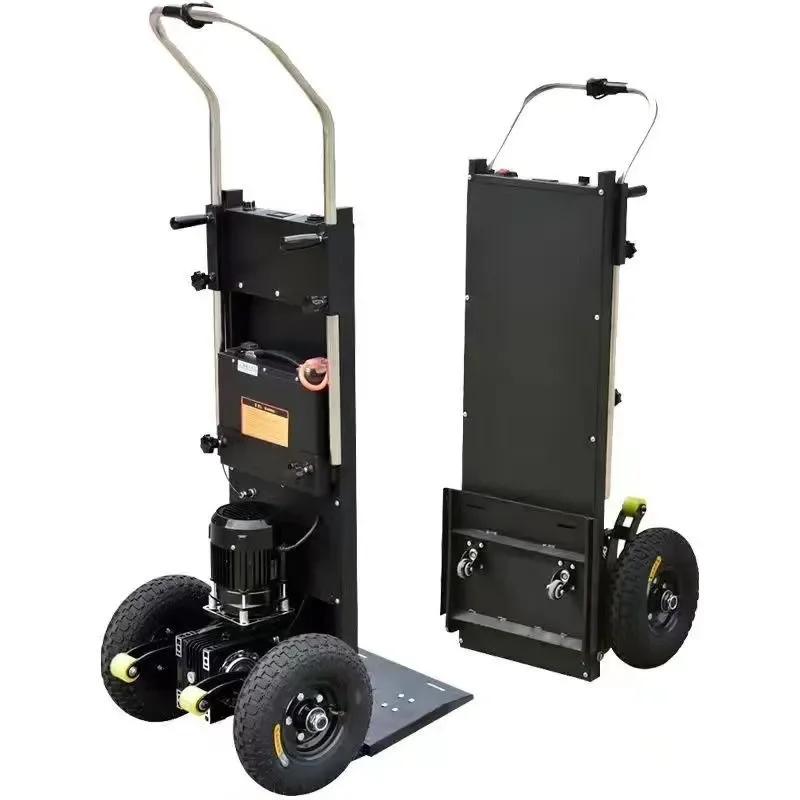
Source-controlled product identity
The Hoting queue identifies Product ID 1601277045365 as an electric stair climbing trolley listed under the title "Hand Heavy Electric Stair Climbing Trolley Load 380/400 kg Metal Climb Stair Shopping Electric Climbing Stairs Trolley Climber".
The recorded parameter block contains four entries: the product size, the folded size, the charger input and the battery. The recorded description repeats exactly those four entries under a product introduction heading, followed by empty packing, company and FAQ headings. There is no motor figure, no speed, no stair geometry, no wheel data and no load rating inside the parameter block, even though a load figure appears in the title.
This article reproduces the four recorded values without alteration, keeps the load figure where the record places it rather than treating it as a specification, and lists the questions that determine whether this machine suits a given building and cargo. Nothing below should be read as a rated capacity, a speed or a stair capability for this machine, because the record states none of those.
The recorded parameter block, in full
| Field | Value as recorded |
|---|---|
| Product Size | 54*62*122cm |
| Folded Size | 122*54*36cm |
| Charger Voltage | AC 100-240V, 50/60HZ |
| Battery | 24AH/36AH |
Three of these four entries are stated in a form that leaves a decisive question open, and each is treated separately below. The one entry that is complete as written is the product size, and even that one cannot be interpreted without knowing the axis order, which the folded size appears to contradict.
The load figure is in the title, not in the specification
The title states a load of 380/400 kg. That figure does not appear in the recorded parameter block, and the record does not say what the load range refers to.
Three readings are possible and they have different consequences. The figure may be two different load ratings belonging to two versions of the machine, which would mean a buyer must choose a version. It may be a range from a working load of 380 kg to a maximum of 400 kg, which would mean the machine is rated continuously at the lower figure. Or it may be a quotation of the maximum load of two different models in the same family, in which case the two models must differ in something else as well, such as battery capacity or motor size.
The record also does not state whether any load figure is a rated working load with a margin, or the maximum load at which the machine has been tested. On a lifting appliance that distinction is the difference between a machine that can be used all day with a safety factor and one that is at its limit on every trip.
Ask the supplier to confirm the load rating per model, to state whether it is a rated working load or a maximum test load, to state what safety factor applies, and to confirm whether the rating is for stair climbing or for level ground. A machine that is rated at 400 kg on the flat may be rated considerably lower on a staircase, because climbing loads the motor, the wheel contact and the frame differently from pushing on a level floor.
As a cross-check on what the figure implies, a powered stair climbing trolley rated for a 380 to 400 kg load belongs to the heavy end of this product family, where typical machines are rated well below that. A buyer comparing this machine with lighter alternatives should therefore expect a heavier machine, a larger battery and typically a higher price, and should verify that the frame, the wheels and the brake are consistent with such a rating rather than only the motor.
Product size and folded size: the two dimension sets disagree on axis order
The product size is recorded as 54*62*122cm and the folded size as 122*54*36cm.
Read in the same axis order, width times depth times height, the machine would be 54 cm wide, 62 cm deep and 122 cm tall when unfolded, and 122 cm wide, 54 cm deep and 36 cm tall when folded. That would mean folding the machine makes it more than twice as wide, from 54 cm to 122 cm, while reducing its height from 122 cm to 36 cm. Folding usually reduces bulk, and a folded footprint wider than the working footprint is unusual for a trolley.
A more natural reading is that the two entries list their dimensions in different orders, with the folded figure reading length first, so that the folded machine is 122 cm long and 36 cm thick. On that reading the unfolded and folded figures share two values, 54 and 122, and folding changes only the third dimension, from 62 cm to 36 cm, which is consistent with a toe plate or a frame section that folds flat.
Two readings that differ by a factor of two in the width of a folded machine are not a detail in a warehouse or a delivery van, and by itself the record cannot settle the question. Ask the supplier for a dimensioned drawing with the three axes explicitly labelled in the unfolded and the folded state, and state in the request whether the figures are to include the handle, the wheels and any protruding toe plate.
The folded figures matter for two practical reasons. First, a stair climber is usually transported to the site in a van or a small truck, so the folded footprint and the folded height decide whether it fits and how many units a vehicle can carry. Second, a folding machine has joints, and joints in a frame that carries a few hundred kilograms are a wear point, so ask how the folded position is locked and whether the lock is load-bearing.
The battery figure is incomplete without a voltage and a chemistry
The battery is recorded as 24AH/36AH. Amp-hours measure charge, not energy, and the energy a battery holds is the amp-hour figure multiplied by its nominal voltage. A 24 Ah battery at 24 V holds a different amount of energy from a 24 Ah battery at 48 V, so the recorded figure cannot be converted into a runtime, compared with an alternative machine, or used to price a replacement until the voltage is known.
The record also does not state the battery chemistry. Lead-acid and lithium batteries with the same amp-hour figure differ substantially in weight, in service life, in how they must be charged and stored, and in price. For a machine that is lifted and carried between floors and vehicles, the battery weight is part of the working weight an operator handles, so the chemistry is an ergonomic question as well as a cost one.
Ask for the nominal voltage of the battery, the chemistry, the weight of the battery, whether it is removable, and whether the machine is supplied with one battery or two. Ask also for the expected runtime under a stated load on a stated stair type, the recharge time, the number of charge cycles the battery is rated for, the cost and lead time of a replacement battery, and whether the machine can be operated while the battery is charging.
Two capacity options, 24 Ah and 36 Ah, appear in the record, which suggests they may belong to different versions of the machine. Ask which version carries which battery, and whether the larger battery is a factory option that can be specified on an order. Where a machine is offered with two battery sizes, the larger battery usually serves either a heavier load or a longer duty cycle, and the supplier should state which.
The charger is specified, but not the machine's own electrical system
The charger input is recorded as AC 100-240V, 50/60Hz. A charger with a universal input range of that kind can be plugged into most domestic and commercial supplies in the world, which is a genuine convenience for a machine that may travel between sites.
The entry describes the charger, not the machine. The record does not state the motor voltage, the motor power, the current draw or the charger output, and it does not state the plug type fitted to the charger. A charger with a 100-240 V input may still be supplied with a plug that does not suit the buyer's market, in which case the buyer either fits an adapter or re-terminates the lead, and the second option can affect both the warranty and the electrical safety of the product as supplied.
Ask for the charger output voltage and current, the input current, the plug type and, for markets that require it, whether the charger carries the relevant approval. Ask also whether the machine uses one charger for its battery type or accepts a range, and whether a spare charger is available, since on a machine used across sites a single charger is a single point of failure.
What a stair climbing trolley must state, and what this record omits
A powered stair climber is bought for one purpose, moving a load up and down stairs, and the figures that determine whether it can do that in a given building are not in the record at all.
- Motor power, motor type, and whether the machine is battery powered only or can also run from mains while working.
- Climbing speed, stated in steps or metres per minute under a stated load.
- The stair geometry the machine is designed for: minimum and maximum step height, minimum and maximum going depth, and the stair angle range.
- Wheel type and diameter, wheel material and tread, and how the wheel engages the stair edge, since grip on a bare concrete stair edge and on a stone or tiled edge differs.
- Whether the machine climbs with a rotating wheel cluster, a track, or a lifting arm, because each behaves differently at a landing and on a spiral staircase.
- Frame material, section and wall thickness, and the construction of the joints and the toe plate.
- Load platform or toe plate dimensions, and how cargo is secured, including whether straps or a ratchet set are supplied.
- The maximum load in the folded state, if the machine is intended to be moved while folded.
- Whether the machine has a brake that holds the load on a slope or a step when the operator releases the control, and how that brake is released.
- Whether there is an overload cut-out, a thermal cut-out on the motor, and an emergency stop.
- Net weight of the machine, and the weight of the battery separately, since together they determine whether one operator can handle the machine unloaded.
- Control position and type, including whether the machine can be operated from above the load on a descent.
- Ingress protection rating, and whether the machine is intended for outdoor or wet stair use.
- Noise level in operation, which matters in residential buildings.
- Certification or declaration held for the machine for the buyer's market, including any machinery safety documentation and any battery transport documentation.
- Packing: carton or crate dimensions, gross weight, and whether the battery is shipped separately, which affects air and courier shipping.
- Assembly required on arrival, and whether tools are supplied.
- Spare parts availability, including wheels, batteries, chargers and the brake assembly, with prices and lead times.
- Warranty period, coverage and the treatment of consumable parts such as wheels and batteries.
- MOQ, unit price at the target quantity, sample or trial terms, lead time and shipping terms.
Safety and compliance: what a buyer should settle before ordering
An electric stair climbing trolley carrying several hundred kilograms up a staircase is a piece of lifting and transport equipment, and the consequences of a brake failure or a runaway descent are not limited to damaged goods. The record contains no safety information of any kind.
Ask the supplier to describe the holding behaviour of the machine on a slope when the control is released, and to explain how a load is lowered in a controlled way rather than dropping. Ask which protective devices the machine has, how they are tested, and whether the machine has a rated duty cycle that limits continuous climbing.
Ask for the documentation the supplier holds for the machine, and for the buyer's own market ask a compliance adviser which approvals the machine needs as machinery, as an electrical product and as a shipment containing a battery. The record makes no compliance claim and none should be assumed from it.
Two operational questions are worth settling at the same time because they determine whether the machine is usable in a specific building. The first is whether the stairs it will be used on are straight, dog-legged or spiral, since a spiral staircase with a narrow going is a different problem from a straight flight. The second is who operates the machine: a 380 to 400 kg rated stair climber is heavy in its own right, and a single operator handling both the machine and the cargo on a staircase needs the machine to hold position on its own while the load is adjusted.
Acceptance and incoming inspection
Because the record states neither a load rating in the parameter block nor any climbing figure, the purchase order should be written from the supplier's written answers, and the delivered machine should be tested before payment is released.
On arrival, check the machine against the order for model, battery version and charger plug type, and inspect the frame, the joints and the wheels for damage in transit. Confirm the folded and unfolded dimensions with a tape measure against the labelled drawing, since the record's two dimension entries cannot both be read in the same axis order.
Then test the machine under load on the type of staircase it was bought for. Start with a partial load and confirm that the machine climbs at the stated speed and that the wheels grip the stair edge without slipping. Test the descent under load and confirm that the machine lowers the load in a controlled way when the control is released, and that the brake holds the load on a step.
Increase the load in steps towards the rated figure, and watch the motor and the battery for heating, since a machine rated at the upper end of its class may be limited in practice by its duty cycle rather than by its load. Time a realistic working cycle, such as several minutes of climbing with a load followed by a loading interval, and confirm the runtime the supplier quoted against the actual behaviour.
Test the battery on a full charge and time the recharge, and confirm that a spare battery, if ordered, is interchangeable between machines. Finally, obtain the documentation listed in the purchase order, including the manual, the dimensioned drawing and any declarations the supplier claims, and order spare wheels with the machine if they are available, since the wheels are the part that wears on every trip.
Buyer decision framework
The source for this guide is a four-entry parameter block stating a product size, a folded size, a charger input range and two battery capacities, plus a description that repeats those four entries and adds no further specification. A load figure of 380/400 kg appears in the title only and is not repeated in the specification.
The first decision is therefore whether the buyer needs a machine at this end of the range at all. A stair climber rated for a few hundred kilograms is bought where the load cannot be broken down, and if the cargo can be split across two trips a lighter and cheaper machine may do the same work with less risk to the operator. Where the load genuinely cannot be split, the load figure becomes the central specification and should be obtained in writing per model, with the meaning of the figure and the safety factor stated.
The second decision concerns the building. The step height, the going depth, the stair angle and whether the flights are straight determine whether a given machine can be used, and none of those figures is in the record. A buyer who knows the staircase should measure it before ordering and put the measurements to the supplier, rather than ordering a machine and discovering the limit on site.
The third decision concerns the battery and the duty cycle. The recorded figures of 24 Ah and 36 Ah cannot be interpreted without a voltage, so the runtime claim should be obtained in writing against a stated load and a stated stair type, and the chemistry should be confirmed because it determines the working weight an operator handles and the cost of the eventual replacement.
Where the supplier can provide a labelled dimensioned drawing, the load rating per model with its meaning, the motor and speed figures, the stair geometry limits, the battery voltage, chemistry and weight, the brake behaviour and the documentation, the machine can be evaluated on the same basis as any alternative, and a single unit for trial is a reasonable next step. Where the supplier answers only with the four recorded entries, the record does not describe a machine, it describes a battery and a carton.
Frequently asked questions
Is the load 380 kg or 400 kg?
The title states 380/400 kg and the parameter block states no load at all. The two figures may be two versions, a working load and a maximum, or two models in the same family. Ask the supplier to state the load rating per model and whether it is a rated working load or a maximum test load.
What does the battery figure 24AH/36AH mean without a voltage?
Amp-hours alone do not give energy or runtime, because energy is amp-hours multiplied by nominal voltage. The voltage and the chemistry are both absent from the record, so neither the runtime nor the replacement cost can be worked out until the supplier states them.
How do I read the two size entries?
Read in the same axis order, the folded machine would be wider than the unfolded machine, which is unusual. The two entries therefore appear to use different axis orders, and the supplier should provide a dimensioned drawing with the axes labelled in both states.
Can the machine be used on a spiral staircase?
The record does not state the stair geometry the machine is designed for, including step height, going depth and angle, and it does not state how the machine turns at a landing. Measure the actual staircase and put those figures to the supplier before ordering.
Does the machine hold the load if the operator lets go?
Not stated. The record describes no brake, no overload cut-out and no emergency stop. Ask how the machine behaves on a slope with a load when the control is released, and how a load is lowered in a controlled way.
Is the charger usable in my country?
The charger input is stated as AC 100-240V, 50/60Hz, which covers most supplies worldwide, but the plug type is not recorded. Ask for the fitted plug type and any charger approval required in the buyer's market.
What is the weight of the machine?
Not recorded, and the battery weight separately is not recorded either. Both matter, because a stair climber of this rating has to be moved to the staircase before it is loaded.
Can a load be moved while the machine is folded?
Not stated. If the folded configuration is intended for carrying loads, ask for the load rating in the folded state and how the folded position is locked, since a folding joint in the frame is a wear point on a machine of this rating.
Source and contact
This guide is based on the Hoting queue record for Product ID 1601277045365. The record carries four parameter entries, reproduced above in full and without alteration: the product size 54*62*122cm, the folded size 122*54*36cm, the charger voltage AC 100-240V, 50/60HZ, and the battery 24AH/36AH. The 380/400 kg load figure appears in the title only and is treated in this article as a claim to confirm rather than as a specification. No motor, speed, stair geometry, wheel, brake, weight, certification or compliance figure is stated for this product in this article, because the record contains none.
Request the per-model load rating with its basis and safety factor, a labelled dimensioned drawing in both the folded and unfolded states, the motor power and climbing speed, the stair geometry limits, the battery voltage, chemistry and weight, the brake and protective device description, the documentation held for the buyer's market, and the consumables prices through the TEBAK sales inquiry channel before placing an order.
Key specifications
- Product Size
- 54*62*122cm
- Folded Size
- 122*54*36cm
- Charger Voltage
- AC 100-240V, 50/60HZ
- Battery
- 24AH/36AH