
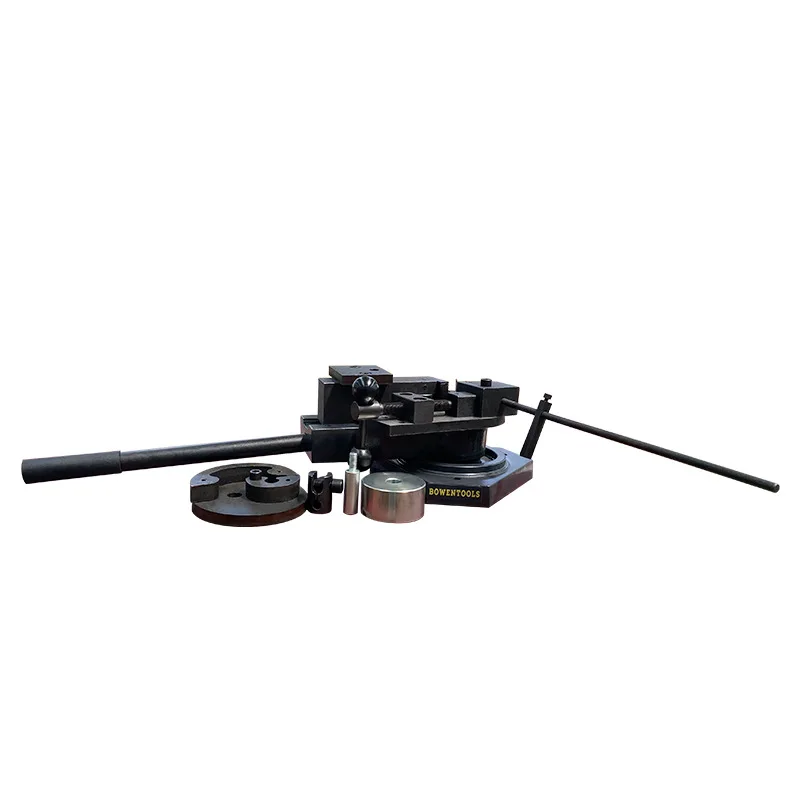
Source-controlled product identity
The Hoting queue identifies Product ID 1601283002201 as a hand-operated metal bending bar bender and universal bender. The source presents two model columns: SBG-30 and SBG-40. The recorded paired values are flat steel capacity 30 X 8 and 30 X 10 mm; round steel 15x15 and 10x10; square steel 13x13 and 10x10; packing size 55 X 30 X 22 and 50 x 32 x 23 cm; and net/gross weight 27 / 29 and 23 / 24 kg.
This guide preserves the paired source values without assuming which model has the larger capacity. The raw record does not define whether “round steel” is actually round or another translated profile, does not provide bending radius, maximum angle, tool/roller set, base fixing method, handle length, material grade or finished-part tolerances. Those details must be confirmed with the supplier and tested using the buyer’s actual stock.
The machine may suit metal workshops, fabrication shops, repair departments, custom railing work, ornamental-metal production, maintenance teams, vocational training and distributors of manual forming equipment. It is a manual tool, so procurement should evaluate operator force, repeatability, workholding, safe clearance and the quality of the bend—not only the listed section capacities.
Recorded specifications and model mapping
| Field | Recorded value | Buyer action |
|---|---|---|
| Product ID | 1601283002201 | Require this ID on the quotation, model label, inspection sheet and shipping documents. |
| Model | SBG-30 | SBG-40 | Ask the supplier to map every paired value to the exact model and provide separate drawings. |
| Flat steel capacity | 30 X 8 | 30 X 10 mm | Confirm width × thickness order, material grade, allowable bend radius and test method. |
| Round steel field | 15x15 | 10x10 | Clarify whether this is round stock, square stock or a translation error; request unit and profile drawing. |
| Square steel | 13x13 | 10x10 | Confirm whether values are side length in mm and whether hot or cold forming is intended. |
| Packing size | 55 X 30 X 22 | 50 x 32 x 23 cm | Map each carton size to a model and confirm packed orientation and accessory packing. |
| Net/gross weight | 27 / 29 | 23 / 24 kg | Confirm which pair belongs to each model and whether accessories are included. |
| Operation | Hand operated listing/source description | Request handle, force, workholding and safe operating instructions. |
| Bending performance | Not provided | Request radius, angle range, repeatability, springback guidance and sample bends. |
Choose the correct model from the workpiece, not the title
The listing title references SBG-40 and a 30x8 mm flat-steel / 13 mm square-steel combination, while the structured record contains both SBG-30 and SBG-40 values. Treat the paired table as the controlled source and ask the supplier to issue a model-specific drawing before purchase.
Prepare a stock schedule with profile type, width, thickness or side length, material grade, surface condition, cut length and required finished geometry. Mark each line as must-pass, occasional or outside scope. The correct model is the smallest configuration that safely handles the must-pass list with the required radius and repeatability.
Do not select SBG-40 solely because it appears in the marketing title. Confirm whether the buyer needs the 30 X 10 mm flat-steel value, the 13x13 square-steel value or a different combination. Ask for signed confirmation that the quotation, product label and capacity table refer to the same model.
For a distributor, keep SBG-30 and SBG-40 as separate SKUs. Do not merge their capacities, weights or cartons into one generic product sheet.
Capacity interpretation and material qualification
The source records “Capacity (mm)” for flat steel and separate fields for round and square steel. It does not provide a material grade or whether the values apply to cold or hot forming. Request the supplier’s test material, hardness range, tensile-strength assumption and acceptable surface condition.
Run a sample test with the buyer’s actual material. Record stock dimensions, grade, initial straightness, bend direction, tool position, operator method, force, final radius, angle, twist, surface marks and springback. Compare the result with a signed drawing.
Test the smallest and largest must-pass sections. If the supplier’s capacity table is based on mild steel but the buyer uses stainless, hardened or coated material, obtain a separate suitability statement. Do not extrapolate capacities across materials without evidence.
Confirm whether the tool can form a single bend, repeated bends, closed shapes, offsets, scrolls or other profiles. The term “universal” does not define the permitted geometry.
Clarify the “round steel” field
The raw value is “15x15 | 10x10”, while the label is “Round steel”. A round profile would normally require a diameter notation, so the buyer must resolve whether this field means a square-like profile, a size code, a translated label or a catalog error.
Ask the supplier for a cross-section drawing and write the answer into the purchase specification. Request separate values for round bar diameter, square bar side length and any flat bar limitation. Do not describe 15x15 or 10x10 as round-bar diameters without confirmation.
Acceptance testing should include the actual profile associated with this field. Check tool seating, rotation, surface contact and finished geometry. If the supplier cannot define the field, exclude it from the promised capacity and treat it as pending.
Radius, angle and repeatability
No bending radius, angle range or repeatability data is included in the source. These are critical for procurement because a section may fit the opening but still fail the finished-part drawing.
Request the minimum inside radius for each recorded section, the maximum practical angle, angle adjustment method, graduation accuracy and springback guidance. Ask how the operator resets the machine for repeated parts.
Make ten or more repeat bends from the buyer’s production stock. Measure angle, radius, twist and length location. Record whether the operator must mark every piece and whether the tool requires a fixed stop, jig or template.
Do not infer production repeatability from the manual operation or from the word “universal”. If repeatability is important, price the required stop, fixture or dedicated tooling as a separate line.
Workholding and installation
The source does not state how the bender is fixed. Ask whether it is intended for a bench, floor, vise or dedicated frame. Request mounting-hole dimensions, clamp points, base footprint, recommended bench thickness and anchor requirements.
Review the packed dimensions separately from the operating envelope. The SBG-30 pair is recorded as 55 X 30 X 22 cm and 27 / 29 kg; the SBG-40 pair is recorded as 50 x 32 x 23 cm and 23 / 24 kg, but the source does not explicitly map these pairs. Confirm the mapping before planning lifting and storage.
At installation, provide space for the handle sweep, stock overhang, operator position and safe clearance. A compact carton does not imply a compact working envelope.
Ask for the unboxed machine dimensions, handle length, center of force, lifting points and recommended number of operators for moving each model.
Manual force and operator safety
A hand-operated bender transfers forming force through a handle, lever or screw mechanism. The source provides no force or handle data. Request handle length, mechanical advantage, maximum recommended force, pinch-point locations and safe grip areas.
Train operators to keep hands away from dies, rollers, pivots and the stock path. Secure the machine before applying force and keep bystanders outside the handle sweep. Do not extend the handle with an unapproved pipe or use impact tools unless the supplier expressly allows it.
Inspect the frame, pins, dies, rollers, locking parts and handle before each shift. Stop if the stock slips, the tool binds, a pin bends or the frame moves on the bench.
Ask for a safe operating manual and maintenance schedule. Confirm grease points, wear limits, replacement parts and the procedure for changing or adjusting forming tools.
Packaging, weight and logistics checks
The source records two packing-size pairs and two net/gross-weight pairs. Confirm which values belong to SBG-30 and SBG-40 and whether gross weight includes all tools, manual, pallet, carton and protective materials.
Request external carton markings, model label, package count, lifting orientation and moisture protection. Photograph the carton before opening and record any impact or water damage.
After unpacking, verify the machine weight and dimensions against the signed packing list. Check that all pins, rollers, dies, handles, fasteners and tools are present. Do not approve a shortage based on a generic packing photograph.
For freight planning, use confirmed packed dimensions and gross weight, not the title or an unverified model mapping. Ask for a final commercial invoice and packing list that identify the selected model.
Factory acceptance test proposal
- Verify Product ID 1601283002201 and the exact selected model, SBG-30 or SBG-40.
- Verify the supplier’s model-specific drawing, capacity table, manual and BOM.
- Map every paired value to the selected model before signing the inspection sheet.
- Confirm flat-steel width × thickness and the test material grade.
- Resolve the “round steel 15x15 | 10x10” label with a cross-section drawing.
- Confirm square-steel values 13x13 and 10x10 and their units.
- Test the smallest and largest must-pass sections using buyer-supplied stock.
- Measure inside radius, angle, springback, twist, surface marks and bend location.
- Repeat at least ten bends to assess operator method and repeatability.
- Verify workholding, mounting points, bench or floor requirements and handle clearance.
- Confirm handle force, pinch points, safe grip areas and approved operating method.
- Verify packing size and net/gross weight for the selected model.
- Check dies, rollers, pins, stops, handles, tools, manuals and spare parts.
- Record acceptance limits, warranty, correction procedure and service response.
RFQ checklist
- Product ID 1601283002201 and selected model SBG-30 or SBG-40.
- Separate model drawing, capacity table, photos, manual, BOM and quotation.
- Flat-steel capacity with width × thickness order, material grade and bend radius.
- Definition and unit of the “round steel 15x15 | 10x10” field.
- Square-steel capacity 13x13 | 10x10 and confirmation of side-length units.
- Minimum inside radius, angle range, springback and repeatability data.
- Die, roller, pin, stop and fixture configuration for each profile.
- Handle length, forming force, workholding, mounting and bench requirements.
- Packing size 55 X 30 X 22 | 50 x 32 x 23 cm mapped to models.
- Net/gross weight 27/29 | 23/24 kg mapped to models and accessories.
- Unpacked dimensions, handle sweep, stock overhang and maintenance clearance.
- Spare parts, wear limits, lubrication, manual, warranty and training.
- Packaging, inspection photographs, shipping marks and delivery documentation.
Safety and compliance
Manual forming equipment presents pinch, crush, shear and stored-force hazards. Secure the bender before use, keep the work area clear and keep hands out of the tool path. Isolate the tool before changing a die, pin, roller or stop.
Do not exceed the supplier’s confirmed section capacity or use unknown stock materials. Never extend the handle with an unapproved lever or strike the mechanism with a hammer unless the manufacturer’s instructions permit it.
Wear suitable eye protection, work gloves selected for the task and protective footwear. Gloves must not create an entanglement risk around rotating or pivoting parts. Use proper lifting technique for the confirmed gross weight.
Request destination-market machinery documents and a model-specific manual. The source does not provide CE, ISO or other certification, so none should be claimed without matching evidence.
Buyer decision framework
This candidate provides two recorded models, SBG-30 and SBG-40, with paired section capacities, packing sizes and weights. The source is useful for initial RFQ comparison, but the unclear “round steel” label and absent bending-radius data make a sample test essential.
Approve the purchase only after the supplier maps all values to the correct model, defines the profile fields and confirms the buyer’s material, radius, angle, workholding, safety method and repeatability requirement. For a distributor, keep the two models and their logistics data separate.
Frequently asked questions
What are the recorded models?
The queue lists SBG-30 and SBG-40. Ask for separate model drawings and confirm which paired capacity, weight and carton data belongs to each.
What flat steel can they handle?
The record shows 30 X 8 and 30 X 10 mm. Confirm the model mapping, material grade, bend radius and whether the value is for cold forming.
What does 15x15 round steel mean?
The field is labeled round steel but uses a two-dimensional notation. Request a cross-section drawing and do not assume a diameter.
Are the packing dimensions the machine dimensions?
The field is labeled packing size, so it should be treated as package data until the supplier provides unboxed dimensions and operating clearance.
Is it suitable for repeated production?
It is hand operated and the source provides no repeatability or duty-cycle data. Run a repeated sample test with the buyer’s actual stock and define an acceptance tolerance.
Source and contact
This guide is based on the Hoting queue record for Product ID 1601283002201. Recorded fields are SBG-30 / SBG-40; flat steel 30 X 8 / 30 X 10 mm; round steel 15x15 / 10x10; square steel 13x13 / 10x10; packing size 55 X 30 X 22 / 50 x 32 x 23 cm; and net/gross weight 27 / 29 / 23 / 24 kg as paired in the source record. Before purchase, request model-specific drawings, sample bends, material limits, radius and angle data, safety instructions, spare parts, warranty and destination-market compliance documents through the TEBAK sales inquiry channel.
Key specifications
- Model
- SBG-30 | SBG-40
- Capacity (mm) - Flat steel
- 30 X 8 | 30 X 10
- Round steel
- 15x15 | 10x10
- Square steel
- 13x13 | 10x10
- Packing size (cm)
- 55 X 30 X 22 | 50 x 32 x 23
- N.W./G.W. (kg)
- 27 / 29 | 23 / 24