
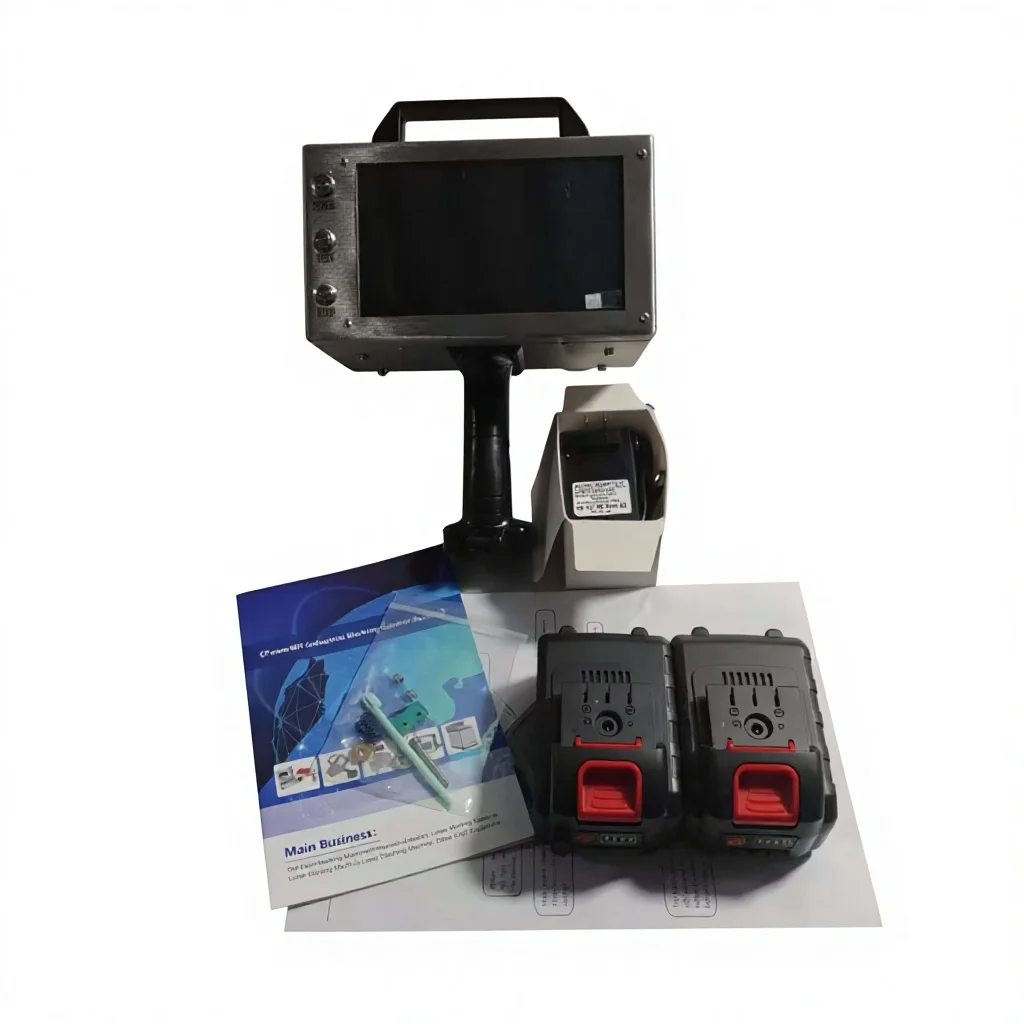
The model number in the title is not in the catalogue
The title of this listing ends in XY/SD-4-9030. The description calls the machine TEBAK XY-24 16040/16090. The six-model comparison panel inside the same listing lists XY/SD-1, XY/M2-D, XY/M6-D, XY/BD-2, XY/SD-3 and XY/TD-2. There is no SD-4 in it, and no XY-24 anywhere.
That is not a detail to shrug at. A dot peen marker is bought once and then used for a decade, and every spare part, every pin, every spring and every software question after the sale is answered by quoting the model number. If the number on the invoice does not exist in the manufacturer's own table, the buyer has no reference point when something wears out.
This guide does the work the listing does not: it puts the six real models side by side, reads the parameter table properly, works out what the published numbers mean for actual marking jobs, and lists the specifications that are missing — because those are the ones that decide whether the machine suits your work.
The six-model table, transcribed exactly
One panel in the listing compares models on four attributes: print range, engraving depth, machine size, and whether the customer has to supply a computer. Transcribed without alteration:
| Model | Print range (mm) | Depth (mm) | Machine size (mm) | Customer computer | Stated application |
|---|---|---|---|---|---|
| XY/SD-1 | 90 × 30 | 0.1–1.0 | 160 × 170 × 280 | Computer | Moulds, workpieces, oxygen cylinders |
| XY/M2-D | 200 × 120 | 0.1–1.0 | 300 × 215 × 325 | Computer | Copper, iron, aluminium and stainless nameplates |
| XY/M6-D | 200 × 120 | 0.1–1.0 | 300 × 215 × 325 | None | Nameplates in the same metals, standalone |
| XY/BD-2 | 160 × 80 | 0.1–1.0 | 275 × 165 × 284 | None | Flat metal, steel plate, assorted workpieces |
| XY/SD-3 | 90 × 30 | 0.1–1.0 | 167 × 115 × 274 | None | Metal parts, moulds, large workpieces, oxygen cylinders |
| XY/TD-2 | 160 × 90 | 0.1–1.0 | 365 × 360 × 750 | None | Small workpieces, moulds, assorted parts |
Three things jump out of that table before any analysis.
First, engraving depth is identical on all six — 0.1–1.0 mm. The models are not differentiated by how deep they hit; they are differentiated by working envelope, physical size and whether they need a PC.
Second, two models require a customer-supplied computer (XY/SD-1 and XY/M2-D) and four do not. Every marketing panel in the listing shouts "no need for computer" — which is true of four of the six, and false of the two that appear first in the table.
Third, the same print range appears at wildly different machine sizes. XY/SD-1 and XY/SD-3 both claim 90 × 30 mm, but one is 160 × 170 × 280 mm and the other 167 × 115 × 274 mm. Meanwhile XY/TD-2 claims 160 × 90 mm from a 365 × 360 × 750 mm body. Print range does not tell you how big the machine is, and machine size does not tell you what it can mark.
What the parameter table adds — and it adds real numbers
A second panel, headed "Product Parameters", is where the electrical and performance data lives. Its rows, in order:
| Parameter | Value as published |
|---|---|
| Marking range | 90 × 30 mm / 120 × 30 mm |
| Marking depth | 0.1–1.0 mm (depending on the material) |
| Marking speed | 1–3 characters per second |
| Power | <120 W |
| Vibration frequency | Maximum 200 Hz |
| Battery voltage | 18–24 V (wide voltage) |
| Input mode | Touch screen input |
| Marking direction | Optional up, down, left, right, various radians, dot matrix |
| Tag content | English characters, Arabic numerals, Chinese characters, graphics, automatic serial increment; barcode optional; CAD import |
| Software system | Windows-style interface |
| Display | Marking effect visible on screen; progress traceable |
| Memory | Automatic memory of settings (speed, content) |
| Counting | Automatic count of printed content |
This is unusually complete for a listing of this kind — most publish a photo and a wish. But note the collision: the parameter table says the marking range is 90 × 30 or 120 × 30, while the six-model panel quotes ranges of 200 × 120, 160 × 80 and 160 × 90. Both cannot describe the same machine. The 90 × 30 figure lines up with the two SD models and with the "9030" in the title; the 200 × 120 figure lines up with the two M models. So the parameter table appears to describe the handheld/portable family, not the whole range — a reasonable reading, but the listing never says so.
What 1–3 characters per second means for a real job
Marking speed is the one published figure that converts directly into labour cost, so it is worth doing the arithmetic rather than nodding at it.
A vehicle identification number is 17 characters. At the top of the published range — 3 characters per second — that is about 5.7 seconds of marking. At the bottom — 1 character per second — it is 17 seconds. A three-character date code is 1–3 seconds. An engine number of 13 characters sits between 4.3 and 13 seconds.
Those are marking times only. They exclude positioning the head, focusing the pin, confirming the preview on screen, and moving the machine to the next unit — which in a workshop are usually larger than the marking itself. The honest way to use the number is as a floor: no VIN plate can be marked faster than 5.7 seconds with this class of machine, and if a supplier promises considerably more, ask what depth they achieved at that speed.
One caveat that matters commercially: "1–3 characters per second" is a range, not a guarantee. Nothing in the listing says at what depth the 3-per-second figure holds, or on which metal. Speed and depth trade against each other in every impact marker — the deeper the pin drives, the slower the carriage can advance. When you quote a cycle time to your own customer, quote the slow end.
Depth 0.1–1.0 mm, and why the catalogue cannot give you a setting
The depth range is published identically for all six models with the qualifier "depending on the material". That qualifier is doing a lot of work.
Dot peen depth is a function of three things: how hard the workpiece is, how much power the solenoid delivers, and how fine the pin tip is. Aluminium at 0.5 mm and stainless at 0.5 mm are not the same operation. So a table that lists one depth range for a machine that marks "various shapes and materials" is telling you the machine's capability envelope, not a recipe.
The practical consequence is that the first article you mark on a new material is a trial, not a production part. Set the depth conservatively, mark a scrap piece of the same alloy and temper, measure, then commit. Any supplier who offers to ship with "the correct settings for your material" without asking for the alloy, the hardness and the required legibility standard is guessing.
For traceability work there is a second question the listing never touches: repeatability. Depth readings of 0.1 mm and 1.0 mm are 10× apart, and a machine that hits 0.4 mm on one stroke and 0.7 mm on the next will fail a customer audit even though every mark is inside the published range. Ask for the depth tolerance, not just the range.
Power under 120 W at 18–24 V: what it implies, and the number that is missing
The electrical row is unusually specific: under 120 W, battery voltage 18–24 V, described as "wide voltage". Two useful derivations follow, plus one hard gap.
Current draw. At 120 W and 18 V the machine pulls about 6.7 A; at 24 V, about 5.0 A. That is the peak figure the wiring and the battery's protection circuit have to carry, and it tells you these are not toy packs — this is a tool-grade current.
Why "wide voltage" matters. An 18–24 V window means the machine tolerates both a nominal 18 V and a nominal 24 V pack, and keeps working as the pack sags under load. For a field tool used on a chassis in a yard, that tolerance is more valuable than a higher peak.
The gap: capacity is never published. The listing shows two slide-on packs, a four-LED charge indicator and a separate charger, but never states amp-hours. Without Ah, runtime cannot be calculated — and runtime is the single number that decides whether one pack marks a whole shift of chassis numbers or twenty plates. Do not estimate it from the photographs; ask for the Ah rating and a measured marks-per-charge figure at your depth and your material.
Standalone or tethered: the column that decides where the machine can go
The "Customer-owned: Computer" column is the most commercially important line in the six-model table, and it is easy to skim past.
XY/SD-1 and XY/M2-D require a computer. That means a PC on the bench, a cable run, software installed and maintained, and a machine that cannot leave the bench. XY/M6-D looks identical to XY/M2-D in print range and machine size but requires no computer — it carries its own screen and input. XY/BD-2, XY/SD-3 and XY/TD-2 are likewise standalone.
For a workshop marking nameplates at a fixed station, a tethered model is fine and often cheaper to run, because a real keyboard and a real screen beat a 7-inch touch panel for entering long part numbers. For anything that has to travel — a vehicle chassis in a yard, an oxygen cylinder in a rack, a mould still in the press — only the standalone models are relevant, and the choice narrows to XY/BD-2, XY/SD-3 and XY/TD-2.
Note also what "standalone" does not mean here: it does not mean wireless. The listing calls the tool "handheld wireless" in its title, but the only wireless element it documents is the battery. Nothing in the parameter table claims Wi-Fi, Bluetooth or a radio link to a host system, and the "barcode optional" row refers to marking barcodes, not scanning them.
The application photographs are the most useful evidence in the listing
The gallery includes actual marked parts, and they are worth reading closely because they show what the machine is really used for:
- VIN and chassis numbers — two 17-character strings including star delimiters, marked into dark, slightly rusted steel. The star form is the standard VIN framing, which tells you the machine is expected to reproduce punctuation as well as characters.
- Engine and unit numbers — a 19-digit string and a shorter alphanumeric code, both marked into machined surfaces.
- Tyre sidewall data — a size marking plus a DOT-style date block, marked into rubber-adjacent surfaces.
- Logos and word marks — a three-pointed star device and a five-letter brand name, both rendered as graphics rather than text.
Two conclusions follow. The graphics samples prove the "CAD import" and "graphics" rows are real capabilities, not brochure filler — reproducing a logo requires vector import, not a font. And the VIN samples prove the intended duty cycle is short strings at moderate depth on curved or awkward parts, which is exactly the job a handheld unit does and a bench unit struggles with.
What the photographs do not show: the depth achieved on any of those samples, the time each took, or whether the same machine produced all of them. Treat them as evidence of capability, not as a performance record.
The numbers the listing never states
This is the list to take into negotiation. None of these appears anywhere in the listing, and every one of them affects whether the machine earns its price:
- Weight — decisive for a handheld tool used overhead or inside a chassis. Not published for any of the six models.
- Battery capacity in Ah, and marks per charge — without these, runtime is unknown (see above).
- Marking force or impact energy — the depth range is given, the force that produces it is not.
- Stroke rate under load — 200 Hz is the maximum vibration frequency, but nothing says how it falls off as depth increases.
- Noise level — impact marking is loud. No dB figure is given, and this matters for workplace compliance in many markets.
- Pin, spring and solenoid life — consumable life is the main running cost of a dot peen machine.
- Spare parts list and part numbers — none published, which is the practical problem created by the SD-4 model number in the title.
- Software requirements for the two PC-tethered models — operating system, port, licence.
- Depth tolerance and repeatability — only the range is given.
- Warranty terms and after-sales scope — the listing claims "life-long maintenance" without defining it.
Incoming inspection for the first unit
Before the machine goes into production, run this sequence. It takes an hour and it is the difference between finding a problem in week one and finding it in month six.
- Confirm the model number against the six-model table. Photograph the nameplate. If it reads SD-4 or XY-24, ask the supplier to reconcile it with the published table in writing before accepting the goods.
- Measure the machine against the published size for that model. A 160 × 170 × 280 mm unit and a 365 × 360 × 750 mm unit are not interchangeable on a bench.
- Verify the print range by marking a full-envelope test: a 17-character VIN at the left edge, the right edge, top and bottom of the claimed area. Edge characters are where range claims fail.
- Measure depth on your own material, at three settings, with a depth gauge or a profile projector. Record the numbers; they become your production baseline.
- Time a real job — 17 characters, start to finish, including positioning. Compare with the 5.7–17 second marking floor.
- Check the battery end-to-end: charge both packs, then run marks until cutoff and record the count. This is the runtime figure the listing withheld.
- Test the graphics path: import a vector logo and a barcode, mark both, and scan the barcode back. "Optional" barcode support often means an extra-cost licence.
- Verify serial increment and auto-count across a 20-piece run, then power-cycle and confirm the count survived the memory.
- Inspect the pin and spring for burrs, and confirm you received spares. Ask for the part numbers in writing.
RFQ checklist
Send this as a table, not as prose. Suppliers answer tables; they ignore essays.
| Item to confirm | Why it changes the order |
|---|---|
| Exact model designation and its match to the six-model table | Determines spare parts and software support for the machine's life |
| Print range for the specific unit, in mm | 90 × 30, 120 × 30, 160 × 80, 160 × 90 and 200 × 120 all appear in the same listing |
| Standalone or PC-tethered | Decides whether the machine can leave the bench |
| Machine size and weight | Weight is unpublished and decides handheld usability |
| Depth achievable at production speed, on your alloy | Depth and speed trade off; the range is not a setting |
| Depth tolerance / repeatability | Customer audits test consistency, not range |
| Battery: voltage, Ah, chemistry, marks per charge | Runtime is the missing number in the listing |
| Charger input voltage and plug type | Destination-country compatibility |
| Noise level in dB(A) at operator position | Workplace compliance |
| Pin, spring and solenoid life, with part numbers | Main running cost and the SD-4 problem |
| Software: OS, port, licence, updates | Only relevant if you buy a tethered model |
| Barcode option: included or extra cost | "Optional" is not a price |
| Spare pin and spring kit in the box | Downtime on day two otherwise |
| Warranty duration and what "life-long maintenance" covers | The claim is currently undefined |
| Packaging and export carton dimensions | Freight cost on a 365 × 360 × 750 mm unit |
Which model fits which shop
Reading the table against real work, the six models sort into four jobs:
Vehicle and chassis marking in the field. The title of this listing points here, and the only standalone unit with the 90 × 30 mm range in a 167 × 115 × 274 mm body is XY/SD-3. It is the model that matches the described use. Confirm with the supplier that the SD-4 in the title is intended to be this machine, and get it in writing.
Nameplates at a fixed bench, long part numbers. XY/M6-D gives 200 × 120 mm standalone, which is the widest envelope without a PC. XY/M2-D is the same envelope with a PC — choose it only if you want a full keyboard and your own software workflow.
Flat plate and general workpieces. XY/BD-2 at 160 × 80 mm, standalone, in a 275 × 165 × 284 mm body — the middle option when 90 × 30 is too small and 200 × 120 is more than you need.
Small parts in volume on a fixture. XY/TD-2, the column machine with a 365 × 360 × 750 mm frame and a 160 × 90 mm envelope. It is not handheld despite the listing's title, and it is the only one of the six built around a base plate rather than a hand grip.
What we will and will not quote from this page
Everything in this guide is either transcribed from the listing's own panels or calculated from those transcriptions, and the calculations are shown so you can check them. We have deliberately not converted the 90 × 30 mm range into "about 3.5 × 1.2 inches and therefore A5-ish", because rounding a working envelope is how buyers end up one character short at the edge of a plate.
We also will not quote a price, an MOQ or a lead time on this page, because the listing publishes none and we are not going to invent a range that then becomes an anchor in your negotiation. Pricing for this family depends on which of the six models you take, what battery configuration ships, whether the barcode licence is included, and how the unit is crated for export — four variables that routinely move the total by more than the machine-to-machine difference.
If you send the RFQ table above with your material, your string length and your destination, the answer comes back as a configured quotation rather than a brochure number.
The one-line summary
Buy this machine by the six-model table, not by the title. The table tells you the working envelope, the physical size and whether you need a computer; the title tells you a model number that does not exist and two dimensions that belong to a different machine. Depth is the same 0.1–1.0 mm on all six, speed is 1–3 characters per second on all six, and the number that actually decides whether the tool survives a shift — battery capacity — is the one number the listing never prints.
Key specifications
- Brand
- TEBAK
- Applicable object
- metal
- Product size
- 160*90MM
- Print height
- 20
Frequently asked questions
- What is the difference between the six models in this listing?
- The six models differ in print range, machine size and whether a customer computer is required — not in depth, which is published as 0.1–1.0 mm for all of them. Print ranges run from 90 × 30 mm (XY/SD-1, XY/SD-3) to 200 × 120 mm (XY/M2-D, XY/M6-D). XY/SD-1 and XY/M2-D need a PC; the other four are standalone.
- The title says XY/SD-4-9030. Which model is that?
- It is not in the manufacturer's six-model table, which lists XY/SD-1, XY/M2-D, XY/M6-D, XY/BD-2, XY/SD-3 and XY/TD-2. The 9030 suffix matches the 90 × 30 mm print range of the SD models, and the described use — handheld marking of a vehicle chassis — points to XY/SD-3. Ask the supplier to confirm the designation in writing before ordering, because spares are ordered by model number.
- How long does it take to mark a VIN?
- At the published 1–3 characters per second, a 17-character VIN takes about 5.7 seconds at the top of the range and 17 seconds at the bottom. That is marking time only; positioning and setup are additional. Quote the slow end when you commit to a cycle time, because the listing does not state at what depth the fast figure holds.
- What depth can it mark, and can I set it for my material?
- The published range is 0.1–1.0 mm, qualified as depending on the material. The listing gives no setting table by alloy, so the first article on a new material is a trial: mark a scrap piece of the same alloy and temper, measure, then commit. Repeatability — not the range — is what customer audits check, and it is not published.
- How long does a battery last?
- That cannot be calculated from the listing. It publishes 18–24 V wide voltage and under 120 W, which implies roughly 5.0 A at 24 V and 6.7 A at 18 V, but it never states the amp-hour capacity of the packs. Ask for the Ah rating and a measured marks-per-charge figure at your depth and material.
- Do I need a computer to run it?
- It depends on the model. XY/SD-1 and XY/M2-D require a customer-supplied computer. XY/M6-D, XY/BD-2, XY/SD-3 and XY/TD-2 are standalone with touch-screen input. If the machine has to leave the bench, only the standalone four are candidates.
- Can it mark logos and barcodes, not just text?
- Yes, per the parameter table: the tag content row lists graphics and CAD import, and the application photographs show a three-pointed star device and a five-letter word mark marked as graphics. Barcode is listed as optional, which usually means an extra-cost licence — confirm that before ordering.
- What should I check when the machine arrives?
- Photograph the nameplate and reconcile the model number with the six-model table, measure the machine against the published size, mark a full-envelope test with characters at all four edges, measure depth on your own material at three settings, time a 17-character job, run both battery packs to cutoff and count the marks, and confirm the spare pin and spring kit arrived with part numbers.