
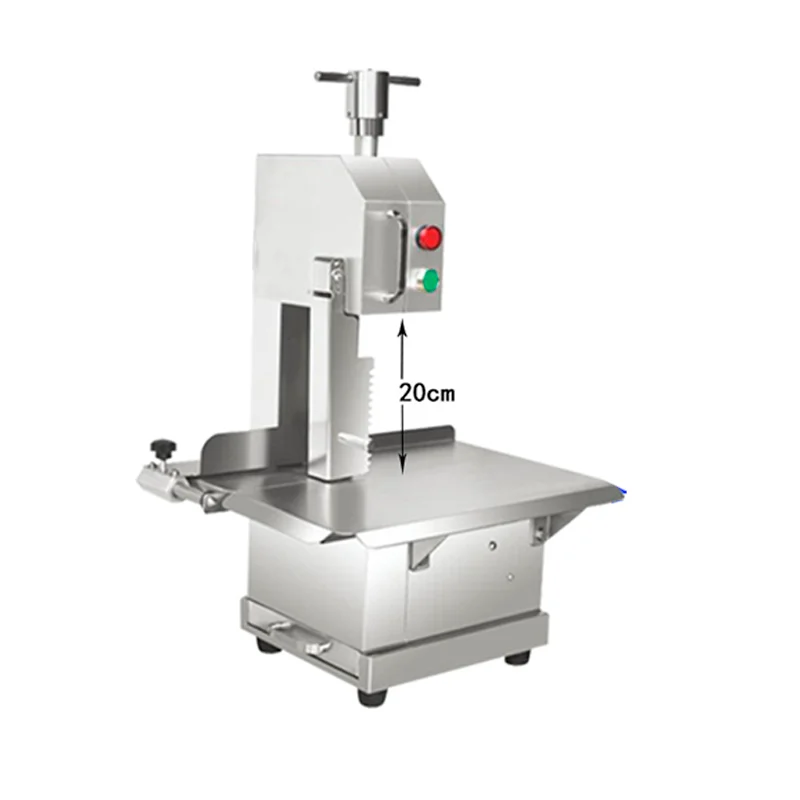
Source-controlled product identity
The Hoting queue identifies Product ID 1601251260733 as a heavy frozen electric saw for meat, fish and bone cutting. The source title also uses the phrases automatic bone cutting machine, butchers bone saw machine and meat saw machine. The source record contains no structured parameter rows.
This guide therefore treats the product as a supplier-qualification lead, not as a verified machine specification. It is intended for B2B buyers evaluating industrial meat saws, frozen food saws, fish processing equipment and bone cutting machines.
The source confirms the product naming and the intended product family only. It does not confirm cutting capacity, blade size, motor rating, electrical supply, table dimensions, construction material, protection rating, throughput, temperature range, sanitation design, safety certification or food-contact compliance.
What is and is not confirmed
| Field | Source status | Buyer action |
|---|---|---|
| Product ID | 1601251260733 | Keep this ID on the quotation, drawing, inspection report and shipping documents. |
| Product family | Heavy frozen electric saw | Confirm the exact model code and whether the quoted unit is for frozen food, fresh food, bone, fish or mixed use. |
| Named applications | Meat, fish and bone cutting | Request a material-specific capability statement and witnessed test cuts. |
| Automation wording | Title includes automatic bone cutting machine | Define which actions are automatic and which require operator feeding, positioning or blade control. |
| Equipment description | Butchers bone saw machine / meat saw machine | Confirm whether the machine is a band saw, circular saw or another mechanism. |
| Technical parameters | No structured parameters supplied | Request a signed technical data sheet before approving a purchase order. |
| Compliance | No certification listed | Request model-specific machinery, electrical, food-contact and destination-market documents. |
Define the cutting job before requesting a quotation
A meat and bone saw should be selected from the material and cut profile, not from the word heavy alone. Describe the products to be cut, including species, frozen or chilled condition, approximate temperature, density, bone content, dimensions, weight, surface condition and required cut thickness.
For frozen material, record the coldest expected product temperature and whether the material is block-frozen, individually frozen or partially thawed. Ask the supplier to state the tested temperature range. Do not assume that the word frozen establishes a safe operating range.
For fish, record whole-fish dimensions, skin, scales, bones, moisture and whether the product is raw or processed. For meat, identify carcass sections, bone hardness, fat content and expected contamination controls. For bone, describe the largest cross-section and whether the material is fresh, frozen or partially thawed.
State the required finished cut: slices, portions, blocks, sections or irregular pieces. Give the target thickness, tolerance, acceptable surface quality, maximum waste and whether the cut must be repeated at a fixed dimension.
Ask the supplier to separate nominal capacity from guaranteed capacity. Capacity should be expressed with material type, temperature, dimensions, operator method, cut thickness, duty cycle and acceptable yield. A generic pieces-per-hour claim is not comparable without these conditions.
Machine architecture and blade system
The source does not identify the saw architecture. Confirm whether the machine uses a continuous band blade, circular blade, reciprocating blade or another cutting system. Request a labeled drawing showing the blade path, wheels, guides, guards, table, feed zone, tension system and drive.
For a band saw, request blade length, width, thickness, tooth pitch, material, weld quality, tension range, wheel diameter, guide design and replacement procedure. Confirm whether different tooth profiles are approved for frozen meat, fish and bone.
For any other saw architecture, request the blade diameter or stroke, cutting speed, guard position, blade-change steps and approved consumables. Confirm which parts are included in the quoted configuration and which are optional.
Request the maximum cutting height, maximum cutting width and table or throat dimensions. These values are not supplied in the source record. Verify them using a representative product rather than an empty table measurement.
Test blade tracking, tension retention, straightness, cut drift, tooth breakage, vibration and surface finish. Record whether the machine remains stable when the material changes from frozen fish to bone or dense meat.
Electrical and drive requirements
The source provides no voltage, frequency, phase, current, motor power or control-panel specification. Ask for the rated electrical supply for the exact model, including voltage tolerance, frequency, phase, full-load current, starting current and recommended protection.
Request motor model, continuous and peak power, duty cycle, drive transmission, overload protection, thermal protection and restart behavior after a power interruption. Clarify whether the title's automatic wording refers to a powered feed, a control sequence or only the motorized blade.
Ask for a wiring diagram, terminal requirements, breaker recommendation, grounding method, emergency-stop circuit and ingress protection rating. Check whether the control enclosure is suitable for the washdown conditions of the intended facility.
At factory acceptance, run the machine at the declared supply while monitoring startup, loaded cutting, stopping, restart prevention and motor temperature. Record measured current and compare it with the supplier's data sheet.
Food hygiene and cleanability
Food processing buyers should define sanitation requirements before purchasing. The source does not state frame material, table material, weld finish, seals, bearings, drainage, removable guards or food-contact status.
Request a material schedule identifying stainless-steel grades, polymer grades, elastomers, lubricants and any painted or coated surfaces. Ask which parts directly contact meat, fish or bone and which parts are outside the product zone.
Inspect corners, welds, fasteners, blade guides, table joints and drain paths. Avoid designs that trap product residue, cleaning chemicals or standing water. Confirm whether components can be removed without exposing operators to an unguarded blade.
Request the supplier's cleaning and sanitation procedure, including permitted water pressure, water temperature, chemical concentration, contact time, drying method and lubrication points. Do not infer washdown suitability from stainless appearance.
Define allergen, cross-contamination and product-changeover controls. If the same machine will process fish, meat and bone, ask for the validated cleaning sequence and any components that require dedicated replacement.
Operator safety and guarding
A powered saw presents cutting, entanglement, pinch, ejection and unexpected-start risks. Confirm that the machine has fixed and interlocked guards, a reachable emergency stop, blade access control and a defined safe method for clearing a jam.
Ask for the safe distance from the operator position to the blade, guard adjustment range, blade exposure limits, push tools, product clamps and anti-slip surfaces. Confirm whether two-hand controls, presence sensing or other protective functions are part of the exact configuration.
Test the emergency stop during unloaded and controlled loaded conditions. Record stopping time, blade run-down, restart prevention, alarm behavior and the reset process. A stop button that does not prevent automatic restart is not an adequate response to a power interruption.
Request a risk assessment, operating manual, maintenance manual and training material. Confirm required personal protective equipment and the limits of PPE; gloves should not be treated as a substitute for guarding or safe work procedures.
Ask how the machine behaves when the blade breaks, loses tension, stalls, overheats or encounters a hard obstruction. Confirm containment of broken blade fragments and the inspection steps before returning the machine to service.
Frozen product handling
Frozen product changes cutting force, blade loading and surface grip. Request tests at the coldest product temperature expected in the buyer's operation, not only at room temperature or a partially thawed condition.
Record product dimensions, support method, feed force, blade speed, cut thickness, cycle time, surface quality and waste. Compare a dense bone section, a frozen meat block and a fish product if all three applications are planned.
Confirm whether condensation, frost, meltwater and cleaning moisture affect the table, guards, electrical enclosure or blade guides. Ask for an operating limit for ambient temperature and humidity.
Define defrosting and changeover procedures. If a product must be tempered before cutting, document the required time and temperature and do not describe the machine as capable of fully frozen cutting without a supplier test.
Capacity and line integration
Request capacity in a format that can be audited: kilograms per hour, pieces per hour, cut thickness, material temperature, product dimensions, operator count, working time and planned pauses.
Clarify whether loading is manual, whether the product is clamped, whether the feed is powered and how finished pieces leave the cutting zone. If the listing says automatic, request a process diagram showing every automatic step.
Confirm upstream and downstream equipment, including conveyors, scales, portioning, packaging, metal detection and sanitation areas. Provide floor plan, access route, doorway size, drainage, utilities, noise limits and production schedule.
Measure the proposed machine's footprint, working clearances, service access and removal route. The source contains no dimensions or weight, so these must be supplied before installation planning.
During a line trial, record available time, productive cutting time, cleaning time, blade changes, jams, rework, rejects and operator interventions. Use these values to calculate practical capacity rather than relying on a headline figure.
Factory acceptance test
- Verify Product ID 1601251260733, exact model code, serial number and quoted configuration.
- Identify the saw architecture and verify the blade drawing, blade specification, guides, wheels, guards and tension system.
- Verify rated voltage, frequency, phase, current, motor power, controller and protection devices.
- Measure maximum cutting height, width, throat or table size, footprint, working clearance and machine weight.
- Run approved meat, fish and bone samples at the declared temperatures and dimensions.
- Record cut thickness, tolerance, cut drift, surface quality, waste, cycle time and operator interventions.
- Test the exact blade or approved blade set for each material; record wear, tooth damage and replacement time.
- Test guards, interlocks, emergency stop, restart prevention, jam recovery and broken-blade response.
- Inspect stainless grades, food-contact materials, weld finish, drainage, seals and cleaning access.
- Run the supplier's sanitation procedure and inspect for residue, standing water and inaccessible zones.
- Measure electrical current, motor temperature, noise, vibration and stopping time.
- Confirm cleaning chemicals, washdown limits, lubrication points and required spare parts.
- Verify manuals, risk assessment, training, maintenance schedule and destination-market certificates.
- Attach test photographs, measured results, serial numbers, approved samples and deviations to the purchase record.
RFQ checklist
- Product ID 1601251260733, exact model, machine type and intended application.
- Material, product temperature, dimensions, weight, bone content, cut thickness and tolerance.
- Guaranteed capacity with test conditions, operator count, duty cycle and acceptable yield.
- Blade type, length, width, thickness, tooth pitch, material, tension, speed and replacement price.
- Maximum cutting height, width, throat, table dimensions, working clearance and machine footprint.
- Frame, table, guards, welds, fasteners, food-contact materials and surface finish.
- Voltage, frequency, phase, current, motor power, controller, overload protection and wiring diagram.
- Emergency stop, interlocks, guarding, restart prevention, blade-break containment and jam recovery.
- Cleaning, sanitation, drainage, washdown, chemical compatibility and lubrication instructions.
- Noise, vibration, operating temperature, humidity, condensation and frost limits.
- Accessories, push tools, clamps, spare blades, guides, bearings, belts and consumables.
- Installation, commissioning, training, maintenance, warranty and service response.
- Food-contact declarations, machinery safety, electrical safety and destination-market compliance documents.
- Packaging, packed dimensions, gross weight, lifting points, shipping protection and spare-parts list.
- Factory acceptance procedure and buyer-witnessed test-cut protocol.
Installation and maintenance questions
Request the installation drawing before shipment. Confirm floor loading, leveling, anchoring, service clearance, power connection, drainage, lighting and access for blade replacement.
Ask for a preventive-maintenance schedule covering blade tension, guides, wheels, bearings, transmission, guards, interlocks, emergency stop, electrical enclosure, seals and fasteners.
Define inspection intervals based on operating hours and cut material. Frozen product, bone and abrasive residues may create different wear patterns; use the supplier's documented inspection limits.
Request a spare-parts kit matched to the serial number. Confirm the availability and lead time of blades, guides, bearings, switches, seals, belts, controllers and emergency-stop components.
Document a lockout and tagout procedure for cleaning, blade changes, jam clearing and maintenance. Confirm who is authorized to restore power and how the machine is tested after service.
Buyer decision framework
This listing is suitable for starting a technical conversation about a heavy electric saw for meat, fish and bone. It is not sufficient for approval because the source provides no structured specifications.
Move to commercial comparison only after the supplier identifies the exact saw mechanism, provides a complete data sheet, demonstrates representative frozen products, proves guarding and sanitation, and supplies destination-market compliance documents.
Use the same test samples and measurement method for competing machines. Compare practical output, yield, blade life, cleaning time, downtime, operator count, serviceability and total operating cost rather than a headline “automatic” or “high quality” phrase.
Frequently asked questions
What is the machine's power and voltage?
The source record does not provide power, voltage, frequency, phase or current. Request these values for the exact model and destination market.
Can it cut frozen meat, fish and bone?
The title names these applications, but capability is not verified. Require material-specific test cuts at the buyer's temperature, dimensions and target thickness.
Is it fully automatic?
The title includes automatic bone cutting wording, but the source does not define the automatic functions. Ask for a process diagram and operator task list.
What is the cutting capacity?
No capacity is supplied. Request a guaranteed kg/h or pieces/h figure with material, temperature, dimensions, thickness, operator count and duty-cycle conditions.
Does it meet food-processing safety requirements?
No certification or compliance information is recorded. Request model-specific machinery, electrical, food-contact, sanitation and destination-market documentation.
Source and contact
This guide is based on the Hoting queue record for Product ID 1601251260733, titled “Heavy Frozen Electric Saw Meat Fish Automatic Bone Cutting Machine High Quality Butchers Bone Saw Machine Meat Saw Machine.” It contains no structured technical parameter rows. Before purchase, request the exact model, complete specification, test-cut evidence, guarding and sanitation details, compliance documents, spare parts, warranty and installation requirements through the TEBAK sales inquiry channel.