
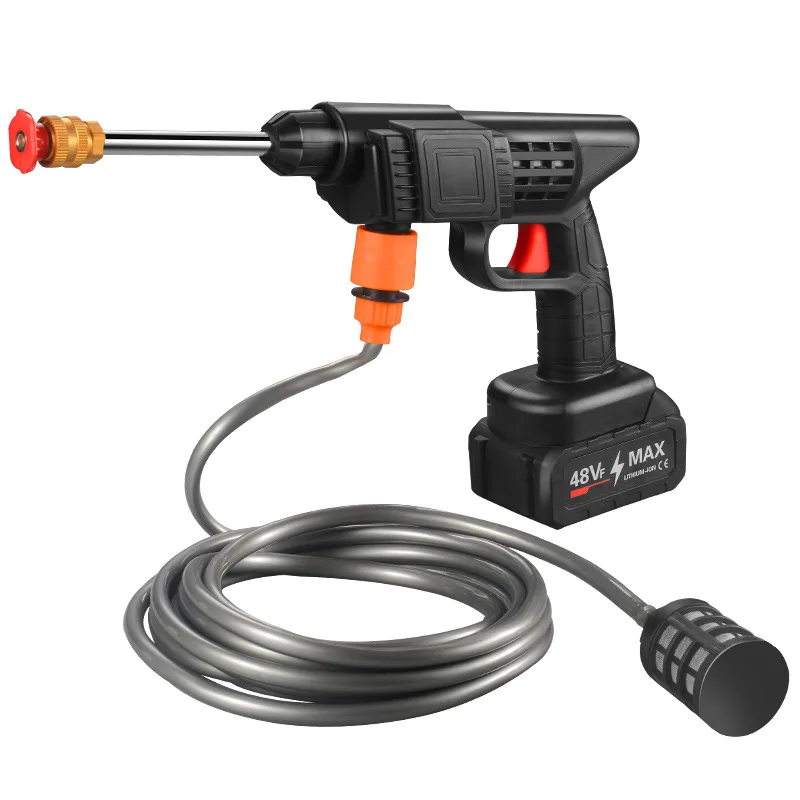
Three voltages in the title, one battery in the box
The title of this listing is a string of search terms, and three of them are battery voltages: twenty-one, twenty-four and forty-eight. Across all five hundred and twelve records in this catalogue, this is the only title that names three or more voltages. Every other listing, where it names a voltage at all, names one, or names two as a choice between a standard and an upgraded variant.
The accessory row says what is in the box: one five-metre water pipe, one water connection, one filter, one charger, one battery, one foam bottle, one stainless steel gun barrel, and two nozzles, one red and one white. One battery, in the singular. The listing does not say which of its three voltages that one battery is.
The images do say something. A battery appears in three of the eight, and the label on it reads forty-eight volts at maximum, with a lithium-ion marking and a CE mark beside it. A different image states, twice, that the pack is a ten-cell battery, and draws it as two rows of five cells. So the product photographed is a forty-eight volt battery built from ten cells.
Those two claims cannot both be right, and the gap is worth setting out because it is arithmetic rather than opinion. A lithium-ion cell of the type used in cordless tools sits at about three point six or three point seven volts nominal and about four point two volts when fully charged. Ten of them in series is therefore about thirty-six volts nominal and about forty-two volts at full charge. A pack of the forty-eight-volt class, in the sense in which cordless tool makers use the number, needs about thirteen cells in series, since thirteen times three point seven is forty-eight point one. The pack in this listing is three cells short of its own label, under any arrangement: ten cells in series gives thirty-six to forty-two volts, and any other arrangement of ten cells gives a lower voltage, not a higher one.
There is a second reading, and the buyer should ask rather than assume. Forty-eight volts is a common marketing figure for a pack whose charger output is in the low forties, and it is also the figure printed on some generic packs sold into the hobby and car-care market without reference to a cell count. So the number on the label may be a nominal-class figure rather than a measurement, and the cell count in the other image may be the more literal fact. Either way the two numbers in the supplier's own pictures disagree, and a buyer who needs to know what they are buying has one question to ask: how many cells are in series, what is the nominal voltage, and what is the capacity in ampere hours or watt hours.
That last part matters more than the voltage, and the listing does not answer it. A capacity would let a buyer compute runtime against the pump's demand. Without it, and without the pump's power draw or the flow rate, the only statement available is a marketing one, that the battery is large-capacity and long-lasting, and that it avoids the embarrassment of power outages. The catalogue's own habits make the point sharply: twenty-seven records mention a battery or lithium, and only four of those state an ampere-hour or watt-hour figure or a runtime or a charge time. No record in the catalogue states a capacity in watt hours. This is not a criticism peculiar to this listing; it is how the category is sold here.
The only three numbers in the listing are in a picture
Beyond the accessory list, the listing's entire quantitative content is three figures printed in the sixth of its eight images: a spray distance of six to eight metres, twenty-five bar, and ten cells. The record's text contains none of the three. Searching all five hundred and twelve records for the figure twenty-five followed by the unit bar returns nothing at all, so the single quantified performance claim in this listing cannot be found by searching the catalogue, cannot be read by a procurement system, and cannot be compared against another listing without a human reading a photograph.
Twenty-five bar is worth translating, because bar is not the unit most buyers think in. One bar is one hundred thousand pascals, so twenty-five bar is two and a half megapascals, or about three hundred and sixty-three pounds per square inch, or the pressure of a column of water about two hundred and fifty-five metres high. That is a real pressure, and it is worth saying plainly that it is not nothing. For rinsing a car with a zero-degree jet, and for driving the foam bottle shown in the fourth image, a figure in the tens of bar does the job.
What it is not is the class that the phrase domestic pressure washer normally denotes. A mains-powered pressure washer sold for home use is normally specified in the hundred-bar class, several times this figure, and that is the class that strips caked mud, cleans a driveway, or drives a surface-cleaning attachment. So a buyer who reads the title's high pressure and compares this machine mentally with a hundred-bar mains unit will be comparing two different tools. The listing itself says high pressure in the title and again in the images, in the phrases strong water pressure, high pressure injection, high pressure nozzle, linear beam spraying body and high pressure decontamination, and quotes exactly one figure against all of that language: twenty-five bar. The figure should be read as the specification and the words as the category.
Two further points follow from the same number. The listing does not say whether twenty-five bar is measured at the pump outlet or at the nozzle, nor which of the two supplied nozzles it refers to, nor with what inlet supply. That matters here more than usual, because the third image makes a feature of self-priming from a bucket or a water bottle, and drawing from an open container adds suction lift, which reduces the pressure available at the nozzle. A figure of twenty-five bar obtained from a pressurised feed and a figure obtained while lifting water from a bucket are not the same number. And second, the figure is internally consistent with the spray distance beside it, which is a point in the listing's favour: a jet at two and a half megapascals has a theoretical exit velocity of about seventy-one metres per second, so eight metres of throw is an entirely plausible consequence of twenty-five bar rather than an exaggeration of it. The two numbers in that image agree with each other.
The reason the pressure can be modest without the machine being implausible is that the hydraulic power involved is small. Power is pressure multiplied by flow, and this listing gives no flow rate, but the arithmetic is easy to bracket: at one litre per minute, twenty-five bar corresponds to about forty-two watts of hydraulic output, and at two litres per minute, about eighty-three watts. Neither figure is a difficulty for a battery tool, and the image's claim of a fourteen-column metal piston pump is not inconsistent with them. The problem is not that the number is too low to be believable. The problem is that the number, and the flow rate beside it, and the battery capacity behind it, are the three things a buyer needs and the listing publishes one of them, as a photograph.
The whole cordless-washer family publishes nothing measurable
This catalogue contains three listings that are cordless car washers rather than industrial machines, and their titles all lead with the same phrase. The first is a portable forty-eight volt lithium battery cordless car washer described as high pressure and easy cleaning. The second is a factory high pressure portable cordless wireless electric cleaning car pressure washing machine. The third is this one, with three voltages in its title.
Checking each of the three for measurable content gives the same answer three times. None of the three states a pressure in bar. None states a pressure in megapascals. None states a flow rate in litres per minute or litres per hour. None states a battery capacity in ampere hours. None states an ingress protection rating. None states a cell count anywhere in its text. Six of the phrases a buyer would search for, across three listings that all call themselves high pressure, return nothing in all three cases. Two of the three are not this record, so this is not a single listing's omission; it is the state of the family.
The wider counts in this catalogue show how far the omission reaches. Across all five hundred and twelve records, the number that states a pressure in bar is zero. The searches for bar return eight records, and reading those eight back shows that every one of them uses the word as a noun rather than as a unit. Three are the sentence pressure bar is made of stainless steel, describing a component of a manual wine-bottle corker, in which the word pressure sits immediately in front of the word bar and the phrase means a part rather than a measurement. The other five use it for bar stock or a bar-handling attachment: a metal bar bender, a hydraulic steel bar straightening machine, a lathe bar turning tool, an automatic bar puller for a lathe, and one slug fragment. Not one of the eight states a pressure in bar. That is a good illustration of why the counts in this guide are published with their search terms and why the records a count returns are read back before the number is used, a discipline adopted earlier in this series after a count of one thing turned out to be a count of another. Three records state a pressure in megapascals, and they are pump and hydraulic listings rather than washers. No record states a flow rate in litres per minute or per hour. No record states a capacity in watt hours. Two records state an ingress protection rating, for a catalogue that includes machinery operated with water and coolants. Six records mention CE.
Set against that, the things this catalogue does measure are diagnostic rows like power in watts, weight in kilograms and dimensions in millimetres. For a machine driven by an electric motor and bolted to a floor, those three rows are most of what a buyer needs. For a battery-powered tool that is held in one hand, sprayed at a car and recharged from a wall, they are the three rows that matter least, and the rows that matter most are the ones nobody publishes. That is the single most useful thing a buyer can take from this listing: the category's published specifications are the ones that were easy to copy, not the ones that decide whether the tool suits the job.
The description is the parameter block, then an empty heading, then a cutting-tool company
The description of this record is worth reading as a document, because its structure is the clearest example yet of how these pages are assembled. It is eight hundred characters, the commonest window size in the catalogue. Its first line is the listing's title repeated verbatim. Then it prints the three parameter labels with their values, in order: product name, then the lithium battery water gun line, then accessories, then the accessory list, then optional, then the note about the tool box. Then it prints a heading, packing and shipping, and puts nothing under it. Then it prints a second heading, company introduction, and begins the boilerplate: Hengshui Mengshang Trading Co., Ltd. is a main professional supplier in Product Machine, CNC Carbide inserts, Turning tools and Milling tools, our brand is TEBAK, and then the window ends.
Every part of that is informative. The description begins by repeating the title, which is a templated-listing signature rather than a description: one hundred and fifty-two records in this catalogue, just under thirty per cent, open their description with their own title, and twenty-four of those also carry a product name row. The description then reproduces the record's own parameter rows, label by label and value by value, adding nothing; two hundred and sixty-one of the three hundred and sixty-one records that have parameters do the same thing, with the values reproduced from the fields rather than written out. This listing does it more literally than most, because there are only three rows to reproduce, so the parameter block and the product content of the description are the same text twice.
The one difference between the two copies is a small tell about how the text was assembled. The accessories value in the parameter row contains a vertical bar between the words standard configuration and the item list. In the description that bar is gone and a line break sits in its place. So the two copies of the same field were not produced by copying one from the other, but by rendering the same source through two different templates, one of which uses a bar as a field separator and the other of which uses a newline. For that reason this record is not among the two hundred and sixty-one that pass a value-by-value comparison of description against parameters: it fails the test only because of that separator character. The method is worth stating because the negative result is an artefact of the test and not a property of the listing.
Then the company profile, and here the listing becomes genuinely informative for the wrong reason. The sentence names the company's products: Product Machine, CNC carbide inserts, turning tools and milling tools. This listing sells a car washer. Across the catalogue the same sentence names CNC carbide inserts in three hundred and seventy-seven records, turning tools in three hundred and seventy-five and milling tools in three hundred and seventy, and the word washer or car wash appears in exactly three records in the whole catalogue. So roughly three quarters of the listings here carry a company profile describing a cutting-tool business, and the profile is the same in all of them, and it is attached to whatever product is being sold. The spellings in that same sentence are equally stable: the typographical error productc appears in two hundred and fifty-one records, the abbreviation written as OED&ODM in three hundred and twenty-nine, the phrase this filed in three hundred and nineteen, and the claim that seventy per cent of the range is for experts in two hundred and sixty-five.
For a buyer, the practical reading is not that the profile is dishonest but that it carries no information about the product. It is furniture. It was written once for a tooling business and pasted into every listing regardless of what the listing sells, and it survived the paste with its spelling errors intact. The one detail in it that is worth having is the company name, and the previous item in this series showed what can happen to that: in that record the description window ran out of characters inside the company's own name and ended at the word Co., four characters short of Limited. Here the window runs out inside the sentence about the product range instead. In both cases the company section is whatever the product section left, which in this catalogue is usually very little.
An empty packing heading, in two thirds of the records that have one
The heading packing and shipping appears in the descriptions of seventy-three records in this catalogue, and this listing is one of them. In forty-nine of those seventy-three, sixty-seven per cent, the heading is followed immediately by the company introduction heading with nothing in between: the heading is present and the section is empty. Two consecutive items in this series have now been examples of it, and the two records are both on that list.
An empty heading is a small thing on its own and a useful thing in aggregate, because it is unambiguous evidence about how the page was built. A writer filling in a template leaves a heading alone only if the section is not needed, and leaves it empty by accident only if the section's content lives somewhere else. In this catalogue the second reading fits: the packing content that exists lives in the paragraphs of the other records, where the wooden case and the preservative film are described, and in the images, where the courier collage and the factory photographs sit. The heading was part of the template, the template was pasted, and the section was never filled. For this listing specifically there is nothing at all about packing anywhere: no carton dimensions, no net or gross weight, no carton count, no statement about batteries in transport, which for a product containing lithium cells is the documentation a buyer's freight forwarder will ask for first.
A correction to the previous item
The previous guide in this series reported that searching all five hundred and twelve records for the company name Sanrenxing returns nothing, and used that as evidence that the second company named in that listing's gallery exists only inside pictures. That figure is wrong, and the correction belongs here rather than in a footnote.
Two records in this catalogue do contain the name, at index forty-three and index four hundred and ten. Both spell it in lower case, in the sentence Hengshui sanrenxing is a professional trading company, which sits in the company profile section of the description. The reason the earlier count returned nothing is that the search was run on the capitalised spelling while those two records use the lower-case one, so the test measured the case of a name rather than the presence of a company. Re-run without regard to case the correct figure is two.
Three things follow, and the third is the one that matters. First, the corrected figure is two, not zero. Second, the same cause affects the other name in that same count: the supplier's own company name returns three hundred and eighty-four records under a case-sensitive search and three hundred and eighty-six without regard to case, so the figure published in the previous item is two low for the same reason. Third, and most importantly, the substance of the previous finding survives the correction but in a narrower form. That listing's gallery carries a questions panel whose header names a trading company in block capitals, and that block-capital form still appears in no record's text. What is no longer true is the stronger claim that the name appears nowhere at all: it appears twice, in lower case, in the descriptions of two other records. The honest version is that the catalogue contains at least two listings that describe themselves, in lower case, as a professional trading company under that name, while the panel carrying it in block capitals is used by twenty records and appears in no text field.
This is the fourth correction this series has published about its own counts, after an entity-escaped value that broke a placeholder test, a volumetric-weight unit error, and a holding-force count that turned out to be the adjective strong in a title. The pattern in all four is the same: a count measures the string that was searched for, and a search string is a hypothesis about how the data is written. The remedy this series adopted after the third correction is to read back the records a count returns before publishing the number, and this correction shows the remedy is incomplete, because here the search returned nothing and so there was nothing to read. The addition to the remedy is to run the search without regard to case as a matter of course, which is what the counts in this guide do.
What the record does not state
The listing has three parameter rows and none of them is a measurement, so the list of absent specifications is longer than the list of present ones. Not stated anywhere, in the data or in the eight images: the working pressure in the parameter block, since the only pressure figure is in a photograph; the flow rate in litres per minute or per hour; the battery capacity in ampere hours or watt hours; the nominal and maximum voltage of the pack actually supplied; the number of cells in series; the runtime per charge; the charge time; the charger's output voltage and current; the motor's power in watts; the pump's material specification beyond the phrase fourteen-column metal piston pump; the seal and valve materials; the ingress protection rating, which for a battery tool used with water is the rating that decides whether it can be left in the rain; the maximum inlet water temperature, against a claim about isolating hot and cold; the hose bore and its pressure rating, against a claim that it is explosion-proof; the nozzle thread standard, which decides whether third-party nozzles fit; the length of the stainless steel barrel; the net and gross weight; the carton dimensions and count; the battery's transport documentation, which is required for lithium cells; the accessories' spare part numbers; the warranty period and what it covers; spare batteries, chargers and seal kits with their prices; and any certification, hygiene or consumer-safety statement, against a CE mark that is visible on the battery in three images while appearing in no text field of the record.
The last of those deserves a sentence of its own because it is a pattern rather than an oversight. Six records in this catalogue mention CE in their text, and this is not one of them, yet a CE mark is plainly visible on the battery label in three of this listing's eight images. A buyer who needs to know which directive the mark refers to, who applied it, and whether the charger and the battery are covered as well as the gun, will not learn it from the listing. The question to ask is short: which standards were tested, by whom, and can the report be supplied.
Incoming inspection when the machine arrives
- Read the battery label, record the nominal and maximum voltage printed on it, and photograph it, because the title offers twenty-one, twenty-four and forty-eight volts while the accessory list contains one battery.
- Establish the pack's nominal voltage and its capacity in ampere hours or watt hours from the battery's own documentation, because ten cells in series is about thirty-six volts nominal and the label reads forty-eight.
- Count or obtain the number of cells in series, and reconcile it against the battery's stated nominal voltage, because the listing's own two images disagree about this by about three cells.
- Weigh the complete set and record it, because no weight is published and a lithium battery in the parcel changes the transport classification.
- Record the contents against the accessory list item by item: the five-metre pipe, the water connection, the filter, the charger, the battery, the foam bottle, the stainless steel barrel and the two nozzles in red and white.
- Identify which nozzle is which by measuring the spray pattern, because the fourth image labels the red one as zero degrees and the white one as forty-five degrees and the parameter row lists them only by colour.
- Establish the delivery pressure at the nozzle rather than accepting the twenty-five bar figure, and record whether it was obtained from a pressurised feed or while self-priming from a container, because suction lift reduces the pressure available.
- Measure the flow rate by timing a known volume, since no flow rate is published and the pair of pressure and flow decides what the machine can clean.
- Time the runtime on a full charge and the charge time to full, and record both, because neither is published and the pair decides whether the tool suits a job away from mains power.
- Check the charger's input voltage and plug type against the buyer's supply, and confirm the charger's output voltage and current, since nothing about the charger is stated beyond its presence in the accessory list.
- Establish the ingress protection rating in writing, and if none is claimed, treat the tool as not water-resistant for storage or outdoor use in rain.
- Confirm the pressure rating and the bore of the supplied hose in writing, against the description's claim that it is explosion-proof, cracking-proof and clogging-proof.
- Establish the maximum inlet water temperature the pump accepts, against the claim about isolating the difference between hot and cold.
- Photograph the CE mark on the battery and ask which standards it covers, which test house issued the report, and whether the charger and battery are covered as well as the gun.
- Ask for the lithium battery transport documentation before shipment, because a freight forwarder will require it and it is not mentioned anywhere in the listing.
- Keep the battery label photograph, the measured runtime and charge time, the measured delivery pressure and flow, the accessory reconciliation and the CE report together as the tool's own specification file, because the listing's specification is one photograph that no search can reach.
What the catalogue says, counted
The counts below are this guide's own scans of all five hundred and twelve records, with the search terms named so they can be reproduced, and run without regard to case unless stated otherwise. Two counts in the previous item are corrected above and again in the methodology.
| Observation | Records | Share |
|---|---|---|
| Records whose description opens by repeating their own title, this record among them | 152 | 29.7% |
| Of those, records that also carry a product name row | 24 | 15.8% of those |
| Records whose description reproduces every parameter value, on a whitespace-normalised comparison, this record not among them and failing only on a separator character | 261 of the 361 with parameters | 72.3% |
| Records carrying a packing and shipping heading, and of those the records that leave it empty, this record among them | 73, of which 49 | 14.3%, and 67.1% of those |
| Records with no parameter rows at all, of which this is not one | 151 | 29.5% |
| Records with three parameter rows, this record among them | 34 | 6.6% |
| Records carrying all three of this record's parameter labels, product name, accessories and optional | 1 | 0.2% |
| Records carrying any optional row at all, this record and one other | 2 | 0.4% |
| Records whose title names three or more battery voltages, this record being the only one | 1 | 0.2% |
| Records naming a cell count anywhere in their text, against this record's ten cells in two images | 0 | 0% |
| Records stating a pressure in bar, in megapascals, or in pounds per square inch | 0, 3 and 0 | 0%, 0.6% and 0% |
| Records stating a flow rate in litres per minute or litres per hour, against eight records that use the word flow without a figure | 0 and 0 | 0% each |
| Records stating a battery capacity in watt hours, against six that state ampere hours and none that states milliamp hours | 0, 6 and 0 | 0%, 1.2% and 0% |
| Records stating a charge time, and records stating a running time, neither being this one | 1 and 2 | 0.2% and 0.4% |
| Records stating an ingress protection rating, and records using the word waterproof | 2 and 0 | 0.4% and 0% |
| Records mentioning CE in text, against this record's visible CE mark on the battery photograph | 6 | 1.2% |
| Records mentioning a battery or lithium, and of those the records publishing a capacity, a runtime or a charge time | 27, of which 4 | 5.3%, and 14.8% of those |
| Records that are cordless car washers, all three titled high pressure, and none of the three publishing a pressure, a flow rate, a capacity, an ingress rating or a cell count | 3 | 0.6% |
| Records whose company sentence names CNC carbide inserts, turning tools or milling tools | 377, 375 and 370 | 73.6%, 73.2% and 72.3% |
| Records mentioning a washer or car wash anywhere in their text, this record among them | 3 | 0.6% |
| Records containing the misspelling productc, the abbreviation OED&ODM, the phrase this filed and the seventy per cent claim | 251, 329, 319 and 265 | 49.0%, 64.3%, 62.3% and 51.8% |
| Records naming Sanrenxing in any case, against zero when the search is case-sensitive, this being the correction published above | 2 against 0 | 0.4% |
| Records whose entire gallery is linked over plain HTTP rather than HTTPS, this record among them | 47 | 9.2% |
| Records whose description is exactly 800 characters, against 61 at exactly 799 and none above 800 | 410 and 61 | 80.1% and 11.9% |
Four rows carry the argument of this item. The first is the absence of the four specification types a battery tool lives or dies by: pressure, flow rate, capacity in watt hours and ingress protection, published by zero, zero, zero and two records respectively out of five hundred and twelve. The second is the cell-count row, where the word appears in no record's text at all while this listing states it twice in images, which is the purest example in this series of a specification that exists and cannot be found. The third is the three rows on the cordless-washer family: a family of three listings, all three titled high pressure, and between them not one measurable figure. The fourth is the correction row, where the same search returns two or zero depending only on the case of the letters, which is the reason this guide now states its search terms alongside its numbers.
The image counts make a separate point. All eight of this record's images are unique to it, the third time in four rounds that a listing's gallery has been entirely its own, and the whole gallery weighs one million eight hundred and ninety-eight thousand two hundred and eight bytes, with the two heaviest files being the pump illustration and the high pressure injection photograph at three hundred and eleven thousand and thirty-nine and three hundred and nine thousand seven hundred bytes. That is the opposite of the furniture pattern recorded in earlier rounds, where shared panels and shared factory photographs made up most of the weight, and it is the honest counter-example: the pictures here are of this product, they are simply invisible to search. All eight are also served over plain HTTP rather than HTTPS, which makes this record one of forty-seven in the catalogue with an entirely insecure gallery; that is a mixed-content condition a browser may warn on, it costs nothing to fix, and it is worth fixing because the images are the only place this listing's specification exists.
The specification to send before ordering
| Item | What to require in writing |
|---|---|
| Battery platform | Which of the title's three voltages is supplied, the pack's nominal and maximum voltage, the number of cells in series and the capacity in ampere hours or watt hours, because the title names twenty-one, twenty-four and forty-eight volts, the accessory list contains one battery, and the photographed pack reads forty-eight volts while another image calls it ten cells. |
| Runtime and charging | The runtime per charge in minutes at a stated spray pattern, the charge time to full, and the charger's input voltage, plug type, output voltage and output current. |
| Pressure | The working pressure at the nozzle in bar, stated for each of the two supplied nozzles, together with the inlet condition it was measured under, because the listing's only pressure figure is twenty-five bar inside an image and it is not stated whether that is at the pump or at the nozzle or with a pressurised feed. |
| Flow rate | The flow rate in litres per minute or per hour, at the same measurement point as the pressure, because the two together decide what the machine can clean and only one of them is published at all. |
| Water source | Which self-priming arrangements are supported, the maximum suction lift, the maximum inlet water temperature and whether a pressurised feed is required or optional, against the claims about bucket and bottle self-priming and about isolating hot from cold. |
| Ingress protection | The ingress protection rating of the gun and of the battery pack separately, because a battery tool used with water needs it and only two records in this catalogue state one. |
| Electrical certification | Which standards the visible CE mark refers to, which test house issued the report, and whether the charger and the battery are covered as well as the gun, because the mark is in the photographs and nothing about it is in the text. |
| Battery transport | The lithium battery transport documentation, the watt-hour rating per pack, the number of packs per carton and the packaging used, because a freight forwarder will require all of it. |
| Hose and nozzles | The hose bore and its pressure rating, the nozzle thread standard, and the spray angle and orifice of each supplied nozzle, because the description claims a hose that is explosion-proof, cracking-proof and clogging-proof and lists the nozzles by colour only. |
| Pump and motor | The pump's construction and materials, the motor's rated power in watts, and the duty cycle the pump is rated for, since the listing offers the phrase fourteen-column metal piston pump and no figure behind it. |
| Dimensions and weight | The net and gross weight of the complete set, the barrel length, and the carton dimensions and count, none of which is published and all of which the delivery rule of a previous item needed. |
| Scope of supply and spares | Written confirmation of the accessory list as supplied, plus spare batteries, spare chargers, spare seals and replacement nozzles with their part numbers and prices. |
| Warranty and service | The warranty period and what it covers, whether the battery is covered separately, and who supplies parts in the buyer's market. |
| Price basis | The trade term, since the listing states no delivery basis, and the price for a second battery, which is the accessory that decides whether a cordless tool is usable for a job larger than one charge. |
Frequently asked questions
Is the battery twenty-one, twenty-four or forty-eight volts?
The listing does not say. Its title names all three, its accessory list contains one battery and does not say which, and the only battery photographed is labelled forty-eight volts at maximum. Because a title that names three voltages is a search-term list rather than a specification, the buyer should treat the number as unestablished and ask for the pack's nominal voltage, its maximum voltage and its cell count in series. Since this catalogue contains exactly one title naming three voltages and it is this one, there is no other listing to compare against.
Ten cells and forty-eight volts cannot both be right. Which is it?
They differ by about three cells, and the arithmetic is short. A lithium-ion cell of this class is about three point six to three point seven volts nominal and four point two volts fully charged, so ten in series is about thirty-six volts nominal and forty-two at full charge, while the forty-eight-volt class needs about thirteen cells in series. Arranging ten cells any other way lowers the voltage rather than raising it. The reading most favourable to the supplier is that forty-eight is a nominal-class marketing figure rather than a measurement, which is common on generic packs and is why the cell count is the more literal of the two statements. Either way the supplier's own two images disagree, and the question to ask is how many cells are in series and what the nominal voltage is.
Is twenty-five bar high pressure?
It is real pressure and it is not the class the phrase normally denotes. Twenty-five bar is two and a half megapascals, about three hundred and sixty-three pounds per square inch, or a column of water about two hundred and fifty-five metres high. That will rinse a car and drive the foam bottle shown in the images. A mains-powered pressure washer sold for home use is normally specified in the hundred-bar class, several times this figure, and that is the class that strips caked mud or drives a surface-cleaning attachment. The honest reading is that twenty-five bar is the specification and high pressure is the category label, and that a buyer should decide against the number rather than the words. It is also worth noting that the figure is internally consistent with the spray distance beside it: two and a half megapascals gives a theoretical jet velocity of about seventy metres per second, so eight metres of throw follows from it rather than contradicting it.
Why does the listing give a pressure but not a flow rate?
Because the pressure appears in an image and the flow rate appears nowhere. Cleaning power at the surface depends on both, and the pair also determines the hydraulic power the pump must deliver: at one litre per minute, twenty-five bar is about forty-two watts, and at two litres per minute about eighty-three watts, neither of which is a difficulty for a battery tool. So the missing flow rate is not hiding an implausible claim; it is simply the other half of the specification, and without it a buyer cannot tell whether the machine rinses a car in five minutes or fifteen. Measure it by timing a known volume into a container.
Is the company in the description the maker?
No, and the description does not claim it is. The sentence calls the company a supplier and then lists its products as Product Machine, CNC carbide inserts, turning tools and milling tools. That same sentence, with the same product list, appears in three hundred and seventy-seven records in this catalogue, and the word washer appears in three. The company is a trading company whose profile was written for a cutting-tool business and pasted into listings of every kind, which is why it carries a typographical error in the word products that appears in two hundred and fifty-one records. The profile carries no information about this machine. What it does carry is the company name, and the previous item in this series showed that the description window can run out before the company name is finished.
What did the previous item get wrong?
It reported that searching all five hundred and twelve records for the company name Sanrenxing returns nothing, and concluded that the name exists only inside pictures. Two records do contain it, at index forty-three and index four hundred and ten, both spelling it in lower case in the sentence Hengshui sanrenxing is a professional trading company. The earlier search used the capitalised spelling, so it measured the case of a name rather than the presence of a company. The corrected figure is two. The same cause makes the supplier's own company name count three hundred and eighty-six rather than the three hundred and eighty-four published last time. The substance of that finding survives in narrower form: the block-capital form used on the questions panel header still appears in no record's text, and the panel itself is still shared by twenty records.
What does the record not state at all?
The working pressure in its data, the flow rate, the battery capacity in watt hours, the nominal voltage and cell count of the supplied pack, the runtime, the charge time, the charger's output, the motor power, the ingress protection rating, the maximum inlet water temperature, the hose bore and pressure rating, the nozzle thread standard, the barrel length, the net and gross weight, the carton dimensions and count, the lithium battery transport documentation, spare parts and their prices, the warranty, and any certification in text despite a CE mark visible on the battery in three images.
How does this item sit in the series?
It is the third of a run in which the specification exists but not where a buyer can reach it. The melting furnace deferred three of its eight rows to the customer. The wax machine had two rows and neither was a measurement. The welder had eleven rows and was contradicted on six quantities by its own panel. The magnetic chuck had no rows and a specification table that reused a model code and then disclaimed itself. The ice cream machine had no rows and a fine two-model table, and contradicted its own title on the flavours it sells hardest. This one has three rows and none is a measurement, and its entire quantified content is three numbers in one photograph: twenty-five bar, six to eight metres, and ten cells. The new element is that the missing measurements are now measurable across the whole catalogue rather than only in one listing, and they come out at zero: no record states a pressure in bar, no record states a flow rate, no record states a capacity in watt hours, and the three cordless washers in the catalogue between them state nothing at all. The constants hold too: the window at eight hundred characters, the company profile naming cutting tools in three quarters of the catalogue, the empty packing heading in two thirds of the records that have one, and a title assembled from search terms rather than from the machine.
Source, scope and what this guide does not claim
Everything about the product comes from the record for Product ID 1601363685225 as it stands: three parameter rows, an eight-hundred-character description, and eight gallery images. The description's structure is quoted from the record: the title repeated as its first line, then the three parameter labels and values reproduced, then a packing and shipping heading with nothing beneath it, then a company introduction heading, ending at the words TEBAK have various kinds of productc and the. The accessory list, the optional row and the product name row are quoted from the parameter block as printed, including the vertical bar inside the accessory value and the phrase coke pick up in the optional row.
All figures attributed to the images are read from them as printed. The battery label reading forty-eight volts at maximum with a lithium-ion marking and a CE mark is read from the battery shown in the first, third and sixth images. The ten-cell description and the drawing of two rows of five cells are read from the seventh image. The spray distance of six to eight metres, the twenty-five bar figure and the ten-cell note are read from the sixth image. The fourteen-column metal piston pump, the claim about larger water output and the caption about low noise are read from the fifth image. The zero-degree red nozzle, the forty-five-degree white nozzle and the foam spray can are read from the fourth image. The self-priming claims about suction, a bucket and a water bottle are read from the third image. The hose claims about being explosion-proof, cracking-proof and clogging-proof, and about isolating hot from cold, are read from the eighth image. The factory and warehouse collage with its eight icon claims is read from the second image.
The arithmetic is this guide's own and its inputs are the listing's own figures. The battery calculation uses three point six to three point seven volts nominal and four point two volts fully charged per cell, with thirteen cells in series for the forty-eight-volt class, these being the ordinary figures for the cell type in question and stated so that a reader can substitute their own. The pressure conversions use one bar equal to one hundred thousand pascals and one pound per square inch equal to six thousand eight hundred and ninety-four point seven six pascals. The jet velocity is the square root of twice the pressure divided by the density of water at one thousand kilograms per cubic metre, which at two and a half megapascals gives about seventy-one metres per second. The hydraulic power figures are pressure multiplied by flow, evaluated at one and two litres per minute. No pressure, flow rate, capacity, voltage, cell count or dimension is corrected or estimated anywhere in this guide, and the twenty-five bar figure is reported as printed rather than adjusted.
The catalogue counts are this guide's own scans of all five hundred and twelve records, run without regard to case unless a comparison says otherwise, with the search terms named so they can be reproduced: parameter row counts and the three-row count; the label sets; the optional rows; the description length distribution; descriptions opening with their own title; the whitespace-normalised comparison of description against parameter values; the packing and shipping headings and how many are empty; the title voltage patterns and title word repetition; the cell, pressure, flow, capacity, ingress protection, certification, charger, battery and lithium terms; the cordless-washer family and what each member states; the company profile's product names and its misspellings; the washing terms; the two company names under both case regimes; the image address scheme; and the image-sharing counts and byte totals. Two counts from the previous item are corrected here and the corrections are stated in the text: the company-name figures were case-sensitive and are two low, one of them by the whole count. The image-sharing counts were established by normalising every image address in the catalogue to one scheme and counting the records that use each of this listing's eight pictures; all eight are used by this record alone, and each file was downloaded and digested to confirm that the eight are eight distinct files.
Nothing here asserts that the supplier has misrepresented anything, and nothing here is an assessment of the machine's quality, its safety, its suitability for any task or any market, or of the honesty of any figure. Titling a listing for three voltages while shipping one battery, labelling a ten-cell pack as forty-eight volts, publishing a specification as a photograph, leaving a parameter block without a single measurement, carrying a company profile written for a different product line, and cutting a description inside a sentence are the ordinary consequences of listings assembled by hand from parts of other listings, and the counts above show how common each habit is. Above all, nothing here is electrical safety advice, battery safety advice, pressure-equipment advice or purchase advice. A lithium battery pack, a charger, a pressure vessel and a mains-powered charger are all items whose correct specification and use are matters for the buyer's own requirements, for the product's own documentation and certification, for the transport regulations that apply to lithium cells, and for a qualified electrical engineer, and not for anything in a supplier listing or in this guide.
Key specifications
- Parameter rows
- three, and not one of them is a measurement: the block is a product name, an accessory list and an optional-item note
- Product Name
- Lithium battery water gun, which is the whole product description the parameter block offers, against a title that calls the same object a high pressure washing cleaner machine, a wash gun and a car washer
- Accessories
- one five-metre water pipe, one water connection, one filter, one charger, one battery, one foam bottle, one stainless steel gun barrel and two nozzles, one red and one white, listed as the standard configuration
- Optional
- Coke pick up or toolbox, which is one of only two optional rows in the entire catalogue and is a machine-translation artefact
- Battery voltage, in the title
- twenty-one, twenty-four and forty-eight volts, named together, which makes this the only record of five hundred and twelve whose title names three or more voltages
- Battery supplied
- one, in the singular, with no statement of which of the three title voltages it is
- Battery voltage, on the product
- the label on the battery photographed in three images reads forty-eight volts at maximum, with a lithium-ion marking and a CE mark
- Battery construction, in an image
- ten cells, stated in two separate images and drawn as two rows of five cells
- The arithmetic between those two figures
- a ten-cell lithium-ion pack in series is about thirty-six volts nominal and forty-two volts at full charge, so a pack of the forty-eight-volt class needs about thirteen cells in series, and the label and the cell count differ by about three cells
- The only three quantified figures in the listing
- a spray distance of six to eight metres, twenty-five bar, and ten cells, all three of them inside the same image and none of them in the record's text
- Twenty-five bar, converted
- two and a half megapascals, or about three hundred and sixty-three pounds per square inch, or about two hundred and fifty-five metres of water column
- Pressure in the parameter block
- none, and the number twenty-five followed by the unit bar appears in no record's text anywhere in the catalogue
- Flow rate
- not stated anywhere in the listing or in any of the eight images, and no record in the catalogue states one in litres per minute or per hour
- Battery capacity in watt hours
- not stated, and no record in the catalogue states one in watt hours; six records state ampere hours and this is not one of them
- Runtime and charge time
- not stated; one record in the catalogue states a charge time and two state a running time, and none of the three is this one
- Ingress protection rating
- not stated, and only two records in the whole catalogue state one, for a battery tool that is used with water
- Certification
- nothing in the record's text, and six records in the catalogue mention CE, this one not among them, although a CE mark is visible on the battery in three of the eight images
- Packing and weight
- not stated; the description carries an empty packing and shipping heading and the parameter block has no weight, dimension or carton row
- Description structure
- the title repeated verbatim as the first line, then the three parameter labels and values reproduced, then an empty packing and shipping heading, then a company introduction that is cut off mid-sentence
- Description length
- eight hundred characters exactly, the commonest window size in the catalogue, ending inside the sentence TEBAK have various kinds of productc and the
- Company profile's own product list
- CNC carbide inserts, turning tools and milling tools, for a listing selling a car washer; the company sentence names cutting tools in three hundred and seventy-seven, three hundred and seventy-five and three hundred and seventy records respectively
- Images
- eight, all of them unique to this record, all of them linked over plain HTTP rather than HTTPS, and the whole gallery weighs one million eight hundred and ninety-eight thousand two hundred and eight bytes