
Source-controlled product identity
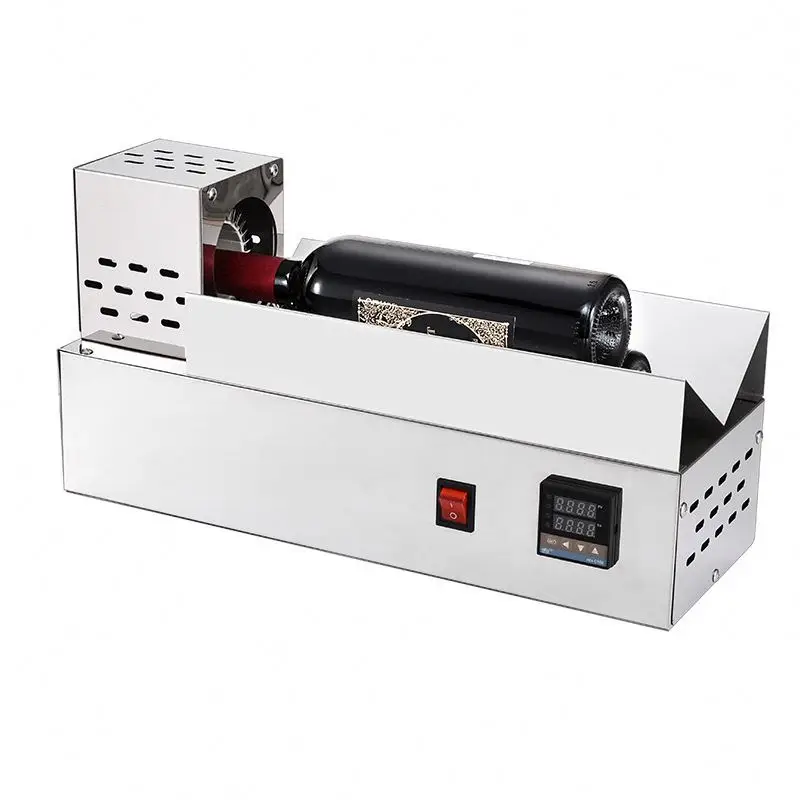
The Hoting queue identifies Product ID 1601276466272 as a horizontal PVC film capsule heat shrinker for wine capsules, bottle capping sleeves and shrinking seals. The source describes a desktop shrinking machine for bottle cap sleeves and says its shrinking temperature can be adjusted for different film materials.
The recorded specification supports preliminary layout, electrical and application screening. It does not replace a test using the buyer's bottle, capsule sleeve, film roll and required finish. Dimensions and weights are retained with the source wording “about” where supplied.
Recorded specification
| Field | Source value | Buyer interpretation |
|---|---|---|
| Voltage / frequency / rated power | 220V 50-60Hz 600W | Confirm destination electrical configuration, current, plug and protection. |
| Working speed | 10-15 pcs/min | Validate with the buyer's bottle, sleeve length, material and finish criteria. |
| Applicable bottle height | 200-350mm | Confirm measurement reference and whether neck, shoulder and closure geometry fit. |
| Applicable bottle diameter | φ70-80mm | Confirm the actual cylindrical diameter, taper, shoulder and sleeve overlap. |
| Suitable film | PVC, PP, PE, POF, etc | Confirm each film's thickness, shrink ratio, shrink direction and temperature window. |
| Machine size | About 450*150*225mm (L*W*H) | Use for preliminary bench planning; confirm actual measured envelope. |
| Package size | About 500*200*300mm (L*W*H) | Use for transport planning; confirm final packed dimensions and protection. |
| Net / gross weight | About 3.1kg / 3.9kg | Confirm weighing method, accessories and final shipping documentation. |
The source does not specify shrink-temperature range, temperature accuracy, heating method, heating-zone size, film thickness, sleeve length, roll width, shrink ratio, sealing method, bottle pitch, actual throughput conditions or compliance documents. Treat these as RFQ and acceptance-test items.
How the machine fits a bottle-capsule workflow
A capsule sleeve shrinking process normally has several controlled steps: bottle preparation, sleeve or capsule placement, positioning, heating, visual inspection and downstream packing. This product listing addresses the heating and shrinking stage, but the source does not define how sleeves are fed, positioned or indexed.
Map the complete line before ordering. Identify whether operators place each sleeve manually, whether bottles are stationary or moving, how the heating zone is aligned with the cap and whether a second operation is required for a tamper-evident band.
Describe the bottle family rather than relying on a nominal diameter. The listed φ70-80mm range may require a substantially different setup for a straight cylinder, tapered bottle, shouldered bottle or irregular shoulder. Provide bottle drawings and sample bottles to the supplier.
Confirm the bottle-height reference. The listed 200-350mm range may refer to total bottle height, body height or usable heating position. Ask for a dimensioned working drawing showing the supported bottle base, cap, sleeve and heating centerline.
Define the target finish: centered sleeve, wrinkle limit, overlap, cap coverage, open vent area, tear-strip position and acceptable seam or edge appearance. A “shrunk” sleeve is not automatically an acceptable finished package.
Film selection and test control
The source lists PVC, PP, PE and POF, plus “etc.” Do not treat the list as proof that every film grade or thickness is compatible. Obtain the exact film supplier, film type, thickness, width, shrink ratio, shrink direction, ink system, adhesive or coating and recommended temperature range.
PVC, PP, PE and POF can behave differently during heating. Validate film response on the actual bottle and sleeve design. Record shrink time, surface finish, wrinkles, holes, distortion, discoloration, label damage and cap deformation.
Ask whether the machine accepts pre-cut sleeves, roll-fed film, perforated capsules or another format. Confirm the maximum sleeve length and the position of perforations, tear strips and graphics.
Request the heating profile rather than a single nominal temperature. A useful profile records setpoint, measured air or surface temperature, exposure time, distance from the heater and product temperature near the cap.
Confirm whether the temperature adjustment is manual or closed-loop. Request sensor location, controller resolution, calibration method, overshoot behavior and recovery after repeated cycles.
Test the cold-start condition and the steady-state condition. The first bottles may shrink differently from bottles processed after the heater reaches equilibrium.
Throughput and the recorded 10-15 pcs/min
The source lists a working speed of 10-15 pcs/min. For procurement, define whether this is a theoretical operating speed, a manual handling rate or a tested rate under specified bottle and film conditions.
Ask the supplier to state bottle height, diameter, sleeve length, film type, film thickness, target finish, operator count, warm-up status and reject rate used for the 10-15 pcs/min claim.
Measure cycle time from one completed bottle to the next. Include loading, sleeve alignment, heating, removal, inspection and any pause for film or bottle adjustment.
Calculate practical output as accepted bottles per minute, not only heater cycles. Record defects, rework, film changes, bottle changes, operator interruptions and warm-up losses.
Run a timed test over a representative batch. Record output in the first five minutes, stable operation, after a film change and after a planned stop and restart.
Do not promise a line rate above the source value without a validated integration test. If the buyer needs multiple lanes or higher output, ask whether parallel machines, upstream indexing or a different model is required.
Electrical and bench installation
The source records 220V 50-60Hz 600W. Confirm that the destination has the correct voltage, frequency, phase, plug, grounding and protection. Request operating current, start-up current, fuse or breaker recommendation and cable length.
The listed machine size is about 450*150*225mm (L*W*H). Treat this as a preliminary envelope, not a confirmed installation drawing. Ask whether controls, cable exits, feet, heater guards and bottle guides are included in the measurement.
Plan clearance for bottle placement, sleeve adjustment, cleaning, heater inspection, cable routing and emergency access. The machine may need more bench depth than its body size if bottles project beyond the heating zone.
The listed package size is about 500*200*300mm and the net/gross weights are about 3.1/3.9kg. Confirm the final packed dimensions, protective inserts, spare parts and accessories before calculating freight or storage space.
Ask whether the unit is intended for continuous service, intermittent bench use or a defined duty cycle. Request ambient temperature, humidity and ventilation limits, especially if the heater is located near other heat-producing equipment.
Safety and operator controls
Heat-shrink equipment creates hot-surface, burn, electrical and film-fume risks. Confirm heater guarding, accessible-surface temperatures, heat-zone shielding, insulation and operator warnings for the exact configuration.
Ask whether there is an emergency stop, over-temperature protection, sensor-failure response, fuse protection and restart prevention after power interruption. The source does not list these features.
Test the unit with an empty work area, a misplaced bottle, a stalled cycle, a film jam and an interrupted power supply. Record heater shutoff behavior and the time required to return to a safe condition.
Confirm ventilation requirements for every film type and ink system. Do not assume that a film listed as suitable is safe in every operating condition without the supplier's material and ventilation guidance.
Request an operating manual, maintenance manual, risk information and training instructions. Define who may adjust temperature, replace film, clear a jam and service the heater.
Appearance and quality criteria
Write acceptance criteria before testing. Define sleeve centerline, cap coverage, wrinkle height, open edge, overlap, tearing, bubbles, burn marks, discoloration, film residue and damage to the bottle or label.
Test bottles at the lower, middle and upper ends of the listed height range where practical. Test diameters near φ70mm, mid-range and φ80mm, and include any taper or shoulder that the buyer will use.
Test each film family separately. A setting that produces a clean finish on PVC may not produce the same result on PP, PE or POF.
Use a measurement record for sleeve position and finish. Photograph the bottle before and after shrinking and retain samples from startup, steady-state operation, restart and film change.
Define the reject process. Operators should be able to identify under-shrink, over-shrink, skew, wrinkle, burn and cap damage without guessing from appearance alone.
Maintenance and consumables
Request a parts list for heaters, sensors, controller, insulation, guards, bottle guides, switches, wiring and fasteners. Confirm which components are consumable and their expected replacement interval.
Ask how to clean film residue from the heating zone and what chemicals or tools are permitted. Confirm that cleaning can be performed only after isolation and adequate cool-down.
Record warm-up time, temperature stability and cycle result at commissioning and during maintenance. A change in warm-up or finish can indicate sensor, heater or film issues.
Define a spare-parts package for the first operating period, including heater-related parts, sensors, fuses and any bottle guides or fixtures needed for the selected format.
Confirm remote support, fault codes, service response, warranty scope and the information required for troubleshooting. Include photos, serial number, controller display and test conditions in a service request.
Factory acceptance test
- Verify Product ID 1601276466272, exact configuration and intended bottle-capsule application.
- Measure machine size and confirm the listed about 450*150*225mm envelope and measurement method.
- Verify 220V, 50-60Hz and 600W; record current, plug, grounding and protective device.
- Measure package size and weights; compare with about 500*200*300mm and about 3.1/3.9kg.
- Test bottle heights across 200-350mm and diameters near φ70-80mm with buyer samples.
- Test PVC, PP, PE and POF samples using the exact thickness, shrink ratio and graphics planned.
- Record temperature setpoint, measured temperature, sensor position, exposure time and warm-up.
- Run startup, steady-state, restart and film-change tests and record appearance and rejects.
- Measure accepted output against the source 10-15 pcs/min under documented conditions.
- Inspect sleeve centering, wrinkles, overlap, cap coverage, burn marks, distortion and label damage.
- Test empty operation, misplaced bottle, film jam, heater fault, sensor fault and power interruption.
- Verify heater guarding, hot-surface access, emergency stop, over-temperature protection and restart prevention.
- Confirm ventilation, film-material guidance, cleaning procedure and residue removal.
- Verify manual, wiring diagram, maintenance schedule, spare-parts list and destination-market documents.
- Attach sample bottles, photos, temperature logs, output records, serial number and deviations to the order.
RFQ checklist
- Product ID 1601276466272 and exact machine configuration.
- Electrical specification: 220V, 50-60Hz, 600W, current, phase, plug, grounding and protection.
- Working speed basis for 10-15 pcs/min, including bottle, film, sleeve, operator and reject conditions.
- Supported bottle height, diameter, taper, shoulder, base, cap and sleeve geometry.
- Film types, thickness, width, shrink ratio, direction, ink, coating and recommended process window.
- Heating method, zone dimensions, setpoint range, sensor, accuracy, calibration and overshoot.
- Warm-up, recovery, exposure time, stable throughput and accepted-output guarantee.
- Machine dimension about 450*150*225mm and what is included in the measurement.
- Package dimension about 500*200*300mm, net/gross weight about 3.1/3.9kg and final shipping data.
- Guards, emergency stop, over-temperature protection, sensor failure and restart behavior.
- Ventilation limits and material-specific safety guidance for PVC, PP, PE and POF.
- Cleaning, residue removal, heater replacement, sensor replacement and maintenance access.
- Accessories, bottle guides, fixtures, spare heaters, sensors, fuses and consumables.
- Warranty, commissioning, training, service response and spare-parts lead time.
- Factory acceptance test using buyer bottles, capsules, film and appearance criteria.
Buyer decision framework
This listing provides a useful starting specification for a compact horizontal capsule-sleeve heat shrinker: 220V 50-60Hz, 600W, 10-15 pcs/min, 200-350mm bottle height, φ70-80mm bottle diameter, listed PVC/PP/PE/POF compatibility and approximate machine and package dimensions.
Approval should wait until the supplier confirms the exact film, bottle, sleeve and heating process. The most important commercial risk is not the nominal electrical rating; it is whether the shrink finish remains acceptable at the required speed across the complete bottle and film range.
Compare suppliers using verified accepted output, finish quality, startup behavior, film change time, temperature stability, safety controls, cleaning access, spare-part availability and destination-market compliance.
Frequently asked questions
What is the recorded power supply?
The source records 220V, 50-60Hz and 600W.
What speed is listed?
The source records a working speed of 10-15 pcs/min. The test basis and accepted-output definition require confirmation.
What bottles are listed as applicable?
The source records bottle height of 200-350mm and bottle diameter of φ70-80mm. Confirm actual bottle geometry, not only nominal dimensions.
Which films are listed?
The source lists PVC, PP, PE, POF and “etc.” Confirm the exact grade, thickness, shrink ratio and process window.
What are the listed dimensions and weights?
Machine size is about 450*150*225mm, package size about 500*200*300mm, and net/gross weight about 3.1kg/3.9kg.
Is the shrinking temperature specified?
The source says temperature can be adjusted according to different materials, but it does not provide a numeric temperature range, accuracy or calibration method.
Source and contact
This guide is based on the Hoting queue record for Product ID 1601276466272. The recorded dimensions, electrical data, speed, bottle range, film list and weights are preserved from that source. Before purchase, request exact machine drawings, film and bottle trials, temperature data, safety controls, acceptance testing, compliance documents and warranty terms through the TEBAK sales inquiry channel.
Key specifications
- Voltage
- 220V 50-60Hz 600W
- Working Speed
- 10-15pcs/min
- Applicable Bottle Height
- 200-350mm
- Applicable Bottle Diameter
- φ70-80mm
- Suitable Film
- PVC, PP, PE, POF, etc
- Machine size
- About 450*150*225mm (L*W*H)
- Package Size
- About 500*200*300mm (L*W*H)
- Net Weight/Gross Weight
- About 3.1kg/3.9kg