
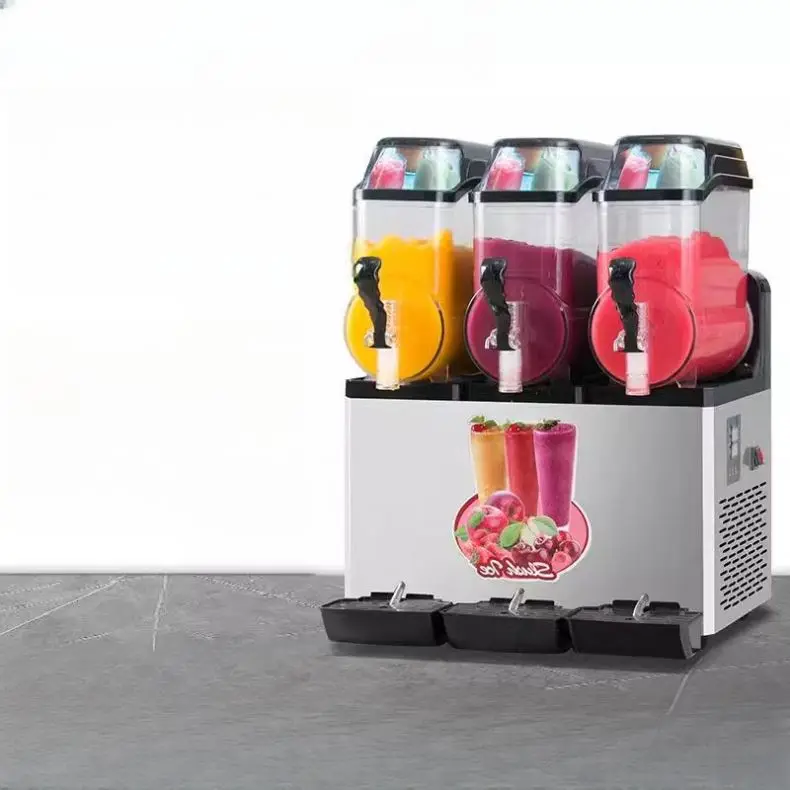
Source-controlled product identity
The Hoting queue identifies Product ID 1601277092558 as a commercial frozen beverage dispenser listed under the title "Hot Sell Commercial Stainless Steel Slush Machine Slushy Frozen Beverage Dispenser Three Bowls Frozen Drink Slush Machine".
Unlike many records in this queue, this listing carries a complete parameter block. The block describes a three-model line rather than a single machine: IT-12SM-1, IT-12SM-2 and IT-12SM-3, which differ mainly in the number of 12-litre bowls and in the corresponding width, weight and electrical rating. The recorded values are reproduced in full below, with the three models mapped column by column, so that no value from one model is attributed to another.
Recorded parameters, exactly as supplied
| Parameter | IT-12SM-1 | IT-12SM-2 | IT-12SM-3 |
|---|---|---|---|
| Model | IT-12SM-1 | IT-12SM-2 | IT-12SM-3 |
| Capacity | 12L*1 | 12*2 (as recorded) | 12L*3 |
| Temp | 0 to -8 (as recorded, applies to the model line) | ||
| Size (mm) | 230*550*800 | 430*550*800 | 630*550*800 |
| Packing size (mm) | 295*600*860 | 490*600*860 | 650*600*860 |
| Gross weight (KG) | 45 | 55 | 80 |
| Refrigerant | R404A | ||
| Power | 570W | 850W | 900W |
| Voltage | 220V / 110V optional | ||
| Frequency | 50HZ / 60HZ optional | ||
Two entries in this table need attention before they are used in a purchase order. The capacity row reads 12L*1, 12*2 and 12L*3: the middle entry omits the litre unit that the other two carry. The temperature row is written as a single value for the whole line, so all three models share the same stated range. Both points are handled below rather than corrected silently.
What actually differs across the model line
Reading the table by column shows that the three models are one machine scaled by bowl count. Width rises with each added bowl: 230 mm, 430 mm and 630 mm, which is 200 mm per additional bowl, a consistent step that supports the reading that each model is the same cabinet with more bowl positions.
Other values scale with the bowl count rather than with the cabinet. Gross weight rises from 45 kg to 55 kg and then to 80 kg, meaning the third bowl adds 25 kg while the second adds only 10 kg. Power rises from 570 W to 850 W and then to 900 W, so the third bowl adds only 50 W where the second added 280 W. A buyer comparing running cost across the three models should ask for the refrigeration duty and the compressor size rather than inferring efficiency from the wattage alone, because the wattage here is a nameplate figure and not a measure of cooling capacity.
Depth and height are identical across the line at 550 mm and 800 mm. That is the useful constant: if the counter depth or the headroom is the binding constraint in the buyer's location, it will not change with the model chosen, whereas the width will.
Capacity: clarifying the 12*2 entry
The capacity row is stated as 12L*1, 12*2 and 12L*3. The natural reading is one, two and three bowls of 12 litres, giving 12, 24 and 36 litres of nominal total volume, but the second entry as written carries no unit, and a specification line that is inconsistent about units inside the same row should not be relied on without confirmation.
Ask the supplier to confirm three things in writing. First, the nominal capacity per bowl for each model. Second, the total nominal capacity for the two-bowl model, stated in litres. Third, and more important for a slush business, the usable working volume per bowl rather than the bowl's geometric volume, because a bowl cannot be filled to the brim and still produce a slush product; the practical fill level is what determines how many servings a bowl yields.
Ask as well whether the bowls are independently controlled and independently switched off, since a three-bowl machine used in a low season may only need one or two bowls running. Confirm whether each bowl has its own auger, its own evaporator and its own thermostat, or whether bowls share a circuit, because shared circuitry means an idle bowl still consumes refrigeration duty.
Temperature: what 0 to -8 does and does not tell you
The recorded temperature range is 0 to -8, applied to the whole line. This is a useful starting figure but it does not by itself describe production performance, and four questions follow from it.
Ask what the two ends of the range mean in operation: which end is the warmest setting, which is the coldest, and how the range is adjusted, since a thermostatic dial and a digital controller with discrete setpoints behave differently in service. Ask whether the stated range is achievable under full ambient load rather than only in a cooled room, and what the maximum rated ambient temperature is, because a slush machine that holds -8 in a 25 degree kitchen may not hold it in a 35 degree kiosk.
Ask for the production capacity in concrete terms: how long an ambient-temperature mix takes to reach a servable slush consistency, and how many servings per hour or litres per hour the machine can dispense once it is at temperature. Neither figure appears in the record.
Ask finally how consistency is controlled. A slush product is defined by its texture rather than by its temperature alone, and the mechanism that holds the product at a servable consistency while the bowl is idle is the difference between a machine that sells product all day and one that separates and must be re-mixed.
Electrical supply: two options, and the figures you still need
The record lists voltage as "220V / 110V optional" and frequency as "50HZ / 60HZ optional". These are stated as options across the model line, not as a dual-voltage capability of a single unit. In practice this means the machine is built to one supply configuration and the buyer must state that configuration on the order; a unit built for 220 V and shipped to a 110 V site, or the reverse, will not run correctly, and frequency mismatch affects motor and compressor behaviour as well as refrigeration.
Two figures are missing. The power ratings of 570 W, 850 W and 900 W are stated without a voltage basis, so ask whether they are rated at 220 V, at 110 V, or at a nominal point between them. Then ask for the rated current and the required circuit protection for the configuration actually being ordered, because the same watts at 110 V draw roughly twice the current of 220 V, which changes the plug, the cable and the breaker.
Ask also for the plug and cable type supplied, the cable length, and whether the machine is supplied with a plug matched to the destination market, since a 220 V machine shipped without a market-appropriate plug may need rewiring at the buyer's cost before it can be used.
Footprint, packing and weight: planning the site and the freight
The machine sizes are 230 by 550 by 800 mm for the one-bowl model, 430 by 550 by 800 mm for two bowls and 630 by 550 by 800 mm for three bowls. The packing sizes are 295 by 600 by 860 mm, 490 by 600 by 860 mm and 650 by 600 by 860 mm respectively. The packed length therefore exceeds the machine length by 60 to 65 mm on every model, and the packed height exceeds the machine height by 60 mm, which is consistent with a wooden case around the unit.
Use the packing dimensions for freight and the machine dimensions for the site. Plan the counter or the kiosk around the machine size plus clearances, which the record does not state, and confirm the ventilation clearance required on each face, because a refrigerated cabinet rejecting heat needs air movement around the condenser. Ask what the maximum ambient temperature is for reliable operation and whether the machine is air cooled or water cooled, since a water-cooled unit has a plumbing requirement that a site survey must catch early.
Gross weights of 45 kg, 55 kg and 80 kg are given for packed units. There is no net weight in the record, so the freight calculation can only be built on gross weight, which is the conservative figure and therefore acceptable for estimating shipping, but a buyer who needs to move a machine in service, or mount it on a counter, needs the net weight as well.
Packing and delivery as described in the record
The record's packing text states that the machine is packed inside with plastic film and outside in a fumigation wooden case, that the wooden case is described as strong enough to bear long sea transport, and that the machine carries preservative film to keep salt sea water out and to limit corrosion. Where that is accurate, it is the right packing approach for a heavy refrigerated appliance shipped by sea, because the two main risks are impact damage to the cabinet and corrosion of the steelwork during a damp voyage.
The record's delivery text is truncated in the source after the sentence that machines are a big and heavy parcel and that delivery cost differs by country, followed by the beginning of a recommendation about delivery methods. The listing therefore mentions a delivery recommendation that the record does not contain. Ask the supplier to send the full delivery and shipping terms, including which incoterms are offered, the ports or airports served, and whether the buyer or the supplier arranges the final leg.
Confirm on the order: the fumigation certificate for the wooden case, since untreated wood packaging is a customs problem in many destinations; the case dimensions and count; whether the case is palletised; and whether the case can be opened and resealed for inspection without damaging the machine.
Refrigerant: R404A is a compliance question, not only a technical one
The record states a single refrigerant for the whole line: R404A. That is the first refrigerant statement in this queue that specifies a charge, and it deserves attention at the buying stage for two separate reasons.
The technical reason is that R404A is a widely used commercial refrigerant for low and medium temperature refrigeration, and a buyer comparing quotes from different suppliers should compare the refrigerant along with the compressor, because two machines with the same bowl capacity and the same nameplate wattage can behave differently if they use different refrigerants and compressors.
The compliance reason is more consequential for import planning. R404A is a high-global-warming-potential hydrofluorocarbon, and hydrofluorocarbons in general are subject to quota phase-downs and to restrictions on servicing refrigeration equipment in a number of markets, notably the European Union under its F-Gas rules, which limit the use of high-GWP refrigerants for servicing refrigeration equipment. Equipment that is legal to place on the market today can be difficult or impossible to recharge economically later, and rules differ by market and by the type and charge size of the equipment.
Within this record there is no charge weight, no statement of which markets the unit is approved for, and no certificate. Before ordering, ask the supplier for the refrigerant charge in grams for the model being bought, whether a lower-GWP alternative refrigerant or an alternative compressor configuration is available, and which markets the configuration is approved for. Then confirm the import and servicing position for the destination market with the buyer's own compliance adviser, because that position depends on local rules, on the equipment category and on charge size, and it changes over time.
Hygiene and food-contact documentation
A frozen beverage dispenser contacts food directly through the bowls, the augers, the dispensing taps and the seals. The record states that the machine is stainless steel, which is a material description in the title rather than a specification, and it gives no food-contact documentation.
Ask for the material grade of every food-contact part, not only the exterior panels, since the exterior panel grade is often quoted while the auger, tap and gasket materials are what actually touch the product. Ask for the food-contact declarations held for those materials and for the seals, and ask whether the bowls are polycarbonate or another material, because bowl material affects both clarity in service and cleaning.
Ask how the machine is cleaned, whether the bowls and augers can be removed without tools, and whether the supplier can provide written cleaning and sanitising instructions with the correct chemicals and concentrations for the seals used. Ask whether a drip tray, a tap cap, spare seals and spare auger bushes are included or priced separately, because those are the parts that wear in daily service.
Where the destination market requires certification of the appliance before sale, ask which certificates the supplier holds for this model and for which markets, and request the certificate documents rather than a claim that certification exists. Nothing in this record addresses certification.
Missing specifications to request before ordering
- Written confirmation that the two-bowl model is 2 x 12 L, with total nominal capacity in litres for all three models.
- Usable working volume per bowl, as distinct from nominal bowl volume.
- Whether bowls are independently switched and independently controlled, including separate auger, evaporator and thermostat.
- Whether the stated temperature range applies to all models and what the warmest and coldest setpoints mean in operation.
- Maximum rated ambient temperature, and whether the unit is air cooled or water cooled.
- Required ventilation and service clearances on each face.
- Production capacity: time from ambient mix to servable consistency, and litres or servings per hour at temperature.
- How consistency is held in an idle bowl and how the product is prevented from separating.
- Compressor make, model and cooling capacity, and the refrigeration duty for each model.
- Auger drive motor type and rating, and whether any drive parts are considered wearing parts.
- Rated current and required circuit protection for the specific voltage and frequency ordered.
- Voltage and frequency basis of the stated 570 W, 850 W and 900 W figures.
- Plug type, cable type and cable length supplied, and whether a market-appropriate plug is included.
- Net weight in addition to the recorded gross weight, for all three models.
- Refrigerant charge in grams, and whether a lower-GWP alternative is available.
- Which markets the configuration is approved for, and the certificate documents held for this model.
- Food-contact material grade for bowls, augers, taps and seals, with declarations.
- Cleaning and sanitising instructions, including the chemicals to use and to avoid.
- Which accessories are included and which are priced separately: drip tray, tap caps, spare seals, spare auger parts.
- Fumigation certificate for the wooden case, case count and whether cases are palletised.
- Full delivery and shipping terms, including the delivery recommendation the record only begins to describe.
- MOQ, unit price at the target quantity, sample or trial terms, lead time and warranty period.
- Spare parts availability and prices for seals, augers, taps and controller parts.
Acceptance and incoming inspection
This record contains enough parameters to write a checkable purchase order, which is unusual in this queue and should be used. Put the model code, the bowl count, the voltage, the frequency, the plug type, the refrigerant configuration and the agreed capacity values into the order in writing, then verify against them on arrival.
Before powering the machine, inspect the wooden case and photograph any impact damage before opening, because a damage claim is far easier with packing photographs. Confirm the model code on the nameplate matches the order rather than accepting the code on the carton, since mixed shipments do occur. Confirm the voltage and frequency on the nameplate for the configuration ordered.
Check the cabinet for dents, check that the bowls are free of cracks and crazing, and check that the taps and seals are present and undamaged. Check the refrigerant circuit for oil traces at joints, which would suggest a leak, and confirm the refrigerant charge figure on the label corresponds to the figure quoted.
Then run the machine with water rather than with product. Fill to the working level, run it to the coldest setting and record the time to reach a servable slush consistency, the temperature achieved, and the ambient temperature during the test. That single test verifies the refrigeration duty, the drive and the controller together, and it produces a baseline the buyer can compare against the supplier's claimed production figures.
Test each bowl independently to confirm that the bowls are separately controlled, and test the machine with one bowl switched off to see how the idle bowl behaves. Check the draw of the machine against the rated current quoted, using a clamp meter, since a mismatch here is a wiring or configuration warning. Finally, confirm every document listed above in the shipment, including the cleaning instructions and the configuration certificate where one was promised.
Buyer decision framework
The source confirms a three-model commercial frozen beverage dispenser line, IT-12SM-1, IT-12SM-2 and IT-12SM-3, with 12-litre bowls, a stated 0 to -8 temperature range, R404A refrigerant, stated power of 570 W, 850 W and 900 W, selectable 220 V or 110 V and 50 Hz or 60 Hz, and recorded machine and packing dimensions with gross weights of 45 kg, 55 kg and 80 kg. The record also describes wooden-case packing with preservative film.
Three decisions follow from the data. First, the bowl count is the main choice, and it should be driven by the site's peak throughput rather than by price, since the width grows by 200 mm per bowl and the three-bowl unit weighs 80 kg packed. Second, the electrical configuration must be fixed on the order, because 220 V or 110 V and 50 Hz or 60 Hz are options rather than a dual capability, and the missing rated current for the chosen configuration should be obtained before the site wiring is planned. Third, the refrigerant needs a compliance check for the destination market before the order is placed, and the refrigerant charge should be quoted in grams together with any alternative configuration offered.
The two entries that need written clarification before the order are the capacity row, where the middle value is recorded without its unit, and the temperature range, where the single value must be confirmed as applying to the model line and as being achievable at the buyer's ambient conditions. Everything else the record states is specific enough to be written into a purchase order and verified on arrival.
Frequently asked questions
Is the two-bowl model 24 litres in total?
The capacity is recorded as 12L*1, 12*2 and 12L*3. The middle value omits the litre unit, so the natural reading of 2 x 12 litres has not been confirmed by the record. Ask the supplier to state the total nominal capacity of the two-bowl model in litres, and separately the usable working volume per bowl.
Can I run only one bowl on the three-bowl machine?
The record does not say. Ask whether each bowl has its own auger, evaporator and thermostat and can be switched off independently, or whether bowls share refrigeration and control circuits, because that determines both the running cost of a partly used machine and how the idle bowls behave.
Does 0 to -8 apply to all three models?
The record writes the temperature as a single value for the line, so all three models share the stated range. Ask what the warmest and coldest setpoints mean in operation and whether the range is achieved at the buyer's ambient temperature, since the stated range is the machine's capability rather than a guaranteed result in a hot room.
Is 220V or 110V dual voltage?
The record lists the voltage as "220V / 110V optional" and the frequency as "50HZ / 60HZ optional", which reads as build options rather than dual capability. State the required voltage and frequency on the order and confirm the rated current for that configuration, because the recorded wattages are not tied to a voltage in the record.
What does the machine weigh, and what are the shipping weights?
Gross weights of 45 kg, 55 kg and 80 kg are recorded for the three models. No net weight is given. Packed sizes are 295*600*860, 490*600*860 and 650*600*860 mm, which are larger than the machine sizes in every dimension, consistent with a wooden case.
Why does the refrigerant matter at the buying stage?
The record specifies R404A. R404A is a high-GWP hydrofluorocarbon, and HFCs are subject to quota phase-downs and to servicing restrictions in a number of markets, including the European Union under its F-Gas rules. Ask for the charge weight in grams, ask whether a lower-GWP alternative configuration is available, and confirm the import and servicing position for the destination market with a local compliance adviser before ordering.
Is the machine certified for my market?
The record contains no certification information. Ask which certificates the supplier holds for this specific model and for which markets, and request the documents rather than a statement that certification exists.
Can I get spare seals and auger parts?
Ask which wearing parts are supplied as spares, at what price and with what lead time. On a frozen beverage dispenser the seals, taps, auger bushes and bowl parts are the items that need replacing in service, so a spare parts list with prices should be requested together with the quotation.
Source and contact
This guide is based on the Hoting queue record for Product ID 1601277092558. The record carries a complete parameter block for three models, and every figure quoted above is taken from it, with the three models kept in separate columns so that no value is attributed to the wrong model. The two entries that are inconsistent or incomplete in the record, the capacity row's missing unit and the single temperature value for the line, are flagged rather than silently corrected. The record's delivery section is truncated in the source and is described as such.
Request the capacity clarification, the independent bowl control question, the ambient and production figures, the electrical current for the chosen configuration, the refrigerant charge and market approvals, the food-contact material declarations, the packing documents and the full delivery terms through the TEBAK sales inquiry channel before placing an order.
Key specifications
- Model
- IT-12SM-1 | IT-12SM-2 | IT-12SM-3
- Capacity
- 12L*1 | 12*2 | 12L*3
- Temp
- 0~-8
- Size(mm)
- 230*550*800 | 430*550*800 | 630*550*800
- Packing size(mm)
- 295*600*860 | 490*600*860 | 650*600*860
- Gross weight(KG)
- 45 | 55 | 80
- Refrigerant
- R404A
- Power
- 570W | 850W | 900W
- Voltage
- 220V/110V optional
- Frequency
- 50HZ/60HZ optional