
1. Why a vertical wood band saw belongs in a production plan
A vertical wood band saw is a flexible cutting platform for furniture plants, joinery workshops, component manufacturers, repair departments, and saw-mill operations that need controlled resawing, contour cutting, and length preparation. Unlike a simple hand-held saw, a stationary vertical machine gives the operator a fixed table, a guided blade path, and a repeatable reference for presenting the workpiece. That difference matters when the buyer is trying to reduce manual variation across a batch.
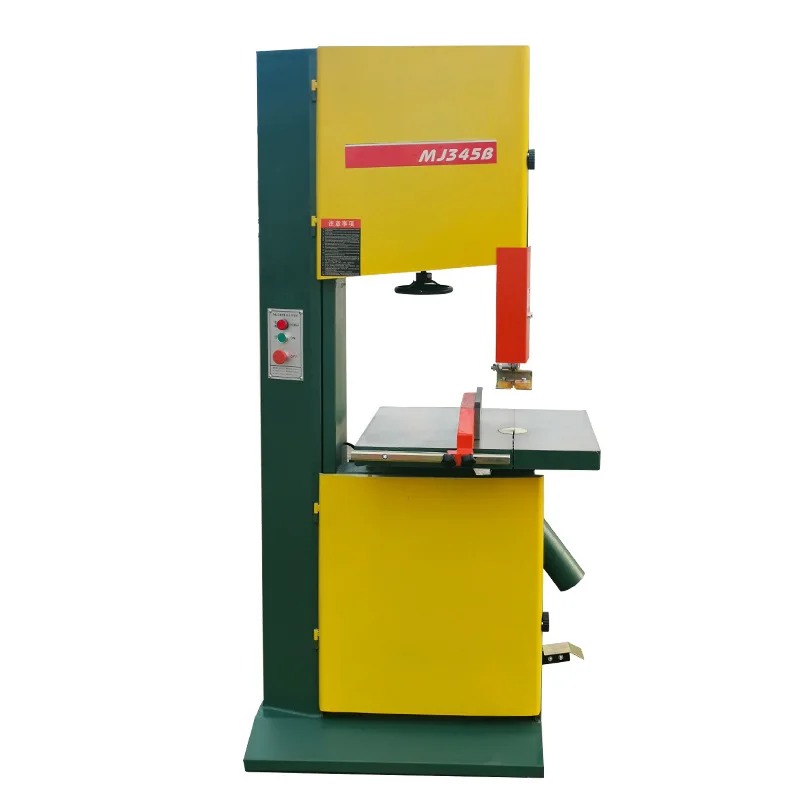
The TEBAK product record identifies the MJ345B as a woodworking vertical wood band saw for furniture cutting and saw-mill work. The confirmed data in that record is deliberately limited: model MJ345B, power 3 kW, and a working-table turning angle of 0-45 degrees. Those are useful selection anchors, but they are not a complete machine specification. A responsible B2B buyer should use them to open the RFQ and then request the remaining cutting, safety, electrical, and delivery details in writing.
This guide focuses on specification-based procurement. It does not claim a cutting height, throat capacity, blade length, wheel diameter, feed speed, dust-port size, or production rate because those figures are not present in the supplied queue record. The correct next step is a sample test using the buyer's timber, board, contour, and target finish.
2. Confirmed MJ345B specifications and what they mean
The MJ345B model designation identifies the configuration to reference in the quotation, drawings, nameplate, spare-parts list, and after-sales communication. Keeping the model number on every document reduces the risk of receiving an item with a similar title but a different table, motor, guard, or electrical configuration.
The listed 3 kW power is the main supplied performance figure. Power alone does not establish the maximum cutting capacity or guaranteed feed rate. Cutting behavior depends on blade selection, timber species, moisture, section size, tooth pitch, tension, guide adjustment, workholding, and the condition of the drive system. Ask the supplier to relate the 3 kW motor to a sample cut rather than converting it into an unsupported production claim.
The listed working-table turning angle is 0-45 degrees. This is important for buyers who need angled cuts, bevel preparation, or repeatable workpiece presentation. The quotation should clarify whether the range is continuous or indexed, how the table is locked, how the angle is read, and whether the scale is calibrated. For an acceptance test, measure the table at 0 degrees and at a selected angle within the 45-degree limit using a suitable shop instrument.
| Confirmed specification | Supplied value | Question for the quotation |
|---|---|---|
| Model | MJ345B | Confirm nameplate, configuration and spare-parts reference |
| Power | 3 kW | Confirm voltage, frequency, phase, motor brand and protection |
| Table turning angle | 0-45 degrees | Confirm lock, scale, calibration and repeatability |
| Woodworking use | Furniture cutting and saw-mill application | Run a sample with the buyer's material and section size |
3. Match the saw to the actual wood and cut geometry
Before requesting price, prepare a cut list. Record the species, moisture condition, board or solid-wood dimensions, required kerf, straight or curved path, bevel requirement, smallest internal radius, acceptable tear-out, and expected daily or weekly quantity. A saw that is suitable for furniture component work may require a different blade and guide setup from a machine used for rough timber preparation.
For straight resawing, the key questions are the maximum workpiece height, throat capacity, blade stability, fence arrangement, and ability to maintain a straight feed. For contour work, ask about the minimum curve radius, blade width options, table clearance, and guide adjustment. None of these values is supplied for the MJ345B in the queue record, so they must remain confirmation items rather than marketing statements.
For angled work, describe the exact part and angle. The 0-45-degree table range indicates a useful adjustment envelope, but the buyer must confirm how the table is secured under load and whether the fence remains usable when the table is tilted. Include a repeatability check in the sample test: set the same angle several times, cut identical test pieces, and measure the resulting difference.
4. Blade and guide questions that determine real cutting quality
A band saw's motor is only one part of the cutting system. The blade, wheel alignment, tensioning system, upper and lower guides, table support, and fence determine how effectively the 3 kW input becomes a clean cut. Ask the supplier for the compatible blade length, width range, thickness range, tooth pitch options, material, joint quality, and recommended tension procedure for the MJ345B.
Guide settings should be practical for the buyer's work. Request the adjustment range and the method used to keep the guides close to the workpiece without interfering with the cut. Confirm whether the supplied guides are suitable for both straight cuts and curved furniture components, and whether replacement guide parts are available as standard spares.
The buyer should also request the wheel alignment and tracking procedure. A clear maintenance procedure is more valuable than an unsupported accuracy claim because operators can use it during commissioning and after blade changes. During the sample test, inspect the kerf, burn marks, blade drift, surface tear-out, and repeatability at both a straight setup and an angled table setup.
5. Table adjustment, fence control, and operator workflow
The 0-45-degree table turning range makes the table-lock mechanism a procurement-critical component. A buyer should verify that the table moves smoothly, reaches the stated range, locks without movement, and can be returned to a known reference. Ask whether the angle scale is engraved, printed, or supplied as a separate indicator, and identify the recommended method for independent verification.
For repeat furniture cutting, a stable fence and clear reference edge are essential. Ask whether a fence is standard, what adjustment range it provides, how it is locked, and whether it remains square to the blade at different table angles. If the machine is intended for curved work, define when the fence is removed and how the operator controls the workpiece safely without forcing the blade sideways.
Work instructions should divide the process into material inspection, blade and guide check, table and fence setup, first-piece approval, batch cutting, inspection, and shutdown. The product record describes the unit as easy to operate only as a key selling point; it does not specify training time or automation. Treat operator simplicity as a point to verify in a demonstration, not as a guaranteed labor saving.
6. Safety and dust-management requirements
A stationary band saw exposes the operator to a moving blade and stored mechanical energy. Before purchase, request the complete guard arrangement, blade-access interlock if fitted, emergency-stop position, restart behavior after power loss, blade tension release procedure, table-tilt lock, and recommended personal protective equipment. Confirm that the delivered machine matches the safety documentation and the destination market's requirements.
Wood dust management should be part of the work-cell design. The queue record does not state a dust-port diameter, airflow requirement, or extraction configuration. Ask the supplier to state the connection size and recommended extraction conditions, then match those requirements to the buyer's central system or local collector. Keep extraction routing clear of moving parts and provide a cleaning schedule for the table, guides, wheels, and surrounding floor.
A receiving inspection should include an unloaded run, emergency-stop test, guard check, blade tracking check, table-lock test, and a controlled sample cut. Record any abnormal vibration, noise, heat, smoke, blade drift, or dust leakage. Do not accept a high-power machine on motor rating alone; accept the complete machine only when the safety and operating functions have been demonstrated.
- Verify the model MJ345B and the 3 kW nameplate against the order.
- Test the working-table movement from 0 degrees toward the stated 45-degree limit.
- Confirm the table lock and angle reference before cutting a sample.
- Inspect blade guards, guides, tracking, tension release and emergency stop.
- Confirm the dust-extraction connection and clean-up procedure.
- Run straight and angled samples using the buyer's own wood or board.
7. RFQ checklist for an MJ345B woodworking band saw
A complete RFQ should identify the product ID 1601351385854, model MJ345B, destination country, required voltage and frequency, material species, maximum section, cut type, angle range, daily quantity, and whether the buyer needs straight resawing, curved furniture components, or both. Attach drawings or photographs of the most difficult part instead of describing the job only as furniture cutting.
Ask the supplier to confirm the 3 kW motor configuration and all electrical details, including phase, frequency, protection, plug or terminal arrangement, motor starting method, and any available customization. For the table, request the exact 0-45-degree adjustment method, scale resolution, lock design, usable table dimensions, and fence behavior at an angle.
The following items are not stated in the supplied record and should be requested before comparing total cost: blade length and width, wheel diameter, maximum cutting height, throat depth, table size, blade speed, guide type, dust-port size, net and gross weight, machine dimensions, packing, standard accessories, spare blades, warranty, lead time, installation guidance, and acceptance criteria.
| RFQ area | Required supplier confirmation | Reason |
|---|---|---|
| Capacity | Maximum cutting height, throat and table size | Checks the actual work envelope |
| Blade system | Blade length, width, speed, guides and tensioning | Determines cut quality and consumables |
| Table | 0-45-degree method, scale and lock repeatability | Controls bevel and angled work |
| Electrical | 3 kW motor voltage, frequency, phase and protection | Prevents installation mismatch |
| Safety and dust | Guards, emergency stop and extraction connection | Defines the complete work cell |
| Delivery | Dimensions, weight, packing, accessories and lead time | Supports logistics and commissioning |
8. Conclusion: select the complete MJ345B configuration
The TEBAK MJ345B is a clear candidate for buyers seeking a vertical woodworking band saw identified by a 3 kW power listing and a working-table turning angle of 0-45 degrees. Those confirmed facts make it suitable for a focused RFQ and sample-test plan, especially where furniture cutting or saw-mill preparation requires a stationary table and an adjustable presentation angle.
The final purchase decision should depend on the missing cutting-envelope, blade, safety, dust, electrical, and delivery details. Request the supplier's configuration sheet and test the machine with the actual wood, board, contour, and angle used in production. For a quotation based on your sample and destination, contact the TEBAK team at info@cntebak.cn.
Key specifications
- Model
- MJ345B
- Power
- 3 kW
- Working table turning angle
- 0-45 degrees
Frequently asked questions
- What is the listed model?
- The supplied product record lists model MJ345B.
- What power is listed?
- The supplied product record lists 3 kW. Confirm the exact voltage, frequency, phase and protection in the quotation.
- What table angle is listed?
- The supplied record lists a working-table turning angle of 0-45 degrees. Confirm the scale, lock and repeatability.
- What is the maximum cutting height or blade size?
- Those values are not stated in the supplied queue record. Request them and test the machine with the buyer's workpiece.