
1. Why this listing needs a specification-first RFQ
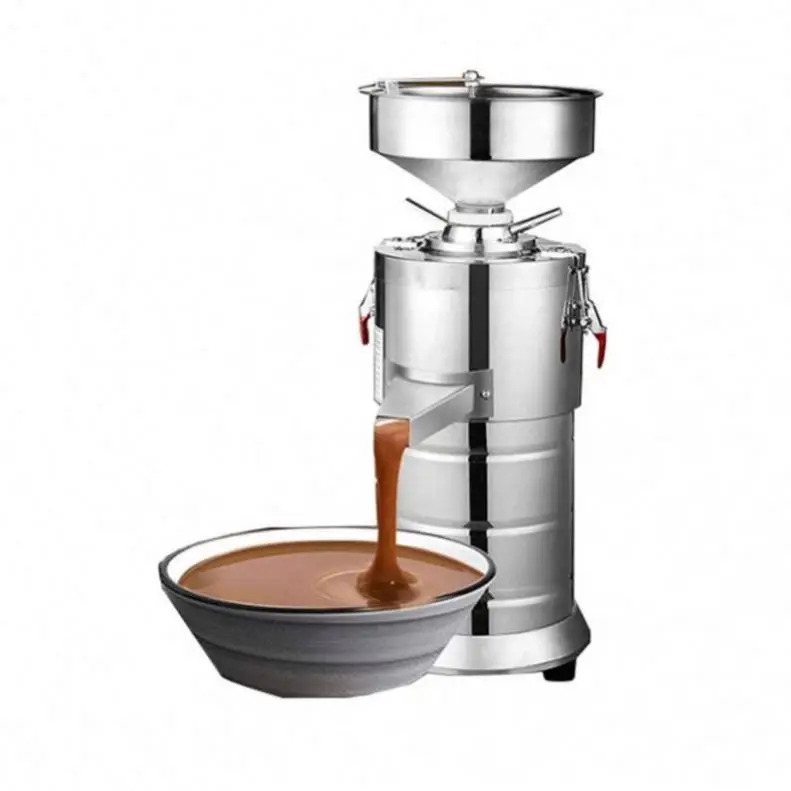
The TEBAK source record identifies an Almond Paste Grinding Production Maker Equipment unit and describes it as a Colloid Mill Almond Butter Machine. The supplied product image shows a vertical stainless-steel-looking grinding unit with a top hopper, a lower outlet and a receiving bowl. The record does not provide a model number, motor rating, throughput, grinding-gap range, electrical configuration, contact-material grade or final particle-size result.
That missing data is not a reason to guess. For a food-processing buyer, these fields determine whether the machine fits a pilot line, a retail kitchen, a small factory or a continuous production system. This guide therefore treats the listing as an RFQ starting point. It explains what can be verified from the source record, what must be measured or confirmed, and how to request a sample test for almond paste before approving the machine.
2. Verified facts from the current product record
The following facts are limited to the wording supplied with the Hoting queue item and the visible product image. The product title names TEBAK, almond paste grinding production maker equipment, colloid mill and almond butter machine. The description repeats the product description heading but contains no numeric parameter table. The image visibly shows a hopper, a vertical grinding body, a discharge outlet and a bowl collecting a brown paste-like product; it does not display a readable specification label.
Because the source does not state a numeric specification, this article does not claim a capacity, power, speed, material grade, fineness, temperature rise or certification. The absence of those claims is intentional and should be preserved in the buyer's internal approval record until the supplier returns a signed data sheet.
3. Define the almond-paste application before comparing machines
Almond paste is not a single standardized feedstock. A buyer should describe the almond preparation before asking for a quotation: roasted or unroasted kernels, peeled or unpeeled material, initial moisture, oil release, incoming particle size, required batch size and whether sugar, salt or another ingredient is introduced before or after grinding. These details change feeding behavior, cleaning requirements and the acceptable final texture.
Ask the supplier to confirm whether the listed machine is intended for a single pass, recirculation or staged grinding. Request a written description of the feed sequence and identify whether the machine is expected to receive whole almonds, pre-crushed almonds or a premixed paste. Do not assume that a machine named an almond butter machine can process the buyer's exact recipe without a trial.
4. Colloid mill questions for the RFQ
The term colloid mill describes a shear-based grinding arrangement, but the source record does not identify the rotor and stator geometry or the adjustment method. Request drawings or photographs showing the grinding assembly, the adjustment scale, the product path and the discharge port. Ask whether the grinding gap is adjustable during operation or only after shutdown, and how the setting is locked against drift.
The quotation should state the inlet size, outlet size, minimum and maximum feed condition, allowable solid content, recommended pre-crushing and whether the unit is suitable for oil-rich almond paste. If a supplier uses a fineness number, ask for the test method, sample preparation, sieve or particle-size method and the number of passes used to obtain the result.
5. Motor power, speed and electrical configuration
Motor power, rotor speed, voltage, frequency and phase are not included in the current product record. They are mandatory fields for a commercial quotation. Ask for rated motor power in kW or HP, rated voltage, frequency, phase, full-load current, starting method, overload protection and the motor nameplate for the exact unit offered.
Do not accept a generic statement such as high speed or high power as a substitute for a data sheet. A buyer should request no-load speed and recommended operating speed, but should not infer either value from the product image. If the supplier offers multiple motor variants, place the selected variant and destination electrical standard on the pro forma invoice and packing list.
6. Capacity must be proved with the buyer's recipe
No throughput value is supplied. Capacity for almond paste can vary with feed preparation, oil content, desired texture, grinding-gap setting, number of passes and acceptable product temperature. Ask the supplier to quote capacity using a clear unit such as kg/h or kg per batch and to define the test material and operating conditions.
A useful sample report should record input mass, feed preparation, processing time, number of passes, output mass, product temperature before and after grinding, observed texture and any blockage or bridging. Request video or test notes only as supporting evidence; the purchase decision should rely on a written test protocol and a retained sample that the buyer can inspect.
7. Contact materials and food-hygiene verification
The source record and image do not establish the grade of stainless steel or the material of the grinding components, seals, gaskets and hose connections. A food-processing RFQ should ask the supplier to identify every product-contact material, surface-finish option, seal material and lubricant boundary. Do not convert a stainless-looking exterior in the image into a food-contact certification claim.
Ask how the grinding chamber is opened, whether tools are required, how residue is removed and whether parts can be inspected without damaging seals. Request cleaning instructions for oil-rich almond paste, including the recommended cleaning agent, rinse procedure, drying method and any restrictions on water entering the motor or control area.
8. Temperature control and product quality
Almond paste quality can be affected by heat generated during shear. The current record does not state a temperature-control system, jacket, cooling connection or allowable product temperature. Ask the supplier whether the machine is designed for batch temperature monitoring, whether a cooling option exists and where a temperature probe can be installed.
Define the quality target before the sample test. The buyer may need a smooth spreadable paste, a coarser almond butter texture or a specific mouthfeel, but the product record does not define one. Agree on a test description using the buyer's own reference sample rather than relying on words such as fine, smooth or premium without a measurement method.
9. Installation, cleaning and spare parts
Before placing an order, request the overall drawing, footprint, inlet and outlet heights, service clearance, lifting points, packed dimensions and gross shipping weight. None of these values are supplied in the current record. Confirm whether the machine needs a separate pump, receiving vessel, electrical control cabinet, pre-crusher or dust and splash protection.
The spare-parts list should cover the grinding surfaces, seals, bearings, fasteners, switches and any wear components. Ask for recommended replacement intervals only if they are based on a defined duty cycle. For an almond-paste line, keep a cleaning and inspection checklist that records residue removal, seal condition, grinding-gap condition and unusual noise or vibration after each production run.
10. Purchase checklist and decision gate
A responsible buyer should not approve this listing on the product title alone. The minimum pre-order package should include the exact model, motor and electrical data, capacity test conditions, grinding-gap adjustment, product-contact material declaration, cleaning procedure, dimensions, shipping data, included accessories, spare-parts list, warranty scope and a sample result using the buyer's almond preparation.
The TEBAK listing is useful as a starting point for an almond paste or almond butter colloid-mill inquiry, but the current record contains no numeric specifications. The correct decision gate is therefore conditional: proceed to a quotation and sample test, then approve only after the supplier fills the missing fields and the test result matches the buyer's texture, capacity, temperature, sanitation and electrical requirements. This protects the buyer from paying for an assumed configuration that was never specified.