
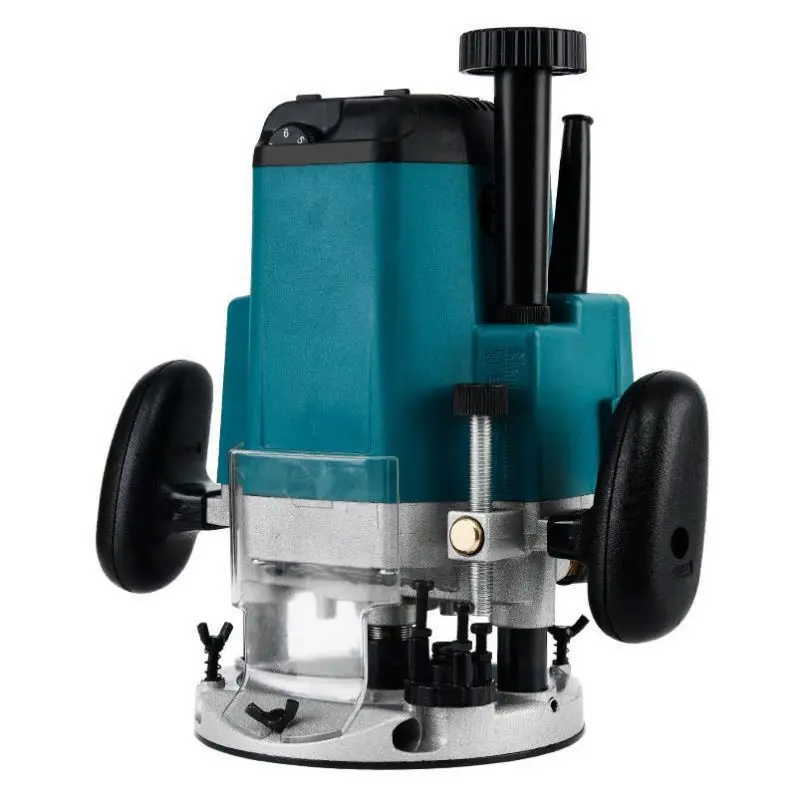
1. What the TEBAK professional electric router is for
The TEBAK product record describes a Professional Electric Router for wood milling, engraving, slotting, carving and carpentry work. It is a portable electric wood router rather than a fixed spindle-moulder line, so buyers should evaluate it around operator control, cutter compatibility, speed selection, workholding and repeatability for the intended woodworking task.
This B2B procurement guide uses the supplied product parameters as its factual baseline. The record lists a 2200W rated power input, 110V-240V~50Hz rated voltage/frequency, three chuck diameters, a 9000-22000 r/min no-load speed range, 0-6 gear variable speed, 6.5 kg product weight and 280 × 160 mm product size. Cutting depth, base design, included accessories, dust extraction and production capacity are not stated and must be confirmed before ordering.
2. Verified specification table for an RFQ
The following table converts the product record into an RFQ starting point. Keep the voltage notation exactly as supplied and ask the supplier to confirm whether 110V-240V~50Hz means a universal input range for one unit or different regional variants. This distinction affects certification, plug configuration, protection and shipment planning.
3. Evaluating the 2200W power input
The listed rated power input is 2200W. For buyers, this is a useful electrical sizing value, but it is not the same as material removal rate or continuous cutting capacity. The actual result depends on cutter diameter, wood species, grain direction, pass depth, feed speed, operator technique and the condition of the cutter.
Ask whether 2200W is input power measured under a defined test condition and whether the motor is suitable for the planned duty cycle. Confirm startup current, overload behavior, thermal protection, recommended extension-cable specification and the correct plug for the destination market. Do not convert the power figure into an unsupported production-rate claim.
4. Voltage range and destination-market configuration
The product record lists 110V-240V~50Hz. A buyer serving multiple markets should request the nameplate photograph, wiring diagram, plug type, fuse or breaker recommendation and user manual for the exact shipment configuration. A broad voltage description does not by itself confirm that every frequency, plug or compliance configuration is available in one production batch.
For procurement, write the destination country and required electrical standard directly into the RFQ. Confirm whether the router is supplied with a grounded cable, whether a voltage selector is present, and whether the supplier offers separate 110V and 220V versions. Keep the confirmed electrical variant on the purchase order and packing list.
5. Chuck diameters and tooling compatibility
The listed chuck diameters are 1/4 in, 3/8 in and 1/2 in. This gives buyers three nominal shank-size references for cutter sourcing, but the quotation should state whether all three chucks are included or whether they are optional accessories. Confirm the actual collet or chuck design, runout measurement method, tightening tool and supported cutter shank tolerances.
Match the cutter shank to the supplied chuck before operation. Ask for the maximum recommended cutter diameter, allowable cutter length, plunge or edge-routing configuration, base opening and guard arrangement. The product record does not state these limits, so a buyer should not infer them from the 2200W motor or from the chuck sizes alone.
6. No-load speed and six-gear adjustment
The no-load speed is listed as 9000-22000 r/min, with variable speed described as 0-6 gears. A variable-speed control can help buyers match cutter size and material conditions, but the correct setting must follow the cutter manufacturer's limits and the router's operating instructions.
Ask the supplier to define the six gear positions, provide the approximate speed at each position and identify the control type. Request a no-load speed verification method and confirm whether the displayed setting corresponds to a calibrated range. For sample testing, record the selected gear, cutter, workpiece, pass depth, feed method and surface result so that the setting can be reproduced.
7. Weight, size and operator ergonomics
The product weight is listed as 6.5 kg and the product size as 280 × 160 mm. These values help with workstation planning, storage and handling, but the supplier should clarify whether the size includes the base, handles, power cable or cutter assembly. Confirm the packed dimensions separately because the net and gross weights may represent a different packaging configuration.
A 6.5 kg handheld router can impose meaningful operator load during extended edge or slotting work. Ask for handle spacing, switch position, base visibility, depth-adjustment method, balance and the recommended operating posture. If the buyer plans repeated production, compare handheld use with a router table or fixture and request the accessories needed for repeatable positioning.
8. Net weight, gross weight and shipping preparation
The record lists net weight of 12 kg and gross weight of 13 kg. Because these values differ from the separate 6.5 kg product weight, the quotation should clarify what each field refers to: one unit, a kit, a carton, or a packaged configuration with accessories. This discrepancy is a practical RFQ checkpoint rather than a value to silently reconcile.
Ask for the packing list, carton dimensions, number of units per carton, shock or moisture protection and the final shipping weight. For distributors, keep the product weight and package weight in separate catalog fields so freight calculations and warehouse handling instructions do not use the wrong number.
9. Safety, dust control and maintenance checks
Wood routing creates chips and fine dust. The product record does not state a dust port, extraction adapter, guard design or filter arrangement, so these should be confirmed with the supplier. Request the operating manual, cutter-change procedure, lockout steps, carbon-brush or motor maintenance instructions and emergency or abnormal-vibration guidance.
Before approving a sample, inspect the base, collet or chuck, spindle lock, switch, cable, guard and adjustment mechanism. Check whether the supplied accessories are suitable for the cutter sizes being evaluated. For a professional workshop, define inspection points for chuck cleanliness, cutter seating, cable condition, ventilation and dust accumulation around the motor housing.
10. Sample test and final buying decision
A useful sample test should use the buyer's actual wood species and intended operation, such as engraving, slotting, carving or edge routing. Record the 2200W unit's selected gear, cutter shank size, cutter type, pass depth, feed method, surface finish, noise or vibration observations and operator fatigue. This creates evidence for selecting the router and its accessories without inventing a nominal capacity.
The TEBAK Professional Electric Router is a candidate for B2B carpentry and solid-wood routing work where the 2200W input, 9000-22000 r/min no-load range, 0-6 gear control and 1/4 in, 3/8 in and 1/2 in chuck options fit the application. Before purchase, confirm the exact voltage variant, included chucks, maximum cutter limits, cutting-depth adjustment, dust extraction, safety documentation, package configuration and the meaning of the 6.5 kg versus 12/13 kg weight fields.