
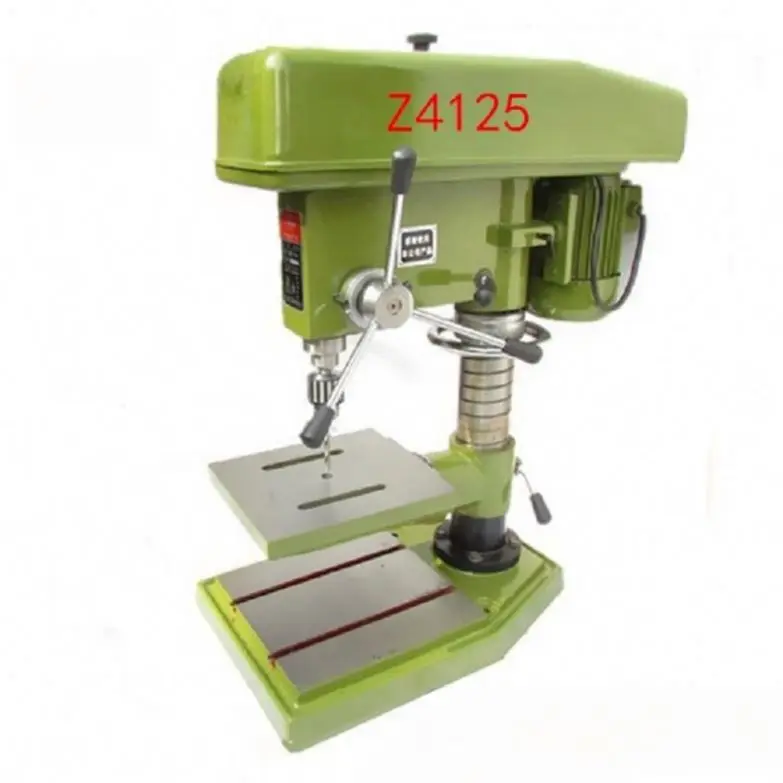
1. Product identity and purchasing scope
The Hoting queue identifies this product as a Vertical Drilling Tapping Machine, New Mechanical Hardware Bench Drill, Tapping Machine, Milling Machine and CNC Drilling Machine. The detailed source description presents it as a vertical drilling machine with a high-efficiency motor, belt drive, aluminum-alloy belt disk, ground worktable and heavy cast-iron construction. The parameter table confirms a maximum drilling diameter of 16 mm and a 550 W motor.
This combination of names should be treated as a purchasing lead, not as proof that every listed function is included in one standard configuration. The record provides drilling dimensions and four spindle speeds, but it does not provide a tapping-size range, tapping-control method, milling travel, CNC controller, automatic feed or reverse-cycle specification. Those claims must be confirmed in the RFQ before a buyer treats the machine as a drilling-and-tapping center rather than a bench drill with optional functions.
2. Verified specification table
The following values are transcribed from the current product record. Units have been normalized for readability, while the original labels remain represented in the wording. The values describe the listed configuration; they do not replace a signed drawing, nameplate or pre-shipment inspection document.
3. Drilling capacity and material planning
The maximum drilling diameter is listed as 16 mm. A maximum diameter should not be interpreted as a guaranteed production rate for every metal, bit type or hole depth. Ask the supplier to define the test material, drill type, feed method, cutting fluid and acceptable hole-quality tolerance used to establish the 16 mm figure.
For procurement, describe the actual workload: material grade, workpiece thickness, hole diameter range, blind or through holes, positional tolerance and daily duty cycle. A buyer should request a sample test with the largest required drill and representative smaller diameters. Record spindle speed, feed behavior, cutting-fluid use, burr condition and runout rather than approving the machine from the maximum diameter alone.
4. B16 spindle taper and tooling confirmation
The spindle taper is listed as B16. This is a critical interface for the chuck or tooling package. Ask the supplier to confirm the complete spindle nose arrangement, chuck type, chuck capacity, arbor or adapter included, key type, drawbar or retention method and the runout measured at a defined gauge position.
The term B16 identifies the listed taper but does not tell the buyer whether a chuck is included or which maximum chuck capacity is supplied. Put the required chuck and arbor in the quotation line items. If the buyer already owns tooling, request a dimensional compatibility drawing before ordering and verify the taper and seating length during incoming inspection.
5. Four spindle speeds and belt-drive selection
The source lists four spindle speeds: 448, 883, 1588 and 2988 r/min. The description says that belt drive reduces noise and that the aluminum-alloy hard belt disk is balanced with low shaking. These are useful configuration clues, but the record does not state whether the speeds are changed by pulley position, a gearbox, an electronic control or another method.
Ask for the speed-selection procedure, belt specification, guard design, belt-change access, measured speed tolerance and the recommended speed for each material and drill diameter. Confirm that speed changes require the machine to be stopped and that the guard can be reinstalled correctly. Do not describe the four listed values as infinitely variable speed control.
6. Spindle stroke, reach and work envelope
The maximum spindle stroke is 80 mm. The spindle center-to-column distance is 190 mm, the maximum spindle-end-to-table distance is 260 mm, and the maximum spindle-end-to-base-table distance is 360 mm. Together, these figures help a buyer estimate the work envelope, but they do not establish the exact clearance available after the chuck and drill are installed.
Request a dimensioned drawing that shows the measurement reference points and the position of the table at its limits. Ask whether the 260 mm and 360 mm values are measured to the spindle nose, taper end or another reference. For deep holes or tall fixtures, calculate clearance using the actual chuck, arbor and drill assembly, not the spindle-end number alone.
7. Table and base dimensions
The table is listed as 190 × 190 mm and the base as 260 × 360 mm. The description calls the worktable finely ground for higher machining accuracy, but it does not provide flatness, squareness, T-slots, slot dimensions, clamping-hole pattern or table load capacity.
Ask the supplier for a table drawing, slot or hole dimensions, usable clamping area and permitted workpiece weight. Confirm whether the table can tilt, rotate or be locked only in a fixed position. If the buyer plans to use a vise, jig or tapping fixture, request the fixture envelope and ensure the 190 × 190 mm table supports the required setup without overhang that could affect stability.
8. Column, cast iron and machine stability
The column diameter is listed as 59 mm. The source description also states heavy cast iron for stability and identifies an aluminum-alloy hard belt disk. Ask which parts are cast iron, which parts are aluminum alloy, and whether the 59 mm value refers to the complete column outside diameter or another measured section.
Stability should be checked under the buyer's actual drilling load. Request the base mounting-hole pattern, anchor recommendations, machine-leveling procedure and allowable vibration condition. Net weight is 35 kg, but a stable installation still depends on the base, bench, fasteners and workpiece clamping. Do not treat weight alone as a substitute for a mounting plan.
9. Motor, electrical data and duty cycle
The motor is listed as 550 W. The current parameter table does not state voltage, frequency, phase, rated current, motor protection, plug type or duty rating. Ask for the exact motor nameplate and destination-market wiring configuration before issuing a purchase order.
A 550 W motor rating does not by itself establish drilling capacity, tapping torque or continuous-duty performance. Request the recommended duty cycle, overload protection, startup method, thermal protection and service access. If tapping is required, ask for the torque or control specification and a demonstration of forward/reverse operation under the required tap size; the record does not provide these values.
10. Drilling versus tapping and milling claims
The listing title includes drilling, tapping, milling and CNC drilling terms, but the detailed parameter table contains drilling geometry and spindle speeds only. It does not state a tapping range, tapping depth, reversing mechanism, tapping clutch, thread-size chart, milling table travel or CNC control system.
A buyer needing tapping should add a dedicated confirmation section to the RFQ: minimum and maximum tap size by material, forward/reverse control, thread-depth stop, torque protection, tap chuck or collet, cycle control and test-thread acceptance criteria. A buyer needing milling should separately confirm cutter compatibility, lateral travel, quill rigidity and permitted milling operations. Until these fields are documented, describe the machine as a listed vertical drilling platform with tapping and milling functions requiring confirmation.
11. Inspection, safety and maintenance checklist
Before shipment, inspect the spindle taper and chuck fit, measured runout, spindle-stroke smoothness, table flatness, column alignment, belt guard, speed-selection labels, emergency or stop controls, motor nameplate, grounding, base mounting points and supplied accessories. Record the inspection method and measurement tools in the purchase file.
Request the operating manual, lubrication points, belt replacement procedure, chuck-key retention method, cleaning instructions, recommended spare parts and warranty scope. Confirm that the guard and rotating-tool safety instructions match the destination market. The description's statements about belt drive, balanced belt disk, ground table and heavy cast iron are product-record claims; they should be checked visually and functionally during inspection rather than expanded into unverified certification claims.
12. RFQ decision gate
The minimum quotation package should include the exact model and product ID 1601364226493, maximum drilling diameter 16 mm, B16 taper, the four listed speeds, 80 mm spindle stroke, 190 mm reach, 260 mm and 360 mm clearance values, 190 × 190 mm table, 260 × 360 mm base, 755 mm total height, 550 W motor and 35 kg net weight. Add the missing electrical, tooling, runout, worktable, safety, packing and warranty fields before approval.
The final decision should be based on a sample test using the buyer's material and tooling. Check the required hole diameter, position, depth, surface condition, spindle runout, speed selection, motor response and clamping stability. If tapping or milling is a required function, do not sign off on the drilling specifications alone. The source record supports a detailed RFQ, but the multifunction claims need their own documented acceptance criteria.