
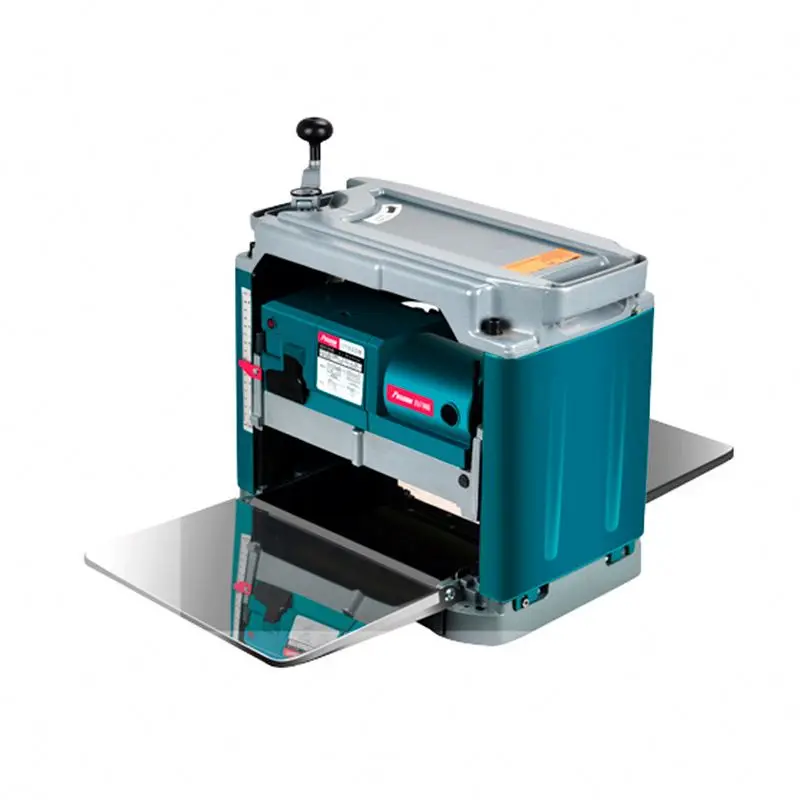
1. What this TEBAK planer is designed to do
The source record describes a TEBAK woodworking wood planer and thicknesser for manual wooden thickness-planing work. It lists a 305 mm planing width in the parameter table and repeats 304 mm in the product description, together with a 160 mm planing height or 6-160 mm cutting-height range. The listed feed speed is 6 m/min and the no-load speed is 8500 r/min.
For a buyer, the machine should be evaluated as a portable or workshop thickness-planing tool whose value depends on stock preparation, board dimensions, feed consistency, cutter condition and the desired final thickness. This guide uses only the supplied product record and highlights every place where the buyer should reconcile duplicate wording before placing an order.
2. Verified specification table
The table below separates the values that are repeated in the source record from the fields that need confirmation. The 305 mm versus 304 mm width difference is small but commercially important: it should be resolved on the final drawing, quotation and purchase order rather than silently normalized by the buyer.
3. Planing width: resolve 305 mm versus 304 mm
The parameter list states Planing width 305 mm, while the repeated description states Planing width 304 MM. A procurement team should treat these as two source values, not as proof that the machine has a guaranteed usable width of either number. Ask the supplier to confirm the effective cutting width, table width, maximum recommended board width and the tolerance at the edge of the workpiece.
Put the confirmed value in the technical annex and ask for a dimensioned drawing. Also confirm whether the stated width is the cutter's nominal length, the maximum board width, or the clear opening through which stock can pass. These are different measurements and can lead to different production results even when the number looks similar.
4. Cutting height and thickness range
The source gives Planing height 160 mm and separately gives Cutting height 6-160 MM. This suggests a lower and upper workpiece-height range in the repeated description, but the exact meaning should be confirmed. Ask whether 6 mm is the minimum finished thickness, minimum input height or a recommended operating limit after flattening one face.
Before ordering, request the thickness-adjustment mechanism, scale graduation, adjustment increment, maximum stock height, minimum stock height, maximum removal at each pass and the method used to verify parallelism. The listed planing depth is 0-3 mm, with the repeated description stating 3 mm per time; do not assume that the maximum removal is suitable for every wood species or board width.
5. Planing depth and pass planning
The product record lists Planing depth(-times) as 0-3 mm and later states Planing depth: 3mm/time. These fields indicate a stated removal range, but they do not define a universal cutting recommendation. Actual removal depends on wood species, moisture, grain direction, board support, cutter sharpness, feed speed and whether the board has already been flattened.
For an acceptance test, use several pass settings below the stated upper value and record the input thickness, selected depth, feed behavior, output thickness, surface quality and any snipe or tear-out. Ask the supplier to specify whether the 3 mm value is a maximum setting, a nominal setting or a value measured under a particular material condition.
6. Feed speed and board handling
The listed feed speed is 6 m/min. A feed-speed figure is useful for estimating handling time, but it is not a guaranteed throughput for every board. The buyer should ask whether 6 m/min is fixed, selectable or an approximate operating value, and whether the feed system maintains speed under load.
Request details on infeed and outfeed table length, roller or belt arrangement, anti-kickback protection, board support and the recommended minimum workpiece length. The source record does not state these dimensions or safety components. A sample test should include the shortest and longest boards the buyer expects to run, not only a convenient test piece.
7. No-load speed and cutter-system confirmation
The no-load speed is listed as 8500 r/min. Buyers should ask for the cutter-head configuration, number of knives or inserts, cutter diameter, knife material, knife-change method and permitted cutter speed. The source does not provide these details, so the no-load figure alone cannot establish surface finish, cutting capacity or tool life.
Confirm whether the no-load speed is measured at the spindle without stock and whether it is fixed. Ask for the operating manual's guidance on startup, shutdown, cutter inspection and abnormal vibration. Record the cutter condition during the sample test because a new or newly sharpened cutter can produce a different result from a worn tool.
8. Electrical configuration for the destination market
The repeated source description lists 220-230V / 50Hz. The record does not state phase, rated current, motor power, plug type, protective device or regional certification. Ask the supplier for the exact nameplate and wiring diagram for the destination country and confirm whether the quoted machine is a single-voltage configuration.
The quotation should show 220-230V / 50Hz exactly as the selected electrical requirement, together with phase, motor rating, cable and plug details once confirmed. Do not infer motor power from the 8500 r/min no-load speed or from the machine's net weight. Those are separate technical fields.
9. Die-cast aluminum body and maintenance checks
The source states Material aluminum alloy die casting. Ask the supplier which components this describes: main body, table, housing, brackets or another part. Confirm the materials of the cutter enclosure, feed components, fasteners, bearings, adjustment parts and work-contact surfaces separately.
For maintenance planning, request the lubrication points, belt or drive inspection method, bearing access, cutter replacement procedure, cleaning instructions and recommended spare parts. A die-cast aluminum body does not by itself prove rigidity, corrosion resistance or suitability for a specific production duty cycle; those questions belong in the sample and inspection plan.
10. Net weight, packing and installation
The listed net weight is 26.5 kg. Ask for the gross packed weight, carton dimensions, number of units per carton, protective packaging and lifting or carrying guidance. Net weight is not a substitute for shipping weight, and the source record does not provide a packed configuration.
Confirm the machine footprint, required service clearance, floor or bench support, extraction connection, infeed and outfeed clearance and the recommended installation surface. If the product is used in a workshop, a 26.5 kg net machine may still need two-person handling depending on packaging and the final lifting arrangement; the supplier should state the safe handling method.
11. RFQ and acceptance-test checklist
A complete RFQ should request the exact effective planing width, maximum and minimum workpiece height, maximum removal per pass, feed-speed behavior, no-load and operating spindle speed, cutter specification, motor power, voltage, frequency, phase, current, safety devices, body and contact materials, dimensions, gross shipping weight, included accessories, spare parts and warranty terms.
The acceptance test should use the buyer's own wood species and representative board sizes. Measure input and output thickness at several points, record the pass setting and feed speed, inspect surface finish and parallelism, and document any snipe, tear-out, stoppage or abnormal vibration. The TEBAK record provides a useful starting specification—8500 r/min, 6 m/min, approximately 304-305 mm width, 6-160 mm cutting height, 0-3 mm planing depth, 220-230V/50Hz and 26.5 kg net weight—but the duplicate width wording and missing motor/cutter details must be resolved before approval.