
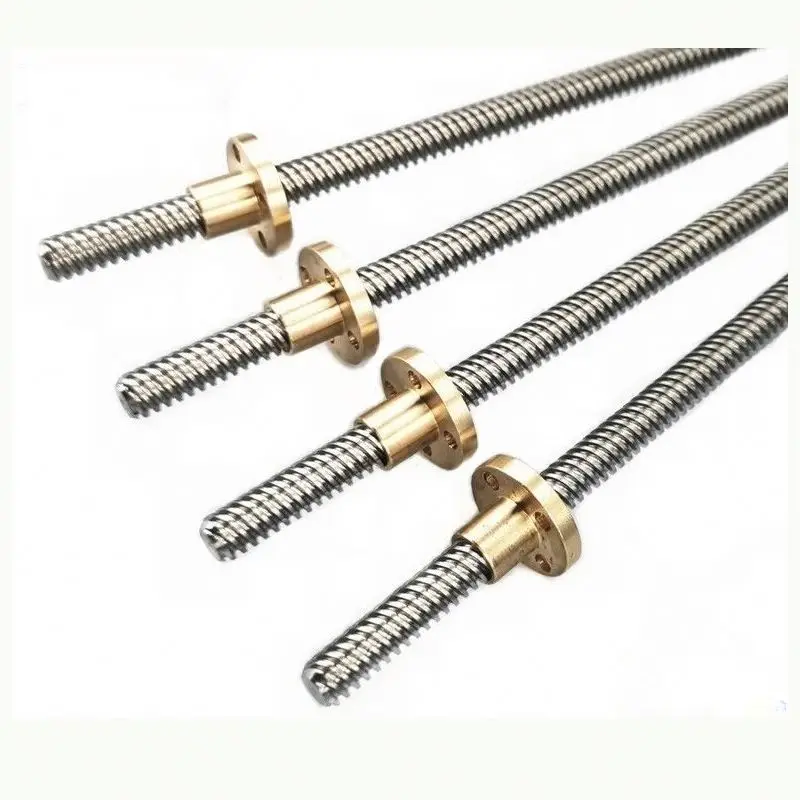
1. What the TEBAK W-08 lead screw is designed to do
The TEBAK W-08 product record describes a T8 trapezoidal lead screw with brass nut for 3D printers and other motion systems. The same record also lists CNC machinery, high-precision applications and servo motors. For B2B buyers, that combination means the lead screw should be evaluated as a motion-transmission component rather than as a generic threaded rod.
A lead screw converts rotary motion into controlled linear travel. The screw, nut, end machining, support bearings, coupling and lubrication method work together. A correct purchase therefore begins with the machine's travel, load, speed, duty cycle and mounting arrangement. The product title mentions 2 mm, 4 mm and 8 mm lead variants, while the parameter block lists Tr22*5; these should be treated as separate variants to confirm, not combined into one assumed configuration.
2. Verified specification table and variant control
The table below uses the product record as the source of truth. It lists Tr22*5 as the lead screw type, 1000 mm as the listed length, standard end process, 45# steel material, CNC/high-precision/servo applications, and C7 as the grade described in the product description. The title also references T8 and 2 mm, 4 mm and 8 mm lead options, so the supplier must state the exact selected variant on the drawing and proforma invoice.
3. Lead, pitch and travel per revolution
Lead is the linear distance travelled in one screw revolution. It directly affects speed, resolution, torque demand and the relationship between motor rotation and axis travel. A smaller lead can support finer incremental movement but may require more motor revolutions for a given travel. A larger lead can increase travel per revolution but may change torque and positioning behavior.
Because the title and parameter block show different lead descriptions, do not select a coupling or motion controller from the title alone. Ask the supplier to confirm pitch, lead, nominal diameter, nut type and the exact thread designation for the purchased item. For a Tr22*5 variant, request the drawing and confirm that the nut and mating screw use the same geometry.
4. Length, support and straightness
The listed length is 1000 mm. A one-metre lead screw requires a support strategy that matches the machine's speed and stiffness requirements. Buyers should confirm whether 1000 mm is the overall cut length, the threaded length, or an available stock length before finalizing the frame and bearing positions.
Request straightness tolerance, runout data, end-to-end dimensional tolerance and the recommended support arrangement. If the screw is used in a long axis, ask whether a fixed-floating bearing layout, intermediate support or anti-whip arrangement is recommended. These details are not provided in the record and should remain procurement questions.
5. 45# steel and surface treatment questions
The material field lists 45# steel. Buyers should ask whether this refers to the screw core material, the finished screw, or a standard material option before comparing quotations. Confirm hardness, surface treatment, corrosion protection, thread finish and the material of the matching brass nut.
Material selection should follow the duty cycle. A light 3D-printer axis, a CNC adjustment axis and a servo-driven high-cycle axis may have different requirements for wear, backlash stability and lubrication. Do not turn the material label into an unsupported service-life promise; request sample data or a stated application limit instead.
6. C7 grade and application fit
The product description states Grade C7. The buyer should ask the supplier to define the applicable accuracy standard, measurement method and whether C7 refers to the screw's lead accuracy, a product family grade or an internal classification. This is especially important when the component is advertised for high-precision applications.
A lead screw grade is only one part of positioning performance. Backlash, nut preload, bearing play, coupling alignment, frame rigidity, temperature and control resolution also affect the axis. For a servo application, request a complete interface drawing and a test method that reflects the actual axis travel and load.
7. End machining and integration
The end process is listed as standard. Standard end machining is not enough to guarantee compatibility because the motor-side journal, bearing seats, retaining threads, keyways and coupling interface must match the customer's machine drawing.
Send the supplier a dimensioned end sketch or request the supplier's standard end drawing. Confirm end diameter, bearing-seat dimensions, shoulder locations, thread details, keyway or flat, and the coupling type. If custom end machining is required, ask for the additional lead time and inspection report before releasing the order.
8. Brass nut, lubrication and maintenance
The title references a brass nut. Confirm whether the brass nut is included in the quoted price, which nut style is supplied, whether it is cylindrical or flange-mounted, and whether an anti-backlash version is available. The nut's fit and lubrication have a direct effect on friction, noise and backlash.
Ask for the recommended lubricant, relubrication interval, allowable contamination and replacement procedure. For CNC or servo axes, define how backlash will be checked during maintenance. A replacement nut should be matched to the same screw geometry rather than selected by nominal diameter alone.
9. RFQ checklist for OEMs and distributors
An effective RFQ should state the selected lead variant, nominal diameter, pitch and lead, total length, threaded length, end drawing, nut style, material, grade, straightness, runout, surface treatment, inspection method, packaging and required quantity. Include the intended application and the motor/coupling interface.
For the record reviewed here, ask the supplier to resolve the title-versus-parameter difference: the title references T8 and 2 mm, 4 mm and 8 mm lead options, while the parameter block lists Tr22*5. Request a separate quotation line for each variant if more than one is needed. This prevents a batch from arriving with the wrong lead.
10. Final buying decision
The TEBAK W-08 lead screw is a candidate for motion systems that need a trapezoidal screw and brass nut, with a listed Tr22*5 parameter, 1000 mm length, standard end process, 45# steel material, stated CNC/high-precision/servo applications and a C7 description. It can be considered for 3D-printer mechanisms, adjustment axes and selected machine-building applications after the exact variant is confirmed.
Before purchase, make the supplier confirm the chosen lead, pitch, nut geometry, end machining, accuracy definition, straightness, runout, lubrication and inspection documents. The safest order is based on a dimensioned drawing and sample validation, not on the product title alone.