
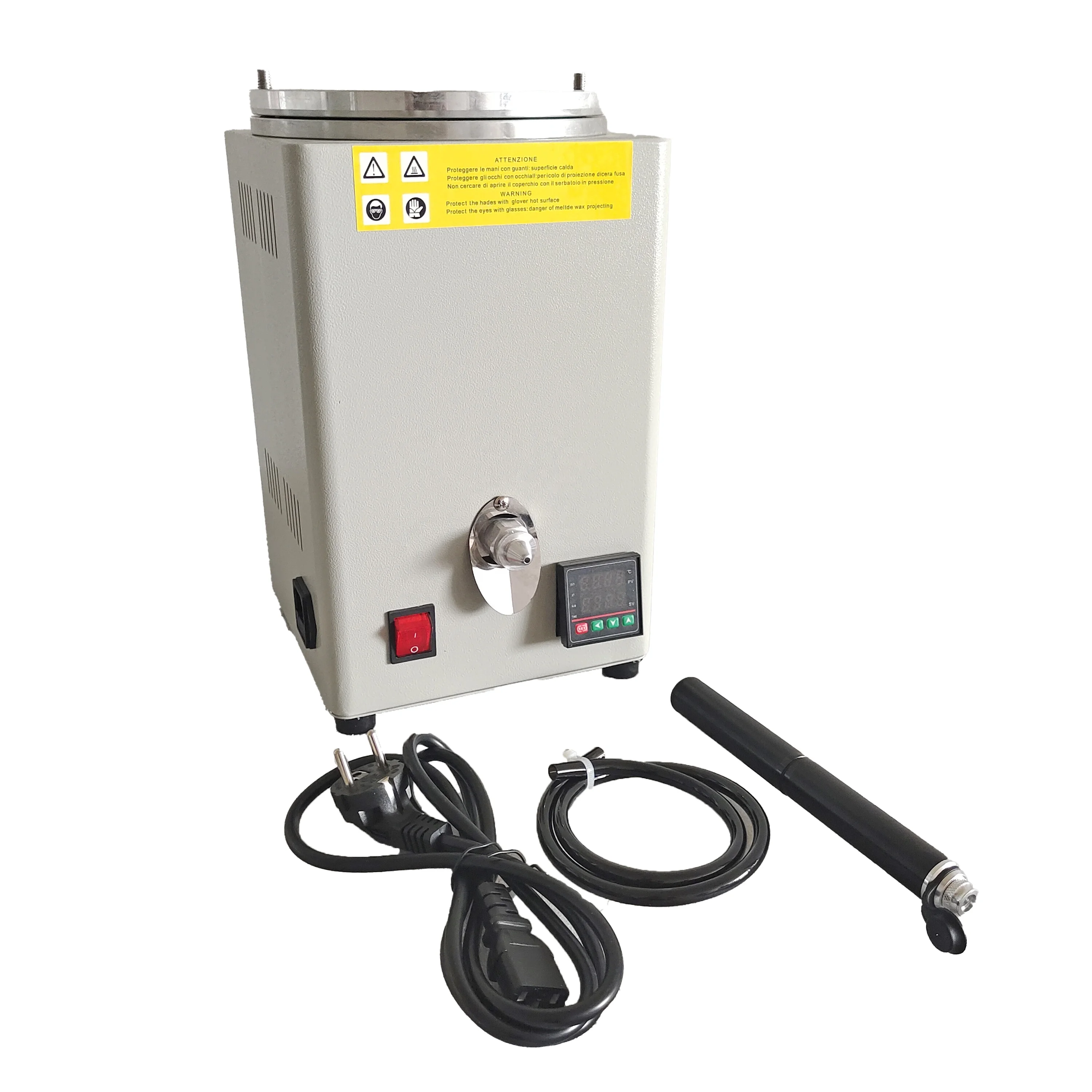
Source-controlled product identity
The Hoting queue record identifies a TEBAK jewellery-tools wax injector listing. The structured fields record 10kN ejector force, 20cm3 theoretical shot volume, 10g/s injection rate, 100g injection weight, 5.5kg machine weight, 100mm open stroke and 0.5kW power. These are the confirmed technical values available for this procurement guide.
The title and description also use the phrases 2.5L, 500W, digital, vacuum, automatic, wax injector, jewelry tools and molding machine. Those phrases are listing claims or descriptive labels in the source record. They do not replace the structured specifications and must be confirmed against the nameplate, controller, pressure system, reservoir and test report for the quoted configuration.
Product ID 1601255250656 should appear on the quotation, machine label, controller, inspection report and packing list. This guide is intended for jewelry workshops, wax-pattern studios, investment-casting suppliers, vocational schools, prototype departments and distributors comparing compact wax-injection equipment.
Confirmed fields and open RFQ questions
| Information | Recorded value or status | Buyer action |
|---|---|---|
| Product ID | 1601255250656 | Require the same ID on the quote, nameplate, test sheet and shipping documents. |
| Ejector force | 10kN | Confirm what mechanism the field describes, measurement point, pressure and adjustment range. |
| Theoretical shot volume | 20cm3 | Confirm whether this is wax volume per shot, usable volume or a theoretical cylinder displacement. |
| Injection rate | 10g/s | Define wax temperature, pressure, nozzle, material and measurement method for the quoted rate. |
| Injection weight | 100g | Confirm maximum shot mass, wax density basis, usable fill and repeatability. |
| Machine weight | 5.5kg | Confirm whether the value includes reservoir, tooling, cable, stand and accessories. |
| Open stroke | 100mm | Confirm the moving assembly, clearance, mold envelope and usable tooling height. |
| Power | 0.5kW | Request voltage, frequency, phase, current, plug, heating and control-circuit ratings. |
| 2.5L | Title or description claim | Request actual reservoir capacity, usable fill, heating volume and safe operating level. |
| 500W | Title claim; structured power is 0.5kW | Confirm whether 500W equals the 0.5kW field and identify heater versus total input. |
| Digital / vacuum / automatic | Listing claims | Define display, vacuum source, control sequence, alarms and which functions are automatic. |
Define the wax process before selecting the injector
A wax injector should be selected from the wax formulation, pattern size, mold design, shot mass, temperature window, injection pressure, air or vacuum requirement, daily cycles and cleaning method. Jewelry pattern production is sensitive to wax viscosity, mold venting, fill speed, shrinkage, flash, surface detail and repeatability.
Write the requirement as a repeatable test: wax brand and grade, wax preparation method, mold material, cavity volume, target shot mass, wax temperature, injection pressure, fill time, hold time, cooling time, release method and acceptable defect limits. Do not approve a machine from its “jewelry” label alone.
For a casting house, prioritize shot repeatability, tooling changeover, contamination control and records. For a small jewelry studio, prioritize safe heating, simple cleaning, compact handling and compatible molds. For a distributor, define each electrical, reservoir, nozzle and control configuration as a separate SKU.
Use the same wax and mold in supplier testing and incoming inspection. A rate stated without wax temperature, nozzle, mold and pressure is not enough to compare two machines.
Shot volume and injection weight are different measures
The source records 20cm3 theoretical shot volume and 100g injection weight. These fields should not be merged into one capacity claim. Volume is not mass unless wax density and the measurement basis are known.
Ask the supplier to define whether theoretical shot volume describes cylinder displacement, maximum wax delivery, reservoir volume or a nominal catalog value. Ask how the 100g injection weight is measured and at which wax density, temperature and pressure.
Measure actual shot mass with a calibrated scale. Record the wax lot, temperature, mold, nozzle, pressure, fill and hold sequence. Run repeated shots and report average mass, range and standard deviation or another agreed repeatability metric.
For a large pattern, confirm whether one shot is sufficient or whether the mold needs multiple gates or injections. For a small detailed pattern, verify that the machine can deliver a stable low mass without excessive flash or air entrapment.
Injection rate and pressure verification
The structured field records 10g/s injection rate, but no pressure, pressure range, actuator type, nozzle diameter or rate-control method is supplied. Request the complete injection circuit diagram and test method.
Ask whether the rate is measured at the heater outlet, nozzle, mold entrance or calculated from a cylinder. Confirm the wax temperature and the pressure at which 10g/s is achieved. Require separate values for warm start and repeated production cycles if relevant.
Test the machine using an instrumented or documented setup. Record wax temperature, pressure, injection time, delivered mass and cavity fill. Check that the rate remains stable after the reservoir has been replenished and after a long idle period.
Do not assume a higher rate produces a better jewelry pattern. Excessive speed can cause flash, turbulence, trapped air or mold damage. Approve a rate range based on the buyer's wax, mold and surface-detail requirements.
10kN ejector force and 100mm open stroke
The source records 10kN ejector force and 100mm open stroke. It does not identify the ejector mechanism, moving parts, force direction, stroke reference or maximum mold size.
Ask for a mechanical drawing showing the mold area, nozzle centerline, mounting surface, open height, closed height, guide system and accessible clearance. Confirm whether 100mm is the full mechanical stroke or a usable opening after tooling and guards are installed.
Clarify whether 10kN is clamping, ejection, mold opening or another force. Request the measurement basis, pressure limit and adjustment method. Do not describe the machine as a press or clamp unless the supplier confirms the function.
Test mold installation with the buyer's intended fixture. Check alignment, repeatable seating, force application, release, pinch points and access for hot wax. Record whether the machine needs an external mold plate, adapter or special fasteners.
Heating system and the 0.5kW power field
The structured power is 0.5kW, while the title also says 500W. These are numerically equivalent units, but the buyer should still confirm whether the figure is total rated input, heater power, controller power or a nominal value.
Request voltage, frequency, phase, current, plug, cable, fuse, breaker and earthing requirements. Ask for the heating element type, sensor, setpoint range, temperature stability, over-temperature protection and warm-up time.
Measure voltage and current at start-up and during stable heating. Record time from ambient to the agreed wax temperature and recovery after a defined refill or shot sequence. Test the controller display against an independent instrument at the reservoir and nozzle where possible.
Do not use a plug adapter or extension cable selected from the title. A qualified electrician should confirm the destination circuit and protective devices. The final quotation should identify the exact electrical configuration.
Reservoir, “2.5L” and wax handling
The listing title or description mentions 2.5L, but the structured data does not confirm reservoir capacity. Ask whether 2.5L refers to gross tank volume, usable wax volume, a model family or a different configuration.
Request reservoir dimensions, safe fill level, lid, heating zone, insulation, drain, filter, agitator if any and cleaning access. Confirm whether the reservoir is removable and whether the machine can be emptied without exposing the operator to hot wax.
Define the wax loading method, maximum charge, refill procedure and response to a low level. Ask whether different wax grades can be changed safely and how residual wax is removed from the tank, nozzle and lines.
Measure actual usable fill with the intended wax. Record warm-up, heat loss, shot stability and the amount of wax that cannot be recovered. Never treat a reservoir title volume as the same as a guaranteed production output.
Digital, vacuum and automatic claims
Digital is a listing label unless the controller and display are identified. Request a control-panel photograph, controller model, setpoint range, resolution, sensor location, alarms, timer and calibration method.
Vacuum is not confirmed by the structured data. Ask whether the machine creates vacuum in the mold, reservoir or a separate chamber; identify pump type, vacuum level, connection, filter, control sequence and maintenance requirements.
Automatic should be decomposed into functions: heating, temperature regulation, pressure, vacuum, injection, hold, cooling, alarm, refill or shutdown. Ask which functions are operator-selected and which are controlled by the machine.
Run a demonstration using the buyer's mold. Record every operator step, the displayed values, actual readings, alarm behavior, end-of-cycle state and restart after power loss. Do not call the system fully automatic unless the supplier provides a function list and test evidence.
Nozzle, mold and tooling compatibility
The source provides no nozzle diameter, nozzle heating, outlet height, thread, adapter, mold plate or tooling standard. Request a dimensional drawing and tooling interface before ordering.
Confirm nozzle material, temperature control, replacement part, seal, cleaning tool and compatibility with the buyer's wax and mold sprue. Check the nozzle-to-mold interface for leaks, flash and alignment.
Ask whether the machine accepts silicone, rubber, metal, plaster or other mold systems used by the buyer. Confirm the mold's external dimensions, mounting method, venting, gate design and maximum mass.
Use a representative mold for acceptance. Inspect fill of fine details, air traps, flash, parting-line pressure, release and pattern shrinkage. A machine can meet a shot specification while still being unsuitable for a particular mold.
Quality control for jewelry wax patterns
Define acceptance criteria before the sample run. Useful records include shot mass, pattern mass, dimensions at control points, surface defects, flash, incomplete fill, bubbles, warpage, shrinkage, release force and repeatability over several shots.
Keep wax lot, mold temperature, injector setpoint, pressure, rate, hold time and cooling time with each test. Photograph representative acceptable and rejected patterns. This creates evidence for production approval and future troubleshooting.
For investment casting, add sprue integrity, burnout behavior and residue observations if those tests are within the buyer's process. Do not promise casting yield or final metal quality from a wax injector specification alone.
For small workshops, start with a conservative process window and expand only after stable filling is demonstrated. For distributors, create a standard sample kit with the same wax, mold and measurement sheet for each customer evaluation.
Safety, maintenance and contamination control
Hot wax can cause burns and may create fumes or slippery residues. Request guards, insulated surfaces, emergency stop or isolation, over-temperature protection, sensor-failure behavior and restart controls.
Inspect heated surfaces, nozzle, reservoir lid, moving ejector parts, pinch points, cables and pressure or vacuum connections. Use heat-resistant gloves, eye protection, ventilation and a controlled work surface suitable for the wax process.
Request cleaning instructions for the reservoir, nozzle, lines, mold interface, filters and vacuum components. Confirm approved tools and temperatures for removing wax without damaging seals or sensors.
For precious-metal pattern work, prevent cross-contamination between wax grades, colors, additives and customer jobs. Record cleaning status and material changeover. Store wax and finished patterns in labeled containers.
Incoming inspection and packaging
The source does not provide package dimensions or shipping weight beyond the 5.5kg machine weight field. Request gross weight, carton size, protection, pallet need and accessory list before freight booking.
Inspect the machine for damaged heater covers, bent plates, broken display, loose fittings, contaminated reservoir, nozzle damage, missing cables and damaged guards. Photograph the package and serial or model label before commissioning.
Match the packing list to the order: injector body, reservoir, nozzle, mold adapters, controller, vacuum components if applicable, cable, manual, tools and spare parts. Do not assume any accessory from the product images is included.
Ask for spare heater, sensor, nozzle, seal, filter, pump, controller and ejector parts as applicable. Part numbers and replacement instructions should be included in the service package.
Factory acceptance test proposal
- Verify product ID 1601255250656, exact model and nameplate.
- Verify 10kN force definition, measurement basis, pressure limit and adjustment.
- Verify 100mm open stroke, mold envelope, guide alignment and usable clearance.
- Verify 20cm3 theoretical shot volume and its calculation basis.
- Verify 100g injection weight with specified wax density, temperature, nozzle and mold.
- Verify 10g/s injection rate, pressure, measurement location and repeatability.
- Verify 0.5kW / 500W electrical configuration, voltage, frequency, current, plug and protection.
- Verify reservoir capacity, safe fill, heating zone, drain, lid and cleaning access.
- Identify digital, vacuum and automatic functions with controller and circuit evidence.
- Run repeated shots using the buyer's wax and representative jewelry mold.
- Record shot mass, fill, flash, bubbles, shrinkage, release and pattern dimensions.
- Test heating, sensor failure, over-temperature, power loss, pressure/vacuum fault and restart.
- Review manual, safety, electrical, EMC, service, spare-parts, warranty and packing documents.
RFQ checklist
- Product ID 1601255250656 and exact machine/model/nameplate photograph.
- 10kN force definition, mechanism, pressure, stroke relationship and adjustment range.
- 20cm3 theoretical shot volume calculation and usable shot-volume limit.
- 10g/s injection rate test method, wax condition, pressure, nozzle and repeatability.
- 100g injection-weight basis, density, temperature, usable range and tolerance.
- 5.5kg machine weight scope, dimensions, package size, gross weight and lifting method.
- 100mm open stroke, mold envelope, tooling interface, guide and alignment drawing.
- 0.5kW / 500W heater and total-input distinction, voltage, frequency, current and plug.
- 2.5L claim verification: reservoir gross volume, usable fill, heating zone and safe level.
- Digital controller, sensor, display, range, resolution, alarms and calibration.
- Vacuum location, pump, vacuum level, filter, connection, sequence and maintenance.
- Automatic function list: heating, pressure, vacuum, injection, hold, cooling and shutdown.
- Nozzle, seal, mold adapter, reservoir and wax-grade compatibility.
- Sample test using buyer wax and mold with shot mass, fill, flash and repeatability criteria.
- MOQ, lead time, spare parts, warranty, inspection terms and destination-market documents.
Buyer decision framework
This is a compact jewelry wax-injection candidate with recorded values of 10kN force, 20cm3 theoretical shot volume, 10g/s injection rate, 100g injection weight, 5.5kg weight, 100mm open stroke and 0.5kW power. Approve it only after the supplier defines the force, volume and rate measurements, confirms the 2.5L and 500W claims, documents the reservoir and tooling, and demonstrates repeatable patterns with the buyer's wax and mold.
For a jewelry studio, prioritize safe heating, simple changeover, stable shot mass and cleaning. For a casting supplier, prioritize repeatability, mold compatibility, vacuum evidence and process records. For a distributor, separate the electrical, reservoir, control and tooling configuration on the quotation instead of relying on a broad product title.
Frequently asked questions
Is the reservoir really 2.5L?
The title or description uses 2.5L, but the structured fields do not confirm reservoir capacity. Request gross volume, usable fill, safe level and the exact model configuration.
What does 20cm3 theoretical shot volume mean?
The source does not define the calculation. Ask whether it is cylinder displacement, maximum delivery, usable shot volume or another theoretical value.
Can it inject 100g of wax?
100g is a recorded injection-weight field. Confirm wax density, temperature, pressure, nozzle and mold conditions, then validate with repeated scale measurements.
Does it have vacuum injection?
Vacuum appears in the description but is not a structured specification. Confirm the vacuum location, pump, vacuum level, control sequence and test report.
Is it fully automatic?
Automatic is a listing selling point. Request a function list and define exactly which heating, pressure, vacuum, injection, hold, alarm and shutdown actions are automatic.
Source and contact
This guide is based on the Hoting queue record for product ID 1601255250656. The recorded fields are 10kN ejector force, 20cm3 theoretical shot volume, 10g/s injection rate, 100g injection weight, 5.5kg weight, 100mm open stroke and 0.5kW power. Before purchase, request the current quotation, exact machine drawing, electrical and pressure data, reservoir and nozzle specification, vacuum documentation, mold compatibility, measured sample results, safety manual, compliance documents, spare-parts offer, warranty and final machine photographs. For sourcing questions, contact the TEBAK sales team through the site's current inquiry channel.
Key specifications
- Ejector Force(kN)
- 10kN
- Theoretical Shot Volume(cm³)
- 20cm³
- Injection Rate (g/s)
- 10g/s
- Injection Weight (g)
- 100g
- Weight (KG)
- 5.5kg
- Open Stroke(mm)
- 100mm
- Power (kW)
- 0.5kW