
Source-controlled product identity
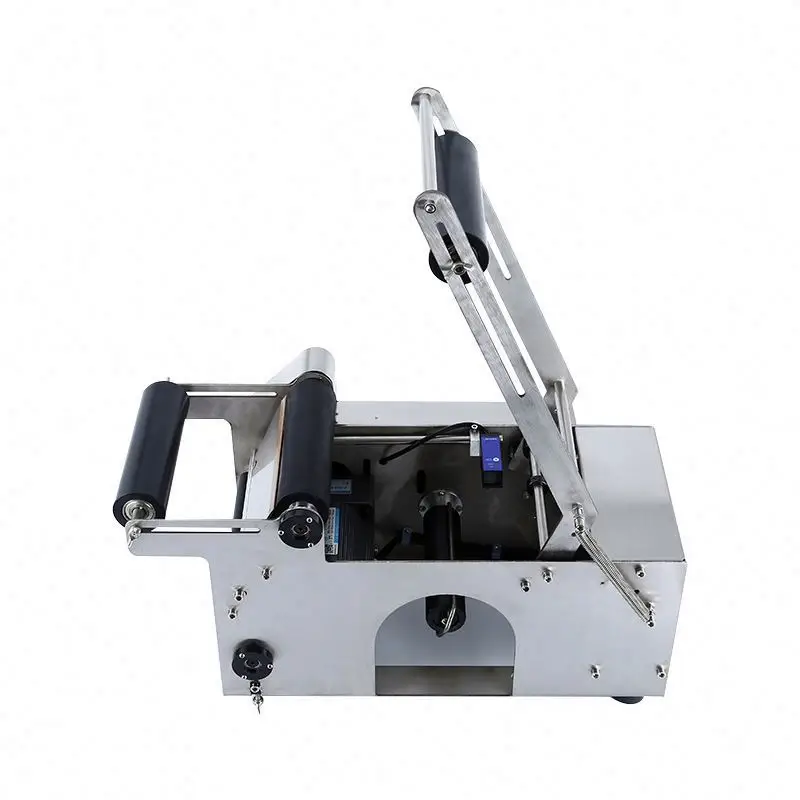
This TEBAK Hoting queue record describes a small desktop semi-automatic labeling machine for spirits, wine, tin cans, jars and round bottles. The source description also uses the terms adhesive sticker applicator, jar bottle labeller and wholesale round bottle labeling machine. No structured technical parameters are supplied for this item. This guide therefore treats the product description as a sourcing lead, not as a complete performance specification.
Product ID 1601251095099 should appear on the quotation, machine drawing, sample approval record, packing list and spare-parts list. The source does not provide labeling speed, bottle diameter, container height, label dimensions, roll-core size, maximum roll diameter, accuracy, voltage, power, air requirements, footprint, weight, materials, change parts, certification or warranty terms. These missing values must be confirmed by the supplier for the exact quoted configuration.
What the source does and does not establish
| Source statement | What it suggests | What the buyer must confirm |
|---|---|---|
| Small desktop | The machine is presented as a compact bench-top labeling solution. | Exact footprint, working height, bench load, clearance, mounting and access for roll changes. |
| Semi-automatic | An operator likely loads or positions each container while the label application cycle is assisted. | Every operator action, trigger method, cycle definition, labor requirement and restart procedure. |
| Spirits and wine | Round beverage containers are included in the stated application description. | Bottle diameter, height, shoulder, taper, seam, fill state, cap, condensation and label position. |
| Tin cans and jars | The source describes additional round-container applications. | Can and jar dimensions, surface, stability, change parts, material compatibility and approved formats. |
| Adhesive sticker applicator | The machine is intended to apply pressure-sensitive labels or stickers. | Label stock, liner, adhesive, backing thickness, transparent labels, gap, overlap and storage. |
| ISO9001 certifications in the description | The supplier description mentions quality-control standards based on ISO9001 certifications. | Certificate number, issuing body, validity, certified legal entity, scope and whether it applies to this product. |
Define the container family before requesting a quotation
Do not purchase a semi-automatic round-container labeler from the title alone. Prepare a container matrix containing every bottle, can and jar that will run on the machine. For each format, record outside diameter, usable cylindrical height, total height, shoulder or neck transition, base shape, seam, ovality, surface finish, material, filled or empty state, cap and approximate center of gravity.
The source mentions spirits and wine but does not establish whether the machine supports narrow-neck bottles, tapered wine bottles, shoulder bottles, heavy glass, thin-wall plastic or cans with a seam. Ask the supplier to mark the exact labeling zone on a dimensioned drawing. A round body may still require a different support, guide or change part when the diameter is the same but the shoulder or base differs.
For jars, document the lid, thread, shoulder and usable sidewall. For tin cans, document the seam, rim, surface coating and whether the label must avoid the seam. For wine bottles, document the shoulder, neck, punt, foil, capsule and the required front-facing artwork. These details determine whether the machine can rotate the container consistently.
Send physical samples whenever possible. If physical samples cannot be sent, provide dimensioned drawings, photographs of the complete container and close-ups of seams and surfaces. Request written approval of every format before the supplier prices the machine.
Clarify what semi-automatic means
“Semi-automatic” is a workflow description, not an output specification. Ask the supplier to provide a numbered operation sequence. Confirm whether the operator places the container against a stop, presses a foot switch, activates a sensor, holds a button, turns a handle, removes the labeled container and loads the next one. Ask which steps occur automatically after the trigger.
Request a video or live demonstration with the buyer's actual containers. Measure the time for loading, alignment, trigger, label application, inspection and unloading separately. A machine may have a fast label-release motion but a slower total operator cycle. Production planning should use accepted labeled containers per labor hour, not an unqualified headline.
Test the machine with a trained operator and a second operator. Compare label height, skew, start position, overlap or gap, wrinkles, bubbles, edge lift and container damage. If the result changes materially between operators, ask for a stop, guide, fixture, scale, template or sensor that reduces operator-dependent variation.
Confirm how the machine behaves after a misfeed, empty label roll, missing container, emergency stop, power interruption or wrong-format container. Ask whether the operator can restart without losing registration or wasting a fixed number of labels.
Label and adhesive compatibility
The source uses adhesive sticker and applicator language but gives no label specification. Ask for the permitted label length, width, liner thickness, backing stiffness, adhesive type, gap, winding direction, core, maximum outside diameter and roll width. Obtain a label-path drawing showing unwind direction, peel edge, pressure roller and waste liner route.
Test the exact labels used in production. Include paper, synthetic, clear, metallic, textured and varnished labels where relevant. A label that works on glass may behave differently on coated tin or flexible plastic. Confirm whether transparent labels require a special sensor, contrast mark or manual alignment method.
Measure label position on the cylindrical surface and at any transition near a shoulder or seam. Define the allowed skew, vertical offset, start-point tolerance, overlap or gap, wrinkles, bubbles and edge lift. The source does not provide accuracy, so a quotation must not silently assume a tolerance.
Run adhesion trials after washing, drying, chilling, condensation, handling and transport vibration if those conditions apply. Record immediate adhesion and later edge lift after an agreed dwell period. Confirm the label and adhesive storage temperature, humidity, shelf life and surface-cleanliness requirement.
Container handling and change parts
Ask the supplier to list every contact part and every format-specific change part. Possible items may include rollers, bottle supports, side guides, mandrels, chucks, stops, collars, fixtures, sensors or peel plates, but the source record does not confirm any of them. Require a drawing and price for each included and optional part.
For glass bottles, check tipping risk, scratching, chipping and pressure marks. For thin plastic, check wall deformation under the roller or guide. For tin cans, check surface scratching and seam interaction. For jars, check the lid and shoulder clearance. These tests should be performed with the buyer's filled and empty states if both are used.
Define changeover from one format to another. Record tools, adjustment points, scales, recipes, guides, sensor positions, label-path changes, test labels and expected waste. Ask for a video or work instruction that a new operator can follow without relying on undocumented supplier knowledge.
Confirm whether the machine stores settings or whether every adjustment is manual. If settings are manual, request a format sheet with reference measurements and a sample label. Do not assume that a small desktop machine has programmable memory, automatic recipe selection or tool-free changeover.
Roll handling and label web control
No label-roll core or maximum roll diameter is provided. Ask for the minimum and maximum core inner diameter, roll width, outside diameter, winding direction, backing thickness and maximum roll weight. Confirm the mandrel, flange, brake, tension control, web guide and usable label-roll clearance.
Install a full production roll and a partially used roll. Check lateral movement, brake control, web tracking, liner waste path, peel angle, label release and roll contact with the frame. Repeat the test with the smallest and largest approved label. Record roll-change time and restart waste.
Ask whether the operator needs a tool to change the roll or thread the web. Request a clear threading diagram and identify pinch points, sharp edges and areas that must be guarded during operation. Confirm whether the machine can be cleaned without removing the entire label path.
Define storage and handling for label reels. Humidity, heat, pressure and deformation can affect release and winding. Include label material storage in the process specification rather than assuming the labeling machine compensates for poor reel condition.
Quality and speed acceptance
Because the source gives no labeling-speed value, request a test using the buyer's actual container and labels. Define one complete cycle as loading, positioning, triggering, labeling, inspection and unloading, unless a different boundary is agreed in writing. Count accepted containers, rejected containers, rework, labels used and downtime.
Run a short start-up trial, a steady-state trial, a roll-change trial, a format-change trial and a restart trial. Record the operator count and the amount of manual handling. Report gross cycles, accepted labeled containers and reasons for rejection separately.
Quality criteria must be satisfied before speed is accepted. Define maximum label skew, height error, start-point error, overlap or gap, wrinkles, bubbles, edge lift and damage. If the buyer uses front-facing artwork, include orientation and registration in the acceptance protocol.
Ask the supplier to repeat the test on the smallest and largest approved formats and at least one mid-range format. Do not accept a speed result from a single empty container when production will use filled bottles, cans or jars with different surfaces and weights.
Utilities, footprint and installation
No electrical or pneumatic data is supplied. Ask whether the machine uses a powered motor, sensor, controller, counter, heating element or air supply. Obtain voltage, frequency, power, current, plug, cable, air pressure, air consumption and utility protection for the exact configuration.
Request the machine footprint, working height, net weight, gross packing weight, bench load, mounting-hole pattern, operator clearance and roll-change clearance. “Small” and “desktop” are descriptive terms, not dimensional specifications. Check that the bench is stable and that the operator can reach the controls and label path safely.
If a sensor or controller is included, request the nameplate, wiring diagram, spare sensor, failure behavior and reset procedure. If the machine is entirely manual, ask the supplier to state that clearly in the quotation. Do not infer that a desktop labeler is power-free from the title.
Ask for guarding and safety information. Identify moving rollers, pinch points, exposed edges, electrical enclosures, emergency stop behavior and cleaning isolation. Request the operating manual and safety labels in the destination-market language.
Quality-system and certification claims
The source description says that quality-control standards are based on ISO9001 certifications. This is a supplier-provided description, not independent verification. Ask for the certificate number, issuing or certification body, legal entity, scope, issue date, expiry date and certificate status. Confirm that the certificate applies to the quoted supplier and activity rather than an unrelated company.
Separate management-system certification from product compliance. ISO 9001 does not by itself establish electrical safety, machinery safety, electromagnetic compatibility, food-contact suitability, adhesive compliance or destination-market requirements. Request the documents relevant to the actual machine configuration and intended use.
Record every claim in the RFQ and acceptance file with the document title, revision, issuing entity and applicability. If the supplier cannot provide current documents, mark the claim as unverified and obtain the buyer's compliance decision before ordering.
Factory acceptance test proposal
- Verify product ID 1601251095099, machine description, desktop semi-automatic configuration, drawing revision and included accessories.
- Approve a container matrix covering the buyer's spirits, wine, tin-can, jar and round-bottle formats.
- Approve label reels and document core, width, outside diameter, backing, adhesive, gap, winding direction and storage conditions.
- Demonstrate the complete operator cycle, including loading, alignment, trigger, label application, inspection, unloading and restart.
- Test the smallest, largest and mid-range approved container formats with the buyer's actual labels.
- Measure accepted output, rejected output, rework, labels consumed, roll-change time, changeover time and operator count.
- Inspect label height, skew, start point, overlap or gap, wrinkles, bubbles, edge lift and container damage.
- Test seam, shoulder, taper, ovality, filled state, condensation and surface finish where relevant.
- Confirm utilities, footprint, bench load, guarding, cleaning, emergency stop, spare parts and maintenance.
- Verify ISO9001-related documentation and separate product-safety or destination-market documents before release.
RFQ checklist
- Exact machine configuration and product ID 1601251095099 on quotation, drawing and packing list.
- Definition of semi-automatic operation and every operator action in one complete cycle.
- Supported container materials, diameters, heights, shoulders, tapers, seams, ovality, caps and fill states.
- Approved spirits, wine, tin-can, jar and round-bottle formats, with change parts and prices for each.
- Label length, width, liner, backing, adhesive, thickness, gap, overlap, winding direction and storage requirements.
- Minimum core inner diameter, maximum roll outside diameter, roll width, roll weight, brake and web-guide limits.
- Labeling accuracy, skew, vertical-position tolerance, start-point tolerance, overlap or gap and cosmetic limits.
- Test method for accepted output, rejected output, operator cycle, roll changes, changeover and restart.
- Voltage, frequency, power, current, plug, sensors, controller, counter, air pressure and air consumption.
- Machine footprint, working height, net and gross weight, bench load, mounting, clearance and transport method.
- Operator training, format recipes, adjustment scales, threading diagram, cleaning, wear parts and spare parts.
- Safety guards, pinch-point controls, emergency stop, electrical documents and operating manual.
- ISO9001 certificate number, legal entity, issuing body, validity, scope and applicability to the quoted supplier.
- Product-compliance documents for the destination market, separately from any management-system certificate.
- MOQ, lead time, warranty, packaging, inspection, sample approval, after-sales response and replacement-part terms.
Buyer decision framework
This listing is a starting point for sourcing a small desktop semi-automatic adhesive label applicator. Its source-backed scope covers the described use cases and application terms, but no numeric performance or installation parameters are structured in the queue record. Approve the purchase only after the supplier proves the buyer's actual containers and labels, defines the complete operator cycle, signs measurable quality criteria, supplies the utility and drawing package, and provides verifiable compliance documentation.
Frequently asked questions
Is the machine fully automatic?
No conclusion should be made from the listing. The source calls it semi-automatic. Ask the supplier to document loading, alignment, triggering, application, inspection and unloading steps.
Can it label all spirits and wine bottles?
The source describes spirits and wine applications but does not establish a universal bottle range. Test each bottle shape, diameter, height, shoulder, seam, surface and fill state.
Can it label tin cans and jars without change parts?
The description mentions tin cans and jars but provides no compatibility matrix. Require drawings, samples and a change-part list for every approved format.
What labeling speed should be expected?
No speed value is provided. Establish a quality-controlled test with the buyer's container, label and operator, and report accepted units separately from gross cycles.
Does the ISO9001 statement prove product compliance?
No. Request the current certificate and verify its scope, then separately obtain documents required for the machine's safety and destination market.
Source and contact
This guide is based on the Hoting queue record for product ID 1601251095099. Before purchase, request the current quotation, container compatibility matrix, label specification, setup drawing, sample labeling report, utility sheet, safety documents, certificate evidence, packing list, spare-parts offer and final machine photographs. For sourcing questions, contact the TEBAK sales team through the site's current inquiry channel.