
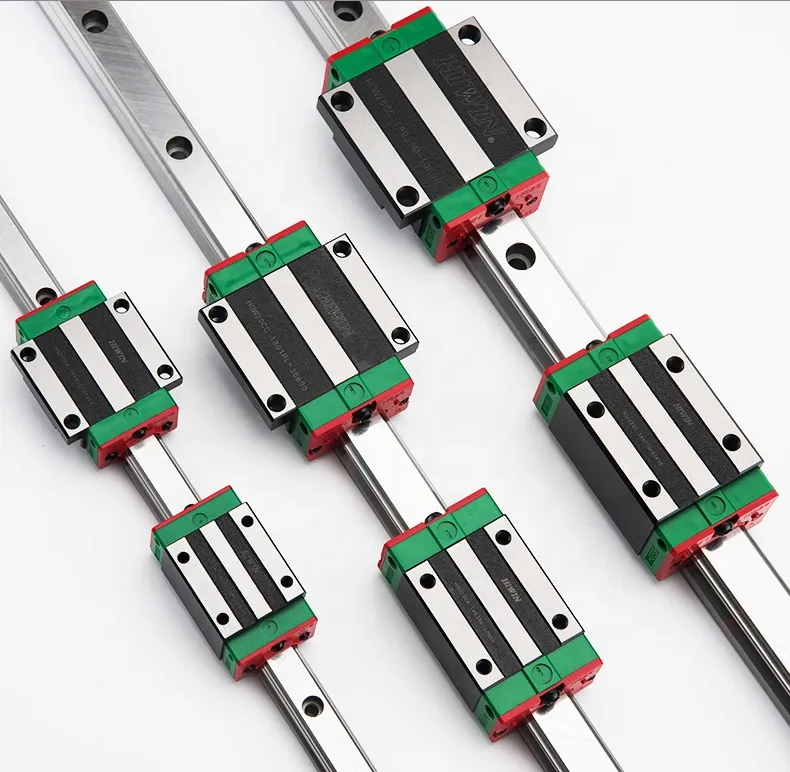
Introduction: two promises a router has to keep at once
A CNC router is a machine that promises two incompatible things at once: a table two metres long and a cut that holds a few hundredths of a millimetre. Every linear motion decision on the machine is a negotiation between those two promises. The axis has to travel far, move fast, and still put the cutter back where the drawing says it should be, thousands of times a day, in a workshop full of wood dust.
This is why the linear motion in a CNC router cannot be copied from a machining centre or from a hobby build. A machining centre is short, slow and rigid; a hobby router is cheap and flexible in every sense. A production router sits between them, and the parts that work are specific: profile guide rails sized to the axis span, a drive that matches the stroke length, and a structure stiff enough that the guide is not asked to absorb deflection it was never meant to absorb.
The article below works through that system. It covers what each motion component actually contributes, where the common configurations differ, what the published parameters mean in practice, and which failures point at which component. The numbers quoted are the ones that appear on real TEBAK linear guide and ball screw product pages, not laboratory figures.
Core concept: three components decide the cut, and only one of them is a guide
People say "the linear motion system" and mean the rails. In practice a router axis is a stack of three decisions that interact, and changing one changes the other two.
The guide carries load and sets the geometry
The rail and carriage pair defines the straight line the spindle is allowed to travel on, carries the cutting force back into the frame, and resists the moment loads that appear as soon as the cutter is offset from the rail. On a router gantry, the cutting force is often small compared with the moment created by the spindle hanging 200 mm out from the beam, so the guide's job is mostly to resist rock, not to carry weight.
The drive sets speed, thrust and the error that shows up as chatter
A ball screw converts rotation into thrust with high efficiency and low backlash, but its critical speed and its whip limit how long it can be. A rack and pinion has no length limit and no whip, at the cost of a reduction stage and a different error signature. The drive choice usually decides the machine's envelope before the guide is chosen at all.
The structure decides whether any of it matters
A guide bolted to a beam that twists under load will follow the twist. The rail is straight to a few microns over its length; the beam underneath it is not, and the bolts will happily bend the rail into the shape of the beam. On routers this is the single most common reason a machine with good components cuts badly, and no amount of preload compensates for it.
Classification: the four configurations you will actually be offered
Router builders converge on a small number of layouts. Each has a natural size range, and each fails in a characteristic way.
Profile rail on all three axes
HGR series rails from 15 mm to 65 mm, or MGN miniature rails from 5 mm to 15 mm on the Z axis, with matching carriages. This is the stiffest option per unit of height and the one that gives the best repeatability. It is also the most sensitive to mounting surface flatness and the least tolerant of dust ingress, so it needs a bellows or a scraper on a woodworking machine.
Profile rail on X and Z, rack and pinion on the long axis
The usual production-router compromise. The long axis gets a rack because a ball screw of that length would whip; the cross axis and the vertical axis get ball screws because their strokes are short and their thrust demands are higher. The guide stays a profile rail throughout, because the guide is what sets accuracy on all three axes.
Round rail and bushing on entry-level machines
SBR series supported round rail, or linear shafts with LM bushings. Cheap, forgiving of misalignment, and adequate for light cuts in soft material. The limitation is stiffness under moment load: a single round rail pair with bushings rocks more than a profile carriage of the same height, which shows up as edge quality on deep cuts.
Belt-driven hobby and light industrial builds
Timing belt on all axes, usually with V-groove wheels or MGN12 rails. Fast, cheap, and limited in thrust. Fine for plywood and signage, marginal on hardwoods, unsuitable for aluminium at any serious depth of cut.
Pros and cons: what each configuration buys and what it costs
| Configuration | Buys you | Costs you | Sensible span |
|---|---|---|---|
| Profile rail + ball screw, all axes | Best repeatability, high thrust, contained dust path with bellows | Critical speed limits long screws; whip above roughly 2 m depending on diameter | Up to about 2 m per axis |
| Profile rail + rack and pinion on long axis | No length limit, high rapid speeds, simple extension | Needs a reducer, backlash control, and a separate lubrication routine | 2 m to 6 m |
| Round rail + bushing | Low cost, tolerant of poor mounting, easy to replace | Lower moment stiffness, more rock under offset load | Under 1.5 m, light cuts |
| Belt drive + light rail | Fast rapids, low inertia, cheap | Low thrust, stretch over time, poor finish in hard material | Under 1.5 m |
The pattern is consistent: as span grows, the drive has to change before the guide does. A 3 m axis with a ball screw is not a stiff machine, it is a machine with a whipping screw.
Parameters and technical standards that actually decide the choice
These are the values worth putting on a specification sheet, and the ones that appear on the product pages this article is grounded in.
Rail size and accuracy grade
Guide rails are supplied in accuracy grades C, H, P, SP and UP, running from general purpose to precision. For a router, grade H is normally sufficient on X and Y; grade P earns its cost on the Z axis and on machines cutting non-ferrous metal. Buying SP or UP for a welded steel gantry is money spent on a tolerance the frame cannot preserve.
Ball screw diameter, lead and accuracy class
Steel ball screws in the SFU, DFU and SFK families, ground in GCr15 and hardened to HRC 60–62, are the common choice. Diameters from 12 mm to 50 mm and leads from 4 mm to 25 mm cover router work. Accuracy class C7 suits general routing; C5 is the usual step up for machines that hold tolerance on aluminium; C3 belongs on a machine with a temperature-controlled environment. Axial play of 0–0.005 mm with preload grades P0 to P4 is the range quoted on the product pages, and efficiency above 90% is why ball screws replaced acme screws on these axes.
Stainless options where coolant or damp air is present
SUS440C rails and SUS303, SUS304, SUS316 or SUS316L screws appear in the range for wet environments. They cost more and are not a substitute for sealing; they are what you specify when the machine will sit in a damp workshop or run mist coolant.
Stainless lead screws and plastic nuts where speed does not matter
ASTM 1045 or stainless lead screws from 10 mm to 25 mm with a 7e clearance and a matching nut are common on Z axes of light machines and on adjustment axes. They are slow and inefficient, and that is acceptable where the axis moves once per job.
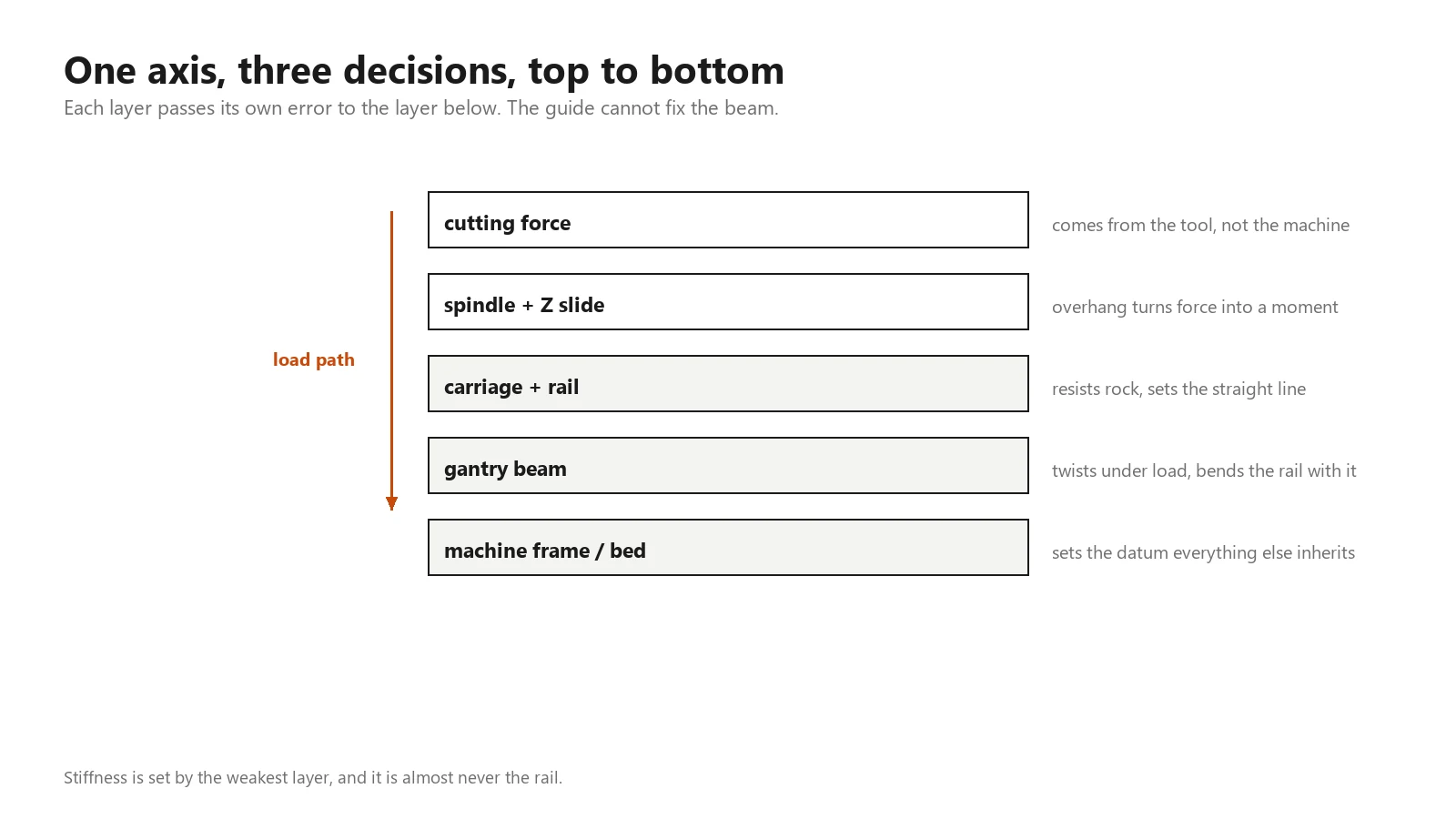 The rail carries what the spindle overhang and the gantry beam pass down to it.
Application scenarios: how the specification shifts with the work
The same frame can be a sign machine or a nesting machine depending on what it is asked to cut. These four cases cover most of the routers built with these components.
Sign making and nested plywood
Large envelope, soft material, deep cuts, high throughput. Rapid speed matters more than thrust, so the long axis goes to rack and pinion and the Z axis stays short. A linear guide rail in HGR20 to HGR30 with grade H is the usual choice, and the Z axis runs MGN15 or HGR15 with a 16 mm ball screw at 5 mm or 10 mm lead.
Furniture components and panel processing
Cycle time dominates, so acceleration and rigidity both matter. Ball screws on the cross axis at 16–25 mm diameter, profile rail on all axes, and a gantry beam sized so the rail does not have to bridge a span that deflects. Dust extraction is part of the motion design here: a rail that ingests MDF dust will fail long before its rating.
Non-ferrous metal routing
Aluminium and brass change the requirement. Cutting forces rise, coolant or mist appears, and thermal growth starts to matter. This is where grade P rails, C5 screws and stainless or coated options earn their price. Preload also matters more, because the axis reverses direction under load constantly.
Plasma and waterjet tables that share the same frame architecture
Same rails, different environment. Plasma brings heat and conductive dust; waterjet brings abrasive mist. Both push the specification toward sealed carriages, stainless hardware, and a bellows rather than a wiper alone.
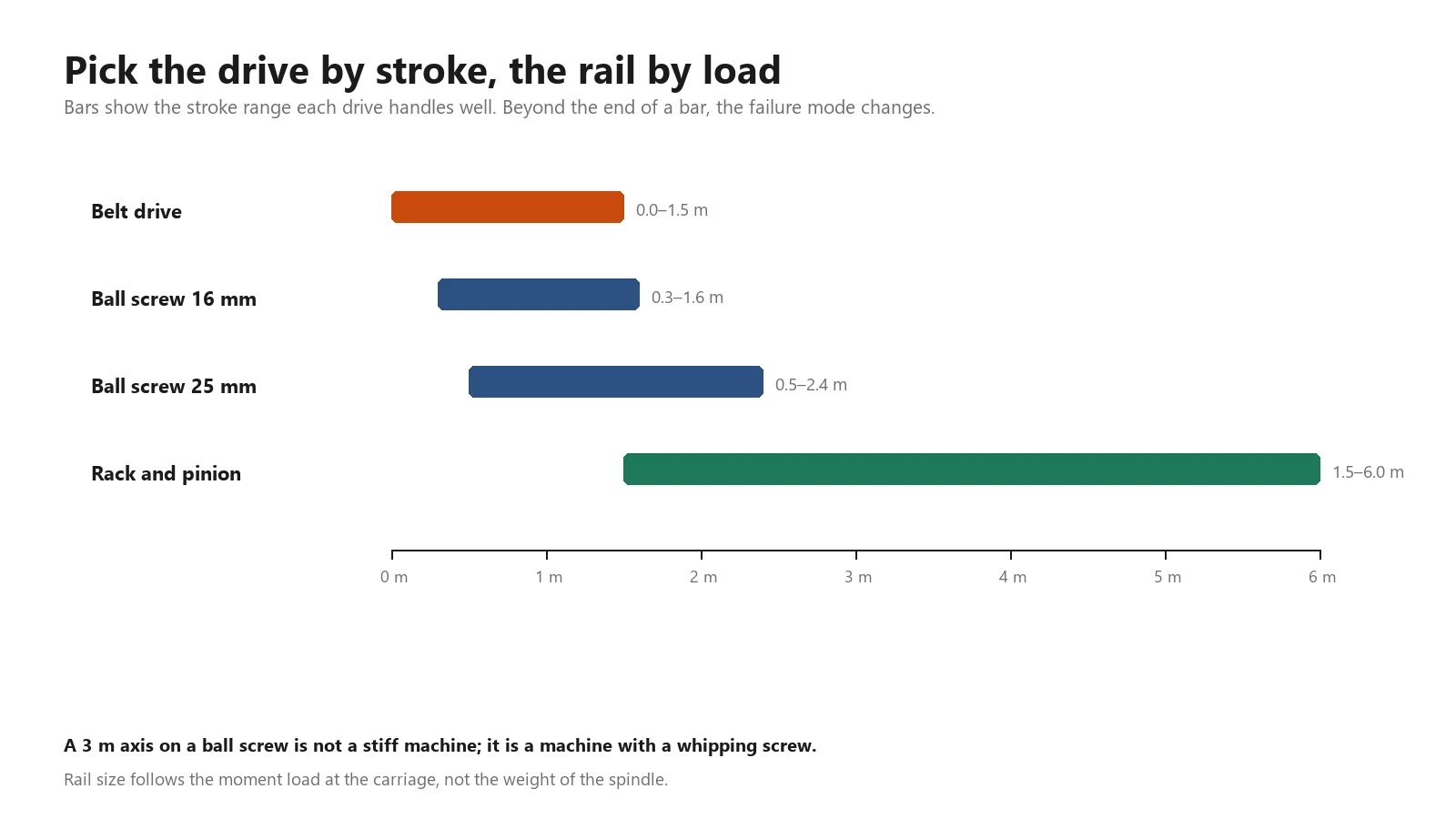 Where each drive stops being the right answer, by stroke.
Common problems and what they actually indicate
Router faults are usually blamed on the wrong component. These are the symptoms, the usual cause, and the check that confirms it.
| Symptom | Most likely cause | How to confirm |
|---|---|---|
| Chatter that appears only on one side of the gantry | Gantry beam twisting, or the two rails not parallel in the horizontal plane | Dial indicator on a bridge carriage, swept along the full stroke |
| Dimension drift that grows with job length | Thermal growth in the ball screw, or lost motion in the thrust bearing | Measure a test cut cold and again after an hour of running |
| Repeatable position but poor finish | Insufficient preload or worn carriage, so the axis rocks under load reversal | Push the carriage by hand with the drive disconnected and feel for play |
| Periodic marks at a fixed pitch | Ball screw whip or a damaged screw raceway | Compare mark spacing with the screw lead; run the axis at half speed |
| Rising motor current on the long axis | Rack mesh too tight, or rail contamination | Current reading with the pinion disengaged, then re-engaged |
| Rust spots on rails in a damp shop | Condensation, insufficient lubrication, unsealed carriage | Inspect the rail underside and the carriage lip after a weekend idle |
The first row is the one worth repeating: a router that cuts well in the middle of the table and badly at the edges is almost never a guide problem. It is a frame problem that the guide is faithfully reproducing.
Selection and installation tips
Six steps that keep the specification honest, in the order that avoids rework.
1. Fix the envelope and the material first
Stroke, depth of cut and material class decide everything downstream. Write them down before opening a catalogue: a machine that must cut 18 mm plywood in one pass and a machine that engraves acrylic do not share a motion system.
2. Choose the drive by stroke, then the guide by load
Ball screw up to about 2 m of stroke, rack and pinion beyond it, belt only where thrust is genuinely low. Then size the rail by the moment load at the carriage, not by the weight of the spindle.
3. Size the rail by span, not by habit
A 1.2 m gantry on HGR15 will flex and the rail will follow. Step up to HGR20 or HGR25 and put the money into the beam section instead of a higher accuracy grade.
4. Machine the mounting face, or accept the consequence
Rails want a flat, machined datum. If the beam is welded and unpainted but not machined, the rail will be pulled into its shape. Either machine it, or use a epoxy levelling compound and check with a straight edge and feeler gauge before bolting.
5. Protect the rail and lubricate on a schedule
Bellows or a telescopic cover on horizontal axes, scrapers on the carriage, and lithium grease at a fixed interval measured in hours, not months. Dust is the failure mode that kills router guides fastest.
6. Commission with a test cut, not a dial indicator alone
A machine can measure straight and still cut badly — the same check applies to a ready-made linear module bought as a unit. Cut a circle and a square in scrap, measure diagonals and wall finish, then adjust. That test catches frame and drive errors that rail measurement misses.
FAQ
Is a ball screw or a rack and pinion better for a CNC router?
Depends on stroke. Below roughly 2 m, a ball screw is stiffer, simpler and easier to preload. Above that, whip and critical speed make a rack and pinion the practical choice, with a planetary reducer to recover resolution.
What accuracy grade should a router guide rail be?
Grade H covers most woodworking routers. Grade P makes sense on the Z axis and on machines cutting non-ferrous metal. SP and UP only pay off when the frame is machined and thermally stable enough to preserve them.
Can I use MGN miniature rails on a router gantry?
On the Z axis, yes, in MGN12 to MGN15 where the stroke is short and the load is modest. On a gantry spanning a metre, no: miniature rail lacks the moment capacity, and the deflection will show at the cutter.
Why does my router cut accurately in the middle and badly at the ends?
Almost always the frame or the rail mounting surface, not the guide. A beam that twists under load bends the rail with it. Check parallelism and beam deflection before replacing anything.
How much preload does a router axis need?
Enough to remove the dead band at direction reversal, not more. Light to medium preload suits most router axes; heavy preload adds friction and heat for stiffness the frame cannot use.
Do I need stainless rails?
Only where moisture or coolant is present. SUS440C rails and stainless screws exist for damp shops and mist coolant. In a dry, heated workshop, standard bearing steel with proper lubrication is the better value.
Conclusion
A CNC router is a long, fast, dusty machine, and its linear motion has to be chosen against all three of those facts at once. The guide sets geometry, the drive sets speed and thrust, and the frame decides whether either of them can do its job. Get the order right — envelope, then drive, then rail, then mounting face — and the components will deliver the tolerance printed on their datasheets. Get it wrong, and the best rail in the catalogue will faithfully reproduce a twisted beam.
Ordering linear motion for a router build
Custom size available: rails cut to stroke, screws machined to length with the end journals your bearing blocks need. OEM and ODM supported for machine builders who need a matched rail and screw set under their own part numbers. Bulk wholesale pricing applies to multi-axis kits. Contact us for technical drawings and a quotation against your envelope, material and tolerance.