
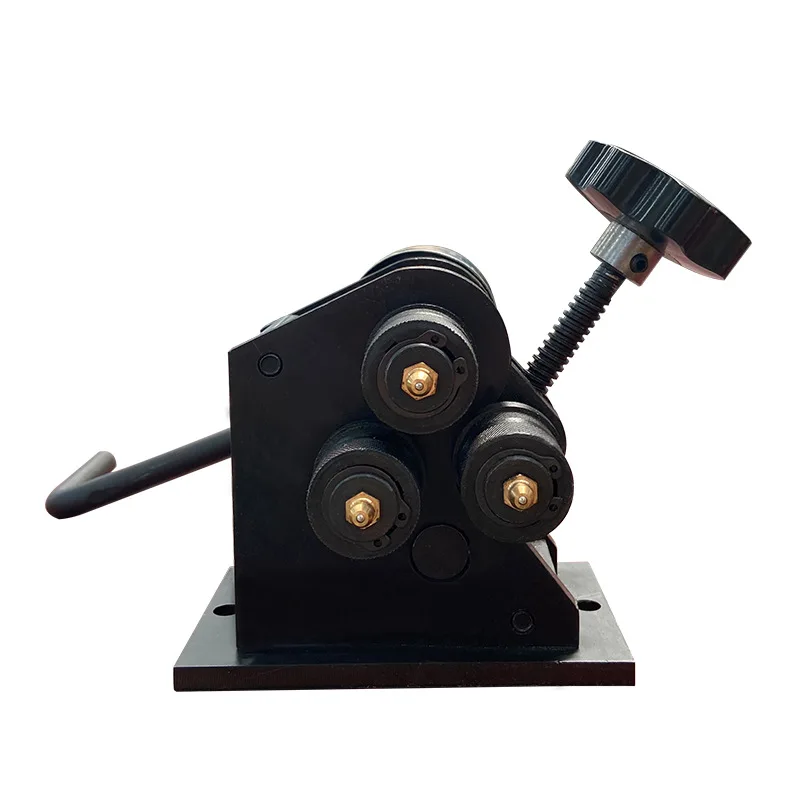
Source-controlled product identity
The Hoting queue record describes a PR-3 manual round bender, also called a gear-driven ring roller. The structured record provides seven procurement fields: item number 376001, model PR-3, roller dial 32mm, round steel capacity 6.5mm, flat steel capacity 25x4 mm, packing size 22x21x20 cm and net/gross weight 6/7 kgs. The title also mentions size 1"-3" and round steel capacity 1/4". Those title terms require clarification rather than replacing the structured values.
Product ID 1601283068021 should appear on the quotation, nameplate or identification label, inspection record, packing list and spare-parts list. The source record does not provide roller material or hardness, center distance, shaft diameter, minimum bending radius, maximum workpiece length, gear ratio, handle dimensions, mounting holes, lubrication points, bend-angle scale, springback guidance, tolerance, certification, MOQ, warranty or lead time. These are supplier confirmation and acceptance-test items.
Verified specifications and listing claims
| Source field | Recorded value | Buyer action |
|---|---|---|
| Item No. | 376001 | Put this number on the quotation, drawing, inspection report and packing list; confirm whether it identifies the complete machine or a component family. |
| Model | PR-3 | Confirm the model plate, roller arrangement, compatible accessories and any regional model suffix. |
| Dial of roller | 32mm | Ask the supplier to define the measurement reference and confirm whether it is roller diameter, shaft dial or another dimension. |
| Round steel capacity | 6.5mm | Confirm material grade, temper, bend radius, workpiece length and whether this is a maximum or recommended value. |
| Flat steel capacity | 25x4 mm | Confirm width-by-thickness orientation, material grade, bend radius and test condition. |
| Packing size | 22x21x20 cm | Confirm L×W×H order, carton or crate status, protection and whether handles or accessories are packed separately. |
| N.W./G.W. | 6/7 kgs | Confirm net and gross weighing method, packing material and shipping declaration. |
| Title claim | Size 1"-3" and round steel 1/4" | Reconcile the imperial wording with 6.5mm structured capacity and define the actual workpiece range. |
Resolve the capacity conflict before ordering
The title states “size 1"-3"” and “round steel capacity 1/4",” while the structured field states 6.5mm. The 1/4-inch value is close to 6.5mm as a unit conversion, but the title does not explain what “size 1"-3"” refers to. It could describe a product family, a roller size, a range of related machines or a marketing phrase. Request a model-specific capacity chart for PR-3 rather than assuming that every title value applies to this unit.
Ask the supplier to mark the following on a drawing: roller diameter, shaft or dial dimension, center distance, usable throat, workpiece entry direction, maximum round-steel diameter, maximum flat-steel width and thickness, and minimum bend radius. The drawing should reference item 376001 and model PR-3.
Require a written reconciliation table with three columns: source wording, metric value, and approved PR-3 specification. If the supplier confirms that 6.5mm is the maximum round-steel capacity, the quotation should state the material grade and bend condition attached to that number. If the title refers to another configuration, correct the quotation before purchase.
Do not use a nominal capacity as a guarantee of a finished ring diameter. Capacity, bend radius, workpiece length, material yield strength and operator technique all affect the result. Approve a practical test coupon that matches the buyer’s actual material and target shape.
Understand the PR-3 manual gear-driven mechanism
The title calls the unit manual and gear driven. The source record does not provide gear ratio, handle length, drive torque, roller adjustment method, shaft material or lubrication specification. Ask for an assembly drawing showing the three rollers, gear train, adjustment screw or lever, handle, guards and base.
Confirm how the workpiece is inserted, how the upper or side roller is adjusted, and how the setting is locked during repeated passes. Ask whether the adjustment is symmetric, whether the rollers can be independently aligned, and whether the machine has a zero reference or scale.
Inspect gear engagement through the full adjustment range. The handle should turn without binding while the workpiece is loaded, and the rollers should maintain positive drive without slipping. Record backlash, handle effort, gear noise and any visible deflection during the buyer’s acceptance test.
Request the lubrication points, lubricant type, interval and cleaning method. Metal chips and scale should not be allowed to contaminate the gear train. Ask whether replacement gears, shafts, bearings and adjustment components are available individually.
Round-steel capacity test
The structured round-steel capacity is 6.5mm. Before treating it as a production limit, request the supplier’s test condition: material grade, tensile or yield range, workpiece length, bend radius, number of passes, roller setting and acceptance tolerance.
Run a test with the buyer’s intended round steel at a diameter below the stated limit, at the stated limit, and—only if agreed—at a higher value to identify the boundary. Measure the finished ring or arc outside diameter, inside diameter, ovality, end straightness and surface marks.
Record whether the workpiece is fed straight, whether the ends require pre-bending, and whether a flat tail remains at the entry and exit. A small manual ring roller may require multiple passes and hand repositioning; the supplier should document the recommended sequence.
Inspect for surface dents, roller marks, twist and slipping. If the buyer needs visible architectural or decorative work, define a cosmetic acceptance limit separate from the geometric limit. A part can meet diameter tolerance while failing the buyer’s surface standard.
Flat-steel capacity and orientation
The source records flat-steel capacity as 25x4mm but does not state the orientation. Ask whether 25mm is the strip width and 4mm the thickness when the strip is laid flat, or whether the machine accepts another orientation. Request a diagram and a material-specific test.
Test flat steel in the buyer’s actual grade and orientation. Measure bend radius, twist, edge marks, out-of-plane deformation and end straightness. Confirm whether the strip must be supported by an operator or fixture during feeding.
Do not interchange round-steel and flat-steel capacity. A machine can accept a 6.5mm round bar but require a smaller flat strip when the material’s width, thickness and stiffness create a different load on the rollers.
Ask for the minimum practical bend radius and the maximum workpiece length for flat strip. If the buyer will make full rings, confirm how the final ring is removed from the machine and whether a removable roller or open frame is required.
Roller geometry and workpiece guidance
The structured field “Dial of roller: 32mm” requires a measurement definition. Ask whether 32mm means the roller’s outside diameter, shaft diameter, roller dial or another dimension. Request a section view and a photograph with a ruler or calibrated reference.
Confirm roller surface profile, width, material, hardness, finish and replaceability. The profile should match the workpiece shape without excessive marking or slip. Ask whether standard and optional rollers are available for round and flat stock.
Inspect roller parallelism and concentricity. Run a reference bar through the machine and record tracking, twist and lateral movement. Check the adjustment lock after several passes and after reversing the handle.
Ask how the machine guides short workpieces and long stock. If the buyer needs repeatable rings, request support tables, side guides or a fixture recommendation. Do not assume that the 22×21×20cm packing size describes the working envelope or machine footprint.
Radius, springback and dimensional control
No minimum radius, maximum ring diameter or springback value is provided. Ask the supplier for a recommended radius chart based on round and flat material, with the material grade and thickness shown for each result.
Springback depends on material properties, section shape, roller setting and pass sequence. Define the target outside diameter or centerline diameter, then establish a trial setting using the buyer’s material. Record the setting, number of passes, measured result and correction required.
Measure finished parts with a template, tape, caliper or diameter gauge appropriate to the required tolerance. Record ovality at multiple positions and compare the first and last part in a batch. A manual machine may require operator judgment; the buyer should define the training and inspection method.
For repeat work, ask whether the supplier can provide a setting scale, stop, sample ring or process sheet. Keep a controlled setting record for each material and target radius rather than relying on the title capacity.
Base, mounting and operator safety
The source record does not provide machine footprint, mounting holes, base thickness or anchoring instructions. Request a dimensioned base drawing and confirm whether the PR-3 is intended for bench mounting, a stand or hand-held positioning.
Test stability while feeding round and flat stock. The machine should not move, tip or twist on the buyer’s bench. Confirm whether bolts, clamps, feet or a mounting plate are included. If the buyer will use long stock, define the support arrangement and the required clearance around the handle.
Inspect pinch points at the rollers and gears. Ask for guards or safe operating instructions and define when the machine must be stopped before adjustment. The manual handle should not be operated with loose clothing, gloves that can catch, or hands positioned between the workpiece and roller.
Request the safe workpiece entry and removal procedure. Long material may swing or fall; short material may approach the rollers unexpectedly. The buyer’s risk assessment should cover stored energy, sharp edges, manual handling, pinch hazards and flying scale.
Dimensions, packing and logistics
The structured packing size is 22x21x20cm. Ask whether this is the carton’s external size, the packed machine size or an approximate value, and confirm the order of length, width and height. Request photographs of the packed crate or carton and the protection around the rollers and handle.
The recorded net/gross weights are 6/7kg. Confirm which value is net machine weight and which is gross shipment weight. Weigh the finished packed unit during inspection and compare it with the commercial invoice, packing list and freight booking.
Check whether the handle, adjustment components or optional rollers are packed separately. The buyer should receive all fasteners, keys, lubrication items, manuals and accessories listed on the packing list. Use product ID 1601283068021 and item number 376001 on outer and inner package labels.
Request shipping orientation and protection against moisture, impact and corrosion. Carbon-steel rollers or gears may require rust prevention even when the external machine is painted or plated.
Factory acceptance test proposal
- Verify product ID 1601283068021, item number 376001, model PR-3 and the identification label.
- Resolve the title’s 1"-3" wording against the structured 6.5mm round-steel capacity.
- Confirm the 32mm roller-dial measurement on a drawing and inspect roller geometry, surface and alignment.
- Test 6.5mm round steel with the agreed material grade, radius, passes and dimensional tolerance.
- Test 25x4mm flat steel in the agreed orientation and record radius, twist, edge marks and end straightness.
- Measure backlash, handle effort, gear engagement, roller parallelism and adjustment-lock repeatability.
- Establish a setting process for springback and record target diameter, passes, corrections and operator method.
- Inspect base stability, mounting holes, guards, pinch points, handle clearance and long-stock support.
- Verify packing size 22x21x20cm and net/gross weights 6/7kg against a completed export package.
- Review drawings, operating instructions, lubrication, spare parts, warranty, inspection report and commercial terms.
RFQ checklist
- Product ID 1601283068021, item number 376001, model PR-3 and exact identification label.
- Definition of “dial of roller 32mm,” with section drawing and measurement reference.
- Round-steel capacity 6.5mm: material grade, yield range, radius, workpiece length, passes and tolerance.
- Flat-steel capacity 25x4mm: width-by-thickness orientation, material, radius, support and tolerance.
- Reconciliation of title claims size 1"-3" and round steel 1/4" with the PR-3 specification.
- Roller diameter, width, profile, material, hardness, surface finish, concentricity and replacement cost.
- Gear ratio, handle length, adjustment method, scale, backlash, lubrication and spare gears or shafts.
- Minimum radius, maximum ring diameter, springback guidance, pass sequence and setting repeatability.
- Machine footprint, base thickness, mounting holes, bench or stand requirement and long-stock supports.
- Guarding, pinch-point warnings, operator instructions, PPE, sharp-edge and manual-handling guidance.
- Packing size 22x21x20cm, net/gross weight 6/7kg, carton protection and shipping orientation.
- MOQ, sample inspection, lead time, warranty, spare parts, manuals, rust prevention and after-sales terms.
Buyer decision framework
This listing is a starting point for sourcing a compact manual round bender or gear-driven ring roller. The source-backed scope includes item number 376001, model PR-3, roller-dial value 32mm, round-steel capacity 6.5mm, flat-steel capacity 25x4mm, packing size 22x21x20cm and net/gross weight 6/7kg. The title’s 1"-3" and 1/4-inch wording requires reconciliation. Approve the machine only after the supplier demonstrates both material capacities with the buyer’s stock, documents radius and springback behavior, confirms the roller measurement, and passes mounting, safety and packing checks.
Frequently asked questions
Is PR-3 confirmed to bend round steel up to 6.5mm?
6.5mm is the structured round-steel capacity in the source record. Confirm the material grade, bend radius, workpiece length and test condition before treating it as a production limit.
What does the title’s 1"-3" size mean?
The source does not define that phrase. Ask the supplier to map it to a model-specific dimension or capacity and reconcile it with the recorded PR-3 values.
Can it bend 25x4mm flat steel in any orientation?
The record states 25x4mm but does not state orientation. Request a diagram and test the buyer’s material in the intended width-by-thickness orientation.
Does 32mm mean the roller diameter?
The field is labelled “Dial of roller,” but the measurement reference is not explained. Request a section drawing and confirm the dimension during inspection.
Is the machine ready for production without mounting?
The source provides no base or mounting specification. Confirm bench or stand requirements, mounting holes, stability, long-stock support and the safe operating envelope.
Source and contact
This guide is based on the Hoting queue record for product ID 1601283068021, item number 376001 and model PR-3. Before purchase, request the current quotation, capacity chart, roller drawing, material test records, radius and springback guidance, base drawing, safety instructions, packing record, spare-parts offer and final machine photographs. For sourcing questions, contact the TEBAK sales team through the site’s current inquiry channel.
Key specifications
- Item No.
- 376001
- Model
- PR-3
- Dial of roller
- 32mm
- Round steel capacity
- 6.5mm
- Flat steel capacity
- 25x4 mm
- Packing size
- 22x21x20 cm
- N.W./G.W.
- 6/7 kgs